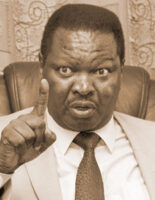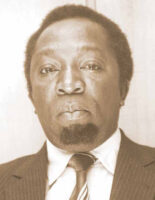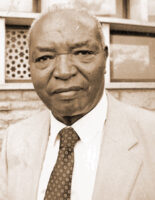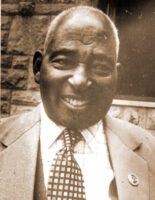
About Us

George Ndotto – Victim of the political wind of change

George Mutua Ndotto served in two Ministries during his five-year term and was considered one of President Moi’s key point men in Ukambani against the bulwark of opposition politics. A career civil servant and Director of Trade, Ndotto contested and won the Kitui Central parliamentary seat in the controversial 1988 mlolongo queue-voting election.

He was first appointed to the newly-minted Ministry of Reclamation and Development of Arid and Semi-Arid Areas and Wastelands (ASAL), later being transferred to the Ministry of Research, Science and Technology in a Cabinet reshuffle. Ndotto served as the Minister in both dockets between 1988 and 1992.

An additional feather in his political cap was the position of Chairman of the Kitui chapter of the powerful ruling party, Kenya African National Union (KANU), to which he was elected soon after his appointment to the Cabinet. He was, however, sent packing from his parliamentary seat by formidable opposition politician and later presidential candidate Charity Kaluki Ngilu. Angered by Ngilu’s victory, Moi nominated Ndotto as an MP in the first multiparty Parliament between 1992 and 1997. In 2013 as the country established devolved governments and assemblies, Ndotto contested and won the position of Speaker of the Kitui County Assembly, a victory he replicated in 2017.

Ndotto was born in a staunch Catholic family in 1945 in Mulutu village, Changwithya Sub-location in Kitui Central Division of Kitui County. He attended Mulutu Primary School and, intent on entering the priesthood, joined Mwingi Seminary Secondary School which was later renamed St Joseph’s Seminary.

He eventually abandoned his pursuit of the priesthood after completing his O levels and joined Nyeri High School for his A level studies. After Form Six, Ndotto proceeded to the University of Nairobi (UON) in 1971 to pursue a Bachelor of Arts degree in Political Science.

Ndotto was credited with expanding existing polytechnics and establishing new ones across the country

Ndotto could not wait to complete his university course to marry the love of his life. He said “I Do” during his third year at the university. The couple was blessed with twins a year later.

His wife Margaret, a clerical officer in the government service, had to take care of the young family using her KES 3,000 monthly salary. That state of affairs continued until Ndotto landed a job in the provincial administration only a week after completing University.

“My last day at the university fell on a Friday and on the Monday of the following week I was already in government employment,” Ndotto’s was fond of narrating. The Ndottos would later add four more children to their family, bringing the total to six.

Ndotto joined the public service as a District Officer (DO) in Pumwani Division of Nairobi. He rose through the ranks in the provincial administration, but later left to join the Ministry of Finance in the position of Director of External Trade. It was in this role that Ndotto showed a marked interest in politics, with special focus on his home base, Kitui Central constituency.

The Kitui Central seat was for a long time the preserve of heavyweights whose capacity for leadership has been recognised by all four Kenyan Presidents. Of the seven MPs who have represented Kitui Central since independence, five were appointed full Cabinet Ministers and one an Assistant Minister. One of the Ministers, Charity Ngilu, is the only woman to have served in the Cabinet under two Presidents, to have led her own party, and to have contested the Presidency.

Eliud Ngala, who served as the first MP for Kitui Central from independence in 1963 to 1974, set the record for future leaders of the constituency who have shone not only in Ukambani but nationally. Ngala served as Minister for Labour and Social Services and represented the constituency until 1974 when he lost to Daniel Mutinda who, at 31, made history by becoming the youngest MP in post-colonial Kenya. A US-trained lawyer, Mutinda was subsequently appointed Minister for Information and Broadcasting.

He retained the seat in the 1979 General Election but lost to Titus Mbathi who had been a Permanent Secretary in the Kenyatta and Moi governments in a consequent election petition. Mbathi was also appointed Minister for Labour. He worked closely and became great friends with Mwai Kibaki when the latter served as Finance Minister in the Kenyatta and Moi governments.

Mbathi’s tenure was short-lived. He lost the seat in 1983 to John Mutinda, a brother to Mbathi’s predecessor Daniel Mutinda. Mutinda became an Assistant Minister. He also served just one term, losing to George Ndotto in 1988 General Election.

After his election as MP through the infamous mlolongo system, Ndotto was appointed to the Cabinet when President Moi formed his government amid uproar from aggrieved politicians countrywide complaining that they had been unfairly rigged out of their parliamentary positions through the controversial election method. There was widespread complaint that many of the poll winners who had the longest queues, were declared losers by corrupt Presiding Officers who had been specially selected to carry out the hatchet jobs. There is no evidence that Ndotto was a victim of electoral fraud.

When he formed the government after the controversial poll, Moi created the ASAL ministry and placed Ndotto at the helm as its first Cabinet Minister. Ndotto was also elected Chairman of the KANU Kitui branch since, more often than not, a Cabinet minister in a given district was elected Chairman of that district branch of the ruling party, an arrangement that ensured that a district had only one centre of power, answerable directly to the President.

By appointing Ndotto to the new ministry, it was the President’s hope that coming from the semi-arid region of Kitui, through personal experience the Minister was well acquainted with the problems associated with such climatic conditions and was best suited to contribute effectively to the reclamation of such lands and create conditions that would make them more habitable and productive. Whether this was realised during his short stint at ASAL is hard to say, because a Cabinet reshuffle in 1990, midway through the five-year term, moved Ndotto to the Ministry of Research, Science and Technology.

Ndotto’s new docket involved funding local research organisations to come up with innovations that would push the frontiers of technology in order to increase agricultural production and innovate appropriate technology that would translate into job creation especially among the ballooning youthful population coming into the job market. He was credited with expanding existing polytechnics and establishing new ones across the country.

Despite his performance as a Minister and his political muscle as the local Chairman of the ruling party, however, Ndotto became one of the many victims of the emergent political wind of change that swept through the country brought about by multiparty politics.

Section 2A of the Kenya Constitution had been amended to give room to the formation of opposition parties to provide plural politics or politics of accommodation, something that was sorely lacking in Kenya at the time.

Ngilu, who had closed ranks with Kibaki, was nominated by the opposition Democratic Party of Kenya (DP) to contest the Kitui Central parliamentary seat. Before the 1992 elections, Ngilu was largely an unknown entity beyond her home district of Kitui and her business circles. When she declared her candidature for the seat occupied by George Ndotto, a Cabinet minister and the district Kanu boss, she drew scant attention.

In Kitui Central, as in other constituencies considered KANU strongholds, the party, with Moi at the forefront, mounted spirited campaigns against the opposition candidates. The ruling party troops fought hard for Ndotto’s re-election.

But Ngilu proved lethal. Everyone soon realised that a young female firebrand had burst onto the scene. She mounted such a scorched earth campaign that when the last vote was counted the little-known woman had consigned Ndotto into political oblivion.

Ngilu was able to effectively sell the increasingly popular anti-KANU, anti-Moi sentiment in the constituency and elsewhere in the country, as was the case in Central and Nyanza provinces. Kanu’s well-heeled election machine, driven by party leader Moi and the party top brass, criss-crossed the constituency drumming up support for Ndotto and other KANU candidates. The wind of change, however, proved too strong.

Thus in the multiparty elections of 1992, Ngilu became the first woman to win the Kitui Central seat. She went on to win many more elections than all her predecessors, serving for a total of 20 years. Ngilu also became the first woman to run for the presidency in Kenya in the 1997 presidential election. She also became the second Governor of Kitui in 2017 after beating the incumbent, Julius Malombe, in a hotly contested gubernatorial poll.

The loss of Kitui constituency to the opposition did not amuse the KANU top brass. In a move to attempt political damage control the loser, Ndotto, became the beneficiary of the political chase game and was nominated as an MP. He therefore served in Parliament for 10 years up to 1997. Like many minority MPs, Ndotto was not as vocal as he had been in his first term when KANU called the shots in the House.

After completing his term as a nominated MP in 1997, Ndotto went under the radar. He was appointed Chairman of the National Hospital Insurance Fund (NHIF). He kept a low profile and only emerged during the 2013 General Election that was characterised by a devolved government. He successfully contested the position of Kitui County Assembly Speaker.

In the August 2017 General Election Ndotto, a strong member of Wiper Democratic Party led by Stephen Kalonzo Musyoka, was re-elected as Speaker of the County Assembly in another landslide victory, thus stamping his authority on the devolved political arena.
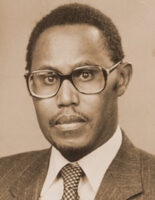
George Saitoti – The mathematician who became Moi’s second in command

There were two celebrated professors in President Daniel arap Moi’s administration: Moi, the self-proclaimed “Professor of Politics”, and his long-serving Vice President, George Muthengi Saitoti, a Professor of Mathematics.

Saitoti acquired his Master of Science in Mathematics degree from the University of Sussex and later, in 1972, a PhD from the University of Warwick. He started teaching at the University of Nairobi in the same year and went on to become an Associate Professor and head of the Mathematics Department, a position he held until 1983. During his teaching career, the professor was also appointed Chairman of Mumias Sugar Company and later, Chairman of Kenya Commercial Bank. Before these appointments, he was a member of the East African Legislative Assembly (EALA) between 1974 and 1977 at the behest of President Jomo Kenyatta, Kenya’s first President.

Moi would nominate Saitoti to the National Assembly in October 1983, signalling the beginning of sweeping changes in the hierarchy of the ruling party, the Kenya African National Union (KANU), and the government. According to political observers, Saitoti’s nomination was orchestrated by Nicholas Biwott, an influential Cabinet minister at the time. Saitoti would subsequently be appointed to the Cabinet as the Minister for Finance, a docket hitherto occupied by Mwai Kibaki, who was relegated to head the Ministry of Home Affairs.

The bestowal of such a great responsibility on a nominated Member of Parliament spoke volumes and was an indication of bigger things coming his way. In the 1988 General Election, Philip Odupoy, the incumbent Kajiado North MP, was prevailed upon not to seek re-election, which enabled Saitoti to be elected as the new MP. He would recapture the seat in 1992, 1997, 2002 and 2007.

Following the 1988 elections, Moi chose political novice and former University of Nairobi Vice Chancellor, Josephat Karanja, to replace Kibaki as Vice President. Karanja was, however, seen as a passing cloud. Following accusations of intent to overthrow Moi’s regime, he was forced out of office a year later, paving the way for Saitoti’s  appointment as VP in May 1989. Saitoti would remain the country’s second in command until December 1997.

After the1997 General Election, Moi held off picking a VP despite insistence from opposition parties that the position must be filled to avert the possibility of a constitutional crisis should anything happen to the President. But he continued to ignore them until April 1999, when he re-appointed Saitoti via a roadside announcement in Limuru Town.

To his credit, Saitoti made major developmental strides in Kajiado North, a constituency that accommodates people from many Kenyan communities and that was by 2009 ranked one of the richest constituencies in the country. While many parts of what was then Rift Valley Province were hit by sporadic tribal clashes from 1991 to 2008, Kajiado North remained mostly unscathed. However, Saitoti himself was at one time accused of complicity in these clashes by Human Rights Watch, a non-government organisation.

While he was VP and Minister for Finance, Saitoti also served as Executive Chairman of the World Bank and the International Monetary Fund (IMF) from 1990 to 1991. And from 1999 to 2000, he was President of the African, Caribbean and Pacific (ACP) group of States. However, during his tenure as the Finance boss, the Kenyan economy performed poorly and inflation soared, mainly due to a misunderstanding between the Kenyan government and foreign aid donors over perceived poor governance.

From 1991 to 1993, a series of financial scandals implicating senior government officials rocked the country and resulted in the suspension of donor aid. The most infamous of these, in which Saitoti was implicated, was the Goldenberg scam. Goldenberg involved millions of dollars in fake gold exports paid to Goldenberg International. In 1999 Raila Odinga, an opposition politician, sued the VP and others for their alleged involvement in the scandal. A mere three months after Saitoti’s re-appointment, Otieno Kajwang’, the MP for Mbita, and an ally of Odinga, moved a private member’s Motion in Parliament seeking a no-confidence declaration against the VP on account of his alleged role in Goldenberg.

Saitoti fought gallantly to clear his name in Parliament and in the courts, but although he won these battles, the political stench of the Goldenberg scandal would never be too far from him.

On 3 February 2006, a report by the Judicial Commission of Inquiry into the Goldenberg Affair chaired by Justice Samuel Bosire, recommended that Saitoti should face criminal charges for his involvement in the scandal. Ten days later, the VP voluntarily stepped down from his ministerial position to make way for investigations into the allegations. On 31 July 2006, a three-judge bench headed by Justice Joseph Nyamu issued an order that would clear Saitoti of any wrongdoing, expunge his name from the Commission’s report and put in place a permanent stay of prosecution against him.

Following riots by multipartism proponents in July 1990, Moi announced the formation of the KANU Review Committee under the chairmanship of Saitoti. The committee was mandated to investigate the party’s internal electoral and disciplinary conduct, and traversed the country collecting people’s opinions on these issues.

In January 1991, the KANU Executive Committee adopted the recommendation by Saitoti that party critics should stop being expelled and instead be suspended for one or two years. The recommendations made by the report got the backing of Moi during the National Delegates Conference held in Kasarani in 1991, paving the way for reforms and setting the stage for the repealing of Section 2A of the Constitution of Kenya. This effectively returned Kenya to a multiparty system of government.

Saitoti remained fiercely loyal to Moi despite facing some hostility from senior KANU officials, and sometimes even from the President himself. The fact that he did not speak the Maa language fluently did not help matters, as leaders from the Maasai community, among them William ole Ntimama of Narok, went all out to try and depict the VP as a Kikuyu and, therefore, unqualified to lead the Maasai. Indeed, so fragile was Saitoti’s position that when Robert Ouko, the Minister for Foreign Affairs, was murdered in February 1990, the VP claimed there were plans to kill him as well.

When the report by the Committee investigating Ouko’s murder was being debated, an angry Saitoti queried: “How come the Committee never deemed it fit to investigate why the Vice President was almost dying at the same time? At the time Ouko was killed, I had been poisoned. I was unconscious. Saitoti was on his deathbed. This is not my original skin,” he raged, while displaying his hands.

Years later, in 2003, at a public rally in Kikuyu Constituency, he would declare, “Kama kuna mtu ambaye amefanyiwa majaribio, ni mimi Prof Saitoti. Hata walijaribu siku moja kunipatia poison.” (If there is anyone who has been subjected to tribulations, it is I, Prof Saitoti. At one time they even tried to poison me.)

At a KANU National Delegates Conference in Kasarani in 2002, the party changed its Constitution to allow for a merger with Odinga’s National Development Party (NDP), and also created four new Vice Chairman positions. This effectively watered down Saitoti’s position and, consequently, his chances of succeeding Moi. Following his vocal complaint to the President that his name was missing from the leaders’ line-up, Moi told him to his face that he was not “presidential material”. In response to the snub, Saitoti famously told the conference, “There comes a time when the nation is much more important than an individual.”

The height of his humiliation came during a meeting in his own constituency, where Moi explained his reasons for overlooking the VP in his succession plans. Speaking in Kiswahili, the President said: “Huyu makamu wa rais ni rafiki yangu. Lakini urafiki na siasa ni tofauti…” (The Vice  President is my friend. But politics and friendship are two different things.)

Later, on arrival from an official trip to America, Saitoti expressed his intention to vie for the presidency on a KANU ticket despite Moi’s endorsement of Uhuru Kenyatta.

“My service to this country has prepared me to handle the challenges of leadership. It is therefore only proper that I respond affirmatively to calls from the Kenyan people that I should offer myself for nomination,” the VP told reporters at the Jomo Kenyatta International Airport in Nairobi. “After seeking guidance abroad from sections of Kenyans, I hereby announce that I itend to seek the KANU ticket at Kasarani and run for President of this great nation when elections are called.”

This announcement led to his sacking in August 2002 for “spearheading a mutiny in the Cabinet”. Saitoti responded by accusing Moi of undermining democracy. “Kenyans have come to value democracy,” he told The Telegraph newspaper, and further asserted, “we should be strengthening democracy, not eroding it. Moi wants to suppress the growth of the democratisation process”.

When Moi declared Uhuru his successor, the marriage between KANU and NDP was dissolved, and Odinga left to form the Rainbow Alliance that later transformed into the Liberal Democratic Party (LDP). The party was made up of opposition leaders and KANU ‘rebels’, including Saitoti. When LDP joined the Kibaki-led National Alliance of Kenya (NAK), the union became the National Rainbow Coalition (NARC) and Saitoti was made a member of the NARC Summit, the coalition’s highest organ.

When Kibaki won the presidential election in 2002, he appointed Saitoti Minister for Education in charge of implementing NARC’s free primary education programme. When the union between Kibaki and Odinga crumbled, Saitoti aligned himself with the President and actively campaigned for the government’s ‘Yes’ vote in the lead-up to the 2005 referendum on a Draft Constitution. Unfortunately, the ‘Yes’ side lost to the combined team of LDP and KANU.

In 2007, Saitoti recaptured his Kajiado North parliamentary seat through the Party of National Unity (PNU) and was appointed Minister of State in charge of Internal Security and Provincial Administration. After the formation of the Government of National Unity following a power-sharing deal brokered to stop the election-related violence of 2008, Saitoti retained his Cabinet position. Between late 2010 and August 2011, he was appointed in an acting capacity as the Minister for Foreign Affairs after Moses Wetangula stepped down to allow for investigations into alleged corruption in the ministry.

In November 2011, as Chairman of PNU, Saitoti announced his intention to vie for the presidency upon the retirement of President Kibaki in 2013. However, on 10 June 2012, while en route to a church service and fund raising event in Ndhiwa Constituency in Nyanza Province, he was killed when the police helicopter ferrying him and his Assistant Minister, Orwa Ojode, crashed in Ngong Forest. Also killed were their bodyguards, Police Inspector Joshua Tonkei and Thomas Murimi, along with their pilots Nancy Gituanja and Luke Oyugi.

Saitoti, born in Oloolua Village in Ngong Town, was 66 years old when he died. He was married to Margaret Saitoti and they had a son, Zachary Musengi.


Godfrey Gitahi (GG) Kariuki – Cabinet stalwart who discerned the illusion of power

At the peak of his political career in the late 1970s and the early 1980s, so close was Godfrey Gitahi (GG) Kariuki to President Daniel arap Moi that it became habitual for commentators to refer to the relationship between the two in derogatory terms.

In the initial years of Moi’s leadership, the second president of Kenya gave the convincing assurance of his intention to follow in Kenyatta’s footsteps and work with the men and women that the late president had elevated to positions of power. But as he consolidated power and gained confidence, he started being perceived as being antagonistic towards the Kikuyu elites. However, Kariuki and Attorney General Charles Njonjo, both from the Kikuyu community, regularly rode in his presidential limousine and were viewed as being among the most influential insiders of the Moi administration.

But even with these two, Moi was just biding his time and soon enough Kariuki and others of his ilk found themselves out in the cold, some hunted down like wild animals. The first major casualty was Njonjo when, in an elaborate scheme, he was fingered as the much-vaunted “traitor” who was planning to use his “foreign masters” to unlawfully overthrow the popularly elected government of Moi. Kariuki could not escape the trap that had been laid for the “friends and associates of the traitor”.

Kariuki’s political association with Moi dates back to 1964 when the latter, who had been the Chairman of the Kenya African Democratic Union (KADU), defected and joined KANU. “During the next 15 years, we worked side by side in the service of KANU and the nation. In the process, we also became close friends,” said Kariuki. However, as the saying goes, there are no permanent friends or enemies in politics.

Kariuki was elected to the National Assembly as a Member of Parliament (MP) in May 1963, but even before his election he had actively fought for the rights of the landless in Laikipia. He continued to advocate for the landless, leading to his appointment as Assistant Minister for Lands, Settlement and Physical Planning in October 1970 at only 33 years old. Although this was a big honour, this appointment was a cause of considerable apprehension for Kariuki, as he had been a critic of the government’s policy on land matters, a policy he was now expected to carry out.

“Many of my friends teased me about how I would behave now that I was on the other side of the fence,” Kariuki would write years later in his autobiography entitled Illusion of Power. In the Lands ministry, he served under veteran and ageing Meru politician Jackson Angaine who was not averse to giving the younger man responsibility. In the 1970s, land matters were critical as the government sought to settle as many landless people as possible. Serving under a minister who allowed him a free hand enabled the Assistant Minister to get very close to the forefront of Kenyan politics.

During the 1974 General Election, Kariuki was opposed by the Gikuyu, Embu and Meru Association (GEMA) Laikipia District Chairman, F.K. Mbuthia, a man whose candidature he had supported for that position two years before. By that time, Kariuki had been noted as a Moi supporter which irked some among the GEMA community who did not want him to automatically ascend to the presidency, hence the opposition.

However, apart from assisting the Kikuyu in his constituency in matters of land and schools, Kariuki also assisted the Nandi community to settle on Lorian Farm. He helped the community build schools in the corner of his constituency where they were the major ethnic group. The support he received from this group, which also sought the backing of other non-Kikuyu members, was critical for the Assistant Minister. “Vice President Daniel Moi, a Tugen and my long-time political associate, visited my constituency as a demonstration of support for me,” said Kariuki.

However, Moi’s visit was not appreciated by the Nandis at the Lorian Farm because of the disagreement between Moi and their (Nandi) leader Jean-Marie Seroney, a fierce critic of the KANU government. Kariuki was, however, re-elected and continued his association with Moi and those who were supporting the VP to succeed Kenyatta.

Kenyan politics were volatile in the late 1970s as the Kenyatta succession was taking shape. Several people were averse to Moi automatically taking up the highest office, even temporarily, upon the death of the ailing president, while others like Kariuki fully backed a Moi presidency. In March 1975 the MP for Aberdare Constituency, J.M. Kariuki, was assassinated by what many believed were forces fearing that he was gunning for the presidency once Kenyatta died.

A Parliamentary Select Committee was formed to investigate the circumstances under which ‘JM’ disappeared and was later murdered. “During the debate on the parliamentary select committee, Moi, Njonjo, Arthur Magugu and I, went to see Kenyatta at State House. Our mission was to inform Kenyatta of the gravity of the matter under consideration in Parliament and suggest some amendment to the motion that would allow the government to investigate the murder professionally under the auspices of the Attorney General,” Kariuki narrated in his book.

By this time, Kenyatta’s health was declining, a factor that motivated the ‘Change the Constitution’ move aimed at preventing Moi from directly ascending to power if and when Kenyatta died. This move was spearheaded by political heavyweights including Angaine, the Minister of Lands; Paul Ngei, Minister of Cooperative Development; Njoroge Mungai, Minister of Foreign Affairs; Njenga Karume, nominated MP and chairman of GEMA; and Kihika Kimani, KANU branch Chairman for Nakuru District.

Between 1976 and 1977, this group went round the country trying to convince people about the need to change the Constitution to avoid the automatic accession of a vice president to the presidency in case of the death of the president. However, a small group of Moi supporters, including Njonjo (the Attorney General), Stanley Oloitipitip and Kariuki opposed the move.

This group convinced Kenyatta that the debate on changing the Constitution was chaotic and could adversely change the course of the nation. It was then that Njonjo made the famous, if short, speech warning “anyone who was imagining or contemplating the death of the President would be doing so at their own peril”. The debate fizzled out.

“For my part, I was convinced that any citizen as long as he or she had the people’s mandate, should lead this nation. (And) as the debate on the constitutional change continued, competition for favour, tribalism, money and parochial politics superseded national vision or patriotism, while the government neglected many of its functions,” Kariuki wrote.

By Njonjo nipping the change the Constitution debate in the bud, he enabled a smooth transition from Kenyatta to Moi when the former died in August 1978. Later that year Kariuki played a crucial role in the KANU election of national officials which was necessary to confirm transfer of power. Years later he wrote, “On 6 October 1978 I convinced about 22 branch chairmen to sign a declaration of support for my proposed slate of party officials to be elected at the national conference of KANU delegates planned for 28 October 1978. Moi was unanimously confirmed as president of the party”.

Kariuki, the close associate of the new Head of State, was attracting a lot of attention and his campaign meetings in 1979 were huge affairs, some of which were attended by Moi. When the elections were over and Kariuki had been duly elected MP, Moi appointed him Minister of State in the Office of the President in charge of National Security and Provincial Administration.

As a trusted confidant of the President, Kariuki had expected a Cabinet post, but the one he ended up with was somewhat overwhelming in scope and responsibility. He soon, however, realised that his power was just in letter but not in deed. “I soon realised that my authority was theoretical and far from reality.”

He found out, for example, that the Special Branch department that was supposed to be under him, reported directly to the President, and although he had to sanction the department’s expenditure, he had no say regarding how the money was used. “In effect, the minister was just a figurehead; real power rested with the president who hired and dismissed officers at will.”

On many occasions the minister in charge of Security learned of decisions made on security matters through the press. Kariuki was supposed to be in charge of the provincial administration, but the department’s officers were “direct agents” of the President. The other headache he had to deal with was the indiscipline within the police force, a department that was under him. This problem, Kariuki surmised, was as a result of the Ndegwa Commission report of 1971 that allowed for civil servants to engage in private business while still serving as public servants.

“(When this report was implemented), the chain of command within the law enforcement machinery broke down, as the basic duties of policemen were left to junior police officers who could not compete in business. When police officers are engaged in private business, the temptation to misuse their authority to further their business interests increases, casting doubt on their capacity to enforce the law with impartiality,” said Kariuki.

After a short and frustrating stint as the “powerful” Minister of State in the Office of the President, during which Kariuki realised that power can be an illusion, he was transferred to the Ministry of Lands, Settlement and Physical Planning in May 1982. “The closer I got to the centre of power (as the minister for state), the more I found my initiative stifled. Power became measured in terms of what would serve the immediate interests of the inner political circle rather than what could be accomplished for the Kenyan people.”

So the escape to the Lands ministry where he had earlier served as Assistant Minister was most welcome. As an assistant and later substantive minister, he played a crucial role in the settlement of the landless in Laikipia, previously part of the white highlands.

While the government favoured the land transfer policy of willing buyer, willing seller, in the initial days Kariuki had proposed the compulsory acquisition of all land owned by foreigners to be used for settling the landless.

When the ‘traitor’ issue that resulted in Njonjo being taken through a tedious Judicial Commission investigation, two camps emerged: those who had to be removed from the centre and those who wanted to come in.

Loyalty was measured by the volume of the voice shouting “nyayo” the loudest. Kariuki, like many others associated with Njonjo or because of their tribal affiliations, had to go.

Any innocent statement made by these anti-nyayo elements was taken out of context and used to victimise them. In mid-1983 at the height of the ‘traitor’ issue, while attending the opening of a church in Nyeri, Kariuki commented that Kenya’s presidency would not be gained through tribal manipulation and groupings. He added that the country was full of rumours, falsehoods and jealousy that could cause chaos. “I refused to discuss the traitor issue and termed it a creation of politicians and newspapers.”

His position was, however, challenged by a section of MPs and KANU officials who insisted it was counter to the President’s assertion that there did indeed exist a traitor within the ministerial ranks. During campaigns for the 1983 General Election, Kariuki was frustrated by junior administration officials to the extent that he could barely hold public meetings, though he still believed he commanded about 90 per cent of the electorate. The election was, however, manipulated, resulting in Kariuki losing by a large margin to J.G. Mathenge.

From then on Kariuki was subjected to a systematic witch-hunting campaign and was probed for all imaginable sins of commission and omission before finally being named in the Njonjo Commission of Inquiry.

Councillor Emmanuel Maitha of Mombasa told the Commission that Kariuki was supposed to be appointed a Minister for State in the government Njonjo would form after the overthrow of Moi. Kariuki was subsequently expelled from KANU on 14 September 1984.

Even after reprimanding him in public on several occasions, Moi rehabilitated his ‘friend’ and former minister in November 1988. He “magnanimously” nominated Kariuki to Parliament in 1993, a capacity in which he would serve until 1997. Kariuki also served from 1993 to 2000 as Chairman of the Betting Control and Licensing Board. He was re-elected MP for Laikipia West in 2002 serving up to 2007, after which he was elected Senator for Laikipia County in 2013.

After falling from grace, Kariuki went back to school and studied accounts, graduating with a certificate from the Institute of Administrative Accountants in 1985. He then completed a Master’s degree in International Relations and in 2016, got a PhD in International Relations from the University of Nairobi.

He was a martial arts (Taekwondo) enthusiast, a sporting activity he engaged in for the better part of his life. He served as an official of local and international Taekwondo associations.

Senator Kariuki died in June 2017 at the age of 78.


Gideon Musyoka Ndambuki – Four government ministries in five years

Gideon Musyoka Ndambuki was one of the technocrats in President Daniel arap Moi’s Cabinet who climbed his way up the ranks of the ruling party, KANU, to become its National Organising Secretary. For some reason, Ndambuki served in four government ministries in the five years of Moi’s final term between 1998 and 2002.

During Moi’s frequent Cabinet reshuffles, Ndambuki was moved from the Office of the President to the ministries of Lands and Settlements, Higher Education, Science and Technology, and Economic Planning and National Development.

For 16 uninterrupted years – from 1997 to 2013 – he was the Member of Parliament for Kaiti Constituency in what was Makueni District (now Makueni County). In 1998 he was elected on a KANU ticket and re-elected to the seat in the historic 2002 multiparty elections. He was also the Makueni District Chairman.

Ndambuki was born around 1947 – he is not sure of the exact date – in Nzuuni Village, Kaiti Constituency. He attended the local Mukuyuni Primary and later Ukia Primary schools between 1958 and 1965 for his basic education. Being of a strong and stout build, he excelled in sporting activities during his primary school days, especially field events such as shot put, discus, javelin and the hammer. He became so good at shot put that when he later went to Kangundo High School in 1966, he represented the school at district and national levels for the four years he was there.

From 1976 to 1978, Ndambuki trained in banking under the auspices of the Bank of America and subsequently received a scholarship to Emporia State University in the United States of America for a degree course in business management. He qualified with an MBA four years later.

Back home, his entry point in employment was in the banking sector. In 1981, he joined Commercial Bank of Africa as an Accounts Manager and in 1986 moved to Trade Bank as Manager, rising to the position of Managing Director until its collapse in 1993. Trade Bank was a politically connected institution that was frequently under scrutiny by the media and Parliament for allegedly providing unsecured loans, especially to politicians and businessmen considered close to Moi’s government.

As boss of the bank, which was fronted by Asian tycoons, Ndambuki found himself immersed in the politics of the day until the bank eventually collapsed. When he later joined Lima Finance, an institution said to be associated with Moi, Ndambuki effectively became one of the President’s business and financial handlers. It was during this period that Moi apparently saw Ndambuki’s political potential and encouraged him to enter the fray.

Ndambuki contested and won the Kaiti parliamentary seat on a KANU ticket in 1998 and quickly consolidated his support, forging political links with the area’s political heavyweights including the Ukambani region’s party supremo, Mulu Mutisya, who was Moi’s point man in the area.

Perhaps as a reward for having handled his business and financial dealings when he worked at Trade Bank and Lima Finance, Moi appointed Ndambuki Minister in the Office of the President in charge of Development, Disasters and the Drought Management Programme, Directorate of Personnel Management and Defence. In Ndambuki, the President knew he had a trusted pair of hands. Curiously, however, he worked there for just about a year.

“The country was hit by severe drought that year,” Ndambuki recalled. “I went all over the country distributing food to drought victims as well as the victims of the El Niño floods that followed. I was also involved in (spearheading and coordinating) the search and rescue operations following the 1998 terrorist bomb attack at the American Embassy.”

In the same year, he was moved to oversee the Defence docket, which was run from the Office of the President rather than being an independent ministry. This was during the no-nonsense Chief of General Staff Daudi Tonje’s tenure . His Permanent Secretary was Sally Kosgei, who would later rise to head the entire civil service as well as become Secretary to the Cabinet.

Ndambuki would not divulge any highlights of his time in Defence “… in the interests of national security”. It is, however, significant that this was the period when through General Tonje, the military introduced measures to professionalise the force, resulting in promotions based on academic performance, lowering the retirement age for the military top brass and allowing servicewomen to get married.

Ndambuki was moved to the Ministry of Lands and Settlement where, he said, he embarked on the computerisation of the ministry’s records and enhanced revenue collection.

In 2001, he was transferred to the newly-created Ministry of Higher Education, Science & Technology as its first minister. The ministry, he said, developed polytechnics and vocational training centres across the country.

His record of moving from one ministry to another and serving in four of them within the span of five years became something of a joke in Ukambani, especially among his rival politicians.

They would often joke behind his back that he was always found unsuitable for whichever ministry he was appointed to. Regarding his frequent transfers, Ndambuki could only comment that the appointment of Cabinet ministers was the prerogative of the President.

What he did not say, however, was that Moi’s final term witnessed tectonic political shifts as the President’s loyalists, several of whom were in the Cabinet, started warming up to the Opposition with the emergence of other political parties. Those perceived to show pro-Opposition tendencies were quickly jettisoned, resulting in frequent Cabinet reshuffles.

Of all the different postings, Ndambuki most enjoyed his tenure in the Ministry of Economic Planning and National Development, which he took over from the late Prof George Saitoti in the heady election year of 2002. He prides himself for negotiating funding for Kenyan farmers as well as export trade deals.

“As Minister in charge of the African, Caribbean and Pacific (ACP) Countries’ Agreement, I travelled to many countries,” said Ndambuki. “I negotiated the Starbucks coffee funding through the European Union (EU) to the Co-operative Bank of Kenya to cushion Kenyan coffee growers. I also successfully negotiated the export of Mumias sugar to the EU under the ACP Pact as well as the export of Kenyan fish to Europe and Israel.”

It was during his stint as Minister for Economic Planning that the off-and-on national census exercise was finally completed. The last census had been held in 1990 and was next due in 2000. But after Parliament voted to allocate rural development funds to districts, including a Constituency Development Fund (CDF) according to population, among other factors, the census issue became a political hot potato. Politicians became suspicious of the intention behind the population count whenever it was announced, leading to its postponement.

But Saitoti had managed to overcome the political shenanigans associated with the census and by the time he vacated the office and Ndambuki took over the reins, it was all systems go.

Satitoti resigned to join the Opposition after Moi named Uhuru Kenyatta as his preferred successor through KANU. Saitoti and other Opposition leaders, among them Raila Odinga, Kalonzo Musyoka, Charity Ngilu, Martha Karua and Kijana Wamalwa, all presidential hopefuls, formed the National Rainbow Coalition (NARC) led by Democratic Party (DP) leader Mwai Kibaki. The coalition went on to resoundingly defeat Kenyatta, who had been nicknamed ‘Moi Project’, and dramatically end KANU’s 40-year reign.

Ndambuki successfully negotiated the export of Mumias sugar to the EU under the ACP Pact as well as the export of Kenyan fish to Europe and Israel

“When we lost the election, Uhuru became KANU Chairman, William Ruto Secretary General (replacing Raila Odinga) and I was elected Organising Secretary (replacing Kalonzo Musyoka),” Ndambuki recalled in an interview. “I won the Kaiti seat again, becoming the only MP elected on a KANU ticket in the entire Eastern Province!”

After the polls that ushered Kibaki into State House, with Kenyatta as Leader of Official Opposition in the House, Ndambuki was appointed Shadow Minister for Water and Irrigation where he dissected budgetary allocations to the ministry and challenged the government’s policies and actions on the ministry at every turn.

In 2007, he was re-elected as the Kaiti MP on an Orange Democratic Movement-Kenya (ODM-K) ticket, having defected from KANU. He was appointed Assistant Minister for Agriculture under Cabinet Minister William Ruto in the Grand Coalition government that had Kibaki as President, Odinga as Prime Minister and Musyoka as Vice President.

Ndambuki is credited with the distribution of subsidised fertiliser to farmers across the country as well as certified maize seeds in a deliberate effort to increase production to boost strategic reserves of the crop.

In the 2013 General Election, Ndambuki decided to contest the Makueni County Senate seat on a Wiper Democratic Movement ticket under the Coalition for Reforms and Democracy (CORD). He was however wiped out by the party’s Secretary General, Mutula Kilonzo, at the nomination stage, after which he retired from active politics.

Ndambuki returned to public service in 2017, when he was appointed by President Uhuru Kenyatta to the plum position of Chairman of the National Social Security Fund (NSSF), a position he holds to date.

He attributes his long service as MP for Kaiti to his performance in the constituency, which included campaigning for the construction of the Katumani-Wote road which kicked off in 2002 at a cost of KES 2 billion during Moi’s tenure. Also during Ndambuki’s tenure as Kaiti MP, power lines were installed from the Mombasa-Nairobi road to Wote, the district headquarters, in addition to the construction of up to 17 health facilities, 30 dams and several administration centres for chiefs and district officers.

“The Red Cross donated through me 100 tonnes of certified maize seed, which I distributed to farmers in Kaiti,” he recalled. “I was the first Kamba MP to start a bursary fund, which I set up after I invited President Moi who raised KES 9 million for the initiative. I was able to achieve a lot thanks to the President, who had lunch in my house four times during his visits to Makueni.”

Reflecting on his tenure as a minister, Ndambuki said Moi had a hands-on policy and was intent on knowing everything that happened in each ministry.

“If we had more freedom to run our ministries, things would have moved faster. Also, initially we were not allocated clear jobs. We were expected to go to the airport to receive State visitors and so on. Remember that many Cabinet ministers were of retirement age but a few of us were young and energetic and needed work to do, not sit idle. So a few of us approached the President about this situation and we were allocated work. Eventually, we became part of the policymaking process.”

Ndambuki is married to Dr Philomena Ndambuki, a lecturer at Kenyatta University, and they have five children, three sons and two daughters. Ndambuki now wants to settle down to a quiet life running his businesses and perhaps writing his memoirs after 35 years of government service.


Francis Loile Polis Lotodo – Fierce defender of his community

Not much is known about Francis Loile Polis Lotodo’s early life. Despite being a key public figure who fought for the rights of his community, he kept a low profile. The little information available about his early life points to a staunch Catholic who attended Kapenguria Upper Primary School and later joined a secondary school. He worked as a clerk in Kapenguria Town before moving to the Kitale African Court in the same capacity.

Lotodo served as an Assistant Minister and later as a Cabinet minister. He held various Cabinet portfolios among them Energy; Land and Physical Planning; Information and Broadcasting, Environment and Natural Resources; and Local Government during Daniel arap Moi’s tenure as president. In 1979 Lotodo was appointed Assistant Minister of Energy. When he died in 2000 at age 60, he was the Energy minister. Throughout his political career, he never minced his words, even if it meant antagonising the ruling party, KANU. Several times he was jailed for inciting intertribal violence. At one time, he was even expelled from KANU. But he always managed to bounce back. The manner in which he defended his community was taken seriously even if the political leaders of the day did not like it. Some referred to him as a “warlord” because he spoke his mind.

While he was Minister for Environment and Natural Resources in 1998, Lotodo was still a key player in what the Weekly Review described in April 1998 as the “militarisation of the pastoral communities”. For example, in March 1999 he was blamed for the massacre of about 100 people following clashes between the Pokot and their neighbours, the Turkana ethnic community. Lotodo denied any involvement in the incident.

He first became a Member of Parliament (MP) for the larger Pokot in 1969 before it was split into three constituencies (East, South and West Pokot). He was re-elected in 1974, 1979, 1983, 1988 and during the multiparty elections of the 1990s.

Lotodo was one of a kind. He put his tribe’s interests ahead of everything else. He was an ultra-conservative and a stubborn stickler for adhering to traditions perceived to be repugnant in a modern Kenya. For example, he believed that cattle rustling (outlawed in Kenya) was part of the Pokot culture, and he was ready to be jailed for his opinions. His rigid traditional opinions often antagonised other Kenyan people groups. In 1993, he is on record as having given members of the Kikuyu community an ultimatum to leave Pokot or face eviction by the locals, accusing them of denying the Pokot their livelihood. He targeted the same community before the 1997 General Election. He reportedly instructed those who had settled in West Pokot to “go and vote where they were born” Several independent human rights bodies, including the Institute for Education in Democracy, the Catholic Justice and Peace Commission and the National Council of Churches, cited this as an election malpractice.

This behaviour not only cost him a Cabinet post, but it also landed him in jail. He however changed his stand in 1998 after Moi placed him at the forefront of brokering peace between the Pokot and the neighbouring communities comprising the Turkana, Samburu and Marakwet.

Mr Lotodo was a man of truth; he never ceased to speak his mind. He never withheld any views if it struck as helpful to his people

The northern part of Kenya was marginalised by government all the way from colonial times. The absence of an effective administration led to insecurity, with the local ethnic groups arming themselves against attacks from neighbouring countries and forming militias. When Moi became president in 1978, the northern Kenya tribes had turned on each other. The Moi administration decided to embark on disarming the Pokots, making those opposed to the disarmament community leaders. Thus Lotodo became a leader.

Once, during a rally presided over by Moi in Lotodo’s home town Kapenguria, Lotodo accused the area District Commissioner (DC) of doing little to end the devastating famine that was ravaging the area. At the time, DCs were considered the president’s representatives at the district level. Some Pokot leaders felt Lotodo had shown disrespect towards the Head of State and they disowned him.

This was not the only time area leaders had differed with Lotodo. In 1984 several of them wrote a memorandum to the President claiming that Lotodo, at the time Assistant Minister of Information and Broadcasting, was urging the Pokot to arm themselves against their neighbours. Moi sacked him and he was expelled from KANU. Two years later, he was pardoned.

Despite the many controversies that surrounded him, Lotodo served in various Cabinet dockets. In January 1993 he was appointed Minister for Home Affairs and Heritage and four years later he swapped positions with William ole Ntimama of Local Government. After a Cabinet reshuffle in February 1999, he was moved to the Ministry of Environment and Natural Resources.

A month later he ordered stone-crushing machines out of Kaya Mwache Forest in Kwale over claims that the investors in the area were not ploughing their profits back into the community. He also accused them of not “respecting local people”, in addition to destroying the environment. Earlier, the local MP (Kinango Constituency), Simeon Mkalla, had directed the quarry miners to reinvest their profits into the community or pack and leave.

Yet, even as Lotodo ordered the stone-crushers to leave, he defended the illegal allotment of Karura Forest in Nairobi. He defended his contradictory position, saying that unlike the Kaya which lies at the Coast, Karura Forest lay in a multi-ethnic area. Nobody, he said “shouted” when Karura was dished out.

When the issue was discussed in Parliament in 1998 and MPs insisted that he degazette the Karura allocations, Lotodo stated that “when it comes to degazetting Karura Forest, maybe another minister will do that. I will not revoke any allotment come what may!”

Lotodo was in charge of forests when police officers assaulted environmental activists at Karura. Among those beaten was renowned environmentalist Wangari Maathai, who later became the first African woman to win the prestigious Nobel Peace Prize for protecting the very forest and environment that Lotodo sought to destroy.

On another occasion in 1997, Lotodo reportedly took issue with other leaders from his region because they were not involving him in area peace initiatives.

In April 1998 the Kimilili MP Mukhisa Kituyi filed a notice of motion in Parliament to censure Lotodo over his utterances regarding the Pokot-Marakwet conflict. The MP called for Lotodo’s resignation. He refused to resign and stated that violence would not end until the Pokot youth got employment. Reportedly, Lotodo even turned his fury on the Church, accusing it of fanning ethnic hegemony.

Even though he defended his community fiercely, his life was not always filled with controversy. Just a month before his death, Lotodo, as Minister of Energy, issued an electric power production licence to OrPower 4 Inc. The permit enabled the company to supply power from Olkaria III station to the Kenya Power grid.

Lotodo died in Johannesburg, South Africa, while in office. Moi described him as a “loyal and faithful minister”. His Cabinet colleague William ole Ntimama eulogised him, saying that “Mr Lotodo was a man of truth; he never ceased to speak his mind. He never withheld any views if it struck as helpful to his people.”

Eleven years after his death, the Daily Nation published an article saying, “The Pokot hold him in awe even in death — and those who saw his style of fiery and fearless leadership describe Francis Lotodo as a man who gave his all for the people he led.”

He put his tribe’s interests ahead of everything else.

Francis Mwanzia Nyenze – Panic over the Presidential sleepover

The humble three-bedroom rural abode of newly-appointed Minister for Sports and Culture, Francis Mwanzia Nyenze, became home for a night for President Daniel arap Moi during a two-day tour of Kitui district in the days when mere proximity to the President was a ticket to power.

Nyenze, then in his late 30s and serving his first term as Member of Parliament for Kitui West, was rendered speechless when Moi called to inform him that he planned to tour Kitui to meet with district KANU Branch leaders, inspect government projects and hold public rallies in Kitui and Mwingi… and that after the first leg of his tour he would spend the night at Nyenze’s home in Kyondoni Village.

Nyenze, who had just been transferred from the Ministry of Environment to that of Sports and Culture in an earlier Cabinet reshuffle, drove to State House in a panic that same afternoon to beseech President Moi to consider spending the night elsewhere because he did not have a good house to host him. As related by Nyenze’s wife Edith, who was then the Principal at Kyondoni Girls’ Secondary School in Kitui, Moi responded that he had no intention of changing his plans and that he was perfectly happy to sleep in Nyenze’s rural home no matter what state it was in.

Happily, according to the Sunday Nation of 17 December 2017 headlined ‘When Moi Spent the Night at Nyenze’s Three-Bedroomed House’, a team of top government officers from both State House and Office of the President was sent off to refurbish the residence, an exercise that involved applying a fresh coat of paint, new furniture, cutlery and even a telephone hotline to ensure the President was accommodated in accordance with his status.

The President kept his word. In the company of Cabinet ministers Kalonzo Musyoka, Jackson Mulinge, Nicholas Biwott, Shariff Nassir and Ukambani KANU supremo Mulu Mutisya among other KANU leaders, he arrived at Nyenze’s residence at 6 pm. He was reported to be in high spirits and engaged the family in conversation before proceeding to have dinner.

The Moi visit to Nyenze’s rural home became the topic of the day, being widely seen as signalling shifting political fortunes for Nyenze himself and other leaders in Ukambani region.

Nyenze initiated policy to strengthen the capacity of Government to protect heritage sites in the country

There was speculation as to why the President had chosen the humble home of a fairly junior politician at a time when Kitui district had many senior leaders including Ministers Kalonzo Musyoka, George Ndotto and Nyiva Mwendwa, all of whom had magnificent residences compared to Nyenze’s modest dwelling. Political pundits saw the visit as a demonstration of Moi’s penchant for playing politicians against each other in order to destabilise them and keep them guessing.

However, unbeknownst to Moi, Nyenze had played host to opposition leader Jaramogi Oginga Odinga in the same house years before Nyenze joined the ruling party KANU. Jaramogi is reported to have officiated over the ceremony to open the house, had lunch and continued on his campaign trail. The only thing he did not do was spend the night there.

One could speculate that perhaps the inadequacy the Nyenzes felt while hosting Moi inspired them to build a huge, ultra-modern home befitting not just a Cabinet minister, but a President in the future.

Nyenze was first elected to Parliament as Member for Kitui West on a KANU ticket while in his early thirties in 1997 after routing the formidable Winfred Nyiva Mwendwa, Kenya’s first female Cabinet minister. For this, Nyenze went down in history books as the son of a bishop who dared take on the Mwendwa family, Kitui’s single most powerful and wealthy family that produced, in addition to Kenya’s first female Cabinet Minister, Kenya’s first Chief Justice (Nyiva’s husband Kitili Maluki Mwendwa) and two other Cabinet Ministers (Kitili’s brothers Eliud Ngala Mwendwa and Kyale Mwendwa).

His election was perhaps attributable to the fact that Nyenze was an outspoken and candid politician. He never shied away from articulating his political convictions. In Kitui West where he was immensely popular, he was nicknamed ‘shabiki’ (fan). This was his rallying call which he is reported to have used to mobilise his supporters, especially the youth.

Nyenze became a close political ally to Moi, who appointed him Minister for Environment in 1997 before transferring him in a Cabinet reshuffle to the Ministry of Heritage and Sports in 2001. As a Cabinet Minister he made significant reforms in the respective dockets and was a household name during Moi’s final term which ran from 1998 to 2002.

In spite of his popularity in Kitui and close relationship with the President, however, Nyenze’s political career ended when Moi left State House. His meteoric political star dimmed after he was trounced in the 2002 elections by his rival Mwendwa, who recaptured the seat she had lost five years earlier. Her successful return to the Kitui West constituency seat effectively consigned Nyenze into the political cold, at least for the next 10 years.

He spent that decade serving as Chairman of a Commission set up to investigate the proliferation of pyramid schemes deemed to be responsible for impoverishing many gullible Kenyans lured into investing in phantom financial schemes that promised to turn small sums of money into mind-boggling financial fortunes. Investors in the Ponzi schemes lost billions when they collapsed in 2005. The Nyenze Task Force Report revealed that 148,784 investors had lost over KES 8 billion to 270 fraudulent schemes. However, none of the Directors of these companies was ever arrested. According to a Daily Nation report, some 40,000 victims formed what they called the National Pyramid Schemes Victims Initiative (NPSVI) and sued several government agencies including the Attorney General and Central Bank in an attempt to recover from the State KES 5.7 billion which they claimed to have lost to the Ponzi schemes. The Nyenze Report noted that the Central Bank of Kenya (CBK) froze the accounts of the Ponzi masterminds with the hope that the money would be used to pay back the victims.

Nyenze also served as Chairman of the Water Resources Management Authority (WRMA) and later a Director of the National Irrigation Board (NIB) until October 2012.

Nyenze was born on 2 June 1957 in Kyondoni village, Kabati, in Kitui West. His father, the late Reverend Philip Nyenze Mwambu, was a renowned Africa Inland Church (AIC) minister. Like many rural African lads, young Nyenze looked after his father’s cattle and went to a local primary school in Kabati before joining Kagumo Boys’ High School in Nyeri County and later the University of Nairobi for a Degree in Architecture, Design and Development.

Nyenze was impatient to join elective politics, an ambition he achieved when he was first elected to Parliament in 1997. As a Cabinet Minister, Nyenze became a household name in Kitui and elsewhere in the country during Moi’s final term. He was charismatic, easy-going and jocular.

During his time at the helm of the Ministry of Environment, Nyenze was credited with strengthening the capacity of the National Environment Management Agency (NEMA) to effectively play its crucial role of assessing the environmental impact of development initiatives across the country. He frequently spearheaded ministerial initiatives to plant more trees and protect riparian land.

When he was transferred to the Ministry of Heritage and Sports in the politically charged year of 2001, Nyenze initiated policy to strengthen the capacity of the Ministry to protect heritage sites in the country. Additional heritage sites were roped in for special protection by Government. He also took significant measures to promote athletics and football in the country.

These were heady political times as a growing Kenyan opposition was determined to wrest power from Moi and the 40-year KANU rule. As a trusted Moi lieutenant, Nyenze’s time was therefore taken up by political campaigns when he accompanied the President during his vote-hunting forays in Ukambani and elsewhere in Moi’s political sunset.

Nyenze suffered a defeat at the polls during the watershed 2002 multiparty elections and his boss Moi was similarly sent home by the Mwai Kibaki-led National Rainbow Coalition (NARC). Nevertheless Nyenze, a never-say-die politician, made a dramatic political comeback in 2013 when he reclaimed his seat in the National Assembly on a Wiper Democratic Party (WDP) ticket.

Nyenze had read the signs of the times and forged close links with Wiper leader Kalonzo, who called the shots in the entire Ukambani region and other pockets across the country as second-in-command of the Coalition for Reform and Democracy (CORD) under opposition leader Raila Amolo Odinga.

The general election saw Uhuru Muigai Kenyatta trounce his rival for the presidency, Odinga and his running mate Kalonzo, who were running under the CORD banner. After their narrow defeat, Raila and Kalonzo trooped to court to contest Uhuru Kenyatta’s election on the grounds that it was fraught with election irregularities and that the results were doctored in his favour. The petition was thrown out.

After Nyenze’s re-election, he was elected Minority Leader of the opposition CORD side in the National Assembly. At a time when the Orange Democratic Movement (ODM) faction of the CORD alliance was loud and confrontational in Parliament, Nyenze became the voice of reason and referred to himself as “the son of a bishop.” He even extended an open hand to the Jubilee administration of President Kenyatta, a stance that drew heavy criticism from ODM legislators who petitioned the Wiper party to replace him as Minority Leader.

During negotiations to draw up a Memorandum of Understanding (MOU) between CORD, Wiper and FORD Kenya, the post of Minority Leader in the National Assembly was reserved for Wiper.

CORD MPs complained that Nyenze was unable to whip the opposition in Parliament in order to counter the Jubilee coalition offensive in the National Assembly. He argued that since Jubilee had the tyranny of numbers, there was little he could do to counter their offensive. He said the only option left to the CORD MPs was to walk out whenever they disagreed with any motion on the floor of the House.

Nyenze served as a member of the Public Investments Committee (PIC) that summoned numerous CEOs in government parastatals to answer questions regarding improprieties, including corruption in their respective institutions.In the run-up to the 8 August 2017 presidential elections, Nyenze was one of the Wiper party leaders from Ukambani who pressured other Wiper leaders to accept nothing less than flag-bearer status in the newly-formed National Super Alliance (NASA) fronted by Raila Odinga. Nyenze and company based their position on a reported MOU drawn up by CORD which provided that Raila would be the CORD flag-bearer in 2013 and would serve for one term and then give way to Kalonzo in 2017.

Nyenze unleashed a political storm when he insisted that only Musyoka’s candidature for the top seat in NASA would convince Ukambani voters to remain in the Alliance. He warned that his party leader’s presidential candidature was not a request and nor was it open for debate. It was either that or there would be no NASA, he declared. He was roundly condemned for what were seen as attempts to rock the boat from within.

In the end, Raila was once again selected to be the NASA flag-bearer with Kalonzo as running-mate; a development that so incensed Nyenze that he caused yet another storm when he and former Wiper National Chairman, David Musila, openly expressed their support for Kenyatta’s re-election in the 8 August polls.

Curiously, Nyenze was re-elected as MP for Kitui West for a third term in the 8 August polls despite going against the grain by declaring his support for Kenyatta.

Only close relatives knew that Nyenze had been battling colon cancer for 10 years. The grim reality of his health condition was revealed in the National Assembly and to the Kenyan public through television footage when he arrived to be sworn in to the 13th Parliament with an oxygen tank strapped on his body.

He died on 6 November 2017 at the age of 60, leaving behind his widow Edith and their three daughters. He was eulogised by President Kenyatta, Kalonzo and others. Edith would later to be elected MP for Kitui West constituency on a Wiper ticket in a by-election.

Francis Yekoyada Omoto Masakhalia – Career civil servant who became the seventh finance minister

Francis Yekoyada Omoto Masakhalia, Kenya’s seventh Minister of Finance, went down in history as Kenya’s shortest serving minister in this role under President Daniel arap Moi. He served only six months in the job. He entered the Finance office on 27 February 1999 after serving as Minister of Industrial Development, and left in August of the same year.

During his short time at the Treasury Masakhalia capped the engine size of cars driven by Cabinet ministers and Permanent Secretaries at no more than 1,800 cc. Large Mercedes Benz vehicles were parked at the Foreign Office, ostensibly to be used by visiting foreign dignitaries, while others were parked in Nairobi’s Industrial Area to be offered for sale through public tender.

But he was just implementing what his predecessor, Simeon Nyachae, had proposed in an earlier budget reading. However, Nyachae’s attempts to seize the big vehicles had floundered as politicians fought the initiative.

Masakhalia was a technocrat par excellence. He was a career civil servant who rose steadily through the ranks of the civil service. With a doctorate in Economic Development, founding President Jomo Kenyatta appointed him the first Chief Economist in the Ministry of Finance and Planning on 17 May 1972. When Moi came to power seven years later, he appointed him Permanent Secretary (PS) in the Ministry of Economic Planning in 1980.

His peers and critics alike acknowledge that he was a brilliant man throughout his academic career. He was a schoolmate of Barack Obama Sr, father of former United States President Barack Obama, at Maseno High School. One of their teachers was Jaramogi Oginga Odinga.

When Tom Mboya began the US airlifts (education sponsorship to study in America) in 1957, Obama Sr and Masakhalia were beneficiaries; Masakhalia went to study at Denver University, Colorado while Obama Sr went to Hawaii. They linked up again in the Treasury where Obama Sr was working as a Research Economist.

It was perhaps his career at the Treasury that caused Moi to notice him. From the Economic Planning ministry, he was switched to Water Development as PS. While there, he was accused of nepotism because he employed people from his home area, Busia, causing a public outcry. He was fired in 1984 and was later employed in the United Nations system.

He was posted to Addis Ababa, Ethiopia, as an Economic Advisor at the UN Economic Commission for Africa (ECA), a body that at the time was headed by Nigerian finance guru Adebayo Adedeji. Later he was transferred to Lesotho in the same capacity, where he remained until the 1988 elections.

Masakhalia will be remembered as a uniquely brilliant person whose intellect and performance were unmatched.

In an ironic twist, the circumstances that led to his sacking endeared him to his constituents. He sailed through as the first MP of the new Butula Constituency in the 1988 General Election. Although he served as minister at the Treasury for only six months, his background gave him an advantage in Finance as he had served in the ministry for a long time before he was appointed minister.

Despite his experience and knowledge of Finance, his stewardship at the ministry did not reverse the downward trend of Kenya’s economy. The shilling plunged from KES 62 to KES 74 per dollar, bank interest rates soared from 7 to 15 per cent and the government defaulted on a USD 52 million (KES 4 billion at the time) foreign debt.

The default on foreign debt was later explained as “administrative delays at the Treasury”, a situation that could have been averted if the minister was a meticulous administrator. Due to the heavy penalties that foreign debt default attracts, any unwarranted default is taken seriously and usually means that someone was asleep on the job and therefore did not deserve to hold that portfolio.

It was not surprising, therefore, that Masakhalia learned of his transfer to the Ministry of Energy via the (in)famous Kenya Broadcasting Corporation one o’clock news bulletin from his Personal Assistant.

As he packed his belongings at Treasury, he told journalists that the energy portfolio was equally challenging as it had a bearing on economic recovery.

“The six-month stint was not adequate for me to put in place economic policies, strategies and measures to get things moving,” he was quoted by the media. He explained that bank interest rates plummeted because there was pressure for additional resources for servicing foreign debt.

Masakhalia revealed that the country was spending KES 35 billion at the time to service domestic and foreign debts. To his credit, he is the Finance minister who instituted the Medium Term Expenditure Framework, a three-year budgeting system enabling the country to project future spending.

His gradual vertical rise through the ranks at the Treasury may have been his undoing. As a minister, one is required to get briefings from technocrats, digest them and attend news conferences or meet donors equipped with the right information. Presentation is equally important.

But here was a minister who considered it strange to be briefed on matters he used to deal with himself and thought he knew it all.

Because he was averse to briefings, he often found himself at a loss when attending crucial meetings with foreign dignitaries. Yet, Treasury is an important part of all governments.

His lacklustre six months at the Finance ministry, coupled with subpar focus, influenced Moi to swap him with his Busia County kinsman Chris Okemo, who moved to Finance from energy.

Masakhalia will be remembered as a uniquely brilliant person whose intellect and performance were unmatched.


Geoffrey Kariithi – Devotion and loyalty defined this top civil servant

As is the case with most governments globally, intrigue was the mainstay of the administration of President Daniel arap Moi. The higher one’s position, the more vicious the game became. During the delicate months surrounding the transition from the regime of founding President Mzee Jomo Kenyatta to that of Moi, the intrigues that played out in the hallowed corridors of power required that those in high office have skins tougher than that of an elephant.

The trauma of realising that there was a faction conspiring to block him from taking office led Moi to embark on an exercise to shed Kenyatta-era officers and replace them with those he perceived to be well inclined towards his new administration.

Geoffrey Karekia Kariithi spent 13 uninterrupted years as Head of the Civil Service during the Kenyatta years. He called the shots, maintaining a hardworking, efficient and largely honest civil service. He kept Kenyatta’s dairy, granting or denying visitors access to the President. He held wheeler dealers at bay and is unquestionably credited, together with Attorney General Charles Njonjo, with organising a smooth transition between the two administrations when Kenyatta died in August 1978. It was Kariithi who drafted the media statement announcing the passing of the Head of State, an unprecedented event in the young nation, and personally delivered it to the Voice of Kenya (VOK) offices in Broadcasting House.

There was no mistaking the breadth of experience and grasp of the intricacies of government operations which Kariithi brought to bear upon his job

Ironically, both Njonjo and Kariithi would be removed from their high offices in the Moi era after false allegations were levelled against them. Moi did not lift a finger to defend them. If anything, some saw the President’s hand in the intrigues that caused their ouster.

A landmark autobiography entitled A Daunting Journey by Jeremiah Gitau Kiereini, a similarly high-ranking government official of the day, describes some of the incidents that aptly depict the insensitivity that was rampant during the Moi regime.

Kiereini writes about how on the morning of 25 September 1979, Moi called to inform him that he (the President) had arranged to announce Kiereini’s appointment to the position of Head of the Civil Service and Secretary to the Cabinet during the 1 pm VOK news bulletin. Kiereini was serving as Permanent Secretary in the Ministry of Defence, and was Kariithi’s deputy at the Office of the President.

Kiereini, caught squarely in the middle of a highly awkward situation, was unable to forewarn Kariithi of the impending announcement in spite of holding him in extremely high regard.

“Kariithi was a level-headed and decent man and had been my mentor in school, in the university and in the civil service, but for some time Moi had been under pressure (he doesn’t say from who) to appoint his own Head of Civil Service and everyone, including Kariithi himself, knew it was just a matter of time before he was shown the door,” narrated Kiereini in his autobiography.

In anxious anticipation of the impending announcement, Kiereini decided to go for an early lunch at the Red Bull restaurant in the city centre.

He parked at Sheria House where he met with his friend, the recently appointed Attorney General James Karugu, and together they walked to the restaurant. There they were joined by the Principal of Kenyatta College (later renamed Kenyatta University), Joe Koinange.

Quite coincidentally Kariithi, the man Kiereini wanted to avoid at all costs, decided to join the group.

“He normally did not have lunch with us so it was purely coincidental that he changed his routine that day. He looked quite happy and relaxed as he joined us,” Kiereini wrote.

As they left the restaurant after lunch, people who knew Kiereini approached to offer their congratulations, but Kiereini pretended not to know what they were celebrating him for. When they told him about the 1 o’clock presidential announcement, he feigned as much shock and surprise as did his boss, Kariithi.

“The news seemed to stun Kariithi, who stood not more than a foot away, and I knew what he must have felt. Having served diligently for all those years, he had not even been made aware that he was about to be retrenched and replaced by his former deputy,” wrote Kiereini.

Back in the office, Kariithi summoned his successor and congratulated him as well. “Do not worry Jerry. These things can happen to anybody,” he said graciously.

Although Kiereini writes that Kariithi had sent Moi a retirement request letter which the President declined to acknowledge, an unprepared Kariithi still received the news with shock. The media were informed that Kariithi had gracefully retired after serving the government for 28 years.

What Kiereini writes in his book and the version of his media interview immediately after his appointment, is contradictory. “The news was a big surprise to me. I was told by a friend who telephoned me in my office and congratulated me. It was then that I learned that the President had appointment me to that post,” he told the Daily Nation on 26 September 1979.

That’s how intriguing the Nyayo era was.

Kariithi, who the Weekly Review of 28 September 1979 described as having “…left a personal stamp on the machinery of government which is going to take quite some time to write down,” served the Moi government for only one year. During that short period, he did not have much opportunity to leave a significant mark for, as Kiereini wrote, Moi started shopping for his own Head of Civil Service almost immediately he came into power in August 1978.

The sensitive position and its workings was a discussion Kiereini had with Moi on several occasions. According to Kiereini, Moi had asked Kariithi to provide him with names of possible qualified replacements and Kiereini had not made the list. All the same, he was Moi’s choice.

Educated at Alliance High School, Kariithi was one of the first African District Commissioners, having been appointed to head Taita District in 1962. He would rise to the post of Deputy Civil Secretary (Deputy Provincial Commissioner) of Nyeri in 1963, and was promoted to the post of Provincial Commissioner at the same station later that year.

In December 1964 Kariithi was appointed Permanent Secretary in the Ministry of Agriculture and two years later replaced Duncan Ndegwa as Head of Civil Service following Ndegwa’s appointment by Kenyatta as Governor of the Central Bank of Kenya.

“From the moment he took over the top job in the civil service, there was no mistaking the breadth of experience and grasp of the intricacies of government operations which he brought to bear upon his job,” the Weekly Review of 28 September 1979 said of Kariithi. On retiring him, Moi also confirmed that Kariithi had served with devotion and complete loyalty.

Kariithi subsequently involved himself in the politics of the ruling party KANU in Kirinyaga district, associating himself with powerful Kirinyaga KANU branch Chairman James Njiru. Kariithi vied for the Gichugu parliamentary seat in Kirinyaga in the snap elections of 1983 following the failed attempted coup of 1982, but lost to Nahashon Njuno who was subsequently appointed Assistant Minister for Tourism.

During the discredited 1988 mlolongo (queue-voting) election, Kariithi took over the Gichugu seat, having polled over 15,000 votes while Njuno, his closest opponent, managed just over 6,000 votes. Moi would subsequently appoint Kariithi Assistant Minister for Tourism, the position previously held by Njuno.

Then amid loud manoeuvres to remove him from the leadership of Kirinyaga KANU branch, Kariithi was dropped from government unceremoniously in May 1989 after a Member of Parliament claimed he had made a clandestine trip to Uganda in February of that year. Relationships between the two countries were strained during that period.

Characteristic of the Nyayo-era political machinations, the Member for Mbooni, Johnstone Makau, stood up in Parliament accusing some government officials, including Ministers, of clandestinely visiting Uganda without government clearance. He demanded that Burudi Nabwera, the Minister of State in the Office of the President, disclose the name of the Minister and the purpose of the visit.

Nabwera ‘disclosed’ that the Minister in question was Kariithi, who had “…travelled to Uganda on 16 February on Uganda Airlines flight QU 311” with a ticket paid for by the government of Uganda. Kariithi was not in Parliament to defend himself and he was summarily dropped from government on the same day without being given a chance to defend himself. His accuser, Makau, was elevated to the Cabinet. At that time there were differing factions within the Kirinyaga KANU Branch and the group opposed to Kariithi had two weeks previously levelled the same accusation regarding the trip to Uganda. The ‘confirmation’ by the Minister sealed his fate.

Kariithi denied all the allegations made against him and maintained that his dismissal was based on political rivalry in Kirinyaga. He said that the last time he had visited Uganda was in 1974 when he headed a Kenyan delegation to Uganda to mark the country’s independence celebrations. He further said that the week he was supposed to have been in Uganda, he was attending the wedding of a daughter of Jeremiah Nyaga, Environment and Natural Resources Minister, at Embu Anglican Cathedral, followed later by a reception at Kangaru High School on 18 February 1989.

“I know that my political opponents in Kirinyaga have been very wild and were issuing unsubstantiated allegations against me,” the Weekly Review quoted him as stating. He hoped that what Nabwera had said in Parliament was based on mistaken identity, urging the government to conduct thorough investigations to unearth the truth. But the die had been cast; the Nyayo government had no further use for Kariithi.

From the time he was elected MP for Gichugu, Kariithi appeared to be headed for the skies, which must have troubled his ally Njiru. Afraid that Kariithi might have wanted to oust him from the helm of the ruling party’s branch leadership, Njiru joined hands with his arch-rival Njuno to fight Kariithi politically, starting with his removal from the Gichugu Sub-branch chairmanship. Following the grassroots party elections, Njuno became the new Sub-branch Chairman. Kariithi insisted that his election had been stolen during the announcement by the provincial administration at Kerugoya stadium.

At the height of the clamour for more democratic space in the early 1990s, Kariithi defected from the ruling party KANU to the Forum for the Restoration of Democracy (FORD) party, citing such reasons as corruption, rigging of elections, hasty introduction of the 8-4-4 education system and the mysterious deaths of Foreign Affairs Minister Robert Ouko and Bishop Alexander Muge of the Anglican Church of Kenya (ACK).

“Arising from the above, I have decided to resign from KANU and join my fellow Kenyans in FORD, who are committed to the ideals for which we fought for our independence,” he told the Daily Nation. In 1992, he contested the Gichugu parliamentary seat against lawyer Martha Karua and lost, signalling the end of his political career.

Kariithi died in a Nairobi hospital in June 2012 after suffering from Alzheimer’s for a long time. According to reliable sources his memoirs, which he was in the process of compiling, were completed after his death, but are yet to be published.


Davidson Ngibuini Kuguru – Boosting lives at the grassroots level

Not one to be seduced by the flashiness of city life, Davidson Ngibuini Kuguru preferred to commute from his rural home in Nyeri District daily – a journey of about two hours, one way – to attend to his official duties in Nairobi. As one of the leaders involved in initiating several development projects in post-independent Kenya, his close connection with the grassroots saw President Daniel arap Moi pick him as one of his point men in Nyeri. He was appointed as a Cabinet minister and by the time he died in 1997, he was the Deputy National Treasurer of the Kenya African National Union (KANU) party.

Kuguru was among a few people who had contact with his local community at different levels, having been a long-time health worker for the British colonialists. As early as the 1930s, he was among the few Africans in Kenya who had managed to get an education. In his autobiography, Trailblazer: Breaking Through in Kenya, Peter Kuguru, one of the sons of the farmer-cum-politician, wrote that his father, who was born around 1914, had joined school at the age of 16. He attended Tumu Tumu Church of Scotland Mission School, one of the first learning institutions established by what is today known as the Presbyterian Church of East Africa (PCEA). After completing his basic education, he was admitted to Tumu Tumu Mission Hospital, owned by the same church, to undergo a two-year medical training course. He graduated as a hospital dresser.

He was recommended for further training at King George Hospital (present-day Kenyatta National Hospital in Nairobi) and qualified as a Hospital Assistant in 1934. The colonial government deployed him to work at the Nyeri General Hospital, the biggest hospital in Central Province at the time. He also worked at Karatina Hospital, which served a smaller population. Very few local people had trained in healthcare, so Kuguru’s was a household name. To address the community’s health needs on a bigger scale, he started his own private clinics in different parts of Nyeri.

During the struggle for independence, he defied all odds to get injured Mau Mau freedom fighters admitted in hospital. The Mau Mau movement had been proscribed by the colonial authorities, who did not expect their employees to participate in any of its activities. When confronted to explain why he was breaking the law, Kuguru would deny having any knowledge that the patients he had admitted in the hospital were allied with the Mau Mau. He also treated Mau Mau fighters in his private clinics and was eventually arrested and detained by the government he worked for.

Several nationalist leaders – among them Moi – recognised Kuguru’s role in the freedom struggle. When he was released, he abandoned the medical profession and became a general contractor before going back to farming, which he engaged in even as a health worker.

In Kuguru’s first stint as a Member of Parliament, President Jomo Kenyatta had appointed him as an Assistant Minister for Works. After a day’s work in a government office or in Parliament, he would be driven to his rural home. He was a busy man, liaising with individual coffee and dairy farmers to find out what they needed to boost their farming activities. He also personally supervised operations on his three farms in Kiamaina, Itoga and Muruguru.

At the beginning of every school term, in his capacity as Chairman of the local coffee society, he was charged with the duty of preparing cheques for students whose school fees were paid from coffee earnings. Most children in Mathira only managed to get a secondary school education in the 1970s and 1980s through coffee farming. And whenever disputes arose among the farmers, it was Kuguru who was expected to address such matters. He continued to play this role even after Moi appointed him Minister for Home Affairs in 1990.

Moi appointed Kuguru as a Cabinet minister when he was in his late 70s, seemingly for his commitment to defending KANU, the ruling party, in Nyeri. Kuguru had recaptured the Mathira parliamentary seat from Eliud Matu Wamae, who had ousted him in 1983. Wamae, a close confidant of Vice President and Othaya MP Mwai Kibaki, had been elected on the promise of bringing change. His attempt to oust Kuguru in 1979 did not bear fruit, but by 1983, there was a clamour for change in most parts of Central Province, as people began to express their disillusionment with the government.

Their argument was that the region was under-developed because members of the Kikuyu community were being denied access to State jobs. They also lamented that their economy was being crippled by the undermining of key sectors such as coffee, tea and dairy, which the region had relied on for years.

Kuguru was among the few leaders who stood with Moi despite his critics pointing a finger at his age. There were calls for him to retire and allow younger and better educated people to take over the mantle. However, in his five years in Parliament, Wamae could not match his predecessor’s development record, which included installing piped water in rural homes.

In addition to ensuring residents had water, it was through the cooperative movement, which Kuguru had founded jointly with others, that families in Nyeri were able to transform their livelihoods through access to loans from coffee societies.

The Mathira Farmers’ Cooperative Society, established in 1961 and whose long-serving Chairman was the MP, established 36 coffee factories across the constituency. And with his experience in dairy farming, Kuguru was also installed as Chairman of the Mathira Dairymen Cooperative Society, established at the same time. Several other cooperative societies followed the example of farmers in Mathira Constituency.

Wamae’s campaign strategy involved shining a spotlight on the poverty that had ravaged the farming community in Mathira; he blamed it on cooperative officials, who were accused of pilfering money from their members. This worked for him in 1983 as coffee prices had dropped since the famous 1976 boom. Kuguru could not stop the young professional who had been at the helm of the Industrial and Commercial Development Corporation (ICDC), a government-owned financial investment company, when he decided to vie against him for the Mathira seat.

The Mathira people had high expectations of Wamae who, unlike his rival, was well educated, with a degree in Economics. But on the ground, Kuguru was the man to beat. The polygamist with a large family was a grassroots mobiliser. He had married from every location in his constituency and used this as a campaign tool.

“Don’t forget that one of my wives comes from this area and therefore I am one of your own,” he would remind the crowds during his campaigns. He knew almost all the community leaders by name. Wamae, on the other hand, had strong backing from elites from all over Nyeri. Theirs was always a battle of titans.

Kuguru’s loss to Wamae in 1983 was seen as the death knell to his political career, but the electorate demanded his return to politics. His rallying call in 1988 was “Tucokie rui mukaro” (let’s return the river back to its course), a slogan that was destined to deflate Kibaki’s well-oiled political machine in Mathira.

Moi first appointed Kuguru as an Assistant Minister. In 1990, he was named Minister for Home Affairs and National Heritage after the exit of Nyeri Town Constituency MP Waruru Kanja, who had been Moi’s point man in Nyeri during the infamous 1988 elections in which voters were required to queue behind their preferred candidates at the party nominations stage.

Kanja was relieved of his Cabinet duties after falling out with the Moi administration over the death of Robert Ouko, the Minister for Foreign Affairs. He criticised the government and blamed it for Ouko’a murder. Kuguru became Moi’s closest confidant in Nyeri upon Kanja’s exit from the political scene, and was named Deputy National Treasurer for KANU in 1991 after Kibaki walked out of government to form the Democratic Party (DP).

Kuguru’s final stab as the Mathira people’s representative came in the first multiparty elections in December 1992 when Wamae, who had since joined DP, once more trounced him at the ballot. The scene had changed; there was a new wind sweeping across most parts of Kenya.

When he died on 10 April 1997, Moi was among the mourners who attended the funeral. Today, Kuguru’s legacy in Mathira lingers on and most of the projects initiated under his leadership remain unrivalled.

Dr Robert John Ouko – Kenya’s most celebrated foreign minister

Robert John Ouko, once the Kisumu Town Member of Parliament, will go down in history as one of the most celebrated Foreign Affairs ministers Kenya has ever had. Ouko, called Bob by his friends, was a diplomat par excellence.

He had an impeccable record in that prestigious docket in President Daniel arap Moi’s Cabinet for six years, between 1979 and 1983 and again from 1988 to 1990, during one of the country’s most turbulent times. The KANU regime was under pressure locally and internationally over its appalling human rights record and grand corruption. The pressure was intensified and spearheaded locally by the Clergy and by an outlawed group of dissidents made up of university students, politicians and activists called Mwakenya.

Despite the onslaught from opposition leaders, Western envoys accredited to Kenya, and development partners like the International Monetary Fund (IMF) and the World Bank, the Kisumu Town MP strongly defended the Moi regime through both local and international media. Indeed, Ouko emerged as one of the foremost articulate defenders of the track record of Moi’s political establishment, especially in view of adverse coverage both in the country and in the western press.

Ouko was eloquent, brilliant and unflinching in his speech and defence of his motherland at a press conference in Oslo, Sweden, in the 1980s. Analysts applauded him for the manner in which he handled the gruelling one-hour forum, in which he fielded a myriad of hostile questions on many topics. He gave a sterling performance and emerged as the perfect spokesman for his country.

Another demonstration of his brilliance was observed when he held another well-attended press conference in Washington, DC in January 1990 when Moi visited the United States. Ouko was reported by the international media to have “out-thought and out-shone a hitherto hostile American Press, as the top-most diplomat and Moi’s blued eyed boy.”

The Kisumu Town MP had organised the controversial oreign trip for his boss to the US at a time when the KANU government was blacklisted by the US media and top government officials. However, at the end of the January 1990 visit to attend the annual Prayer Breakfast, Moi’s image and that of his regime is reported to have been changed for the better, thanks to Ouko’s public relations and international connections with the who is who in and out of government. On his return from the trip, the Foreign Minister continued to defend the government against claims that it was persecuting its critics led by the Opposition and the Clergy, for its dismal human rights record and corruption in high places among other ills.

One of the best legacies Ouko left behind was the multi-billion shillings Kisumu Molasses Plant in Kisumu City, which he had lobbied Moi and the government to build

Indeed, those who knew him well say Ouko’s love and passion for his President, country and ruling party was evident. He was reputed to be in Moi’s kitchen cabinet, and was the President’s friend and confidant.

Born in Nyahera village near Kisumu, Ouko attended Ogada Primary School and Nyang’ori School before proceeding to Siriba Teachers Training College. He worked as a primary school teacher and later as a Revenue Officer in Kisii District (now Kisii County). In 1958 his dream of going back to school came true when he was admitted to Haile Selassie University in Addis Ababa, Ethiopia, graduating in 1962 with a degree in Public Administration, Economics and Political Science.

Ouko’s passion for education led him to the prestigious Makerere University in neighbouring Uganda to pursue a Diploma in International Relations and Diplomacy. He received an honorary Doctorate from the Pacific Lutheran University in Seattle, USA, in 1971.

On the eve of Kenya’s independence in 1963, Ouko worked as an Assistant Secretary in the office of the Governor before his skills were recognised. He had a stint as Permanent Secretary in two ministries: Works and, most important, Foreign Affairs.

During his career, Ouko wore many hats: he served as Chairman of the Governing Council of the International Labour Organization (ILO) in the 1970s and was a recipient of South Korea’s highest award in which he was described as “a brilliant and articulate politician”. He later served as the Vice Chairman of the Non Aligned Movement’s Ministerial Conference in 1981.

In 1969 when the East African Community was formed he was appointed Community Minister for Finance and Administration, itself a prominent position in the fledgling grouping of the neighbouring states of Kenya, Uganda and Tanzania. Ouko’s star was on the rise in the realm of the Community and his stature at home was growing. But when the East African Community collapsed in 1977, he was recalled and later nominated as an MP by President Kenyatta, who also appointed him the Minister for Economic Planning and Community Affairs.

Moi, who succeeded Kenyatta after his death in August 1978, retained Ouko in his Cabinet after recognising his ministerial experience in the community and his knowledge of community affairs. By then the bug of politics had bitten him and the career diplomat officially plunged into politics in 1979 and successfully vied for the Kisumu Rural constituency. He defended the hotly contested seat in the next polls in 1983 and retained it.

But as the Kisumu politics became more competitive, Ouko switched his constituency from Kisumu Rural to Kisumu Town in the 1988 elections and was re-elected to Parliament. During that stint in the august House, the Kisumu Town MP served in the ministries of Labour, Planning and National Development, and Industry.

On 27 January 1990, Ouko was part of a delegation of 83 ministers and officials led by the President, to attend the annual National Prayer Breakfast in Washington, DC hosted by the Assistant US Foreign Secretary in charge of Africa desk, Herman J. Cohen. The delegation returned to Nairobi on 4 February. On 13 February the mutilated body of Ouko was discovered in a thicket near Got Alila. His right was leg broken in two places and his body partially burned.

To date, an unresolved question during the Ouko murder inquiry is whether the Minister was secretly hosted at the White House during the presidential trip to Washington, just over a week before he was abducted and murdered. Authorities in the US repeatedly denied such a meeting ever took place. A year after Ouko’s murder, the White House Chief of Protocol sent the US Ambassador to Kenya, Smith Hempstone, a photograph of Ouko with the US President George Bush taken at the White House.

The story of the mysterious photograph was later revived by his widow, Christabel Ouko, on the 25th anniversary of his death in September 2017, when she opened up and shared the most guarded secrets about her husband. She confirmed that he met the US President as per a photo sent to her a year after his murder.

The secret meeting with Ouko was reportedly set up by the White House Chief of Protocol, Joseph Verner Reed who, like President Bush, personally knew Ouko. The US President had met Ouko when he was his country’s Ambassador to the UN, while Reed had met Ouko when he was US Ambassador to Morocco.

At the Ouko Commission of Inquiry into his death a year later his sister, Dorothy Randiak, revealed that a few hours before her brother was picked up from his home, never to be seen alive again, he had confided that while in the US, he had been hosted by President Bush. That had caused much bad blood between him and a Cabinet colleague.

The mystery would be partially revealed by Hempstone, who later wrote in his memoir, The Rogue Ambassador, thus: “About a year after Ouko’s death, I received, from my friend Joseph Verner Reed, President Bush’s long time friend and White House chief of protocol, a manila envelope containing an undated photograph of a smiling President Bush shaking hands with an equally happy Ouko at the steps of the White House.” This is according to a media report carried by the Daily Nation.

The report further noted that the envelope had a cover note asking Hempstone to pass on the photograph to Ouko. Reportedly, Hempstone replied it would not be possible since Ouko had been dead for a year, but promised to give the photograph to his widow, which he did. There was no further communication either from the White House official or from Ouko’s widow.

Much later, Cohen corroborated this by also revealing in his memoirs that, indeed, Ouko secretly met Bush while on a visit to Washington with Moi. He said in part: “The White House breakfast had been arranged following a call by Ouko, a friend of the US President. President Moi didn’t know of the Bush-Ouko meeting in advance, and I could imagine his fury when he learnt of it.”

Indeed, 29 years after Ouko’s murder, the pledge by the Moi, Mwai Kibaki and Uhuru Kenyatta governments that “no stone will be left unturned” rings hollow as the case has never been solved.

Moi is on record describing Ouko as “a true friend and confidant”. He also denied claims that his government played any role in the murder.

Most of the State witnesses who testified during the Ouko Commission of Inquiry and at the Anguka murder trial have since died. The list includes Ouko’s widow, who died in a road accident along the Kisumu-Kericho highway on 21 August 2017, and his Foreign Affairs PS, Bethwel Kiplagat, on 14 July 2017, after serving as Chairman of the Truth, Justice and Reconciliation Commission (TJRC) which also probed the Ouko murder mystery and had nothing new to tell the public.

Several foreigners were also summoned to testify, the most prominent being Marianne Brinner. She flew into the country from Italy to testify at the parliamentary commission and linked Ouko’s death to an alleged multi-billion shilling foreign deal involving the stalled controversial Kisumu Molasses Plant which had gone sour. But she reportedly had to leave hurriedly, citing fears for her safety and her life after she started to mention big names in the Moi government.

The closest the authorities ever got to zeroing in on the suspect(s) was when three prominent leaders were arrested and locked up for over a week as investigators recorded their statements. They were thereafter released. The three were Cabinet minister Nicholas Biwott, Internal Security PS Hezekiah Oyugi and Nakuru District Commissioner Jonah Anguka. The names of the three were provided by a team of New Scotland Yard sleuths led by Superitendent John Troon, who were called in by public demand to probe the murder after the government claimed that the minister had committed suicide.

Moi had also set up a public Commission of Inquiry lead by Justice Evans Gicheru in October 1990. The President, however, disbanded it in November 1991 claiming that it had lost direction and was on a wild goose chase promoting politics, rumours and innuendo.

In March 2003 just after Kibaki became President, a Parliamentary Select Committee was appointed to investigate the murder. The Committee, chaired by Kisumu East MP Gor Sungu, held 140 public hearings and interviewed over 100 witnesses locally and abroad with evidence showing that a hit squad was paid KES 8 million to kidnap and murder the minister. The report was rejected by Parliament.

Several books have been published about the murder. Absolute Power, The Ouko Murder Story was written by onah Anguka soon after he was acquitted by Justice Daniel Aganyanya on grounds that “…the murder was so complex that it could not have been executed by an individual”. The Risks of Knowledge: Investigations into the Death of Hon. Dr Robert Ouko was written by David William Cohen and E.S. Atieno Odhiambo. A third, Dr Ian West Case Book, was documented by a member of the New Scotland Yard team who was later successfully sued by Biwott for defamation.

Until her last breath, Christabel Ouko refused to speculate on who did it, despite the many rumours about the likely killers of her husband. In a rare media interview in 2010, the mother of seven said she had no power to judge anybody despite all the signs of political assassination in her husband’s death. “I don’t want to apportion blame, though I have gone through hell,” she disclosed, adding that she did not wish to bear false witness. She was, however, relentless in her demand that justice be done concerning the masterminds of the death of her husband.

One of the most impactful legacies Ouko would have left behind was the proposed multi-billion shilling Kisumu Molasses Plant in Kisumu city, which he had lobbied Moi and the government to build. According to the minister, the plant would create jobs and wealth, and support the agriculture sector, especially cane farmers, in the production of molasses, alcohol and ethanol among other by-products for local and foreign exports. But his dream was not to be; the project never materialised.

In his memory, his widow and children built an ultra-modern community library and a state-of-the-art primary school in his honour at his Koru home.