About Us

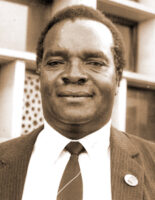
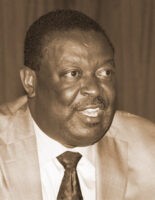
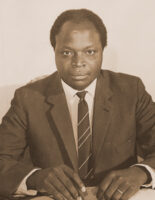
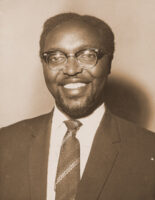
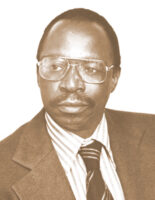
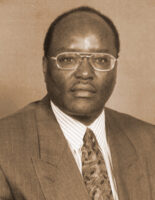
Ojwang’ K’Ombudo – Going against the grain

Ojwang’ K’Ombudo, an erstwhile Member of Parliament for Nyakach, worked for a relatively brief period in the Cabinet of President Daniel arap Moi. The fiery MP served for several months during a turbulent time in the country’s history as Moi, who doubled as Chairman of the ruling party, KANU, gave in to pressure from the Opposition, civil society and Western powers to introduce a multiparty political system in the country in 1990.

By then K’Ombudo, the Assistant Minister for Environment, had landed the coveted position after his friend and neighbour in Kisumu District (now Kisumu County), Mathews Onyango Midika, joined his fellow Luos in the Cabinet who defected en masse to the FORD-Kenya party, the Opposition party founded by Kenyatta-era Vice President, Jaramogi Oginga Odinga.

K’Ombudo was one of the longest-serving MPs for Nyakach and in Nyanza region, having retained his seat a record six  consecutive terms from 1969 to 1992. Among his supporters, the no-nonsense MP was popularly referred to using the symbolic lantern he had adopted as his campaign symbol. They described him as “K’Ombudo taya, chiel wiye oke (a brave man who cannot be scared)”.

Consequently, the presidential appointment to the Cabinet turned out to be rather awkward.

The Nyakach MP was informed of the best news in his political career, announced during the State-run Kenya Broadcasting Corporation (KBC) radio news bulletin, four days after the fact by his secretary on his return from an overseas trip.

K’Ombudo said, “I did not know of my appointment until I arrived back at the Jomo Kenyatta International Airport from a UN trip to Montreal, Canada. I was met at the airport by four armed bodyguards and an official Government Mercedes Benz with a flag flying on it.”

None of the guards spoke to him about his appointment until he arrived at his Kencom House office where his secretary broke the sweet news to him. She told him that they were moving to the Kenyatta International Conference Centre as he had been appointed Minister for Regional Development. She also informed K’Ombudo that the President had summoned him for a meeting at State House Nairobi that afternoon, when he was scheduled to be sworn in. K’Ombudo said he tried to have the ceremony postponed so that his wife could attend but the State House Comptroller would not hear of it. In fact, he was expected to travel to Japan the next day to finalise the funding of the Sondu-Miriu hydroelectric power project.

According to K’Ombudo, who once had a short stint as a primary school teacher in Molo, Nakuru District (now Nakuru County), he ended up in the Cabinet by default. This was after the heavyweights in Luoland like Peter Oloo Aringo (Alego Usonga MP) and Midika (MP for Muhoroni) resigned and joined the Opposition in protest following the mysterious kidnapping and death of their friend and Minister for Foreign Affairs, Robert John Ouko, at his Koru home in Muhoroni Constituency in February 1990.

“President Moi called me; by then I was an Assistant Minister for Environment and I had just been elected at the World Summit in Geneva, Switzerland, as Chairman of the Ozone Layer Protection Committee, with an office in Toronto in Canada, where I had called an international meeting,” he said.

The Kenyan Government delegation was to be headed by Minister for Environment Dr Njoroge Mungai. K’Ombudo’s plane ticket and accommodation were to be paid for by the United Nation Environment Programme (UNEP) from its Nairobi office.

In those days, it was a requirement that all senior Government officials, including MPs, get written clearance to travel from the President through the Secretary to the Cabinet, Prof Philip Mbithi. But the Nyakach MP’s name was missing from the list of the Kenyan delegation because he was under the UN team as Chairman of the Summit. When K’Ombudo enquired about the omission, Mbithi called him to his office and informed him that the President had rejected his application to be allowed to leave the country for the UN meeting, of which he was the convener.

“Prof Mbithi told me he had explained that to Moi, but he still refused to clear me for the trip. Moi instead asked that I meet him at State House Nairobi at 7am,” said K’Ombudo. During the tense meeting, the President did not mince his words; he asked the Nyakach MP point blank whether he was also intending to join his Luo Nyanza colleagues in abandoning KANU and his government.

“I said, ‘No, I will not do so. I will defend my Nyakach seat on a KANU ticket because the projects I initiated have been supported by your government; the Sondu-Miriu hydroelectric power project and the Nyakach water projects are more important to me’,” K’Ombudo recalled.

In response, Moi said if that was the case, he should “… take this form and go to Canada for three to four days and return to Kenya”. On his return four days later, the assistant minister discovered he had been elevated to the Cabinet to replace Midika. He was later allocated a spacious Government house among other benefits.

Looking back, K’Ombudo recalled that after his Montreal trip, his friendship and ties with Moi were strengthened. “He treated me with lots of honour and dignity. I was now an insider and I was accepted by the likes of Chief Secretary Simeon Nyachae among others. But this gesture hardened my people’s loathing for me,” he revealed.

After his swearing-in ceremony, he was hosted for lunch by President Moi, who told him, “I am happy with you for choosing development politics over pure politics.” They continued to talk about politics generally over the sumptuous meal as Moi expressed regret that Luos had abandoned him and KANU, and that no one would push development projects in the Government for them.

“I also found out that the Sondu-Miriu project had been transferred from the Minister for Energy, Nicholas Biwott, to my docket!” he recalled.

K’Ombudo’s Nyanza parliamentary colleagues branded him a traitor and kept their distance from him. They used election campaign platforms to criticise him for going against the grain in the Opposition zone. Moi kept him close by, using him as his point man in Kisumu and Nyanza as a whole by holding fund-raisers, political rallies and other public events with him at the forefront to popularise KANU. The Nyakach MP lasted barely a year in the Cabinet, as the country was deep in campaign mode.

“During one of the meetings on his way to Karachuonyo, Moi campaigned for me, saying I was an industrious and development-conscious leader who deserved to be re-elected to complete the development projects I had started,” said K’Ombudo.

Plans were also underway to dam the Sondu-Miriu river jam at Magwaga, to be used to irrigate parts of Kisii and Kisumu districts to create wealth, jobs and business opportunities.

“But when the polls were held, I lost heavily to trade unionist Dennis Akumu, who did not have as many resources as my party KANU had, but who was a member of the party of choice, FORD-Kenya,” said K’Ombudo.

The irony was that shortly after the elections, Akumu approached him to request his support saying, “I know you still have good relations with Moi.”

“But I reminded him, ‘You are the MP, get on with the job!’”

Later, during a tour of Kisumu, the President met with KANU leaders like K’Ombudo, who requested him to sub-divide West Nyakach Location. He agreed and acted on the spot. Thereafter, Moi appointed K’Ombudo Chairman of the Lake Basin Development Authority (LBDA) where he worked for two years and initiated the Yala Swamp irrigation farm project – later taken over by the US-owned Dominion Farms Ltd – as well as a massive borehole project in the lake region.

The 82-year-old former Minister, who at one point was also the Kisumu Town Clerk, is a father of six and a businessman, a large-scale cane farmer in Muhoroni, and a prominent hotelier in Kisumu. His best memories of his time in the Cabinet are the free hand Moi gave him to promote the Sondu-Miriu and the water projects.

K’Ombudo’s lowest moment in the Cabinet came during the 1992 General Election, when tension had built up and it was obvious that no Luo politician in KANU would be elected.

“There were comments during our Cabinet meetings that unless our views changed, it would be hard to be in Government. It was a fact that has continued to date.”

K’Ombudo attended Ndori Primary School in his village before proceeding to Nyakach Secondary School and then St Peter’s in Mumias, Kakamega District, where he trained as a P3 teacher. He was transferred to Nyabondo in Nyakach in 1952 and taught for a year before moving to Nakuru as an education officer. He shared a house with Luo colleagues, one of whom was married to the sister-in-law of trade unionist and politician, Tom Mboya.

K’Ombudo said, “I admired and made friends with Mboya, and when he started the famous air lifts to the United States for bright Kenyan students who wanted to further their eduction, I approached him and asked him to help me.”

Because of his desire to meet with Mboya, he regularly attended his political rallies held by the Nairobi People’s Convention Party (NPCP) that Mboya founded, at the historic Makadara Hall off Jogoo Road in Nairobi.

“Tom inspired me and helped me to go to the US in the first air lift of Kenyan students; I was in the same group as Barack Obama Sr, the father of former US President Barack Obama,” he revealed.

In the US K’Ombudo attended Missouri University for one year and transferred to Fairley Dickinson University in New Jersey from where he graduated with a degree in economics. He later got a US scholarship to study for his master’s degree in economics at the University of Southern California. On graduating, he decided to “… dodge the Education Attaché at the Kenyan Embassy, Seth Adagala, and his team”, who were recruiting Kenyans and helping them return home to take up managerial jobs.

On graduating in 1964, he returned to Kenya with his wife and was employed as a lecturer at the Kenya Institute of Administration (since renamed Kenya School of Government) for two years before he moved to the Industrial Credit Development Corporation as a loans officer, initially in Nairobi and later in his home town, Kisumu. He successfully applied for the job of Town Clerk after James Miruka Owuor resigned to set up his own law firm. K’Ombudo worked in this capacity until 1979, when he decided to venture into the murky waters of politics by vying for the Nyakach parliamentary seat, which he won.

Asked what inspired him to go into politics, the former Minister said it was after a tour of Hoover Dam on the Colorado River in the US, where he saw the potential of a massive irrigation scheme and a hydroelectric project dammed from a big river, like Sondu-Miriu in his constituency.

“From then on, I always had in mind that one day, if I ever had a chance to influence a similar project in Nyakach, it would be a wonderful project,” said K’Ombudo. And when the opportunity arose in 1980, while he was serving his first term in the august House, K’Ombudo moved a motion calling for the construction of the ambitious multi-billion shilling Sondu-Miriu hydroelectric project.

He served three five-year terms as MP before running into problems with KANU and some of its top brass, who blacklisted him as an Odinga sympathiser. Others on the blacklist included Karachuonyo MP Phoebe Asiyo and Muhoroni MP Midika. His neighbour, Samuel Ayodo, MP for Kasipul-Kabondo, was an independent and was considered neutral as he preferred to sit on the fence saying, “Ling ber!” (It’s better to be quiet!) in protest after Moi refused to appoint him in his first Cabinet in 1978.

“Despite the low salary of KES 4,000 per month compared to the KES 8,000 I earned as a town clerk, I opted to represent my people because Nyakach was seriously backward,” he said. “It was also because these were the same people who had raised funds to enable me to travel and study in the US. The fund raiser was presided over by Odinga and the managing director of Miwani Sugar Factory.”

K’Ombudo was the first resident of Nyakach to ever travel abroad for higher education. Looking back, the former MP is proud that more than two decades since he lost his seat, no one has surpassed his development record.

“Now the Sondu-Miriu Hydroelectric Power Station is up and running and serving the entire western Kenya with electricity, thanks to my efforts,” he said.

K’Ombudo deliberately used the name Sondu-Miriu to get the support and votes of Rift Valley MPs in addition to those in Nyanza who easily embraced it. “I had used serious politicians from Nyanza and the Rift Valley in Parliament after the House approved my motion. I later went and personally talked to President Moi to embrace this project. He then instructed Nicholas Biwott, the Energy Minister in the Office of the President, to prioritise it.”

But the Nyakach MP would later be shocked to learn that his pet project had been allocated a token budget while the Turkwel Gorge hydroelectric project in Biwott’s Rift Valley backyard was apportioned the lion’s share and was implemented immediately. That caused a huge uproar in the House as MPs took the Government to task over the blatant discrimination and marginalisation of Nyanza region. Sondu-Miriu was given priority in the next budget.

At the time K’Ombudo was first elected in 1969, there were only three public secondary schools in his constituency: Nyakach, Rae Girls and Nyakach Girls. By the time he was leaving there were 40 secondary schools built through funds drives. The schools were later taken over by the Ministry of Education.

His fondest memory of his tenure in Parliament was when he removed his shoe, banged it on the table and hurled it at the Speaker of the National Assembly, Prof Jonathan N’geno. This was during the height of multiparty politics, when tribal and ethnic violence erupted along the Kericho-Kisumu border.

An angry K’Ombudo said, “I have been forced to attend more than 14 funerals of my people in one day because of these clashes and I am not ready to see my people being killed like rats! We are now ready to prepare for total war!”

This incident made K’Ombudo a household name throughout the nation. Moi was away on an official trip in Geneva, Switzerland, when it happened, and K’Ombudo’s intention was that the Head of State should get the message loud and clear that Kenya was on the brink of civil war.

The Nyakach MP was immediately arrested after his threats and thrown into the bunker cells of Parliament Buildings where he was kept locked up for over 10 hours until the President called from Geneva and ordered his release. Moi was concerned because K’Ombudo’s utterances and arrest had given the country a bad name locally and internationally. The President then directed the Nyanza and Rift Valley provincial commissioners to send the police to stop the clashes forthwith.

“When Moi returned, he called me and dispatched police officers, not to arrest me, but to take me to his Kabarak home from my Kisumu residence at 8pm, two days after my release. But I dodged them by pretending that I was going to my bedroom to change, only to escape through the kitchen and jump over the fence to my neighbour, Joel Omino’s house from where I fled.”

The next day he presented himself at Kabarak in the company of 120 constituents in four matatus, but the guards at the gate barred them from entering, saying only the MP was expected. State House Comptroller Abraham Kiptanui had to intervene to allow the delegation to enter and meet the Head of State.

“Moi received us and fed us well; he then spoke to me in the presence of my supporters, assuring us of security and asking us to maintain peace as his government was handling the matter,” he recalled.

Asked what his wish would be if he had a chance to turn back the clock, the veteran politician replied, “I don’t see such a prospect because of my age; I have no strength to mount a political campaign. My advice to my Luo people is that they can differ as much as they like with the national government under the 2010 Constitution, but their elected representatives should not stop looking for development from the national government. Even during our time we had differences with the Government, but we still pushed for projects like Sondu-Miriu among others.”
Ngenye Kariuki – The stockbroker who would be king

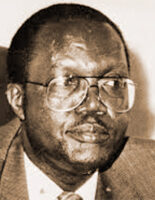
Stockbroker Ngenye Kariuki was elected Member of Parliament for Kiharu in 1997 on a Safina party ticket. He was among the Opposition politicians who were vocal critics of President Daniel arap  Moi’s regime, but in the twilight days of the administration he shifted his support to the ‘Uhuru for President’ campaign and accepted a Cabinet position.

Kariuki was Minister for Vocational Training for a few months from August to December, pending the 2002 General Election. Asked to comment on Kariuki’s appointment to the Cabinet when he was a member of an Opposition party, Paul Muite, the Safina party leader, said it was his (Kariuki’s) choice.

Kariuki defended his decision to take up the appointament, claiming that he was ‘assisting’ in the transition from Moi to another regime, after senior Kikuyu community leaders had rejected Moi’s invitation to participate in the transition process. This invitation had apparently, according to Kariuki, been extended in 2001.

“I’m sure you have been asking why I took up President Moi’s offer of a Cabinet post. I wish to tell you now that the President had earlier approached a group of senior leaders from our community and asked that they work together. But they turned him down,” the Minister told his constituents in September 2002, a month after his appointment.

The Kiharu MP further explained, “… a group of us younger MPs felt let down by our leaders and decided we were going to fill the gap. Uhuru Kenyatta told us at the time that the President was interested in entering into negotiations with leaders from the Kikuyu community.”

Kariuki claimed that six MPs from Central Province were involved in the October 2001 meeting with the President, but apart from Gatanga MP David Murathe, a close associate of Kenyatta, and Stephen Ndichu (representing Juja), Kariuki did not name the other leaders.

It was clear that Kariuki was playing a major role in Moi’s ‘Uhuru for President’ project when, immediately after his appointment, he started holding high-level consultative meetings with other KANU leaders, especially those from central Kenya. One such meeting held in August 2002 was in his office and attended by fellow Minister Isaac Ruto, KANU Deputy Treasurer Peter Kuguru, Assistant Minister Nduati Kariuki and Opposition MPs Murathe and David Manyara of Nakuru Town, among others.

Kariuki’s interest in politics started during his school years at a time when he greatly admired his MP and Kenya’s first PhD holder, Julius Kiano.

“I admired his style of politics in the 1950s and 1960s. He fascinated me with his politics and leadership generally,” he remarked.

Following in his role model’s footsteps, Kariuki was appointed a prefect in primary school, head boy at Njiri’s High School and a member of the Students’ Organisation of Nairobi University leadership. While studying at the university he met other future politicians, including Chris Okemo, Njehu Gatabaki and Onesmus Mwangi. He would later be involved in the political campaigns of Kiano, Nduati Kariuki, G.G. Kariuki and Kenneth Matiba.

“I have been a king-maker and I have enjoyed it, until the people of Kiharu came to me in 1997 and insisted I become the king,” he quipped in 2002.

The principal shareholder and managing director of Ngenye Kariuki & Company Ltd, a stockbroking firm, would also rise to become Chairman of the Nairobi Stock Exchange between 1979 and 1980, and again between 1983 and 1992.

“My father was a businessman in Murang’a and he influenced the choice of my degree course (Bachelor of Commerce).” However, despite his efforts to operate small retail businesses in the interior and later in Murang’a Town, Kariuki’s father could not adequately support his eight children and at one stage he had to sell his land to take the children through school.

“I then decided I would be a better businessman than my father, but for me to do that I had to gain experience through the exposure of employment by reputable firms,” he explained. Kariuki worked for such giants as Barclays Bank, Family Planning Association of Kenya and the Central Bank of Kenya.

His entrepreneurial skills were evident from early on. He started by building networks in Murang’a Town, where his father had moved his retail business.

“It was in primary school when I started washing cars for a fee and I made contact with wealthy Asian families, including the ones who own the Sarit Centre in Westlands (in Nairobi). When I was not washing their cars, I did other odd jobs for them,” he recalled.

This gave him financial independence as well as the power to lend and give to others. “I would pay my school fees and buy myself clothes and then put aside what was left in a tin. Opening the tin (which was equivalent to going to the Post Office bank) and handing over money to my brothers and sisters, who would come to borrow, was a ritual. It made me very proud and want to work even harder. Even now, it feels good to give, but you must have enough in the first place to be able to give.”

Kariuki enjoyed the political game while it lasted and in 2002 he was quoted as saying, “Politics is very exciting. No single day in politics is like another. There are daily challenges; you open a new chapter and people call you names. That excitement keeps you alive and that is why politicians live long.”

Kariuki would be a member of the Cabinet for just five months as the December 2002 elections saw the dumping of KANU into the political dustbin following Uhuru Kenyatta’s loss to the Opposition’s National Rainbow Coalition (NARC) candidate, Mwai Kibaki. Kembi Gitura, a lawyer who was also riding on the NARC wave, defeated Kariuki to win the Kiharu parliamentary seat.

In 2012, Kariuki unsuccessfully tried to contest the same seat via The National Alliance (TNA) party but was defeated at the nomination level by a youthful lawyer named Irungu Kang’ata. Before the party nominations, Kariuki was quoted as saying that his experience in the Cabinet would help him win the seat. But this was not to be and when he lost to Kang’ata, he faded into political oblivion, burying himself in his brokerage firm.

In 2010, his firm was placed under statutory management for failing to comply with market rules, becoming the fourth company to face a similar fate. According to the Capital Markets Authority (CMA), Ngenye Kariuki & Company Ltd had for some time failed to comply with the legal and regulatory provisions as outlined in the CMA Act.

“While efforts have been made to restructure the company, these have not borne significant fruit and as a result, no significant progress has been made,” said CMA Chief Executive Stella Kilonzo at the time.

The statutory management order was revoked in December 2011, following which the firm recruited a new CEO and constituted a new board of five directors, of whom three were independent, in compliance with one of the conditions tabled by CMA in January 2012.

Kariuki was born in 1945 in what was then Murang’a District (today known as Murang’a County). After university, he rose through the ranks in the accounting profession to become General Manager of Dyer & Blair between 1979 and 1980. In the 1980s, Kariuki also worked as a member of the Court Brokers Licensing Board, the Nairobi City Commission and as Deputy Chairman of the Murang’a College of Technology.

Wilson Ndolo Ayah – The politician media described as refined


Wilson Ndolo Ayah’s political fortunes took a turn for the better when President Daniel arap Moi appointed him Minister for Research, Science and Technology. The story surrounding this promotion is worth re-telling. It all began on a certain day in August 1987.

Ayah had been unwell and was resting at home when the change came: the State broadcaster, Voice of Kenya (since renamed Kenya Broadcasting Corporation), announced in its 1 o’clock news bulletin that he had been appointed to the Cabinet. And the rest is history, so to speak.

This development was a godsend. He had been appointed Assistant Minister for Finance barely three months earlier. The burden of helping Moi fix the country’s financial and monetary equation had been overwhelming. Now, as a full Minister, his work appeared cut out for him.

The appointment appeared to be the result of some political problems that the former Minister, William Odongo Omamo, faced which had resulted in his sacking. This left the Cabinet position vacant: Omamo’s loss was Ayah’s gain. When Moi appointed and relieved ministers of their duties, he usually replaced them with someone from the same ethnic community. This was called tribal balancing.

Ayah subsequently worked in several ministries, including Transport and Communication, Foreign Affairs, Research, Science and Technology, and Water and Irrigation. Interestingly, it appeared that he was moved whenever the incumbent was fired. He also served as KANU National Chairman for four years from 1992.

Born on 29 April 1932 in Kitambo, West Seme Location, Kisumu District, Ayah went to Ramba Primary School before joining Maseno School. He was later admitted to Uganda’s Makerere University (then the most prestigious university in East Africa), graduating with a Bachelor of Arts degree before proceeding to the University of Wisconsin-Madison in the United States for a Master of Science in Rural Economics/Sociology.

Soon after his return to Kenya, he joined Sterling Products as the marketing research manager until 1969 when he joined politics and was elected MP for Kisumu Rural Constituency. As soon as he entered Parliament, Ayah became Chairman of the Public Accounts Committee, the most powerful oversight committee in Kenya’s Parliament; it scrutinises public expenditure.

However, Ayah lost the next two elections — in 1974 and in 1979 — only returning to Parliament in 1983 as MP for the neighbouring Kisumu Town Constituency.  In the 1988 General Election, Ayah again became the MP for Kisumu Rural, switching constituencies with Dr Robert Ouko, who became the MP for Kisumu Town Constituency. Only two years after appointing Ayah to the Cabinet, Moi moved him to the Ministry of Water Development. Not long after this he became the Minister for Foreign Affairs and International Cooperation, following the death of Ouko in February 1990.

This was a powerful position. As the country’s chief envoy Ayah had to oversee Kenya’s external image by ensuring that the nation enjoyed goodwill in the international community. Apart from taking charge of Kenya’s embassies abroad, he also made sure that Kenya honoured its international obligations such as treaties.

The period 1990 to 1993 was momentous for Kenya with the push for transformation from single-party politics to multipartism. Like other Africans elsewhere, Kenyans were clamouring for the return of multiparty democracy. Europe and America were in support of this, especially the US which, through its ambassador in Kenya, Smith Hempstone, practically supported the emerging Opposition.

For example, in May 1990 Hempstone informed Kenyan authorities that US economic assistance would be available only to those nations that supported democratic institutions, defended human rights and embraced multipartism. In response, Ayah labelled the ambassador a racist, accusing him of having a slave-master mentality.

But Hempstone remained unfazed and with support from his German colleague, Bernd Mutzelburg (German ambassador to Kenya from 1991 to 1995), would sometimes rope in other foreign diplomats to increase the pressure on Moi’s government to be more open, transparent and accountable, and to institute the much-needed democratic reforms.

The 1992 elections marked a turning point. For the first time in decades, Kenyans chose leaders from multiple political parties. Political pluralism had been reintroduced the previous year following the repeal of Section 2A of the Constitution that had declared Kenya a de facto one-party State. Moi, and by extension the ruling party, therefore expected Ayah to woo Luo Nyanza back to KANU.

At the time, the Luo ethnic community, then the third most populous in the country, was firmly in the Opposition under the leadership of Jaramogi Oginga Odinga, and later his son, Raila Amolo Odinga. Therefore, Ayah and all the other KANU MPs from Luo Nyanza were unable to retain their parliamentary seats because of the change in the political landscape. This loss marked the end of his political influence in the region. However, he remained in KANU even though the party had become unpopular in his backyard.

In the ensuing Cabinet appointments after the elections, Ayah was replaced by Kalonzo Musyoka; KANU did not nominate him to Parliament. However, he was elected KANU National Chairman after the previous holder, Oloo Aringo, left KANU for the Forum for the Restoration of Democracy (FORD)-Kenya party in 1992. But he faced legitimacy questions: “… to begin with, he is the only top official in the ruling party who rose to the post without facing an election … Secondly Ayah has to contend with the fact that he serves in a party that enjoys little support from his backyard of Luo Nyanza,” The Weekly Review news magazine reported on 5 May 1995.

Ayah played second fiddle to Moi (who also served as party President) in KANU and to the then influential Cabinet Minister, Nicholas Biwott. Ayah would face all the flak levelled against the ruling party but could not influence its decisions. “In fact, some of the more stubborn KANU supporters have had little time for Ayah, and view him as a man who has hardly any business occupying the post of chairman in the party,” said The Weekly Review in May 1995.

Civil servants, among them provincial commissioners, also appeared to dismiss the KANU chairman. Indeed, Nyanza PC Joseph Kaguthi differed with the political leadership on the best strategy to win the region back to KANU. The party’s Kisumu Branch officials felt the PC was undermining their boss. Ayah, ever the suave gentleman, took it all in his stride, leading the media to describe him as a refined politician; a gentleman.

Unable to convince his community to join KANU, he became an advocate for political defections. He switched to persuading Opposition MPs to join the ruling party, despite a public outcry about the high rate of political defections from the Opposition ranks. Ayah said it was absurd for a party not to lure political rivals. He even asked rival parties to cooperate with KANU to achieve collective voting on key issues.

In 1996, Ayah was again appointed to the Cabinet to replace Dalmas Otieno, who had been sacked as Minister for Transport and Communication for criticising a Government decision to abolish the sugar import ban. Otieno argued that imported sugar would kill local production, a position that ran contrary to the Presidential directive.

Ayah hit the ground running. His first order of business was to deal with the road carnage that was claiming many lives. He ordered that speed governors be installed in all passenger vehicles that could seat seven passengers and above, and in all commercial vehicles with a tare weight of over three tonnes. He also had to defuse a row involving Kenya Airways (KQ) and Aero Zambia over flight schedules and landing rights. Zambia was uncomfortable with the KQ approach to business. Ayah led the delegation to Zambia to resolve the issue. His tenure was also marked by a strike by air traffic controllers over working conditions.

Ayah’s other achievements included launching a policy paper in 1997 to help regulate the Kenya Posts and Telecommunication Corporation (KPTC). He noted that the market place was changing and new technologies were being developed that were shaping the communication sector on a global scale. A year later, the Kenya Roads Bill was drafted to create an autonomous body to manage, regulate and control the road transport sector. It became the Kenya Roads Act 1999 after sailing through Parliament.

Towards the tail end of Moi’s leadership, the Opposition increased its calls for political reforms. To mitigate against potential division in the country, Ayah opened his party to dialogue with the Opposition on matters of constitutional reforms. This set the stage for the cooperation between KANU and the National Development Party of Raila Odinga, resulting in Odinga joining Moi’s Cabinet.

Ayah can therefore be credited with playing a role in bringing democracy to the country.

After retiring from active politics, he served as the founding chairman of Safaricom, the giant mobile communications company. The firm has grown to become among the most profitable mobile communication companies in East and Central Africa. He also served as chairperson of the KPTC Board. Ayah died at the age of 84 years in March 2016.

Nahashon Kanyi Waithaka, A stalwart KANU supporter

Nahashon Kanyi Waithaka was an influential figure, especially in the 1970s and early 1980s when he was mayor in his home town of Nyeri, the administrative headquarters of Central Province. President Daniel arap Moi appointed Waithaka to the powerful post of Minister of State in charge of Internal Security in late 1991 after transferring him from the Ministry of Information and Broadcasting. This is how the once high-flying Mayor of Nyeri became a national figure.

At home, however, his elevation to the Cabinet did not amuse the locals.

Pluralism had just been re-introduced after a period of political turbulence that resulted in the arrest and detention of multiparty crusaders Kenneth Matiba, Charles Rubia, George Anyona and Mukaru Ng’ang’a among others.

Mwai Kibaki, who had been dropped as the country’s Vice President after the infamous 1988 mlolongo (queue) system of elections, had left the Government to form the Democratic Party (DP). Since he was seen as the de facto leader in Nyeri and the neighbouring districts of Kirinyaga, Embu and Meru, the likes of Waithaka and others who were fervent supporters of the ruling party KANU were viewed as non-conformists in their respective communities.

Born in 1936 in Tetu, Nyeri District, Waithaka trained as a primary school teacher and taught at Kaigonde Primary School in Tetu. He rose to become headmaster at the school but resigned to join the Kenya Prisons as a correction officer in 1968. Prior to joining Kenya Prisons, he had successfully sat for his Cambridge School Certificate (O’ level) as a private candidate, qualifying to become a P1 teacher.

Teachers were being encouraged to diversify and take advantage of vacant positions in the public service where there were better chances of promotion. Those who joined the Ministry of Home Affairs as correction officers did not, however, last long due to what they cited as frustration from their seniors, who seemingly felt threatened by the young professionals being offered every opportunity to rise to the top. Most of the warders in senior positions were primary school drop-outs, and therefore those with Form Four certificates and professional qualifications like teachers were more likely to be promoted.

This explains why Waithaka and many other teachers who had secured senior positions in the Prisons Department resigned. There were still other opportunities for the young officer, who was still in his 30s, but Waithaka chose to leave. He established his own trading company in Nyeri, which mainly dealt in farm inputs and animal feeds.

An ambitious young man who had made a name for himself as a local leader and mobiliser, he joined civic politics in 1974 and was elected to represent Mount Kenya Ward in the Nyeri Municipal Council. Having been a head teacher and a prisons officer, not many councillors could match his experience and so he easily won the mayoral seat to become one of the most influential leaders in Nyeri. These were Waithaka’s heydays; he was among very few people who owned a palatial home and a Range Rover vehicle among other property.

As fate would have it, his business started facing financial difficulties. While establishing his trading company, the young Waithaka had secured huge loans using title deeds from trusting friends and relatives. He moved from wholesale trading to construction and established Kanyi Waithaka Builders, which was awarded a Government contract to expand a hospital in 1980. On completion, however, the Government failed to pay him, claiming that the work was not completed. Banks engaged auctioneers to recover their money and many of his properties were auctioned off.

The following year there was a by-election in the larger Nyeri Constituency occasioned by the imprisonment of the incumbent MP, Waruru Kanja. At the time, the powerful Minister for Constitutional Affairs, Charles Njonjo, was using his position and influence to undermine Kibaki by fronting a strong opponent for the Nyeri seat. His first choice was Peter Ndirangu Nderi, who unfortunately died just a few days after the seat fell vacant. His next option was Waithaka, who lost at the polls.

Njonjo did not, however, abandon him. Come the following year he was appointed Chairman of the Agricultural Finance Corporation, a position he held for one year. When Njonjo was fired from the Cabinet, all his allies, including Waithaka, became collateral casualties and were similarly relieved of their duties.

Between 1982 and 1988, Waithaka had no involvement in politics. His redemption came during the 1988 General Election. By then, Moi had reconciled with him and picked him to contest the newly-created Tetu Constituency seat carved out of the larger Nyeri alongside Nyeri Town and Kieni during the boundaries review exercise.

Once in Parliament, Waithaka, initially a backbencher, found himself in the Cabinet after Kanja lost both his Cabinet position and his parliamentary seat. The following year (October 1991), he was transferred to the powerful Internal Security docket.

Kibaki resigned from Government after renouncing KANU in the same year. He founded DP after the repeal of Section 2A of the old Constitution, which then allowed for the existence of more than one political party. This changed the political landscape in the entire country, including Nyeri where Waithaka and his other pro-Moi MPs were shunned by the electorate.

While serving as a Minister of State, his case against the Government and the Attorney General over non-payment of his dues from the hospital expansion project was concluded. Justice Gideon Mbito awarded him KES 13.9 million in January 1992 as reported by the Daily Nation of 21 August 1992. The Minister demanded a further KES 70 million accrued interest, which was reportedly never paid.

To demonstrate his loyalty to Moi and the ruling party, the politician was not averse to making use of every available opportunity to ruffle the feathers of local leaders. On one occasion he was quoted in the Daily Nation of 8 May 1991 likening controversial Presbyterian Church of East Africa (PCEA) cleric, Reverend Dr Timothy Njoya, to Jim Jones, an American religious cult leader.

Waithaka said, “… he’s no different from the cult leader who influenced his followers in Guyana, South America, to take poison because God was waiting for them in heaven… They all died and never reached there.” Waithaka warned that the same fate would befall those who followed Njoya.

A critic of the KANU regime, Njoya commanded respect among Christian faithful. At the height of his campaign of criticism against the Moi government, he was transferred to Tumutumu Presbytery in Nyeri from St Andrew’s Church in the heart of Nairobi.

Waithaka’s greatest test came when ethnic clashes broke out in Rift Valley Province while he was at the helm of the Ministry of Internal Security. The clashes mainly affected the Kikuyu community, which blamed him for not protecting them against the onslaught. Then came 1992, the year the first multiparty General Election was held. Nyeri became very hostile towards him and his pro-KANU colleagues. At political rallies the MP could not explain his decision to remain in KANU while members of his community were being killed and displaced from their farms in the Rift Valley. It was a turning point in his political career when his friends in the village deserted him and boycotted his campaign meetings.

Religious leaders led voters in Tetu Constituency in condemning Waithaka, accusing him of being used by the KANU regime to eliminate members of his own community. His first wife, Agnes Gathoni, was forced out of her position as a leader of the Women’s Guild in Gititu PCEA Church following constant condemnation by the clergy for supporting her husband.

During one of his campaign rallies, an agitated Waithaka told a gathering to “… feel free to vote for a presidential candidate of your choice as long as you re-elect me as your MP”. This drew the wrath of Moi, who was facing opposition from Kibaki, Matiba of the FORD-Asili party and FORD-Kenya’s Jaramogi Oginga Odinga. The President immediately withdrew support for his Minister, including his security detail. Waithaka eventually lost his seat to Joseph Gethenji Marekia from Kibaki’s DP team.

Many remember Waithaka as being a stalwart KANU supporter. He was asked on several occasions to abandon KANU but he continued to stand with his party even when it became detrimental to him.

Upon his exit from politics, the old debt problem reared its ugly head again. Waithaka left his Nyeri home and went to live with his second wife, Ann Nyambura, who had started an evangelistic ministry in Nairobi. The two lived on a farm owned by the former Minister in Ngong Town. They are among a group of Christians who established the Chrisco Church in Nairobi.

In 1994, he relocated to the US with his wife and only came back when she was contesting a parliamentary seat in Tetu Constituency. By the time of his death in July 2017, young politicians where routinely seeking him out as an adviser.

Wycliffe Musalia Mudavadi – His performance gained him national recognition

Wycliffe Musalia Mudavadi joined politics in 1989 after the death of his father, Moses Mudavadi. He won the parliamentary seat vacated by his father, becoming the Member of Parliament for Sabatia Constituency.

He is credited with saving the country from runaway inflation and resumption of aid when he became Minister for Finance after the 1992 multiparty elections. Mudavadi was the seventh and last Vice President of Kenya – appointed three months before the 2002 General Election after Vice President George Saitoti left KANU for the Opposition.

Within KANU the soft-spoken politician came across as more refined and youthful than the older members of the party. He preferred to concentrate on his Cabinet docket and rarely held public rallies like his party colleagues.

As soon as Mudavadi won the by-election, Moi appointed him Minister for Marketing, making him the youngest Kenyan ever to join the Cabinet. He introduced reforms in cereals procurement and marketing, and the National Cereals and Produce Board (NCPB) was reformed to accept maize only from Kenyan farmers, cutting out cartels that used to import the commodity and “dump it” on NCPB.

He became Kenya’s fifth Minister for Finance after the 1992 General Election and moved to the Ministry of Agriculture after the 1997 elections. From there he was transferred to Transport and then named Vice President. Mudavadi’s performance in all the ministries gave him national appeal and the experience required to run Government.

When he took over the Finance docket in 1993, the economy was in tatters. There was excess money circulating in the country and the Government had borrowed too much from the local market. The Government had also printed money to use for the election campaigns the previous year, causing hyperinflation. The prices of food and other essential commodities skyrocketed.

The country did not have enough money left for individual and business borrowing, precipitating a sharp rise in bank interest rates – as high as 45 per cent in some banks. Mudavadi admitted to Parliament that the Government had printed more money than the country needed during the 1992 elections. The Opposition praised him for his boldness.

At Treasury, the Minister began to mop up the currency in circulation. This move won him admiration from the Opposition and the international community. His work was made easier by the appointment of Micah Cheserem, a no-nonsense technocrat, as Governor of the Central Bank of Kenya.

Mudavadi oversaw privatisation of local State corporations, won back donor confidence to resume foreign aid and established a strong banking industry. He also resisted pressure to honour payments for contracts the Government had signed. He received support for this move from Cheserem and from a former Cabinet colleague, Simeon Nyachae, who argued the Government would collapse if that money was paid.

Things came to a head when the Public Accounts Committee, under the chairmanship of Forum for the Restoration of Democracy (FORD)-Kenya leader Michael Wamalwa, presented a report to Parliament in 1995 recommending that a contract for export compensation for diamonds and gold — filed by Kamlesh Pattni on behalf of Goldenberg International — be paid since it had been approved by Parliament. The claim was for KES 1.2 billion, a monumental sum that would have effectively crippled the budget.

Mudavadi successfully lobbied for support from MPs to oppose payment and to vote to delete the paragraph from the report, thereby saving the Government.

During his time in Agriculture he faced challenges from the ailing sugar industry over illegal imports, late payments for milk and cereals produce, and delayed bonus payments for coffee and tea farmers. He tackled these issues with help from the ministry’s Permanent Secretary, Shem Migot Adhola, who was part of the so-called ‘dream team’ that had been formed to repair the economy. They got off to a good start in dealing with the problems but did not manage to complete the task before they left the ministry.

In 1998 the President named the Cabinet but made the job of Leader of Government Business in Parliament, traditionally occupied by the Vice President, rotational. Mudavadi was the first to be appointed to the position in 2002. Although his time as VP was too short for him to leave a mark, two notable things happened during his tenure.

First, soon after his appointment there was a terrorist attack at a hotel in Kikambala on the Kenyan coast. Mudavadi promptly travelled to the area to assess the situation.

Second, Ugenya MP James Orengo moved a motion of no-confidence against the Government. He enumerated several alleged corrupt dealings within the Government. Orengo summarised his motion by saying that a corrupt government did not deserve to be in office.

Mudavadi defended the Government, saying there was no evidence of the claims and that it was unfair to subject Kenyans to another election. He successfully lobbied MPs to vote against the motion.

Mudavadi was born in 1961 and attended high school at the Nairobi School. He was a Member of Parliament under Moi from 1989 to 2002, the year he lost the Sabatia seat to Moses Akaranga. He stayed out of Parliament until 2007. He was Deputy Prime Minister and Minister for Local Government under the Mwai Kibaki-Raila Odinga coalition government from 2008 to 2012, the year he ran for President.

Mwai Kibaki – The gentleman politician

When President Jomo Kenyatta died in 1978, Mwai Kibaki was his long-serving Minister for Finance. Once Vice President Daniel arap Moi took over and constituted his Cabinet in October the same year, he retained Kibaki in the Finance docket and elevated him to the vice presidency.

At the height of the ‘Change the Constitution’ clamour, Kibaki was solidly behind Attorney General Charles Njonjo in his support for Moi. To show his distaste for the group behind the move, he offered to challenge James Gichuru for the position of National Chairman of the ruling party KANU in the abortive 1977 national party elections.

Gichuru was, albeit passively, part of the group agitating for an amendment to the Constitution to bar Moi from automatically succeeding Kenyatta in the event of the President’s death. Kenyatta was ailing at the time.

In a profile of Kibaki, the Weekly Review of 12 August 1983 noted that his decision to oppose Gichuru was his first public alignment with Njonjo “in a political manner”. While Njonjo was a pushy, ambitious member of Government who did not shy away from flaunting his extensive powers, Kibaki was a self-effacing, suave politician whose ambitions rarely came to the fore.

However, in an interview with the news magazine at that time, Kibaki said his decision to face Gichuru had come from feelers from KANU officials in Nyeri District and other politicians across the country.

By mid-1979, however, the relationship between Kibaki and Njonjo had soured. In 1980 Njonjo resigned as Attorney General, contested and won the Kikuyu parliamentary seat. Moi retained Kibaki as his Vice President and named Njonjo Minister for Constitutional Affairs.

After the infamous mlolongo (queue) method of elections of 1988, Kibaki was appointed Minister for Health and Josephat Karanja replaced him as VP. Calls were made for Karanja to be elected unopposed as Vice President of KANU in subsequent party elections, and Kibaki announced that he would not defend the seat.

Kibaki appeared to take his ‘demotion’ in his stride, performing his ministerial duties with the same professionalism he had the vice presidency. The man who was routinely accused of ‘fence-sitting’ because of his non-confrontational brand of politics continued to be loyal to Moi.

But just days after the repeal of Section 2A of the Constitution allowing the return of multipartism, Kibaki resigned from Government and from KANU, and announced the formation of the Democratic Party (DP) in December 1991. He was its party leader and its presidential candidate.

Kibaki was elected Kenya’s third President in the December 2002 General Election with the support of politicians who had rebelled from KANU following the announcement that Uhuru Kenyatta would be the party’s flag-bearer. Following the Opposition defeats in the 1992 and 1997 elections, Kibaki and the National Rainbow Coalition (NARC) — a marriage between the National Alliance Party of Kenya (NAK) and the Liberal Democratic Party (LDP) — won with 62 per cent of the vote in the 27 December polls. He was sworn in while seated in a wheelchair on 30 December 2002, following a car accident on the campaign trail.

He was re-elected a second and final five-year term in December 2012.

Born on 15 November 1931 in Othaya, Nyeri, Kibaki was expected to look after his father’s livestock as a young boy. But a brother-in-law influenced his father to enrol him in school, where he turned out to be an exceptionally bright student. He went to Gatuya-ini and Karima Mission schools, and thereafter attended Mathari School (now Nyeri High) between 1944 and 1946 for Standard Four to Six.

In addition to academic studies, he studied carpentry and masonry, as students were expected to repair furniture and maintain the school buildings. Like everyone else, he grew his own food in school. During the holidays he worked as a conductor for the Othaya African Bus Union to earn some pocket money. At the end of his primary school education, he performed exceptionally well and was admitted to Mangu High, the top Catholic school in the country, in 1947. He sat his final examinations in 1950 and passed with six points, the best possible grade.

Influenced by soldiers of the Second World War who had returned home in 1945, he considered becoming a soldier during his final year at Mangu. However, Colonial Secretary Walter Coutts barred the recruitment of the Gikuyu, Embu and Meru communities into the army. This put paid to Kibaki’s military ambitions.

He enrolled at Makerere University College, Uganda, and studied economics, history and political science, graduating as the top student in the faculty with a Bachelor of Arts (First Class Honours) degree in 1955. After graduation, he got a job as an assistant sales manager at the Uganda Division of Shell Company, East Africa. But he did not stay long; his excellent academic performance earned him a scholarship to the prestigious London School of Economics for postgraduate studies in public finance. He graduated with a distinction and returned to Makerere in 1958 as an assistant lecturer in the Economics Department. He taught until December 1960 when he returned to Kenya to take up a position as the first KANU Executive Officer.

In 1962 Kibaki was elected the Member of Parliament for Doonholm Constituency in Nairobi. It was later renamed Bahati and is now called Makadara.

A brilliant debater, Kibaki was appointed Assistant Minister for Finance and Chairman of the Economic Planning Commission in 1963. He played a key role in drafting the famous 1965 Sessional Paper on African Socialism and its Application to Planning in Kenya.

He was promoted to become Minister for Commerce and Industry in 1966 and later Minister for Finance and Economic Planning in 1969. During his time in the Finance docket, the economy was well managed and grew steadily. When he was appointed to the ministry, he promised to put the economy on a sound footing so Kenyans could reap the fruits of independence.

He was re-elected in Bahati in the 1963 and 1969 elections. But pressure from the people of Othaya convinced him to move his political base from Nairobi in 1974. He was overwhelmingly elected and re-elected to Parliament in subsequent polls: 1979, 1983, 1988, 1992, 1997, 2002 and 2007.

Kibaki was highly respected in global economic and academic circles. World Bank President Robert MacNamara once described him as “one of the greatest economic brains to have emerged from Africa”. In 1974 Time magazine nominated him among the top 100 people in the world who had the potential to lead.

In his 50-year political career, Kibaki eschewed petty politics and controversy even during the one-party regime when mass condemnation of those perceived to be enemies of the State was the order of the day. He has been described as the gentleman of Kenyan politics even though his detractors interpreted his suave style to mean indifference.

Lawrence Munyua Waiyaki – Conscientious to the end

Suave, witty and distinguished even into his sunset years, over the course of his colourful life Frederick Lawrence Munyua Waiyaki cultivated an enduring international reputation as a man who could hold his own in the highest echelons of power; one who demonstrated uncommon courage in a sycophantic era and could be trusted to think on his feet. It is no wonder, then, that his service to the nation spanned the administrations of both founding President Jomo Kenyatta and the man who succeeded him as Head of State, Daniel arap Moi.

As a qualified medical doctor of impeccable repute, Waiyaki was part of the Cabinet first in the key docket of Foreign Affairs under Kenyatta and then in Agriculture under Moi.

A trusted confidant of the elderly Kenyatta, Waiyaki went down in history as the first person to be sent for by State House Mombasa in the early hours of 22 August 1978 when the President breathed his last. Celebrated as Kenya’s top diplomat, Waiyaki was awakened from his bed at the Nyali Beach Hotel where he was hosting an annual retreat for Kenyan diplomats – a delegation that had paid a courtesy call on the President a mere few hours prior to his demise.

The Minister was telephoned by Kenyatta’s son Peter Muigai and was among the first people to see the President’s lifeless body when he arrived at 3am. Together with Kenyatta’s personal physician Dr Eric Jumwa Mngola, who doubled as the Permanent Secretary for Health and Director of Medical Services, the trusted medic issued the official confirmation that Kenyatta was indeed dead.

Also present at that moment in addition to Muigai were the President’s wife, Mama Ngina Kenyatta, and Coast Provincial Commissioner Eliud Mahihu. Waiyaki had been one of the few people privy to the details concerning Kenyatta’s failing health, along with Mngola and Minister for Defence Njoroge Mungai, also a medical doctor.

But not having been fully briefed about the reason for the call, it came as an immense shock to learn what had happened. “When I entered State House, I sensed that something was seriously wrong,” recounted Waiyaki in a press interview. “His face looked so peaceful in death. He could have been asleep.”

Waiyaki and Kenyatta were such close friends that the Minister visited Kenyatta at his residence in Gatundu regularly, so it was no accident that he was one of the first to be informed when the old man died. “I got on very well with Mzee and had free access to his home,” he said.

Waiyaki first met Kenyatta at the Green Hotel Restaurant on Latema Road, Nairobi, in 1951 when he was a fresh university graduate. His father had taken him to the restaurant for lunch and they found Kenyatta and Mbiyu Koinange in one of the cubicles. Waiyaki suspects his father knew Kenyatta would be there and purposely took him there to meet him.

“I knew Mbiyu as he was my father’s age-mate. I was introduced to Kenyatta, a man who was interested in young educated men as the struggle for independence intensified,” Waiyaki remarked.

Later, when Kenyatta was detained in Maralal by the colonial government, which then began spreading propaganda that he was not medically fit to lead the country, Waiyaki would volunteer along with medical colleagues Njoroge Mungai, John Nesbitt and Jason Likimani to visit him in detention to ascertain the contention by the mzungu that he was not in good shape. “We found a jolly, intelligent and fantastic man who not only was fit medically but had a very sharp brain,” Waiyaki recalled.

Waiyaki commanded great respect in Kenya and internationally as Kenya’s Minister for Foreign Affairs. He became Kenya’s unequivocal voice on the local and international scene in the 1970s. He clearly articulated the country’s position, especially on two contentious international issues: apartheid and colonialism. Credited with bringing pride and recognition to the ministry, Waiyaki valiantly fought the apartheid regime in South Africa, of which he had first-hand experience.

Career diplomat Ochieng’ Adala, who headed the African Division in the ministry, often travelled to international and continental meetings with Waiyaki. According to Adala, Waiyaki was a man who developed ideas and initiatives. “He was able to handle situations that arose outside the prepared text and make impromptu decisions,” he revealed.

In 2007 Bethuel Kiplagat, a former diplomat and Chairman of the Truth, Justice and Reconciliation Commission, described Waiyaki as “a committed Pan-African, a great and outstanding Foreign Affairs Minister and a pleasant individual. He provided no-nonsense leadership, was courageous and spoke his mind. He was brilliant, wise and did not throw his weight around.”

When Moi took over the reins of power following Kenyatta’s death, he retained Waiyaki in the Ministry of Foreign Affairs until the 1979 General Election, after which the doctor was moved to the robust Ministry of Agriculture. As was his nature, Waiyaki plunged into his new job with zeal and integrity, immersing himself in the issues affecting local farmers. He was conscientious in finding solutions aimed at removing various hurdles exacerbated by the transition period from the overbearing colonial approach to land ownership and agricultural practice, to the newly instituted Government policies aimed at prospering the indigenous farmers.

It was an uphill battle, as was to be expected. Erroneous perceptions among the largely unschooled farming fraternity at times sabotaged efforts to boost crop production in post-colonial Kenya. As reported in a 28 July 1983 New Scientist magazine article on soil conservation in eastern Africa, under British rule Kenyan labourers had been habitually forced to dig terraces in addition to other back-breaking work on coffee and tobacco farms to protect the soils. As a result, by 1960 virtually all arable lands had been terraced. This practice, however, produced a substantial and widespread resentment among farmers, who equated the ‘slave’ labour with the colonial master.

According to the article, the resentment proved to be useful fodder for the independence movement, which promised the farmers freedom from the heavy toil. The result was that the terraces inevitably deteriorated once independence came.

Quoted by the magazine, the Minister commented, “It took a long time to persuade people that (soil) conservation was not part and parcel of colonialism.”

The former diplomat faced other obstacles in the agricultural sector head on, determined to secure cohesion in its management systems. At a time when coffee was the country’s main foreign exchange earner, Waiyaki campaigned diligently for harmonious working relations among the local coffee industry players, who included the Coffee Board, the Kenya Planters Cooperative Union, the Kenya Coffee Growers Association as well as commission agents and brokers. In his customary forthright manner, he reprimanded them for the unnecessary controversies and personality clashes that were bedevilling the lucrative sector.

The Minister was diligent in driving an agenda that could lead to coffee producers and workers earning a fair wage through subsidies for inputs, as well as keep operating costs at a minimum level consistent with efficiency. He encouraged growers to soldier on with determination to succeed in spite of inflation and other major challenges. He employed his considerable diplomacy skills in lobbying at the international level for recognition of African coffee growers as a bloc.

Waiyaki is on record as berating Government authorities for short-sightedness in their dealings with coffee producers. Responding to a concern expressed in 1982 by the CBK about exorbitant taxation the Minister said, “I required local authorities to justify the use of that money but so far they have not bothered to give details of how they had aided the coffee farmer. I hope they will not blame anyone except themselves when the hammer falls.”

His words, it turned out, were prophetic and Kenyan coffee growers would later abandon the crop in favour of less labour-intensive and expensive agricultural pursuits.

Waiyaki descended from colonial resistance figure Waiyaki wa Hinga, who was killed in 1891 by a British soldier for protesting the harassment of his people and takeover of land in Dagoretti by employees of the Imperial British East Africa Company. He was also a brother of the controversial freedom fighter Wambui Otieno, remembered for participating actively in the struggle for independence and later striking a blow for women when she resisted the traditions of the clansmen of her late husband, S.M. Otieno, who insisted that his body be shipped for burial to his ancestral home in Nyanza in contravention of her wishes.

Waiyaki was born in 1926 in Kiawariua (place of the hot sun) in Muthiga, Kikuyu, to Tirus Waiyaki and Elizabeth Wairimu. His father was the first African police chief inspector. He was stationed at Nairobi’s Central Police Station and among Muslims at Pumwani, near the mosque.

“Over the holidays, my brother Kimani and I would be shipped from our rural home to the city where my father would tutor us especially in English. I was, therefore, a child of two worlds – at home I was born among, went to school with and was surrounded by Christians of the Church of Scotland Mission, but in the city most of my playmates were Muslim youths,” he said.

When the young man enrolled at Alliance High School in 1942, his classmates included Paul Ngei, Jean-Marie Seroney, Mbiti Mate and Kyale Mwendwa. Unlike many former Alliance students of his generation, he held no fond memories of the legendary school principal and mathematician, Carey Francis. Instead, he remembered him as a “huge, bad-tempered bachelor” who, when angry, menacingly stamped his feet, took repeated long strides and puffed up his cheeks. Waiyaki was not one of the principal’s favourites either and, at the end of the first term the teacher told him bluntly that he would never master algebra.

His deliverance came via another maths teacher, J.M. Ojal, who offered to give Waiyaki extra evening classes in his house five days a week, and thanks to this intervention he eventually became as good as the other students in algebra.

Waiyaki would spend his final year of high school at Adams College, Natal, in South Africa prior to joining Fort Hare University. There he came to know Jonah Kinuthia, a Kenyan who worked in the laboratory at the McCord Zulu Hospital, and through him had the opportunity to do elementary clinical work at the hospital for a year. He read physics, chemistry and botany for three years at Fort Hare where he would meet his future Cabinet colleague Mungai, who was studying physiology.

Waiyaki had sailed on an Indian ship, the SSS Kalagola, through Beira and Lourenço Marques (Maputo) to Durban in 1946.

In April 1951, defying the colonial government which had refused to clear him, Waiyaki boarded a ship for Britain along with others who included Likimani, renowned lawyer Sammy Waruhiu, two Asian boys from Mombasa and a “brilliant” mathematician named Minjo from Luhyaland. “For 28 days, we travelled through the Indian Ocean and the Suez Canal to the Mediterranean, then through Gibraltar to the English Channel and finally landed at the Albert Docks on the east side of London,” Waiyaki recalled.

But once ashore he faced an uphill battle. The Director of Colonial Scholars had denied him a university place in Britain, insisting that he should instead have taken a course at Makerere. Waiyaki spent a whole year in London seeking admission to a university. Finally, in 1952, he was admitted to St Andrew’s Medical School in Scotland. His joy knew no bounds.

“Even before I set foot on the campus, I felt that I was now a medical doctor,” he said. He graduated in general surgery, neurosurgery and psychiatry in 1957 followed by a year-long internship.

When he returned to Kenya in 1958, the Director of Medical Services offered him a job at the Murang’a District Hospital which he declined because he did not like the house assigned to him. He later took up a surgeon’s job at the Machakos District Hospital where, apart from performing up to seven surgeries a day, he doubled up as a psychiatrist.

Waiyaki left Government employment a year later to set up in private practice. He also began to engage in politics through the Nairobi People’s Convention Party (PCP) fronted by trade unionist Tom Mboya. In 1960, when nationalism was at fever pitch with independence in the air, Waiyaki was elected Chairman of the Nairobi branch of the Kenya African National Union (KANU) party which was jostling for position with the Kenya African Democratic Union (KADU) in a competition to become the independence party.

At independence in 1963, Waiyaki was elected Member of Parliament for Nairobi North-East (Kasarani) on a KANU ticket. With Kenyatta as Prime Minister, Waiyaki was appointed Assistant Minister in the Office of the President in charge of Internal Security and Defence. He was subsequently elevated to Minister for Foreign Affairs and re-elected MP in 1969, 1974 and 1979. The constituency was renamed Mathare in 1974, and became Kasarani in 1997.

Waiyaki would abandon 24 years of competitive politics after a snap election called in 1983 by President Moi to consolidate his authority following the attempted coup of 1 August 1982 that was seen to have considerably weakened Moi’s presidency. The election cost Waiyaki his career, as he lost the Mathare parliamentary seat to Nairobi Mayor Andrew Ngumba.

Waiyaki involved himself in real estate development, farming and business after retiring from politics. He lost his wife Naomi early in 2008 after a devastating battle with cancer. “In 2003, my wife was diagnosed with cancer. She underwent surgery, and we were convinced that the disease had been controlled. But it spread to her kidney eight weeks later,” Waiyaki recalled. He would later engage in teaching diplomacy at a university in the US and briefly practised medicine.

He died on 25 April 2017 at the age of 91.

Apollinary Mukasa Mango – Implemented robust changes in the Livestock and Health ministries

Veterinarian-turned-politician, Apollinary Mukasa Mango, is remembered for implementing changes to improve the livestock and health sectors in Kenya. He worked in three ministries  under President Daniel arap Moi, starting as Minister for Livestock when the position fell vacant in 1981, two years after he joined Parliament for the first time.

Before entering politics in 1979, Mango was a lecturer in Veterinary Sciences at the Kabete Campus of the University of Nairobi. He won the Busia East parliamentary seat, which was later split into Butula and Nambale constituencies. He won the seat on his first attempt and initially remained on the backbench in the National Assembly. After the 1979 General Election, Busia South Member of Parliament James Osogo’s win was challenged in court and nullified. He had been Minister for Livestock. Moi replaced Osogo with Mango.

Mango wasted no time in introducing animal censuses, a first in the country. This action helped Moi when he gave detailed population statistics of animals per district and province during his public rallies. The animal statistics covered cattle, goats, sheep, chicken and even donkeys where they existed.

In conjunction with the Ministry of Public Works, Mango is credited with intensifying the construction of cattle dips around the country complete with link bridges on small rivers to ensure easy access by the animals to the dips. He also increased the budgetary allocation for animal vaccination against rinderpest and foot-and-mouth disease.

After just one year, he was transferred to the Ministry of Health where he undertook to open several health centres and dispensaries around the country. He tried his best to distribute them in every district based on population and distance from one clinic to the next. Relying on his knowledge of primary health care, he sought financial aid through his international connections. It was under him that the Kenya Finland Company (KEFINCO) was established to dig boreholes in villages nationwide. His argument was that clean water was key to preventing diseases like cholera and dysentery. Kefinco water not only helped communities but also rural schools where children and teachers were able to gain access to clean water. These boreholes remain a major source of clean water supply in rural areas.

A stickler for procedure, Mango began to question how some tenders had been awarded in the ministry. This did not please influential medical procurement networks, which fought to have him removed from the ministry. He was transferred to Cooperative Development following a Cabinet reshuffle in September 1983 after just two years in the Health docket. Mango took office when the cooperative movement was undergoing a transformation. Savings and credit cooperatives (SACCOs) were going beyond extending the traditional loans to members and diversifying into buying and developing property, which had been the exclusive preserve of farmers’ cooperatives in coffee, tea, pyrethrum, cotton, sisal and cereals before and after independence. It was now extending to the salaried members of SACCOs. Mango only stayed in this ministry until a Cabinet reshuffle in 1984 when he returned to the backbench.

Mango’s time in the Cabinet was not without some controversy. He is alleged to have threatened journalists with the banning of newspapers, an allegation he denied. In 1983, he was counted among politicians calling for Charles Njonjo, the disgraced Minister for Constitutional Affairs, to be charged with treason.

Born on 18 March 1936, Mango eventually left Parliament to lead a simple life between Nairobi and his rural home until his death on 13 October 1998 at the age of 62.

Stanley Kenneth Njindo Matiba – The minister who resigned

Stanley Kenneth Njindo Matiba became the first Minister ever to resign from President Daniel arap Moi’s Cabinet in 1989 after the mlolongo elections of 1988. He had been in Parliament since 1983.

He became the Member of Parliament for Mbiri (later Kiharu) Constituency in Murang’a District in 1983 and was later appointed to the Cabinet as Minister for Culture and Social Services. He remarked, “At no time had I ever aspired to be a Cabinet Minister.” The President had not consulted Matiba on the appointment. He later headed other ministries: Health, Transport and Communications, and Public Works. He vied for the presidency in 1992, emerging second. He was MP for Kiharu from 1992 to 1997 while serving as Leader of the Opposition.

While he was Minister for Transport and Communications, he protested against the way the KANU party elections had been conducted in the Murang’a branch. When his protestations were ignored, he resigned from his Cabinet post. In 1990 Matiba began campaigning for the return of a multiparty political system in Kenya. He was detained for agitating for multiparty politics along with his co-campaigner, Charles Rubia, who was held without trial at the Kamiti Maximum Security Prison.

During his time in detention, Matiba suffered a stroke and after his release spent a lengthy period in the United Kingdom undergoing medical treatment. He returned to Kenya in May 1992. Although he was not fully recovered, he joined Jaramogi Oginga Odinga, Masinde Muliro and others at the newly-formed Forum for the Restoration of Democracy (FORD). This was a strong Opposition movement formed after Section 2A of the Constitution was repealed.

Matiba launched a strong campaign to be the FORD presidential candidate. However, before the elections, FORD split into two factions: one that he led was renamed FORD-Asili and the other was known as FORD-Kenya, led by Odinga.

As chairman of FORD-Asili, Matiba took second place after Moi in the 1992 General Election and easily won the Kiharu parliamentary seat. He however ignored parliamentary sessions and only made what were famously known as technical appearances to sign the register. In 1997 he announced that he would be boycotting the 1997 elections and burned his voter’s card. He did not participate in the 1997 and 2002 elections. In the run-up to the 2002 General Election, he was leader of a small party, Saba Saba Asili, which declined to join the National Rainbow Coalition (NARC). However, he did not run for the presidency as his health remained fragile.

Wherever he worked, Matiba’s passion and energy were apparent. He used the Kikuyu phrase “kuuga na gwĩka” (loosely translated in English as “saying it and doing it”). As a politician he confirmed this, leaving firm development footprints that included Murang’a College of Technology (now Murang’a University) and Muriranja’s Hospital, a Level 4 facility.

At the peak of his business and political career, Matiba owned the Hillcrest Group of Schools, horticulture farms, five-star hotels and other high-end businesses. Before that, he headed the Kenya Football Federation, an organisation he captained admirably between 1974 and 1978. He also served as Executive Director of Kenya Breweries when it was among the very few blue chip companies in the country.

Matiba began his career in the civil service as a teacher and as a senior education officer in the Ministry of Education. Between 1961 and 1962 he completed an attachment at the Hampshire County Education office to study the British education system. He was appointed Permanent Secretary of Education in May 1963.

President Jomo Kenyatta moved him to the Ministry of Commerce in the same capacity when Kenya became a republic in 1964. He worked under Mwai Kibaki, who was the Minister. The two were alumni of Makerere University in Uganda.

Matiba was well-connected politically and through his businesses, but no one doubted his commendable work ethic and determination.

During his time as the PS for Commerce, Kenya underwent the Africanisation programme where businesses were transferred from non-indigenous people to Kenyan Africans. Many were allocated business premises along busy streets such as Kirinyaga (then Grogan) and River roads in Nairobi. But this did not work well because the new business owners soon re-sold the businesses to the previous Asian owners. Several other issues plagued the programme, and it was not until many years later that young Africans would embrace commerce and entrepreneurship. The Government was also undertaking the Kenyanisation programme that aimed at replacing expatriates with Kenyan employees.

In 1968 Matiba left the civil service to join the private sector as a manager at Kenya Breweries Limited, gradually rising to the position of executive chairman and major shareholder of the beer company.

After resigning from the Cabinet, Matiba returned to the running of his various businesses and tried to keep a low profile. This did not work well because he was under constant security surveillance.

Born on 1 June 1932, Matiba was a protégé of the celebrated Carey Francis, the founding headmaster of the Alliance High School.

As a politician he is most remembered for his valiant fight for multiparty democracy. He died in April 2018.

Moses Substone Budamba Mudavadi – A soft-spoken but influential minister

Moses Substone Budamba Mudavadi, as an influential member of President Daniel arap Moi’s government, was known as the only person other than the President to receive ‘delegations’ at his residence. He bore the nickname King of Mululu in reference to the village of his birth. Even diplomats who wanted to quickly pass certain messages from their countries to State House reportedly paid courtesy calls on him at home instead of going to the Foreign Affairs ministry.

Mudavadi held four Cabinet positions at various times during his tenure in Parliament. These were Basic Education, Water Development, Culture and Social Services, and Local Government and Physical Planning. He also served as KANU Secretary General.

Born in 1923 in Sabatia, Mudavadi attended the old Kima Boys Secondary School before joining Maseno School and then Alliance High School. For his tertiary education, he studied at Leeds and Harvard universities. He served briefly as a warrant officer in the King’s African Rifles before becoming a teacher, later rising to the position of District Education Officer in western Kenya and Rift Valley Province before being appointed Nairobi’s first provincial education officer.

During his time working for the Ministry of Education in the Rift Valley, Mudavadi met Daniel arap Moi, a teacher at the time, and a strong friendship developed.

As a schools inspector stationed in Kabarnet and in charge of Baringo among other areas, Mudavadi recommended the future President for an in-service course that paved the way for his promotion. Mudavadi also influenced decisions to appoint Moi as head of the Kabarnet Intermediate School and to repr
esent the Rift Valley in the Legislative Council.

Mudavadi ventured into politics in 1969 but failed to win the Vihiga parliamentary seat. He was also unsuccessful in his second attempt in 1974. He lost the seat to Peter Kibisu who was subsequently convicted on an assault charge. Mudavadi won the 1976 by-election and his long-term friendship with the President proved useful in his political career.

By all accounts, Mudavadi was an active and effective Minister at all the ministries he headed, although his tenure in the Cabinet was not without controversy. He joined Parliament at a time when a group of politicians were trying to change the Constitution to block Moi, then the Vice President, from succeeding President Jomo Kenyatta. Mudavadi backed his friend, a decision that worked well for him when Moi became President in 1978.

He was appointed to the Cabinet in 1979 as Minister for Basic Education in charge of teacher training colleges and schools. During Mudavadi’s time at this ministry he sorted out delayed payments for teachers in Lodwar District. However, he was accused of admitting mostly people from his home area to teacher training colleges and was accused of the same when he was moved to Water Development in 1980. Despite the public outcry, he was not fired.

Although his stay at the Ministry of Water Development was somewhat controversial, Mudavadi worked to improve the water situation in drought-stricken areas of the country. The solution at the time was using water tankers to supply water, but they were not enough to deal with the situation. The Minister indicated that the tankers were a temporary measure and that the ministry was looking into implementing more permanent solutions such as dams and boreholes.

In 1992 Mudavadi was moved to the Ministry of Culture and Social Services. Women’s issues fell under this docket. He was instrumental in urging Maendeleo ya Wanawake, the women’s development organisation, to ensure that its efforts resonated in the rural areas.

Mudavadi is perhaps best remembered as Minister for Local Government, a position he was appointed to in 1983. Once again, his time there was not without controversy. At one point he over-nominated councillors in civic authorities, exceeding the one-third ratio stipulated. A Validation Bill was quickly approved in Parliament to regularise the anomaly.

In 1982 the Minister disbanded many wayward civic authorities in the country, establishing commissions in their place. The biggest casualty was Nairobi whose Mayor, Nathan Kahara, was dismissed along with all his councillors. A commission headed by John Ramtu was established to run the affairs of the capital, a situation that remained in place for the next 10 years until 1992. With the reintroduction of multipartism, elective councils under mayors returned to City Hall.

A man of few words, Mudavadi was feared by some and loved by others. He used his influence in each ministry to ensure people from his home area were hired. While this angered many of his colleagues, it endeared him to the people in western Kenya. He left an indelible mark on Vihiga County, hiving  off Vihiga District from the larger Kakamega, and inaugurating the Maragoli Cultural Festival in 1982, a tradition that still thrives today. After an illustrious career in the Civil Service and in politics, Mudavadi died in 1989, aged 66 years. His funeral was attended by President Moi and many dignitaries. His son, Wycliffe Musalia Mudavadi, carried on the legacy by going into politics and is today a prominent politician.