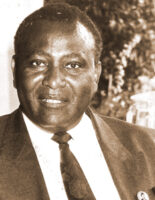
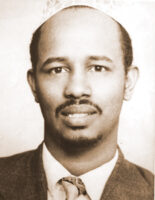
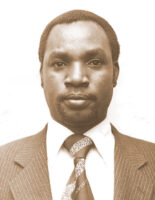
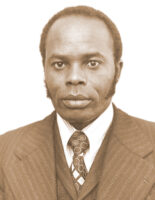
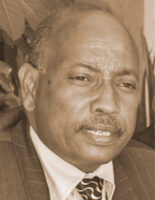
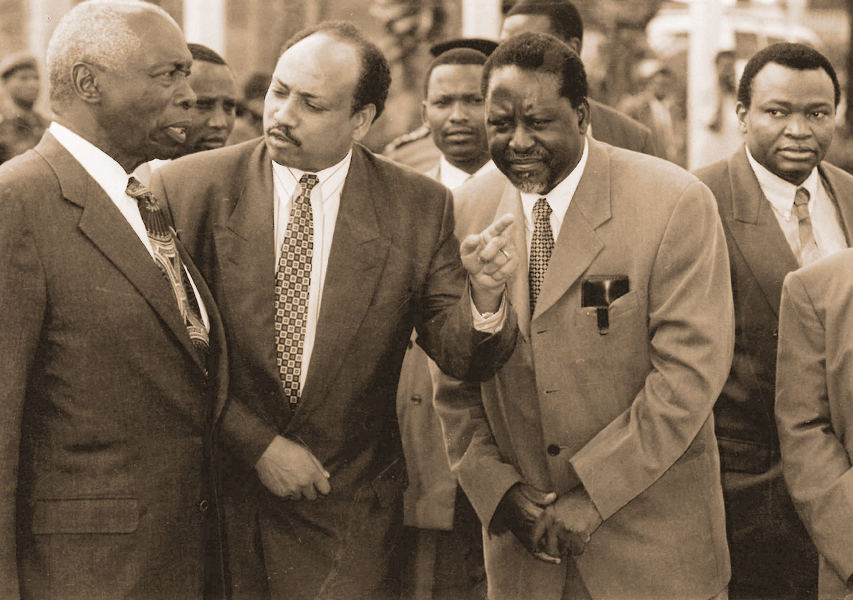
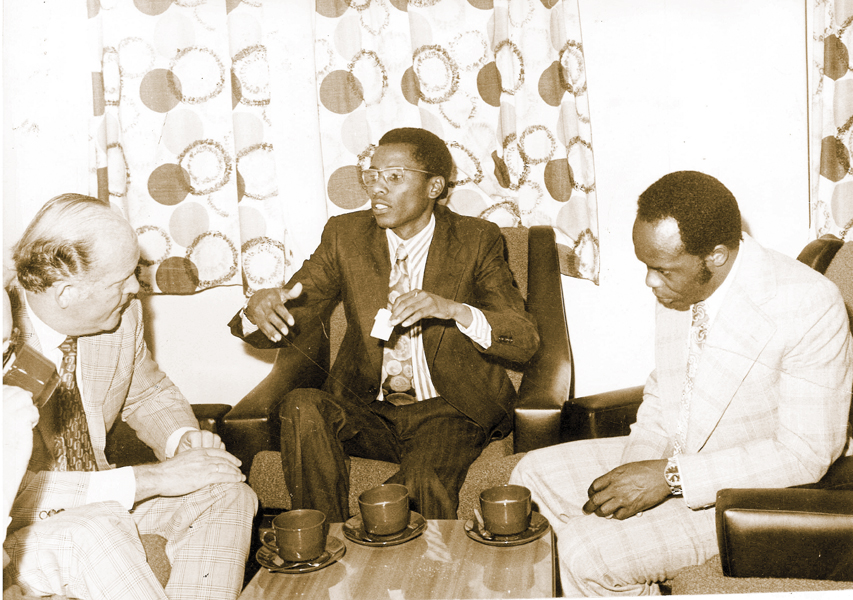
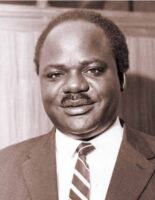
James Kabingu Muregi was first elected as the Member of Parliament for Nyandarua South in 1969 and he held the seat until 1979. From 1975, Muregi also doubled as Deputy Speaker of the National Assembly following the detention of Jean-Marie Seroney.
Seroney was jailed together with Martin Shikuku for dismissing the ruling party, the Kenya African National Union (KANU), as dead. Shikuku had stated in Parliament that the party was dead but when challenged to substantiate his claim, Seroney, who was Deputy Speaker at the time, said, “There is no need to substantiate the obvious!” He, Shikuku and a few others had been constant critics of President Jomo Kenyatta’s administration.
Muregi was a pro-Government figure and a fierce defender of the Gikuyu, Embu and Meru Association (GEMA), a Central Province outfit, during Kenyatta’s tenure. In 1979, he lost the Nyandarua South seat to Kimani wa Nyoike, following which he was appointed Chairman of the Pyrethrum Board of Kenya. By this time, he had become a close associate of President Daniel arap Moi, who had succeeded Kenyatta in August 1978.
In 1988, Muregi became the first MP for Kipipiri Constituency. He would lose the seat to Laban Muchemi in 1992 with the return of multipartism following the repeal of Section 2A of the Constitution of Kenya.
In October 1989, at the height of the season when leaders who shouted ‘nyayo!’(Moi’s rallying call, meaning footsteps) loudest were seen as being most loyal to the President, his government, and KANU, Muregi was appointed Assistant Minister for Environment to replace Josiah Kimemia, the MP for Kinangop. Kimemia was at that time viewed not to be loyal enough to the President and the ruling party, hence his ouster. Party hawks from the Nyandarua KANU Branch also wanted him removed as branch chairman; he was replaced by Muregi.
Once appointed to the Government, Muregi displayed his total loyalty to Moi by aggressively speaking out against those viewed to be ‘anti-nyayo.’ For example, speaking in Parliament in December 1989, he not-so-politely asked Andrew Ngumba, the MP for Mathare who had returned to the country from self-exile in Sweden, to keep a low profile “lest he awaken bitter memories of how he swindled investors with the fallen Rural Urban Credit Society”.
Ngumba had fled to Sweden following the collapse of the credit society, which had specialised in giving unsecured loans to upcoming business people in his constituency and other parts of Nairobi. Muregi termed Ngumba’s efforts to seek rehabilitation into KANU as “…lack of respect for fellow Kenyans and big-headedness. Ngumba should lie low and give us time to study him and see if he was brainwashed while in exile. He should be humble and grateful to President Moi for granting him amnesty”, the Hansard recorded.
In the early 1990s, Muregi was appointed to the Cabinet as Minister for Livestock Development but he did not last long as he had lost Kipipiri Constituency to Muchemi. Immediately after he lost the seat, politicians aligned to KANU started salivating over his party post. He would be replaced as the Nyandarua KANU Branch Chairman in Nyandarua by Kimemia, the man he had previously ousted.
In May 1994, the party branch purported to remove him as Chairman of Kipipiri Sub-branch for allegedly not supporting Moi and senior KANU officials. But he pleaded his innocence and accused Kimemia of trying to finish him politically. Barely a week later, the branch Executive Committee in a surprise move reinstated him. The committee chairman and Muregi’s political nemesis, Kimemia, told the press at the time that the branch had restored Muregi “to deny the Opposition in the district the chance to celebrate the power struggle in the party”, as reported in the Daily Nation of 17 May 1994.
When Muchemi died in 1995, KANU hoped to reclaim the Kipipiri seat and the Government campaigned for its candidate, Joe Maina, and promised residents electricity in the whole constituency. But Maina lost to Githiomi Mwangi of the Democratic Party. Electricity poles that had been strewn all over the constituency in readiness for the electrification programme were immediately reclaimed. The KANU loss was attributed to the sidelining of the party branch bigwigs that included Muregi.
The former Cabinet Minister became a preacher after bowing out of elective politics and today he is a bishop whose church operates in Nyandarua and its environs. In a telephone interview early last year, Muregi’s son, Pastor Moses Ndungu, said his father was born in Elburgon in 1934, where his grandfather worked on one of the European settler farms.
Muregi attended Micinda Primary School and later joined a health institution in Nyandarua where he pursued a course in public health. He was employed as a public health officer in Nyandarua, where among other issues he created awareness on the proper use of toilets. While working in Nyandarua, Muregi bought a farm and relocated his parents from Elburgon to his new home. According to his son, it was during his father’s time as a public health officer that his leadership skills came to the fore and he was elected as a councillor in the Nyandarua County Council. He would later become chairman of the council.
One of very few Kenyans of Somali descent to have risen to positions of influence in President Daniel arap Moi’s administration, Hussein Maalim Mohamed was a politician who tactfully avoided controversy, except when it came to defending the rights of his people. He made history as the longest-serving Cabinet Minister from the region formerly known as North Eastern Province (NEP).
No other MP from the region has managed such an uninterrupted political career. Mohammed never lost a parliamentary election and represented Dujis Constituency (formerly Garissa Central and later renamed Garissa Township) for five consecutive terms, serving as a nominated MP during one of those terms. He chose to retire from politics in 2007.
Mohamed was not known beyond the boundaries of NEP until one year into Moi’s presidency. It was 1979, when the newly installed President formed his first government after a General Election in November. Mohamed was among the people Moi nominated to Parliament. The President was keen to promote the interests of small communities that had been marginalised since the colonial era.
Mohamed was neither from an influential family nor did he have a good education. He had dropped out after primary school and made a name for himself in business. He was a popular businessman in Garissa Town before people chose him to be their civic leader in the 1974 elections. His popularity spread throughout the province for his role in helping Somali students seek higher education abroad. People even nicknamed him Hussein Maendeleo (Kiswahili for development) on account of his business, which he operated under the trade name Maendeleo Stores. The retail store was among the first businesses in the town in post-independent Kenya.
Before finishing his term as a nominated MP, the attempt in August 1982 by soldiers from the Kenya Air Force to overthrow the Government would change the fortunes of Mohamed and his family. Coincidentally, it was Mohamed’s older brother, Mahmoud Mohamed, then a senior military officer, who was instrumental in saving the situation by suppressing the coup.
Moi then appointed the older Mohamed, a deputy commander in the Kenya Army, as Commandant of the renamed 82 Air Force. Four years later, he was named Chief of General Staff. The younger Mohamed, who was already in Moi’s good books, contested the Garissa Central parliamentary seat in the 1983 snap elections that Moi called to reorganise his government following the attempted coup. He won easily, beating the incumbent, Abdi Arres Mohammed.
Moi went on to appoint him Minister of State in the Office of the President alongside Justus ole Tipis and Peter Nyakiamo. Mohamed was not only the first Cabinet Minister from North Eastern Province but also the first one to hail from the Muslim community in Kenya. Likewise, his brother was the first from the Somali community in Kenya to hold such a position; he was the highest ranking general in the military. For years, there had been mistrust between the Government and the Somali people living in Kenya owing to their marginalisation since colonial times. By appointing Mohamed to the Cabinet, Moi began a process of building a new culture of trust between his government and the people of NEP.
One of Mohamed’s first duties as a Minister was to help the Government combat insecurity and banditry in northern Kenya. Another was ending the suspicion that existed between the people and the Government.
A key issue that needed to dealt with even before addressing insecurity in NEP was the political dynamics in neighbouring Somalia, which directly affected Kenya. In 1977 Moi, then the Vice President, raised concerns about the alleged recruitment of Kenyan Somalis to fight in the Ogaden War, which had broken out in July of that year between Somalia and Ethiopia; both countries were laying claim to the Ogaden region. There were reports that Somalia government agents were issuing passports to Kenyan Somalis to go to Somalia for military training. It was feared that Kenyans recruited to fight in the war would later be used to attack Kenya in an old campaign to hive off the NEP and join it to the Republic of Somalia.
Moi, who held the docket of Minister for Home Affairs, ordered the screening of all Somalis in Kenya through registration, to make them easily identifiable by Kenyan security forces. This was deemed necessary because many Somali nationals had fled their country in the 1970s and settled among their relatives in NEP. Others had established a base in Nairobi’s Eastleigh Estate.
After the Ogaden War, the Somalia government was under threat from opposition parties, portending more trouble for Kenya. The political tensions were felt not only in NEP but also in Nairobi, since Eastleigh was slowly becoming the home of fleeing refugees. For fear of reviving the expansionist dream of a greater Somalia by residents of NEP, the Kenya government had to tackle the crisis in Somalia with caution. And this is where Mohamed became instrumental.
On top of all this, there was an ivory smuggling ring operating between the two countries. Poachers believed to have the blessings of high-ranking officials in the Somalia government would cross over into Kenya’s wildlife sanctuaries, kill elephants and smuggle the ivory back into their country. Somalia’s ambassador to Kenya had denied the claims but Mohamed insisted that the allegations were true.
The Weekly Review news magazine of 17 February 1989 quoted the Minister issuing a bold ministerial statement on the matter: “Somali nationals are infiltrating the country, irregularly obtaining Kenyan citizenship and identification documents and supporting or engaging in poaching and banditry.” He went on to say that the same foreigners had amassed wealth through the transport and haulage business, real estate and other commercial enterprises, and that some of the proceeds were being used to finance poaching and other illegal activities against Kenya.
The statement sparked an unprecedented public row between him and MPs from Wajir and Mandera districts. Mohamed and an unnamed MP from Garissa District are said to have handed over a secret list of five Somali nationals suspected to be behind the poaching. The five, who owned transport businesses, were arrested in an ensuing crackdown but were released after questioning.
In the same month, there was an exchange of fire between Kenyan security forces and poachers who had invaded Liboi in the Tsavo National Park and killed six elephants. One Somali poacher was killed and another, who turned out to be a soldier in the Somali National Army, was injured. After taking such a bold stance on the poaching issue, Mohamed grew in popularity. Moi retained him in the Cabinet and he was now viewed as a spokesperson for NEP; the residents praised his efforts to incorporate them in Government.
By the early 1990s, the Garissa MP had become a decisive leader in the ruling party, KANU, following agitation for the re-introduction of multipartism in the country. Mohamed had been elected as the KANU Assistant National Organising Secretary and was the party’s leading light in NEP as well as Moi’s point man in the 1992 General Election. He was able to bring together other leaders in the province who voted overwhelmingly for Moi’s re-election as President. The Minister himself won the Dujis Constituency seat for a third consecutive term.
Prior to the elections, the rather reserved politician had embarked on a campaign in which he criticised Moi’s administration, accusing it of neglecting the Muslim community and failing to end insecurity in NEP by not providing adequate security. Mohammed had even hinted at forming a broad-based Islamic Party that would serve the interests of Muslims in the country. Four other KANU MPs from the region supported him.
Although this irked the Government and other KANU leaders, they could not afford to discard the Dujis MP in the face of an increasingly strong opposition. The FORD-Kenya party had made inroads in NEP in the 1992 election campaigns. Party luminaries led by their chairman, Jaramogi Oginga Odinga, accused Mohamed of doing little to end banditry in the region. And following intense campaigns in which they promised to end insecurity, the party managed to win Lagdera Constituency through their candidate Farah Maalim.
In early 1993, Mohamed found himself colliding with the Provincial Commissioner of NEP, Amos Bore, who he accused of failing to fight insecurity in the region. At a public meeting in Garissa Town in February, the politician claimed that ammunition was being obtained easily from the security forces in exchange for money. “I am now happy the security in the area has improved two-fold. But I am not happy that there is a syndicate on arms in Garissa Town involving the police and civilians,” he was quoted as saying in the Daily Nation of 22 February 1993. In April, in what was seen as a demotion, he was moved to the Ministry of Culture and Social Services. The Minister later claimed he had criticised KANU from within “… only in the spirit of constructive criticism.”
Not much was heard from him after that as he dedicated his time to his ministerial duties. In the 1997 General Election, he again surprised the Opposition by retaining his seat with ease. Moi appointed him Minister for Research, Technical Training and Technology, where he served for only one year before he was moved to the Ministry of Rural Development. He was then moved to the Ministry of Women and Youth Affairs. By the time Moi was concluding his tenure in 2002, Mohamed was Minister for Medical Services. In the elections that year, he was yet again one of the few MPs who did not struggle to retain their seats.
Mohamed found himself in the Opposition after KANU’s presidential candidate, Uhuru Kenyatta, lost to Mwai Kibaki of the National Rainbow Coalition. In 2007 he opted to resign from active politics and the Dujis seat was won by a relative, Aden Duale, who was later to become Leader of Majority in Parliament and is married to the daughter of Mohamed’s older brother.
In 2016, President Kenyatta appointed him Chairman of the Ewaso Ng’iro North Development Authority.
The 29 January 1988 issue of The Weekly Review news magazine carried on its cover a portrait of Henry Kosgey, the Minister for Culture and Social Services, bearing the headline ‘Man in Trouble’. Inside, the article stated that the KANU Nandi District powerbrokers at that time, Mark arap Too and Ezekiel Bargetuny, had decided that Kosgey must lose his Tinderet parliamentary seat. No reason was given for the fallout.
At the time, Kosgey was smarting from accusations that he had dipped his fingers in the All Africa Games till. Later, it emerged that the two key allies of President Daniel arap Moi had claimed that Kosgey had failed to utilise his position in the Cabinet and as the KANU Nandi chairman – the most senior politician in the area – to benefit the community.
To replace Kosgey for the Tinderet parliamentary seat was Kimaiyo arap Sego, a young, unassuming Kapsabet-based lawyer who had unsuccessfully campaigned against the Minister in 1983. And with that began Sego’s short-lived fairy tale – because the powerbrokers also fell out with the newcomer and were soon plotting a Kosgey comeback.
The Weekly Review of April 1989 titled his exit ‘A rapid rise, a precipitous fall’ and described it thus: “The (MP) for Tinderet in Nandi District, Mr Kimaiyo arap Sego, who was the Minister for Commerce until his dismissal from the post by President Daniel arap Moi in mid-January this year, would probably curse the day when he decided to leave his legal practice… to enter the volatile field of politics. The troubles that have dogged his nascent political career ever since he fell out (with those who sponsored him) have been growing by leaps and bounds.”
Sego was born in September 1952 in a place called Kaptendon in Lessos Location, Nandi District (now known as Nandi County), to Sylvester and Felister Sego. The elder Sego served with the Kings African Rifles during the Second World War and later retired to farming.
The former MP attended Kalibwani Primary School before moving on to the then prestigious Kapsabet High School for his O’ level education and then St Mary’s Yala to do his A’ levels. He would later join the University of Nairobi for a degree in law. He undertook his pupillage with Amata & Company Advocates in Eldoret and worked there for about two years before setting up his own law firm in Kapsabet Town.
In 1983, Sego attempted what was viewed as an almost impossible task – he challenged Kosgey for the Tinderet seat. Kosgey garnered 17,797 votes against Sego’s 1,045. In the subsequent elections, five years later, Sego got 14,499 votes in the party primaries against Kosgey’s 6,151 votes. Since the KANU regulations at the time provided for direct entry into Parliament for candidates with 70 per cent and above votes in the primaries, Sego was announced as Kosgey’s replacement.
Soon after the elections he was appointed Minister for Commerce. He was 32 years old, the same age as Kosgey when he joined the Cabinet. There was a massive re-organisation of the Government in forming the new Cabinet. New ministries were created while others were hived off from old ones. Among the new ministries was Technical Training and Applied Sciences, previously a department of the Ministry of Education. The Ministry of Works, Housing and Physical Planning was abolished and its departments given to other ministries.
Immediately he joined Parliament, Sego started building his own power base, being the senior-most politician in his home district.
“He perhaps thought that as the district’s most senior politician, he did not need any political patronage. In this, Sego may have over-estimated his political clout and under-estimated that of Too, who had increasingly assumed the posture of Nandi District’s predominant political patron,” The Weekly Review stated.
Sego lasted only nine months in the Cabinet and was replaced by John Cheruiyot, another MP from Nandi District. According to The Weekly Review, Sego “… became the first Minister of those elected and appointed (the previous year, after the General Election) to bite the dust… when he was dismissed amid speculation that he had fallen out with Too. Soon afterwards there was a move to throw him out of the party and Sego responded to it by taking a back seat in Nandi politics.”
The Nandi KANU Branch accused him of failing to participate in fund raisers in the area, snubbing party leaders’ meetings, refusing to participate in party elections, and not joining President Moi on tours of the district. He declined to defend himself or apologise to his political mentors, which infuriated the party branch officials even more; to the extent that adversaries wanted him expelled from the party.
It would appear that Sego consistently failed the loyalty test. It wasn’t so much that he publicly disobeyed his masters, but that he always remained silent while other leaders were literally falling over themselves to pledge loyalty to the President and to their power brokers. At one time, Sego had a public spat with Too, his key sponsor, accusing him of sponsoring rivals to take away his parliamentary seat. Too hit back, declaring that Sego’s cries were the last kicks of a dying horse.
As Minister for Commerce, Sego oversaw the amendment of the Trade Licensing Act to promote local industries. This was within the Government’s policy of import substitution to curb the huge export bill and imbalance in trade against Kenya. Of note is that Sego represented the country during the Uruguay Round of the World Trade Organisation’s multilateral trade negotiations under the auspices of the General Agreement on Tariffs and Trade.
At face value, his tenure was uneventful, almost lacklustre. But in reality, he headed a ministry whose industries were in the eye of a storm characterised by cartels out to make quick money. The contentious Kenya National Trading Corporation (KNTC), the Sugar Equalization Fund and the Industrial and Commercial Development Corporation (ICDC) were regarded as cash cows for the well connected. Indeed, in his 1987-1988 report, the Controller and Auditor General brought to the fore financial irregularities in these authorities.
Sego had inherited a ministry whose corporations were in deep debt. The KNTC was saddled with a KES 389 million loss by the time he took over. Reports swirled around regarding the theft of sugar from the corporation’s godowns as well as en route to Nairobi from factories in western Kenya (4,020 bags) between 1980 and 1982. Another 643 bags of sugar meant for export had been lost in April 1981.
“In the previous year’s report, reference was made to various irregularities which had occurred at the (sugar) godowns in Nairobi and Mombasa where the ministry had stored sugar. A review of the position in 1988 revealed continuing and additional unsatisfactory matters,” the Controller and Auditor General said in the Appropriation Accounts 1987-1988 report.
With regard to ICDC, the ministry issued the corporation loans without precise terms and conditions, according to the same report. There were “unexplained differences” between the ICDC loans and those of the corporation. While the government’s position showed that ICDC had received loans and grants worth KES 720 million by June 1987, the corporation’s figures reflected KES 600 million.
After the re-introduction of multiparty politics in the 1990s, Sego abandoned KANU to join the Opposition’s Democratic Party led by Mwai Kibaki. His defection was met with a hostile reception back home in Nandi; he was even attacked by a mob on his way to submit his nomination papers for the 1992 elections. This wasn’t unexpected. The Rift Valley was considered an exclusively KANU zone. Sego lost the election and filed a petition against Kosgey’s victory as Tinderet MP, which he also lost.
Sego disappeared from the limelight until 2003, when he joined the public service as a Delegate to the National Constitutional Conference that was established to give Kenya a new constitution. In 2005, he was appointed Chairperson of the National Anti-Corruption Campaign Steering Committee (NACCSC), created the previous year to champion the fight against corruption.
Sego resigned from the NACCSC in 2014 and settled back into his law firm.
Apart from politics, Darius Mbela made a mark as a choral composer, singer and conductor. He was “the only old boy who had sung his way into Parliament”, Mbela’s fellow Alliance High School alumnus, Attorney General Amos Wako, once said of him. Accompanied by the St Stephen’s Church Choir, he was reportedly involved in the composition of the dirges that were sung during founding President Jomo Kenyatta’s funeral in 1978. He was at the time a Permanent Secretary.
But what singularly defines Mbela’s role in national politics was his tenure at the Ministry of Lands and Housing where, despite his best efforts, he was not able to address Kenya’s squatter problem, especially in Coast Province. It was during his tenure that land grabbers ruthlessly targeted public utilities.
Among his first assignments at Lands and Housing was opening a key conference that focused on unplanned settlements. At this meeting he said the greatest challenge in Nairobi was to work out viable strategies for adequate shelter for the city’s residents, according to the news magazine The Weekly Review, of December 1988. The Government, he stated, would discourage rural-urban migration by decentralising the country’s urban structure. Experts were predicting the population of Nairobi would hit the 5 million mark in 2000.
In July 1988 he appointed a team – drawing officials from the Nairobi City Commission; the ministries of Housing, Local Government and Physical Planning; and the provincial administration – to improve housing in Nairobi, especially in the unplanned settlements.
“Many of the city dwellers are living in squalid conditions which have in turn created a host of other problems such as violent crimes, prostitution, illicit brewing of alcohol, drug abuse and begging,” he said as he announced the creation of the committee. “No government can feel proud when its people are living in temporary shelter made of cardboard and plastic materials.”
Three months later, he proposed that all housing projects in urban areas must be multi-storey because such buildings offered the best use of land, making them the most suitable for densely populated urban areas.
“From now henceforth, high-rise housing development will be the rule rather than the exception,” he declared as he launched a KES 179 million Kibera high-rise scheme for the National Housing Corporation (NHC).
In May 1989 the Daily Nation reported, “Open stinking sewers, narrow filthy earth roads and wretched timber and mud-walled dilapidated buildings with rusty corrugated iron-sheet roofs which characterise slums everywhere in the world will be an endangered species in Kenya by the turn of this century.”
Mbela had just declared war on slums. “It is a Government policy that no slum should see the year 2000.” This announcement followed a Presidential directive in 1987 that had ordered NHC to plan to wipe out all slums in Nairobi, Mombasa, Kisumu and Nakuru, and all other major towns. This started with high-rise buildings in Pumwani and Kibera.
His other task as minister was to resettle the landless. Whereas this was a noble idea, it emerged later that the land was issued out to senior military officers and public servants, top politicians and politically-connected individuals, and not the intended squatters. It was thus not surprising that in 1988, Mbooni MP Johnstone Makau claimed that the Ministry of Lands and Housing was full of corruption, inefficiency and chaos.
Dr Bonaya Adhi Godana came from a very poor background and how he managed to beat all odds to become a legislator left many puzzled. His Gabra community was barely known beyond Marsabit District (now known as Marsabit County). The former herdsboy’s struggle to go to school and eventually become a distinguished lawyer before ending up as a people’s representative won him the admiration of many.
Godana’s appointment marked the first time since independence that a Member of Parliament from Marsabit had been made a Cabinet Minister. The country was keenly watching the young MP who had been assigned the Foreign Affairs docket, especially because of his brilliant contributions in Parliament.
At the time of his appointment, the relationship between Kenya and Ethiopia, countries that had traditionally been allies in the Horn of Africa, had begun to deteriorate following claims of the presence of members of the Oromo Liberation Front (OLF) in Kenyan territory. The Kenya Government found itself in a delicate situation – both the Gabra and Borana communities who occupy Moyale and other parts of Marsabit are Oromo speakers. As such, they share names and have even intermarried over the years. These intercultural relations made it difficult to differentiate between Kenyans and Ethiopians. In violent encounters with Kenyan security forces, there would often be casualties, which provoked anger from local leaders, especially politicians, who denounced such incidents as they blamed the Government for failing to protect its own citizens. The porous border was also a transit point for smuggling small arms and light weapons.
To calm this situation, President Daniel arap Moi chose Godana as an indigenous member of Marsabit and a distinguished lawyer with a PhD in international law as he was conversant with the politics of the Horn of Africa.
Godana was first elected to Parliament in 1988 to represent the newly-created North Horr Constituency, which was carved out of Marsabit North during a review of constituency boundaries in 1986. With his knowledge of law, the sharp-witted MP was quick to study parliamentary rules and procedures in his first stint in Parliament, and he stood out as a knowledgeable debater.
As a renowned lawmaker and diplomat, Godana continued to work to establish peace between the two communities even after Moi retired.
When Daniel Musyoka Mutinda was appointed to head the Ministry of Information and Broadcasting, it was a relatively small docket presiding over only the Kenya News Agency and the Voice of Kenya (VoK). He concentrated his efforts on improving broadcast services to reach more Kenyans through the installation of more short-wave and VHF radio transmitters in Langata, Kisumu, Meru, Nyeri, Nakuru, Limuru and Timboroa.
The Minister said in 1977 there were only 1.5 million radio sets in Kenya with about 5 million listeners, and just 50,000 television sets and about 350,000 viewers in urban areas. The installation of radio transmitters enabled more Kenyans to access VoK services. At that time, private television and FM radio stations did not exist.
Mutinda is also credited with developing and promoting local radio and television programme material, and sourcing suitable programming from the West, especially from the United States and Europe. On numerous occasions he called for cooperation between African television organisations for drama, music and other cultural programmes. This quest led to the establishment of the Union of National Radio and Television Organisations of Africa (URTNA) which, at the invitation of Kenya, set up a Television Programme Exchange Centre at Kenyatta International Conference Centre in Nairobi. Through it, African television organisations exchanged programmes that enriched overall content.
Mutinda also boosted the film industry through the Kenya Institute of Mass Communications and the ministry’s Film Department. But this effort did not go very far, because the UNESCO-funded exchange programme ended after funding dried up due to a general lack of interest from many participating countries.
Mzee Jomo Kenyatta being sworn in as Kenya’s first Prime Minister by Governor Malcolm Macdonald (right) on June 13, 1963. The event was witnessed by, among others, Cabinet Ministers James Samuel Gichuru (left) and Joseph Otiende (centre).
Kenya’s first President and Prime Minister, Mzee Jomo Kenyatta was an African statesman who rose from jail and house arrest to lead a new nation from 1963 to 1978.
Mzee Kenyatta was born Kamau wa Ngengi at Ng’enda in Gatundu, Kiambu, in the 1890s. His parents, Muigai and Wambui, died when he was young.
The orphaned Kenyatta received early cultural training from his grandfather, Kung’u wa Magana, a traditional healer, and later his paternal uncle, Ngengi.
From an early age, Kenyatta took interest in the Agikuyu culture and customs, learning the legends, kinship system and government. With little parental guidance, and aged slightly above 10, Kenyatta, who was then herding livestock, left his paternal uncle’s animals in the field and joined the Scottish Mission Centre at Thogoto, Kikuyu, where he worked as a cook.
It is at the Church of Scotland Mission at Kikuyu that he was baptised Johnstone by the Rev J. Soutter in August, 1914. Initially, he had gone for an operation on his leg. There are claims that he was suffering from a spinal illness and was operated on by Dr J.W. Arthur, “who probably saved his life”.
“After schooling, he brought me some money, a blanket and a piece of linen and we reconciled,” his uncle would later say.
Still in his early teens, Kenyatta underwent the Gikuyu rites of passage with the Kihiu Mwiri initiation group.
Kenyatta’s grasp of the English language, having lived with the missionaries at Thogoto from an early age, enabled him to rise from his underprivileged position. In his spare time, he helped in the first translation of the Bible into the Gikuyu language while still working as a cook at the mission.
He was later employed by J. Cooke to help in the kitchen. Cooke was nicknamed John Chinaman, for he could spin yarns like an old Chinaman. Besides working as a cook, Kenyatta received vocational training in carpentry and basic education in Bible study, English and arithmetic.
During the First World War, Kenyatta went to his relatives in Maasailand near Narok to possibly escape conscription into the colonial army. But he got a job as a clerk for an Asian trader in Narok. After the war, he became a storekeeper at a European company. At this time, he began wearing a beaded belt, kinyatta.
Shortly after the First World War, Kenyatta returned to Dagoretti to settle down.
In 1919, he married Grace Wahu, who bore him two children: Peter Muigai and Margaret Wambui. Muigai Kenyatta, MP for Juja and Assistant Minister for Foreign Affairs (1974-1979), was born in 1920 and died in 1979. Margaret Kenyatta, a former Mayor of Nairobi and a member of the defunct Electoral Commission of Kenya, was born in 1923.
Between 1921 and 1926, Kenyatta worked for the City Council of Nairobi’s Water Department as a meter reader for a monthly salary of Sh250, a lot of money at the time. He bought a bicycle and in one of his early pictures, he is captured with his son Muigai beside it, no doubt a sight to behold back then for an African.
Although he had a farm and a house in Dagoretti, he preferred to live closer to town, at Kilimani in a hut he had built. He cycled home on weekends. He was not yet openly engaged in politics since government employees were barred. But it is believed that Kenyatta had joined the Kikuyu Central Association (KCA) as early as 1922 and had registered as a member in 1924.
The force behind Kenyatta’s recruitment was the central Kenya politician James Beauttah, who carried on with the political work started by Harry Thuku, a pioneer trade unionist who had founded the East African Association before the colonial government banished him from Kiambu to Kismayu, Somalia.
Kenyatta’s supporters formed the KCA in 1924. In 1927, the association started a publication, Muiguithania (Reconciler), a title that reflected the fallout between local chiefs, religious leaders, traditionalists and activists within the KCA. It was also a forum to raise funds and recruit more people to fight the colonial inequalities and preserve the African cultural bond.
In 1927, Kenyatta joined the KCA leadership, which had problems with the translation of bulletins and memoranda into English. This was a turning point for the organisation. Because of his oratory skills, Kenyatta became the KCA secretary-general, with the duty of crafting and presenting KCA petitions to the colonial administration.
Muiguithania promoted the KCA manifesto with zeal and the European church missions were suspicious of its agitation for equality. But what was overplayed abroad was its attack on Christians over their stand on cultural values, especially female circumcision practised in Gikuyuland. It was in the KCA that Kenyatta was to hone his political skills. He was chosen to present the Gikuyu land problems before the Hilton Young Commission. In February, 1929, he left the country for England, much to the chagrin of the colonial government.
The Governor Edward Grigg asked the KCA if it was worthwhile wasting money on a mission the colonial government deemed impossible. But the KCA was determined to press on with the matter. Although in London he was not able to hand over his petition directly to the Colonial Secretary, the trip was an eye-opener for Kenyatta, who got useful contacts, among them William McGregor Ross, a former member of Kenya’s Legislative Council (Legco) and Director of Public Works. Ross had been forced to step down for dismissing settlers as corrupt and exploitative. Together, they discussed politics and struck good rapport. In the short period he was in Europe, Kenyatta visited Moscow and attended the International Negro Workers Conference in Hamburg, Germany, where he met a man who would be a lifetime friend, a West Indian trade unionist and writer, George Padmore, who would make a great impact on Kenyatta’s character transformation.
In September, 1930, Kenyatta returned home to a warm welcome and continued to challenge the Scottish Mission Church on female circumcision. He started working for the Kikuyu Independent Schools in Githunguri, Kiambu. But in November, 1931, he returned to England to present a written petition to parliament. So important was the event that he was escorted by a group of KCA members, including its president, Joseph Kang’ethe, to the Nairobi Railway Station to travel by rail to Mombasa and then by ship to London. Kenyatta was accompanied by a KCA official, Parmenas Githendu Mukiri, and by lsher Dass, who was to present a similar petition for the Indian community. The discrimination on the way to Europe via Mombasa appalled the two nationalists.
Kenyatta met Mahatma Gandhi of India, a man who eschewed violence as a means of winning political power. It is not clear whether this encounter influenced Kenyatta and was later the cause of his moderation in politics compared with the Mau Mau leaders. After giving evidence to the Morris Carter Commission, Kenyatta proceeded for Moscow to learn economics, but was forced to return to Britain in 1932. He enrolled for studies at Woodbrooke College, near Birmingham, and briefly stayed with anthropologist Norman Ley’s family, which had connections with Kenya.
It was from Woodbrooke that Kenyatta cut his teeth as an activist, writing articles, normally letters to the editor, for his favourite newspaper, the Manchester Guardian (now the Guardian newspaper), which had identified itself with the left wing liberals. How Woodbrooke changed Kenyatta is little known, but from then on he advocated equality of political rights as a KCA representative, a moderate association whose policies, according to Kenyatta, were chiefly “those of cooperation between the Agikuyu and the government on the one hand, and the Agikuyu and the white settlers on the other”.
At that time, the KCA was little understood. According to Kenyatta, the association stood for negotiation and he was quick to deny that it harboured any motive apart from what was expressed in its published literature.
Kenyatta cut short his studies at Woodbrooke to return to Moscow, stayed for a two-year stint and went back to Britain in 1934. In this period, the British intelligence started watching him with a keen interest, especially after his return from Moscow, partly because he shared a flat with South African writer Peter Abrahams and Paul Robeson, an African-American son of an escaped slave who was a popular civil rights activist, singer, athlete, actor, lawyer and film star. In 1933, Kenyatta had enrolled at the London University’s School of African and Oriental studies (SOAS) to study Kiswahili and other African languages. It was during this period that Robeson met Kenyatta and Kwame Nkrumah of the Gold Coast (now Ghana) and nudged them into embracing communism.
The British MI5 noted Kenyatta’s close relationship with the American shipping heiress, Nancy Cunard, who was a champion of black civil rights. One of the MI5 reports in December, 1933, says Cunard “has recently been associating — apparently with considerable satisfaction to herself — with Johnstone Kenyatta”. To the British Foreign Office, he seemed “a harmless individual if left alone, but apparently susceptible to outside influences”. Kenyatta was a well-known figure within his circle of friends, who viewed him simply as a dandy and had nicknamed him “Jumbo”.
In 1935, from his contacts in the film industry, Kenyatta and his friend Robeson played a brief part in an Alexander Korda film, Sanders of the River. But politics remained his main focus and when the Italians invaded Ethiopia, Kenyatta was so incensed that he broke through a police line in 1936 to embrace Haile Selassie when the exiled Emperor arrived at the Waterloo Station. Kenyatta had by then joined the University College London to work in the Department of African Phonetics and got to know leading journalists and commentators interested in African affairs. He developed an interest in writing about Gikuyu traditions and culture, supervised by the famous Polish anthropologist Prof Bronislaw Malinowski. Kenyatta not only enrolled in Malinowski’s anthropology class but also published, Facing Mount Kenya in 1938 under the name Jomo Kenyatta.
The book carried a photograph of a bearded Kenyatta with a spear and a blue monkey cloak slung over his shoulder, Malinowski’s idea being to make him look more like a tribal elder than a Western student. Kenyatta soon became an activist and would be seen around London’s Hyde Park or Trafalgar Square speaking to British crowds on African issues and denouncing colonial policies. In 1942, he published two more books — My People of Kikuyu and The Life of Chief Wang’ombe. In the same year, he married Englishwoman Edna Clarke, 32, and together they had a son, Peter Magana Kenyatta.
It was in 1945 that he helped to organise the Fifth Pan-African Congress in Manchester, which brought together important African leaders, among them Nkrumah. Shortly after Manchester, KAU sought Kenyatta’s return and in September, 1946, he came back to Kenya. Shortly after, he married Wanjiku, daughter of Kiambu Senior Chief Koinange, who died as she gave birth to Jane Wambui.
Wanjiku’s brother, Peter Mbiyu Koinange, would later become a very powerful figure in the Kenyatta government.
When Kenyatta returned, James Gichuru, a former teacher at the Alliance High School, was the KAU president. In June, 1947, he stepped down for Kenyatta, who started demanding the return of Kikuyu land that had been grabbed by white settlers.
The year 1951 was crucial for Kenyatta. In September, he married Ngina Muhoho, a daughter of Chief Muhoho.
In the same year, he started organising KAU meetings, met British Secretary of State for Colonies James Griffiths, and proposed a constitutional conference before May, 1953. KAU was torn between moderates and radicals and politics hit fever pitch with the emergence of the Mau Mau movement, which launched an armed struggle.
When the colonial administration could no longer stave off the wave of violence and discontent sweeping Kenya in 1952, the war council devised what it conceived as the final solution.
At an August 17, 1952, meeting to discuss emergency powers, the fate of prominent politicians deemed to be fuelling the “malevolent” wind of freedom over the past 18 months was sealed. The top security meeting was told a list had been prepared and that leaders such as Jomo Kenyatta were to be arrested, even though the officials knew they could not sustain any charges against them.
Top secret papers the British government was recently forced to release in London indicate the colonial administration knew all the evidence it had against the politicians was wishy-washy and could not support charges even in a “quasi-judicial proceeding”.
This notwithstanding, E.R. Davies of the Native Council, told the 1952 meeting that he was determined to “put Kenyatta away by some means or other under the present law”.
Frustrations by the administration’s inability to dispense justice as fast as they wanted is summed up by one Nairobi magistrate, quoted in a circular dated September 12, 1952, complaining that some witnesses were even dispatched for holidays in undisclosed destinations when they were expected in court, making them unavailable to testify.
Before this, a plot had been hatched to hold a big anti-Mau Mau meeting in Kiambu by the local District Commissioner, N.F. Kennaway, on August 24, 1952, which elders and church leaders would attend.
Kenyatta, the senior government officers were told, had already been roped in by David Waruhiu and Eliud Mathu and had promised to disown Mau Mau in the meeting.
The Government was growing impatient about its inability to convict suspected Mau Mau adherents and sympathisers because witnesses had the habit of refusing to testify even after recording statements with the police.
The Criminal Investigations Department too was frustrated by the lack of cooperation. It cites the case of Moris Mwai Koigi who publicly bragged to 300 listeners how he had administered Mau Mau oath but none could be persuaded to testify against him.
Chief Nderi Wang’ombe of Nyeri who wanted to testify received a letter on the day of the hearing, warning him of dire consequences should he betray his people and country. The chief was later killed.
The judiciary also altered the rules to allow changes on charge sheets during any stage in trial, to save the Government the embarrassment of losing a case as a result of defective charges.
In the meantime, the tension which had been building up in the country reached a boiling point on October 9, 1952, when Kiambu Senior Chief Kung’u Waruhiu was gunned down in broad daylight just as the recently posted governor, Evelyn Baring, was on a tour of Central Province.
Kenyatta attended the funeral together with Governor Baring, amid threats to his life by White settlers.
Chief Waruhiu’s killing changed the political landscape and gave the Government the perfect excuse it had been seeking to round up all the political undesirables. On the night of October 20, 1952, the operation dubbed “Jock Stock” struck.
Kenyatta and five other politicians, Kung’u Karumba, Achieng Oneko, Fred Kubai, Paul Ngei, and Bildad Kaggia (famously known as the Kapenguria six) were seized in the crackdown, which marked the start of a state of terror in Kenya, as thousands were arrested and detained after a state of emergency had been declared. Erstwhile government allies were not spared either. Government security forces arrested ex-Senior Chief Koinange wa Mbiyu and his son John Mbiyu in connection with Waruhiu’s murder. The government also started executing a system of disinheriting the seized leaders of their land.
When the issue of political repression arose in Britain days before the declaration of the State of Emergency in Kenya, the Secretary of State for Colonies, Oliver Lyttelton, told Parliament on October 16,1952, that some laws were needed to intimidate the Mau Mau.
According to Lyttelton, as quoted in the Hansard, Mau Mau was a secret society confined to the Kikuyu, an offshoot of the KCA, which had been proscribed in the 1940s.
The Kapenguria Six were charged with managing Mau Mau. Despite the legal defence by Denis N. Pritt, Diwan Chaman Lall — an Indian MP sent by Prime Minister Nehru — Kenyan-Indian lawyers F. R. S. De Souza and A. R. Kapila and Nigerian advocate H.O. Davies, the six were in April, 1953, each sentenced to seven years hard labour and indefinite restriction thereafter. Their appeal to the Privy Council was also turned down in 1954. Kenyatta completed his sentence at Lokitaung, nearly 800km from Nairobi to the north, in 1959 and was restricted at Lodwar, 430km from Nairobi, where his wife, Ngina, joined him.
The release from jail of Dr Hastings Kamuzu Banda in Malawi in April, 1960, set off a new demand for Kenyatta’s release from restriction, though Oginga Odinga had started the campaign on the floor of the Legislative Council (Legco) in 1958. Back in London, Colonial Secretary Ian Macleod was weighing all the options, although the Governor in Nairobi, Patrick Renison, was hesitant to release Kenyatta, a man he would later describe as a “leader unto darkness and death”.
While the colonial government wanted to accelerate changes without Kenyatta, the African leadership, led by Odinga and Tom Mboya, wanted Kenyatta back to lead the independence phase. In 1960, Ambu Patel, a follower of Mahatma Gandhi, formed the Release Jomo Committee to whip up public support. By April, he had collected numerous signatures in a plea for Kenyatta’s release, which the Nairobi People’s Convention Party presented to the Governor. The election of Kenyatta as Kanu president in absentia and the birth of Kadu, bringing together the so-called small tribal parties, transformed the political landscape. The “No Kenyatta, No Legco” campaign continued and Kenyatta was moved from Lodwar in northern Kenya to Maralal, about 90km apart, in April, 1961, where he addressed a press conference, his first in eight years. Four months later — on August 14, 1961 — he returned to Gatundu and in October was installed as the president of Kanu. For Kenyatta to be a member of Legco, Kigumo MP Kariuki Njiiri stepped down and Kenyatta was elected to the Legco. Kenyatta then led the 1961 and 1962 Kanu delegations to the Lancaster Constitutional Conference in London.
With Kenyatta’s leadership, Kanu grew into a mass party, transcending all expectations. In May, 1963, Kenyatta led the party to an electoral victory and subsequently formed the Government as Prime Minister on June 1. This is celebrated as Madaraka Day. Madaraka is a Kiswahili word, which means self-management. With Kenya’s economy depending on colonial farming, Kenyatta was caught between sustaining growth and appeasing his supporters. The question of land was to be a tinderbox in his regime. A clear policy on the landless was one of the early tests that Kenyatta faced as Prime Minister. It was felt that land transfers should be orderly lest it caused panic and destroyed the economy.
Kenyatta managed to balance between the different interests and when Kenya got independence in December, 1963, and became a Republic in 1964, he became the first President, bringing the mandate of the Governor-General, Malcolm McDonald, to an end.
Kenyatta used his political acumen to convince leaders of the opposition party Kadu to cross the floor to the Government side without having to go for by-elections.
The merger of Kanu and Kadu had the effect of consolidating Kenyatta’s power and gave him all the powers to run the State and control its organs. He became the ruling party Kanu’s chief, was the head of the only political party, the head of State and the Government and Commander-in-Chief of the Armed Forces.
A policy document — Kenya African Socialism: Its Application to Planning in Kenya (better known as Sessional Paper No. 10 of 1965) was also passed to balance between the different thinking within Government.
Revered as Baba wa Taifa (Father of the Nation) and fondly referred to as Mzee (old man), Kenyatta held the country together despite the numerous internal and external challenges he faced. The economy grew at an average rate of five per cent annually between 1963 and 1970, and eight per cent every year from 1970 to 1978.
The growth followed measures taken to distribute productive land to small-scale farmers and promotion of the cultivation of cash crops such as tea, coffee, and hybrid maize, as well as the development of dairy farming. As a result, rural incomes rose by five per cent annually from 1974 to 1982, and the smallholders’ share of coffee and tea production rose to 40 and 70 per cent respectively by 1978.
Under Kenyatta, State parastatals and institutions were alternative wheels of development. He died on August 22, 1978, at the State House Mombasa.
Prime Minister Jomo Kenyatta and Justice and Constitutional Afairs Minister Tom Mboya at the September, 1963, Kenya independence conference in London.
Thomas Joseph Mboya will be remembered as one of the most charismatic and most flamboyant Cabinet Ministers Kenya has had. At independence in 1963, he was appointed the Minister for Justice and Constitutional Affairs. In 1965, he was moved to the Ministry of Economic Planning.
TJ, as he was popularly known, was born on August 15, 1930, the eldest son of Leonard Ndiege and Marcela Awuor who hailed from Rusinga Island in Nyanza Province. His parents valued education and, though they were labourers in a sisal farm in Kilimambogo, near Thika, they ensured he was educated at Catholic mission schools.
Mboya started school at the age of nine. His father sent him to a mission primary school in Machakos run by an Irish priest where he remained for three years. In 1942, he moved to St Mary’s Mission School, Yala, Nyanza. It was while at St Mary’s that he began learning English and history. The slogan, “No taxation without representation” of colonial American fame, was lodged in his mind at a young age. He passed the Kenya African Primary Examination in 1945, and joined Holy Ghost College (Mangu), a leading Catholic school in Central Province, in 1946. Mboya was one of the school’s leading debaters and actors, playing Mark Twain.
He was fond of Western rhetoric, and admired French Emperor Napoleon Bonaparte, US President Abraham Lincoln and black civil rights leader Booker T. Washington. Mboya read and re-read British Prime Minister Winston Churchill’s wartime speeches among others. Unfortunately, his meagre resources ran out in his final year and he was unable to sit the national examination that would have made him qualify to join a university. But that did not dampen his spirit to make something out of his life.
In 1948, he joined the Royal Sanitary Institute’s Medical Training School for sanitary inspectors, and qualified as inspector in 1950. He then worked for the Nairobi City Council for two and a half years. He resigned to become the general secretary of the Kenya Government Workers Union, which he had formed.
He later joined the Nairobi African Local Government Servants Association and within a year was elected vice-president. In November, 1953, he became the general secretary of the Kenya Federation of Labour, staying on until 1962, when he resigned to join the Cabinet as a Minister for Labour in a coalition government.
In the 1950s, Mboya had decided that his ‘activist’ career should begin in workers’ organisation. In 1952, his star rose when he founded the Kenya Local Government Workers Union, at a time when the colonial Government had declared war on Mau Mau and rounded up and detained nationalist leaders and supporters like Kenyatta and Achieng’ Oneko.
Mboya made a name for himself locally and internationally in the 1950s and 1960s, thanks to his position in the trade union movement during the State of Emergency, one of the darkest times in Kenya’s history. He was later appointed the Kenyan representative to the International Confederation of Free Trade Unions, a post he used effectively to boost his own career.
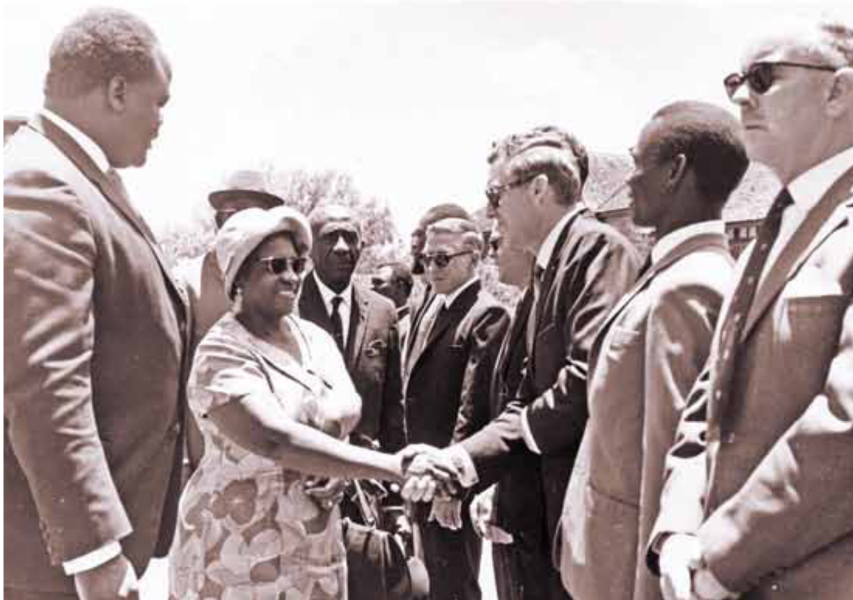
Major-General Yakub Gowon of Nigeria shakes hands with Kenya’s Information and Broadcasting Minister, Dr Zachary Onyonka, who was among a group of ministers and assistant ministers at hand to welcome the Nigerian leader at the Nairobi Airport on May 8, 1971, on his arrival for a State visit.
Zachary Theodore Onyonka was born on June 28, 1939, in Meru, where his father, Godrico Oeri Mairura, was a policeman. Zachary was the second child of Oeri and Kerobina Kebati. The family left for Kisii after his father resigned from the police force to join the Provincial Administration as an assistant chief.
In school, Onyonka was brilliant and disciplined. He attended Catholic schools — St Mary’s Nyabururu in 1949 and St Mary’s Yala, where he studied till 1958. His schoolmates at Yala included Peter Oloo Aringo, later a fellow Cabinet minister.
After school, the Gusii County Council employed Onyonka until 1960 when he benefited from the famous education airlifts with a scholarship to the University of Puerto Rico at San Juan in the US. He graduated in 1965 and, in 1966, joined Syracuse University, New York, where he enrolled for a masters’ degree in economics, specialising in money and banking. Upon completion, he embarked on doctoral studies at Syracuse. It was then that Onyonka joined the University of Nairobi as a tutorial fellow, as he carried out research for his PhD degree. He pulled it off in 1969.
Onyonka closely worked with Prof Terry Ryan of the Statistics Department, who helped him with statistical work for his doctorate degree. Thereafter, the University of Nairobi employed him as a lecturer in the Department of Economics.
But he had political ambitions. It dawned on him that the Kisii considered an unmarried man unsuitable for leadership. To qualify as a serious parliamentary candidate, and to start a family, he married an undergraduate student Beatrice Mughamba from Moshi, Tanzania. At the time, Beatrice was a student of home economics at the University of Nairobi. Her peers included Chris Obure (now a Cabinet Minister), politician David Kombo and former Permanent Secretary Sospeter Arasa.
Beatrice remembers Onyonka as a dashing young lecturer, whose brilliance and articulate voice dazzled many. She describes him as talented, captivating and humorous. She was, however, attracted to him due more to his dignified and forthright nature and honesty regarding their future marital union. She recalls how his unusual candour played out when Onyonka proposed.
Onyonka and Beatrice married on August 2, 1969. They had six children: Elisabeth Kwamboka (1970), Tolia Nakadori (1972), Kiki Christopher Robert (1975), David Wilfred (1976), Timmy Eric (1977) and Naanjela Anna (1980). Beatrice describes Zachary as a loving husband and father. Even when he was engaged in public functions, Onyonka called home to say he wanted the family to share a meal in the evening.
When Onyonka worked at the Gusii County Council before he left for further studies in the US, he was married to Teresia Nyakarita, with whom they had a son, Momoima Onyonka, now an Assistant Minister for Foreign Affairs. When Onyonka left, Teresia remarried and moved on with her life. Momoima finally linked up with his father when he was a Form Three student at Kisii High School. Beatrice accepted Momoima as her son. Before Onyonka died, Momoima teamed up with and helped his father in his political campaigns. It was then that Momoima polished his political skills.
The Principal of Egerton College, Dr William Odongo Omamo (left), introduces Mrs Antoinette Tubman, wife of Liberian President William Tubman, to members of Dr Omamo’s staf when she visited the college on October 10,1968. She had accompanied her husband on a State visit to Kenya.
Like his nickname, ‘Kaliech’ (Dholuo for like an elephant), Dr William Odongo Omamo’s contribution to Kenya’s political landscape was gigantic. He was one of the most polished and eloquent politicians Kenya has ever had. A man with the gift of the gab and a great sense of humour, he could speak for hours and not bore his audience. Once, on a campaign trail, he was hard pressed by his constituents to point out what he had done for them. In reply, Omamo left his audience in stitches.
Omamo had two wives, Joyce Acholla and Anne Audia, and 16 children. One of the most prominent is Raychelle, a former Law Society of Kenya chairperson who also served as Kenya’s Ambassador to France.
Omamo was a large-scale farmer in Bondo and Muhoroni and served as the Chancellor of the Great Lakes University in Kisumu. At independence he became the first African principal of Egerton College, which has since become a university. He joined politics in 1969 and successfully vied for the Bondo seat. It was previously Jaramogi Odinga’s, but he was detained just before the elections.
Omamo was born on February 27, 1928, in Bondo in a family of eight children, two boys and six girls. His father married eight other women and had scores of children.
He went to Maranda Sector School, five kilometres from his home, in 1936. He once talked about his first day in school: “I was half naked, with only a goat skin strip to cover the private parts and buttocks.”
The next day, his parents arranged to get him better clothes in line with the strict school rules enforced by the colonial administrators.
From the first day, his teachers and classmates saw a leader in him because of his oratory and ability to grasp fast what was taught. He stood out “like a cockerel among chickens”. His classmates described him as a bright student, whose hobbies were hunting and planting trees and flowers.
Unlike his schoolmates who dropped out of school or repeated classes for lack of fees or poor academic performance, Omamo’s school days were a bed of roses. When he sat the national examinations, he passed with flying colours. Later, he joined Maseno School for secondary education. It was at Maseno that he fell in love with agriculture as a subject.
In 1951, Omamo got a scholarship for further studies in India. That was when he met Odinga, one of the panelists who vetted Kenyan students for the Indian Government’s scholarships. He remembered the time thus: “I was one of the few Kenyans who benefited from an Indian scholarship. I went to the Punjab Agriculture College for two years, and then moved to Madras Agricultural College, where I graduated with a Bachelors of Science degree in agriculture in 1955.”
The only Kenyan he recalls meeting during his undergraduate days in India was Titus Mbathi, who was at the neighbouring Madras Christian College. Mbathi was later to rise in the Public Service, join politics and become a Cabinet Minister. Today, Mbathi is the chairman of the Kenya Generating Company (Kengen).
On his return to Kenya, Omamo was hired as an assistant agricultural officer and posted as a lecturer to Siriba Teachers College in Western Province. But he resigned after two years — in 1957 — to join Lahore University in Pakistan for postgraduate studies in agricultural economics for two years.