About Us

Lawrence George Sagini – A man of peace, a consensus builder

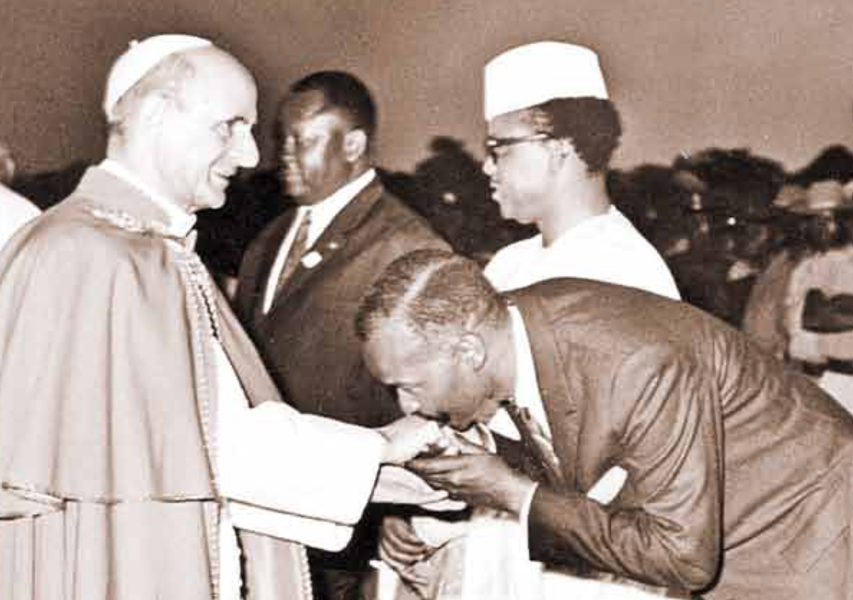
The Minister for Local Government, Mr Lawrence Sagini, kissing Pope Paul VI’s ring at the Entebbe Airport before the Pontif boarded a plane back to Rome on August 25,1969. Mr Sagini was in a Kenyan delegation to Kampala.

Lawrence George Sagini was born at Gesonso, Kisii, on January 1, 1926, the first son of Ndemo Kibagendi and Esther Nyanganyi. His father was the president of the African Tribunal Courts in Kisii. Sagini belonged to the Mwabogonko clan, which traces its roots to Nyakundi, a fearless warrior who confronted the British expeditionary forces.

Sagini was baptised when he was a student at Mangu School. His wife, Mary, says her husband never failed to attend church even when he was ill. He helped construct Ria’Sagini Catholic Chapel named in his honour. He also supported other churches and self-help projects.

In appreciation, the Catholic Church in Kenya selected him, with seven others, to visit the Pope to be honoured with a “knighthood”. Paradoxically, the religious background of Sagini’s family was Seventh Day Adventist. His mother was an SDA deaconess when Sagini joined Mangu, a Catholic school. But she later converted to Catholicism, along with some members of the Ndemo family.

His father valued education and Sagini started primary education in 1934 at Isecha Sector School. His father and five wives would in turns meet Sagini halfway with porridge or food as he walked home from school. Those days, primary school pupils walked long distances to school. In 1937, Sagini joined Kisii Government African School and then proceeded to Kabaa Mangu Holy Ghost College. His schoolmates included Andrew Omanga, Moody Awori, Mwai Kibaki, Tom Mboya, Lawrence Oguda and Chrisantus Ogari.

One of the memorable events of the time was when missionaries discouraged students from using family names. This explains why officially, Sagini did not use his father’s name, Ndemo. After Mangu, Sagini went to Kagumo Teachers’ Training College in Nyeri and, after graduation in 1950, became a teacher, a headmaster and an education officer in Central and South Nyanza.

In 1957, he quit teaching to pursue a Bachelor of Arts degree in sociology and political science at Allegheny College in Pennsylvania, United States. He graduated with honours in 1959. Upon his return, Sagini rejoined the teaching profession and taught briefly at Asumbi Teachers College. In 1960, the Government appointed him assistant education officer, a position he held until 1961. He also became a member of the Provincial Council of the University of East Africa.

Sagini married Mary Nyaboke in 1950 and they had six children. Sagini tutored his children and siblings, especially in mathematics. The children did well and are university graduates.  He also educated his brothers Paul Mong’are, Francis Mayieka, Salim Ndemo, Prof. Francis Abuga, Job Kibagendi and Dr Bitange Ndemo, the present Information and Communications Permanent Secretary.  Just before independence, the need to increase constituencies and African representation in the Legislative Council arose. Consequently, Kisii was delinked from South Nyanza and became a separate constituency.
Juxon Levi Madoka Shako – The force behind ban on ivory trade

Jaxon Levi Madoka Shako is one of the few Kenyan leaders who quit diplomacy to plunge into politics, eventually making it to the Cabinet as Minister for Tourism in 1969.

He was born in 1918 in Wundanyi, Taita-Teveta District and was educated at local primary and secondary schools, joining Alliance High School, Kikuyu, in the 1930s. He went for university education in the United Kingdom at the premier Oxford University.

When he returned to Kenya, he enrolled for a public administration course and thereafter served as a school headmaster before joining the colonial administration at a time when most senior administrators were white. He rose through the ranks to become Regional Government Agent in Mombasa, serving until independence in 1963.

Shako was an administrator when colonial governor Evelyn Baring declared a State of Emergency on October 20, 1952 in an effort to contain the Mau Mau in central Kenya and Nairobi. That day, thousands of Africans, including leaders of KAU, were arrested and later tried and jailed.

But other leaders applied pressure on the colonial government to grant more freedom to the African majority, forcing the colonial authorities to allow Africans to set up political parties, albeit on a regional, not a national, basis. By 1955, the Coast had two regional parties — Francis Khamisi’s Mombasa African Democratic Union (Madu) and Ronald Ngala’s Kilifi African Peoples Union (Kapu). Madu and Kapu would, in due course, give way to the more inclusive Coast African Association (CAA).

The CAA was essentially a Mijikenda and Mombasa affair, with very little appeal elsewhere in the province. The Coast was dominated by Madu, which was transformed into Kadu, led by Ngala, just weeks after Kanu was formed in May, 1960.

Kenyatta appointed Shako ambassador to France and West Germany in 1964, one of five envoys Kenyatta sent abroad. The others were Burudi Nabwera (Washington and the United Nations headquarters in New York), Dr Josephat Karanja (London), Henry Muli (Cairo) and Okuto Bala (Moscow).

Shako served as ambassador until 1967, when he was recalled. He retired from the Civil Service and entered politics at a time when his relative by marriage, Dawson Mwanyumba, was the MP for Wundanyi and Minister for Power and Communications. In the two years following his return, Shako consolidated his position in Wundanyi. In the 1969 elections, he ousted his younger relative from Parliament.

In the Cabinet Kenyatta formed after the election, Shako was appointed Minister for Tourism and Wildlife. Mwanyumba’s old Ministry of Power and Communications went to another Coast politician, Ngala, the region’s political kingpin who had been leader of the opposition party Kadu.

Shako forged a close political and business relationship with Kenyatta, the first family and  powerful ministers from Kiambu. The relationship centred mainly on cash crop production, especially sisal, and the mining of rubies. This raised controversy. Many of Shako’s constituents and the larger Taita-Taveta showed open resentment towards their MP, accusing him of exploiting their natural resources without giving anything back to the community. No wonder in the 1974 elections, Shako lost and Mwanyumba came back to Parliament.

Joseph Gordon Odero-Jowi – Politician who abandoned his flock

Dr Joseph Gordon Odero-Jowi is best remembered for all the wrong reasons. He hardly made an impact on the political arena.

He was the Ndhiwa MP between 1969 and 1974 on a Kanu ticket, when Nyanza was an opposition zone, dominated by Odinga’s KPU.

President Kenyatta’s appointment of Odero-Jowi to the Cabinet did not make matters better for him. He stepped into the shoes of Mboya, the slain Minister for Economic Planning and Development. It was claimed that he had been compromised to appease his community.

Odero-Jowi had previously served as an Assistant Minister for Finance and had defended the Government whenever the Opposition attacked it. In his contribution during the debate on a motion of adjournment on December 22, 1967, Odero-Jowi said: “The country has done well and we must thank the leadership of Mzee Jomo Kenyatta for giving this country the political stability which has enabled this Government to perform miracles.”

Showering the Government with more praise, he singled out the social services as exemplary, and said that the effort the Government put into self-help work had given birth to schools which would have taken years to build. “I think we must give this Government credit where it is due for giving inspiration and providing the leadership which has enabled the citizens to do these things,” he stated. Turning to the Opposition, Odero-Jowi asserted: “All the propaganda and lies from the Opposition are now dying out!” Taken to task by Butere MP Martin Shikuku on the claims, the Ndhiwa MP stood his ground, saying the Opposition had indulged in propaganda and fed it to the public. He made a passionate appeal to the Opposition to abandon what he described as “futile efforts to divide the citizens of this country”. There was no doubt that the Assistant Minister was loyal to Kenyatta: “I can see a few heads ruffled, but I maintain that the Opposition has no room as long as the leadership of this country is acceptable. It is impossible for an opposition party to make headway as long as the people have confidence in the President.”

Odero-Jowi made history as Kenya’s first politician to win a closely fought election and then abandon his electorate for greener pastures abroad after the 1974 election. He was said to have been frustrated when Kenyatta did not appoint him to the Cabinet.

He was in a dilemma: To please the electorate who adored the Opposition or the Government blamed for Mboya’s assassination, frustrating Odinga, banning the KPU and detaining its MPs on security grounds.

Another Nyanza politician in such a fix because of the cold war between Kenyatta and Odinga was Kasipul-Kabondo’s Samuel Onyango Ayodo, the Local Government Minister from 1963 to 1969. In June, 1963, the India-trained economist and former principal of the African Labour College in Kampala, Dr Joseph Gordon Odero-Jowi won the Lambwe (as Ndhiwa was then known) parliamentary seat on a Kanu ticket. At the time, under the Lancaster House Constitution, Kenya had a tri-cameral Parliament — the National Assembly, the Senate and the Regional Assembly. The latter two were abolished through parliamentary constitutional amendments.

A new constituency, Mbita, was carved out of Lambwe in 1965. Odero-Jowi switched to the new Ndhiwa constituency, and Senator Mbeo Onyango became the MP for Mbita. Odero-Jowi lost his seat in a bruising election campaign in 1969, when he was serving as the Minister for Economic Planning and Development, which he had inherited from Mboya.

In that election, the Luo voted against all Kanu candidates. Matthews Otieno Ogingo, a former vice-chairman of the Nyanza Regional Assembly, trounced Odero-Jowi in a controversial contest. But Odero-Jowi challenged the victory in court. The election was nullified.  In the repeat election, Ogingo again beat Odero-Jowi and with a larger margin. Kenyatta appointed Odero-Jowi Kenya’s permanent representative to the United Nations, where he served between 1972 and 1974 and was instrumental in bringing the UNEP headquarters to Nairobi. He returned to Kenya before the 1974 General Election and recaptured the seat, beating Ogingo and seven other candidates hands down on a Kanu ticket. But he did not complete his tenure. He left to join a UN agency in Canada in 1977. Once again, a by-election was called and a former senior police officer, Zablon Olang’, won.

Julius Gikonyo Kiano – Champion of African small-scale business

The Minister for Local Government, Dr Joseph Gikonyo Kiano and his wife Jane cut the cake after their marriage was blessed at the Presbyeterian Church of East Africa (PCEA), Tumutumu, on April 20,1970. Dr Kiano was the second son of Mrs Damaris Wanjiru and the late Gikonyo of Kangema while the bride is the youngest daughter of Mr and Mrs Nguyo of Tumutumu, Nyeri.

Julius Gikonyo Kiano, the first Kenyan to obtain a PhD degree, was a pioneer scholar and freedom hero. He was born in 1926 at Githiga in Kangema, Murang’a District. He went to Weithaga Primary and Kagumo Intermediate schools before joining Alliance High School. He subsequently did two post-secondary education programmes at Makerere in Uganda and eventually proceeded for Antioch College in Ohio, US, in 1948 and graduated with a degree in economics in 1952. At Antioch, Kiano developed an interest in the cooperatives, a movement that would revolutionise agriculture and other sectors of the economy after independence.

Before leaving Kenya for the US, Kiano was aware of the political situation (colonialism) and the need for educated and non-educated Kenyans to join hands in the liberation struggle. Kiano, who stayed for eight years in the US studying economics and political science, got a university fellowship from Stanford University to study political science in 1953. The desire to free Kenya from the yoke of colonialism had been planted in him by African soldiers returning home from the Second World War in 1945 when Kiano was in high school.

Kiano, who later became independent Kenya’s first Minister for Commerce and Industry, went to California University’s Institute of International Studies, Berkeley, for a PhD in comparative studies on colonial liberation in Asia and Africa. At Berkeley, he worked under professors and other academics, knowledgeable in China, Japan and other south-east Asian countries that had shown interest in Africa.

In a 1996 interview, Kiano recalled: “My going to Berkeley to study nationalism was, therefore, not theoretical at all. I could see what had happened in India, what was happening in Indonesia, what was happening in Dien Bien Phu and so I knew things would also be happening in Africa. “In 1951, Dr Kwame Nkrumah became the leader of government business in the Gold Coast (Ghana) and it later became the first African country to be independent from British rule in 1957, a year after I got my PhD. I was trying to relate my studies as much as I could with what was happening in Africa and what was likely to go on in the continent.”

President Mobutu Sese Seko of Zaire (second right) arrives in Nairobi for a visit on December 5, 1974. He is received at the airport by Foreign Minister Munyua Waiyaki, the Minister for Commerce and Industry, Dr Gikonyo Kiano (right) and Assistant Ministers Kamwithi Munyi (third left) and Gilbert M’Mbijjiwe (left)

In September, 1956, after eight years of study in the US, Kiano, came back to Kenya and got a job at the only post-secondary college in the country, the Royal Technical College (now the University of Nairobi) as its first African lecturer. He taught economics and constitutional law. He later abandoned the classroom for politics and was elected to the Legislative Council in 1958 to represent Central Province South. Kiano and other leaders, including Tom Mboya, knew freedom would not mean much unless the country had enough personnel to take over from the departing colonial technocrats.

They, therefore, wrote to their friends in American universities, colleges, the political leadership and the trade union movement, seeking scholarships for young Kenyans to study in America. The response from American universities was overwhelming. This resulted in the ‘Great Airlift’ through which hundreds of Kenyan students went to the US to study.

Joseph D. Otiende – Principled independence politician

The Minister for Education, Mr Joseph D. Otiende (right) after announcing the appointment of a commission under the chairmanship of Prof Simeon Ominde (centre) on February 14,1964, to recommend Kenya’s education policies. Looking on is Education Permanent Secretary Kenneth Stanley Njindo Matiba.

Joseph D. Otiende was a pioneer educator, politician, administrator, freedom fighter, MP and Cabinet minister, and he is still engaged in community leadership in Western Province.

With others, this nonagenarian offered selfless service that led to political independence and provided the building blocks of Kenya’s nationhood. He held several Cabinet dockets in President Jomo Kenyatta’s Government — Education, Agriculture, Culture, Health and Housing. He lost the Vihiga parliamentary seat in 1969 and did not contest again, opting to retire from politics when he was hardly in his 50s.

In a recent interview, Otiende said the role he played in life was shaped right from his childhood. He says of the 1920s, when he started school: “My father was a teacher and a cleric. He appreciated education and its benefits even in those early days when its importance had not quite sunk in the populace.”

Otiende was born in 1917 in Akelo village, Vihiga, where he still lives. He recalls that his father not only ensured that he received an early education, but was also responsible for the education of many other children in the Maragoli, Kisumu and Maseno areas, where he preached the Gospel and rooted for education. Wherever he was posted, he went along with his family. This had a lasting impact on Otiende, particularly the exposure to the languages and cultures of communities other than his Maragoli. Before he joined his first institution, Butere Normal School, he had been told that all knowledge came from the Bible. This was because his father always read the fairly “big book” at home and on the pulpit.

When the Church Missionary Society established a school at Maseno in 1926, Otiende was one of the first pupils. His other classmates included Oginga Odinga and Anglican Church Archbishop Festus Olang.

The Minister for Health, Mr Joseph D. Otiende (left), speaking on United Nations Development Programme (UNDP) day at the residence of the UNDP Representative in Kenya, Mr Steadman (right), on November 7, 1968, accompanied by Mrs Otiende (centre).

He recalls: “Even though we were still young, Jaramogi and I discussed politics and had our sights focused on future leadership.”

Olang showed predilection for religion from an early age. Because they were boarders, the bonding among the pioneering students was enhanced and they treated one another as brothers.

Otiende says Maseno has a special place in his heart for the all-round exposure the European missionaries-cum-educators inculcated in him and his schoolmates — strong spiritual and secular learning.

When he joined Maseno, the only culture other than his own that he related to was Luo. At the time, the colonial government operated a policy akin to apartheid. Communities were not allowed to mingle freely lest they conspire against the oppressors. If boys from other communities in western Kenya exposed young Otiende to cultures other than his own, this was intensified in 1930, when he joined Alliance after excelling at Maseno. “For me, the breaking of inter-tribal barriers took an irreversible turn when I went to Alliance,” he recalls.

Jeremiah Nyagah – Teacher who left a political dynasty

The Minister for Agriculture, Mr Jeremiah Nyagah, meets Her Majesty Queen Mamohato Berena Seciso of Lesotho at the Nairobi Airport when she made a stopover on October 5, 1977, on her way back home from Taiwan.

Jeremiah Joseph Mwaniki Nyagah is best remembered as a politician who opted to retire from politics to a village life, having served with distinction in the ministries of Agriculture and Education.

Born at Igari, Embu, on November 24, 1920, Nyagah started primary education in 1925 at the Anglican Missionary School at Kabare in present-day Kirinyaga County. Later, he was moved to Kagumo in Nyeri, where he sat the Standard Eight examinations. He then joined Alliance High School in 1937 (student number 427). From Alliance he went to Makerere College, Uganda, in 1940 for a three-year diploma course.

Nyagah had many firsts in his life. He was among the first Africans to sit the Cambridge School Certificate exam in Kenya. Among his classmates at Alliance were B.M. Gecaga (they later taught at Kahuhia, Murang’a, where politician Kenneth Matiba was their student) and Njonjo. From Makerere, Nyagah returned to Kenya in January, 1944, to begin a teaching career that he slowly combined with moderate politics. Between 1944 and 1958, Nyagah taught in various schools and colleges and became the first teacher of Kangaru School in Embu with only 30 students.

It was his appointment as an education officer that enabled Nyagah to criss-cross central Kenya, endearing himself to the moderates and the church leadership, especially in the Anglican Church. Before he was posted to Kiambu as an assistant education officer, Nyagah had a two-year break at Oxford University’s Department of Education for further training from 1952 to 1954. In this period, the Mau Mau war of liberation had started. Nyagah integrated the independent schools, run by the Kikuyu Independent Schools Association (KISA), into the leadership of District Education Boards (DEB). The schools were considered as education bases for subversion.

When — as a result of the Lyttelton Constitution — the colonial government called the March, 1957, elections to allow the first group of eight Africans to the Legco, Nyagah contested the Central seat. But he lost to a comparatively unknown South African-trained teacher, Bernard Mate, who won 51 per cent of the votes against Nyagah’s 12 per cent. Others in the race included Eliud Mathu, the first African at the Legco, lawyer David Waruhiu and Stephen Kioni, the first Kenya National Union of Teachers’ (KNUT) secretary-general.

In the Legco, the eight African representatives, under Tom Mboya’s leadership, pushed for an additional six African elected seats to bring Africans to parity with European legislators. This move forced Allan Lennox-Boyd, the British Secretary of State for the Colonies, to impose a constitution on Kenya in November, 1957, that created additional African seats. Nyagah vied for the new Embu seat in the 1958 elections and won.

Nyagah was a moderate politician and in 1960 he joined a small multi-racial band of idealists — known as Capricorn Society or, officially, as the  Kenya College of Citizenship Association. The group believed that a future without racial discrimination would allow East and Central African countries to prosper. He was appointed the governor of the association in place of Musa Amalemba.

James Samuel Gichuru – Gentle, but made of sterner stuff

Cabinet ministers after donating blood on January 8, 1965. They are (from left) are Justice, Mr Thomas J. Mboya, Dr NjorogeMungai (Health) and Mr James S. Gichuru (Finance), the Assistant Director of Medical Services Dr J. Kinya, the Minister for Agriculture and Mr Bruce McKenzie

Born in 1914 to pioneer Christians Samuel Gitau and Mariam Nyaguthii, James Samuel Gichuru was the first of nine children. His 90-year-old sister Hannah Wanjiku says that at a young age, Gichuru led a life different from boys his age, mostly because his parents were religious and put education ahead of traditional cultural activities.

“While tradition dictated that boys look after livestock, my parents, who were among the very first Christians in Thogoto, Kikuyu, insisted that Gichuru and my brothers and sisters attend school instead. Gichuru was a very obedient young man,” Wanjiku recalls.

Because of the relationship between his parents and missionaries, the man, who went on to become the first president of the Kenya African National Union (Kanu), went to school at the Church of Scotland Mission School, Kikuyu at five. He completed primary education and went to Alliance High School and completed secondary education at 16.

Gichuru proceeded for Makerere College for a diploma in teaching. He returned to teach at Alliance, whose teaching staff was then exclusively white, between 1935 and 1940. He was then the headmaster of Church of Scotland School at Dagoretti.  The other pioneer African teacher at Alliance was J.D. Otiende, who became a minister in the first independent Cabinet.

“Gichuru was head-hunted to encourage more Africans to take up studies at the school,” his sister recalled. His students included Charles Njonjo and Njoroge Mungai’s brothers Nyoike and Ng’ethe.

Gichuru’s freedom credentials emerged at Alliance, where he fought against discrimination, protests that provided a fertile ground for his political career.

His first protest was against a rule that African teachers wear shorts similar to students’ uniform, while their white counterparts wore long trousers. His sister Wanjiku says this was the main reason for his transfer to Kikuyu Secondary School, where Kikuyu Day Secondary stands today. But at Alliance, he married Rahab Wambui Ndatha in 1936 and they had two children. She has since died.

Wanjiru reports: “Alliance was a white man’s island and the Africans who worked there copied their habits and acted like Europeans. Gichuru was no exception and his first and second-born children were never carried on their mother’s back. Instead, they were pushed around in a pram, like European children. But Gichuru soon interacted with other educated Africans, especially those involved in the struggle for freedom. As a teacher, he encouraged his students to read newspapers and follow the progress of the struggle.”

Gichuru got involved in active politics in 1940 and travelled long distances on his bicycle to meet other leaders. He was elected the first president of the Kenya African Union (KAU) in 1944, but vacated the seat for Jomo Kenyatta when he came back from Britain in 1946.

James Osogo – Oversaw growth of hospitals

The Premier of Nova Scotia, Mr Genald Regan (right), is welcomed on arrival in Nairobi by Health Minister James Osogo on September 11, 1976.

What comes to one’s mind whenever one converses with James Charles Nakhwanga Osogo is Shakespeare’s dictum in as you like it: “All the world’s a stage, And all the men and women merely players; They have their exits and their entrances; And one man in his time plays many parts…”

At his Kilimani home in Nairobi, the evidence of Osogo’s graceful aging is a doting granddaughter who won’t leave the old man alone. Clearly, the young girl will one day understand that his grandfather was a pioneering political leader, one who contributed greatly to shaping the political theatre that Kenya is.

Osogo fought many political battles and stuck out his neck sometimes in the most charged of circumstances in Kenya’s history. In 1975, for instance, following the death of Josiah Mwangi Kariuki, Osogo who was the Minister for Health, led the Government’s attempt to scuttle the Parliamentary Select Committee’s report that had implicated Police Commissioner Bernard Hinga and General Services Unit Commandant Benjamin Gethi in the murder.

The Busia South (now Bunyala) MP moved a motion urging the House to “…note and understand rather than accept the report”. This amendment motion was defeated. MPs were so incensed that they could not entertain anything that would water down the motion.

Today, Osogo explains the circumstances in which he moved the motion thus: “I had no ulterior motives. All I wanted was to save the Mwangale report. What had happened was that an initial report which I happened to have seen had many more names (of people implicated) compared with the one that Mwangale had presented in parliament. It appears that Mwangale had been forced to withdraw the first report because the names of some very senior politicians were in it but some of us had seen this very report.”

Whether it was because of his taking a pro-Government line at a time when the mood in Parliament and elsewhere was anti-Government remains a matter of conjecture. What is for sure is that in the post-JM murder period, his political stock appreciated, a major boost to his career being his elevation to the position of Deputy Leader of Government Business in the House.

Osogo was born in the little village of Bukani in Bunyala district in 1932, the second born in a family of 10. He was raised in a strict Catholic family, his father being an official of the local church. Indeed, he says that, as a child, his first desire was to join a seminary and become a priest but that this was not to be. But he ended up at St Mary’s Yala School, the famous Catholic-church sponsored institution that nurtured many a talent in Kenya’s formative years. Indeed, his school-mates included a certain Thomas Joseph Mboya.

After school, Osogo had a lingering ambition for the military, specifically the Royal Navy, but opportunities in this area were scarce and thus he took an opportunity to serve in the East African Railways – a major source of employment then. This entailed training at the East African Railways and Harbours Institute (today, the Kenya Railways Training Institute) in Nairobi.

If Osogo’s political consciousness, particularly against the colonialists, had been pricked while at Yala, joining the Railway Institute brought him face to face with the brutal face of imperialism. He would witness and participate in the riots called by such fiery trade union leaders as Markhan Singh and Kung’u Karumba.

James Nyamweya – Architect of Kenya’s labour laws

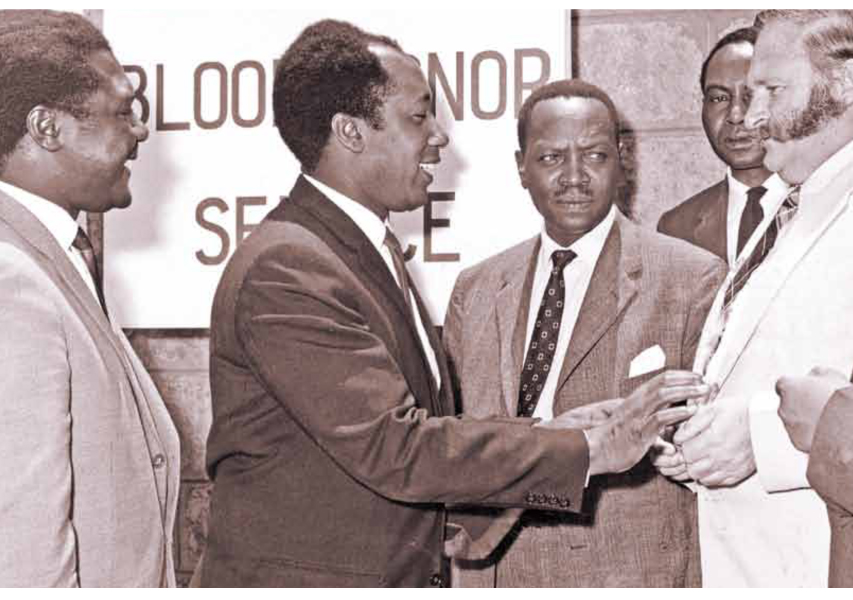
Tourism and Wildlife Minister J.M. Shako, his Works counterpart James Nyamweya (right) and Assistant Minister Jan Mohammed (left) on their way to board an aircraft for Ankara, Turkey on October 15, 1971. Mr Shako was leading the Kenyan delegation to the International Union of Tourists Organisation.

Born in Kisii on December 28, 1927, James Miyenda Nyamweya was the fifth child of Pastor Paul Nyamweya and Louise Manyange. His father had another wife, Len Kwamboka. James had seven siblings and three half-siblings.

In the late 1950s, Nyamweya left for the United Kingdom to study law. His daughter, Joyce (a former Permanent Secretary), was about a year old, and his son, George (now a Nominated MP), only two weeks old. When he returned in 1959, the two children could not recognise him.

Joyce remembers her view of her father when he returned: He so closely resembled one of her uncles she thought they were twins! Nyamweya could not bear the thought that the youngest two of his four children could not recognise him. He went to great lengths to change that. For instance, whenever he travelled to Kisumu to do legal work, he took the two with him.

Nyamweya married Tabitha Moige, a daughter of a prominent Seventh Day Adventist Church (SDA) elder, Zachariah Nyaribo of Gesusu, in 1948. They had nine children — Charles Ratemo, Rebecca Moraa, Joyce Bochere, George, Kenyalyn Monyenche, Mary Nyaboke, James Ogendi, Christopher Nyambane and Paul.

Throughout his public life, Nyamweya’s household was under strict instruction to make visitors feel at home, regardless of their station in life. He cautioned his family that an Omugusii man is a proud person and that only serious issues would make him leave his home to seek help from or audience with another man. Therefore, when a person humbled himself and came to Nyamweya’s homestead, they were to be accorded respect.

Nyamweya went to Nyanchwa SDA Primary School and later Kamagambo Mission School, where he excelled and earned reputation as an avid reader. Consequently, he qualified to join Kisii Secondary School. His father, a pioneer pastor of the SDA Church, rejected the colonial missionaries’ appeal for his son to go to a missionary school as part of his progression towards eventual service to God.

For that reason, his father sent him to Kamagambo Secondary School. Unfortunately, however, the missionaries discontinued the secondary school section at the school. But Nyamweya stayed and joined a teacher-training course, after which he taught at Nyanchwa, Sengera, Isecha and Sironga. But he did not give up the desire for higher education. He later enrolled for a correspondence course to pursue secondary education. He passed the Cambridge School Certificate and sat a qualifying examination which allowed him to start law studies.

Once again, the missionaries got wind of his intention to study law, a discipline they considered an affront to the spiritual development of a son with the potential of inheriting his father’s mantle in the Church. For the second time, his father failed to stop the young man’s dream and Nyamweya got admission to Kings College, University of London, for undergraduate studies. In 1958, he graduated with a Bachelor of Laws degree.

Isaac Omolo Okero – Defied Odinga wave for 10 years

The Minister for Transport and Communications, Mr Isaac Omollo Okero, arrives at Uhuru Park, Nairobi, for a national day celebrations in 1974.

Isaac Edwin Omolo Okero had a relatively successful political career between 1969 and 1979 as a Cabinet Minister and Member of Parliament for Gem constituency in Siaya District. He served in various ministries in the Kenyatta administration between 1969 and 1978 and briefly in President Moi’s government as the Minister for Power and Communications (1978-1979).

For about a decade, Okero’s name was synonymous with Gem and national politics.  He proved to be an astute and brilliant politician who knew how to make political manoeuvres and stamp his authority. These attributes made him stand tall among his peers and helped him to wade through the turbulent tide of politics.

Okero joined politics at 40, following in the footsteps of luminaries who had represented Gem constituency. Before him was Wasonga Sijeyo, an ardent supporter of Odinga, and C.M.G. Argwings-Kodhek. Sijeyo held the seat for a few months. He was arrested and detained for being a member of KPU.

Okero, popularly known as “The Barrister”, was born on July 28, 1929, at Ulumbi village in Gem, near Yala town. Like other children, he worked on the farm, fetched firewood and looked after cattle.  Having been born near the home of the no-nonsense Senior Chief Odera Akang’o, who ensured that education was not compromised in Gem, Okero attended Ulumbi and Uranga primary schools. “At that time, education was crucial and you were nothing without education,” he reminisces.

After primary school, he went to Ambira High School, whose headteacher was Mark Wellington Ombaka, the father of a later Gem MP, Oki Ooko Ombaka. The senior Ombaka was the first person from Gem to join Makerere College and the first African to head Ambira High School.

At Ambira, Okero’s schoolmates were Bethwel Ogot, now a professor of history and Chancellor of Maseno University, and Wilson Warambo, the first African Fellow of Royal College of Surgeon (FRCS) in Kenya.

Between 1946 and 1947, Okero and Ogot joined Maseno School for a two-year Junior Secondary Education course. At Maseno, his schoolmates included people who later became prominent politicians and professionals — Cabinet Ministers Ayodo, Odero Jowi, Burudi Nabwera, Edward Khashahala and  Thomas Odhiambo (the scientist who later founded  the international research centre ICIPE).

Okero’s rebellious nature, however, prompted the principal of Maseno to send him to Alliance High School, Kikuyu, in 1948 for Senior Secondary School education. At Kikuyu (1948-1949), his schoolmates included Geoffrey Kareithi (who later became Head of Civil Service), James Mugo Waiyaki and Cyrus Muthiga.

In 1949, Okero passed the Entrance Examination and qualified to join Makerere University College in 1950 to become the third person from Ulumbi village to enrol in the institution after Ombaka Senior and Owiti Mudhune. He was at Makerere with President Kibaki and former Nairobi Town Clerk James Gitonga, who joined the institution in 1951.

In 1952, Okero was among students who pursued degree courses at the University of London. Minister Andrew Omanga was also at Makerere at the time.  In August 1952, Okero led a students’ strike and was kicked out of Makerere. Josephat Karanja — later Kenya’s Vice-President — was also expelled.