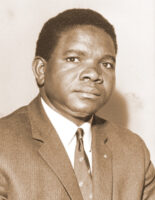
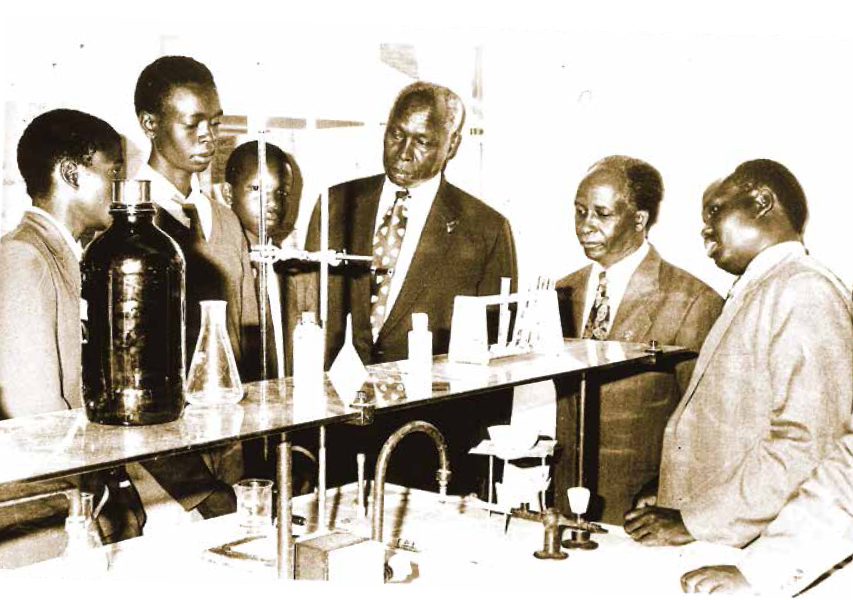
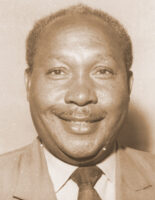
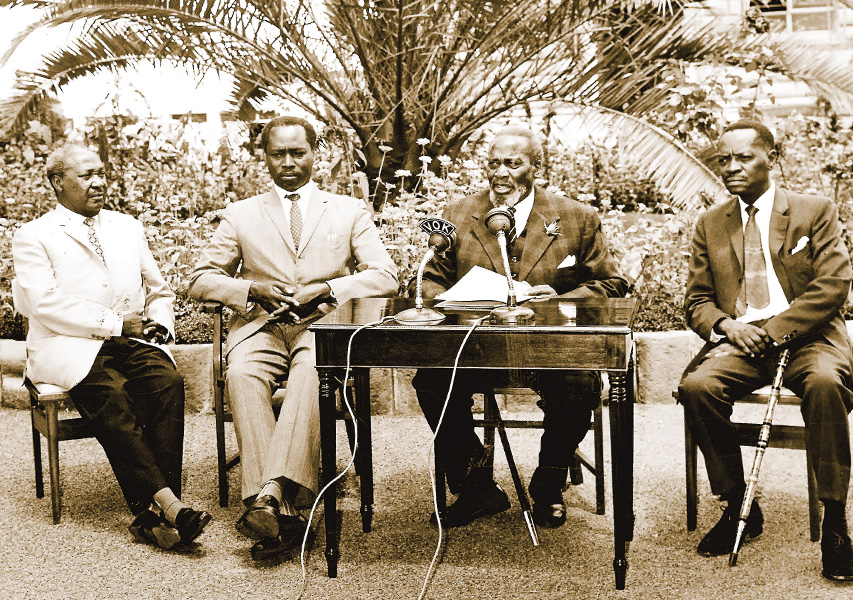
Mathews Joseph Ogutu, the Minister for Tourism and Wildlife in President Jomo Kenyatta’s last Cabinet, was born in Uyundo Village, Sega, in Siaya District in 1931. He was an ordinary boy whose father, Julius Oduor, would later be appointed as an assistant chief. Even as Ogutu walked to Uyundo Primary School and later crossed the border to Uganda for his secondary school education at a time when the world braced itself for World War II, he displayed little with which to lay claim to any measure of fame.
On completing his education, he returned to Kenya and started work as a building contractor, criss-crossing Ugenya Constituency. After working for a number of years, mainly building houses, he got a job as a site engineer with a British firm, Mowlem Construction Company, and was posted to Uganda. Ogutu worked as an engineer at the Kilembe mines, which elevated his social status back home in Ugenya, especially after he married his first wife, Josephine. He later married three more women and went on to have 14 children.
Never one to do things in half measures, Wuod lando (son of the light-skinned woman), as Ogutu was popularly known, made a major statement when he built himself a five-bedroom bungalow in Uyundo in 1964, making him the talk of the entire neighbourhood. As he explained in a 1996 interview with the Daily Nation, the house was built in readiness for his retirement.
This ‘palace’ attracted the attention of Ugenya, as it was renovated every three years by the man who many considered blunt to the point of being arrogant. Ogutu’s visits to his rural home increased when Mowlem transferred him to Nairobi, giving him an opportunity to consolidate a future political base.
The 1969 fallout between President Jomo Kenyatta and his Vice President, Jaramogi Oginga Odinga, presented Ogutu with an opportunity to try his hand at elective politics. He resigned from Mowlem to contest the Ugenya parliamentary seat in Nyanza Province. That was also the year when the only Opposition party, the Odinga-led Kenya People’s Union (KPU), was banned and its leaders detained following a public showdown between Kenya African National Union (KANU) and KPU leaders in Kisumu. Ogutu and William Odongo Omamo of Bondo Constituency stepped in to fill the political vacuum.
Kenyatta appointed Ogutu Assistant Minister for Local Government where he worked for five years before he was elevated to Minister for Tourism and Wildlife. In his contribution to a debate on the presidential address during the opening of Parliament on 6 February 1970, the Minister said: “Mr Deputy Speaker, Sir, I join hands with the honourable colleagues to thank His Excellency the President for his exposition of public policy when he addressed this House.
“I would like to touch a bit on the tourism industry. We welcome the President’s mention in his well-made speech about the expansion of the Kisumu Airport. We request the Government to speed up the expansion and include Kisumu Township and other areas in Nyanza Province in the tourist market so that we can benefit also from the tourism industry like other parts of the country.
“On roads, Mr Deputy Speaker, we are pleased with the preparations being made to tarmac the Yala-Busia road. This road passes through congested areas and is used by heavy traffic. We request the Government that this road be given expediency in raising it to bitumen standard.”
Turning to the Kenyanisation programme, Ogutu said a lot more needed to be done to make it a reality: “We have young men and women, school-leavers, who are desperate. I believe that the Kenyanisation programme at the moment is merely being used to register the job-seekers and I do not think the Government is doing much.”
He welcomed the President’s plan to introduce an industrial levy, saying it would mark a new era of compulsory training and industrial cooperation that would provide training programmes with grant schemes. Ogutu said the proposed compulsory levy would change national training patterns and proposed that training should be taken away from companies and industrial organisations and instead be made a joint Government-industry responsibility, with every establishment being compelled to pay for training.
One of his biggest achievements as Minister for Tourism was to convince the Government that Kenya had more to gain by banning the sale of game trophies. The President made the announcement on Madaraka Day in 1977, directing that it be implemented in three months.
In 1996, Ogutu asserted that he was proud to have served Kenya and Kenyatta loyally and to the best of his ability. “I believe I lived up to the expectations of my voters in Ugenya and Mzee Kenyatta. Voters do not owe you a living; you owe them a service if they elect you.”
Contributing to a debate on the 1971 Budget Speech read by Minister for Finance Mwai Kibaki, Ogutu described it as “excellent” and said it balanced taxation. “I am a great believer in the growth of the Kenyan economy. In Kenya, we are well known as a predominantly agricultural country. The disappointing thing is that we have not balanced our agricultural economy.”
He recalled that in 1970, Kenyans had had to make do with imported yellow maize meal and that another maize shortage loomed in 1971. Rationing in the supermarkets meant that customers were only allowed to buy two packets of flour. He challenged his colleagues to plan for the agricultural sector if the country was to attain food self-sufficiency.
He blamed the food crisis on a colonial hangover, citing the Government policy of confining cash crops in the Rift Valley and parts of Central Province. With regard to the poor state of roads, Ogutu accused expatriate engineers of being ignorant of local weather conditions.
Ogutu’s political star started to fade on 30 June 1980, when the High Court nullified his election as Ugenya MP following a petition by his political opponent, Archbishop Stephen Ondiek. It was a dark day for Ogutu when the judges directed the Speaker of the National Assembly to declare his seat vacant and call a by-election. Ondiek beat him hands down at the ballot box.
After Kenyatta died, President Daniel arap Moi appointed Ogutu Chairman of the Cotton, Lint and Seed Marketing Board, in place of Odinga. He did not, however, stay long in the position; he resigned in 1983 to try and recapture the Ugenya seat but ended up losing to James Orengo, a lawyer who had just graduated from the University of Nairobi.
Recalling his Cabinet days in a media interview, Ogutu affirmed that they were satisfying and enjoyable because Kenyatta allowed everybody a “free hand policy” to use his skills to the fullest. He spoke fondly of the President: “Kenyatta was the founder of the nation and had the upper hand in politics, thus uniting us. We always worked as a team in the Cabinet. He was the most charismatic leader I have ever met. He also taught us to be one people and one country.”
Peter Mbiyu Koinange, the long-standing confidant and bosom buddy of founding President Jomo Kenyatta, served under his successor President Daniel arap Moi for a very fleeting, and what may well be described as lonely, stint.
Used to literally being the President’s right hand man and constant companion, in the Moi administration Koinange found himself in the wilderness, with a Head of State who did not want him anywhere near the Office of the President, let alone in the President’s presence. In fact, when Moi formed his first Cabinet the year following Kenyatta’s death, he abolished the Minister of State docket, which Koinange had monopolised.
Though known to be a member of the ‘Kitchen Cabinet’ opposed to Moi’s ascent to the presidency upon Kenyatta’s death, Koinange had no active role in the 1976 ‘Change the Constitution’ lobby. This was, however, typical of him; he rarely made media pronouncements, preferring to display his authority subliminally through his ubiquitous appearances in public with Kenyatta.
Moi nonetheless consigned Kenyatta’s friend to the unfamiliar jungle of the Ministry of Natural Resources. For a man whose typical haunt had been the presidential lounge at State House, tipping the old man on political affairs and where necessary offering a word of advice, the idea of sitting in the top office of some ministry and actually giving direction must have been scary. For the short stint Koinange headed the Natural Resources docket, nothing much in terms of policy was heard from him.
As if that was not enough punishment, in the 1979 General Election (the first under Moi) Mbiyu lost his Kiambaa parliamentary seat to Njenga Karume, the powerful chairman of the Gikuyu, Embu and Meru Association (GEMA). During the campaigns, Mbiyu found himself on unfamiliar ground campaigning against both Karume and a man who was hitherto his friend, Peter Gachathi, the Permanent Secretary in the Ministry of Education. Koinange never lost a parliamentary battle while Kenyatta was alive, and a disparaging rumour doing the rounds at that time had it that Kenyatta’s single vote was enough to see him sail through at the polls.
The 1979 defeat saw Koinange retire from Government and active politics and settle down to the quiet life of farming and business, far away from the centre of power and the public eye. Then sometime in 1980 he resurfaced in the newspapers when he was appointed to chair the Kenya Salt Manufacturers’ Company until his sudden death the following year. Koinange’s death was unexpected since he was only in his early seventies and widely considered to be in good health. Just two weeks before his death he had attended a fundraiser presided over by Moi in Gatundu during which he was photographed laughing with members of Kenyatta’s family.
Born in 1907, Koinange was among the first batch of students of the highly reputed Alliance High School at its inception in 1926. In 1938 he went on to become the first Kenyan to obtain a Master of Arts degree. His father, Senior Chief Koinange wa Mbiyu, had sent him to the United States in 1927 to complete his secondary school education and enrol for higher education, making him the first Kenyan to be educated in America. Having also studied in Europe for many years, he was a man of uncommon academic and social credentials.
Koinange first attended Hampton College in West Virginia and later Ohio Wesleyan University, where he graduated with a Bachelor of Arts degree. He then studied for a postgraduate degree at the University of Columbia. On his return to Kenya, he partnered with his father to establish the Kenya Teachers’ College in Githunguri, Kiambu District, the cornerstone of independent schools in colonial Kenya. These were focal institutions in the struggle for independence. Koinange was the principal of the college between 1938 and 1947.
Kenyatta and Koinange met in England for the first time in 1936 when Koinange was on a scholarship at Cambridge arranged by Canon Harry Leakey, grandfather of conservationist Richard Leakey. Kenyatta was in London as a student and a representative of the Kikuyu Central Association (KCA), whose demands he had presented before the Colonial Office. The two remained in touch when the younger man left the United Kingdom. It is as a result of the bond they forged in these early years that Koinange would later become Kenyatta’s constant and trusted companion throughout the latter’s presidency, earning himself the nickname Kissinger after American Secretary of State Henry Kissinger.
In 1947, Koinange handed over the college in Githunguri to Kenyatta so he could enrol at the University of London for a diploma from its Institute of Education, and later at the prestigious London School of Economics for further postgraduate studies.
It was many years before Koinange was able to return to Kenya due to the Mau Mau war and the declaration of the State of Emergency in 1952. His father and a host of relatives were caught in the crossfire between the Mau Mau and the colonial government. Many were either detained or restricted.
While in England, Koinange represented the Kenya African Union (KAU) in Europe from 1951 to 1959. He was also involved in Pan-African meetings and demonstrations. He became acquainted with the Gold Coast’s Kwame Nkrumah and when the West African country became independent in 1957 adopting the name Ghana, Nkrumah appointed him Director of the new Bureau of African Affairs in Accra. He held this post between 1959 and 1961.
During his years in the United Kingdom, Koinange was also in touch with other key supporters of Pan-Africanism, such as Nnamdi Azikiwe of Nigeria, George Padmore of Trinidad and Fenner Brockway, the British politician and anti-war activist. Secret material released recently by the British security service known as MI5 (Military Intelligence Section 5) show that Mbiyu received so many letters from all over the world, including Kenya, that it is not clear how he was able to cope with the volumes in a non-electronic age. But this emphasizes the impressive global network of political leaders, trade unionists and NGOs that Koinange interacted with.
They included the International Friendship League, National Council for Civil Liberties, Kenya Taxi Drivers’ Union, Kikuyu Highlands Ex-Squatters Landowners’ Association, Somali National League and United Somali Association. Others were the Fabian Colonial Bureau and the Fabian Society, Indian Peasants’ Institute, Zanzibar African Union, Socialist Youth Union, World Federation of Trade Unions and the Japan Petroleum Workers’ Union. They mainly wrote to support the cause of Mau Mau. Many more letters came from colleagues, family and friends in Kenya.
Jaramogi Oginga Odinga, who was considered the doyen of Opposition politics, invited Koinange for the first Lancaster House Constitutional Conference in London in 1960. Koinange returned to Kenya in 1961, was elected MP for Kiambaa in 1963 and subsequently Kenyatta appointed him to the first Cabinet as the Minister for Pan-African Affairs. He worked briefly in the Education docket and was moved to the President’s Office as the Minister of State in charge of Provincial Administration in 1966, where he worked until Kenyatta died in 1978.
When he came back from Lancaster, many thought the much more educated, thoroughbred and well-connected son of a colonial senior chief would take up the country’s leadership at independence. But Koinange felt (as did KANU head James Gichuru) that Kenyatta had better leadership qualities.
Upon establishment of the new nation, so close were Koinange and Kenyatta that they jokingly called each other korobi (the quarrelsome one). Many have intimated that Koinange was the real ‘power behind the throne’ and that when Kenyatta was angry, only he and First Lady Mama Ngina Kenyatta could face the older man. Mzee’s temper was legendary. But Geoffrey Kariithi, the second Government officer to head the Civil Service in Kenyatta’s administration, reportedly dismissed the view that Koinange was Kenyatta’s co-President, saying they were only bosom buddies. He reported that at times Kenyatta kept his friend at a distance on official matters and that Koinange would occasionally be asked to leave the room as the President consulted technocrats in Government.
Koinange was a cautious politician who barely campaigned and was suspected of neglecting his political and personal responsibilities. His life revolved around Kenyatta, and the closeness between the two was said to have been at the expense of his family and constituents. His wives and children rarely saw him; when they did, it was at State Houses in Nairobi, Mombasa or Nakuru, by appointment, and then for only a few minutes. They often had to find out from the newspapers where the President would be and travel there to meet their husband and father.
Family events such as the weddings of his children, as well as household bills, school fees, visits to the children in boarding school and replies to private mail were left to his secretary, Carmen Pereira, to take care of. His children’s school fees receipts, report forms and personal letters were reportedly often mixed with Government documents in his office drawers.
Koinange’s proximity to the seat of power gave him the courage to get away with inexcusable actions. In 1975 he declined to honour a summons from an official committee investigating the death of popular Nyandarua MP Josiah Mwangi (J.M.) Kariuki. Elijah Mwangale, who was a Cabinet Minister in the Moi era, chaired the committee. Moi, who at the time was Vice President, and Attorney General Charles Njonjo submitted themselves for questioning but Koinange did not even acknowledge the letter asking him to present himself. Later, when asked to appear before the committee to respond to allegations made against him by others, he did not even send an apology.
Years later, one of his wives would tell a reporter that Koinange had declined to honour the summons as the “… people had already made up their minds and only a few would believe whatever he said”. She added that he refused to apologise to the committee as that would have meant he was “afraid of them”. The word fear was not in his vocabulary.
When the report was presented to Kenyatta allegedly with reference to Koinange, the President asked the committee to “correct” it where it had mentioned the Minister, saying that naming Koinange was “tantamount to naming me” (Kenyatta). The committee chairman is said to have erased Koinange’s name on the spot.
One weekend in August 1978, while he and Kenyatta were on a working holiday in Mombasa, Koinange asked for some time off, promising that he would be back the following day. Kenyatta died that night. Koinange received the most shocking telephone call of his life from Coast Provincial Commissioner Eliud Mahihu at 4 am. His bosom buddy had breathed his last.
For Koinange, the world literally came to an end. According to people who knew him well, the man who spoke in a high-pitched voice appeared to have lost the will to live. He became increasingly withdrawn and depressed, and died at the age of 74 in September 1981, three years after his friend Kenyatta’s death.
Kipkalya Kiprono Kones was part of President Mwai Kibaki’s Cabinet for just 57 days before his death in a plane crash on 10 June 2008, aged 56. Given such a brief stint, it is difficult to put a finger on any agenda he might have had that would have contributed to the legacy of Kenya’s third President. However, a review of the Hansard (Parliament’s record of proceedings) of June 11, a day after his death, presents a peek into this politician who went about everything he laid his hands on with zeal and aplomb. Kones, a veteran politician who represented Bomet Constituency from 1988 to 2008 with only one hiatus – from 2002 to 2007 (and even then he was a nominated MP) –found his way into the Cabinet through the power-sharing pact that saw Kibaki and Raila Odinga form the Government of National Unity. The pact was the result of protracted negotiations to quell violent unrest in the country after the disputed 2007 General Election. President Kibaki announced a coalition government comprising 40 ministers and 57 assistant ministers on 14 April 2008.
Kones was handed the influential Ministry of Roads and Public Works. This was familiar territory – he had once headed the Public Works and Housing docket under Kibaki’s predecessor, President Daniel arap Moi. While eulogising the fallen Minister, Odinga, who was Prime Minister in the coalition government, said he had had an opportunity to work with Kones very closely and found him dependable. “In recent times, before the dissolution of the Eighth Parliament, he had served briefly as my Assistant Minister in the then Ministry of Roads, Public Works and Housing. We worked very closely because he had been a Minister before in that ministry and he knew a lot of things. Together, we were able to carry out several reforms in the ministry,” Odinga said without going into detail. He said after Kones was appointed Minister for Roads, he went to the PM’s office with his staff and explained his plans and vision for the ministry.
“He explained what he intended to do for this country. So the printed estimates that have just been laid on the table of the House include those for the Ministry of Roads. The estimates of the Ministry of Roads basically bear the thumbprint of Mr Kones,” explained Odinga while seconding a motion of adjournment to mourn Kones and Lorna Laboso, the MP for Sotik Constituency and an Assistant Minister in the Ministry of Home Affairs, who died in the same crash. One of Kones’ last official acts was to accompany President Kibaki to the Tokyo International Conference on African Development (TICAD IV) held in Yokohama, Japan, between 28 and 30 May 2008. At the event, Kibaki put up a spirited campaign for Kenya’s tourism sector, calling for direct flights between the two countries,according to press reports at the time.
Shortly after the Japan tour, Kones would also represent the President, with Odinga, at the World Economic Forum in South Africa where he made “a very positive contribution, leading to the Kenyan delegation being hailed as the most organised and prepared at that conference”, recalled the former PM. Jovial, yet strikingly fearless and warlike at the same time, Kones easily made friends from both sides of the political divide. And this was evident in the different politicians that eulogised him. For instance, describing his contributions in the House as being of the highest quality, Beth Mugo, then Dagoretti MP and Minister for Public Health, recalled a time when she invited Kones to her home, where he immediately struck up a friendship with her husband. Kones and Mugo, a staunch Kibaki supporter, were in opposing political camps that duelled bitterly in the 2007 election and in the months before the signing of the National Accord that restored peace in the country.
Sally Kosgei, the Minister for Higher Education and one-time Head of Civil Service in President Moi’s government, described Kones as a brilliant communicator with an infectious smile. “You would go to him because you thought the world was coming down, but his first response would be to laugh and you would realise that all was not lost.” Having schooled only up to Form Six in a region that produced the likes of Prof Jonathan Ng’eno and Dr Taita Towett – Cabinet ministers in years gone by – Kones was not considered well-educated in his larger Bomet-Kericho backyard, but his eloquence and mobilisation skills were widely acknowledged. This, combined with his courage, is what endeared him to Moi, who kept him on as Minister for nearly 15 years.
Kones attended Tenwek High School from Form One to Form Four and then Cardinal Otunga High School for his A’ levels after which he was employed as a supervisor at James Finlay Tea Company in Kericho District (now Kericho County). It was here where the beautiful green expanse of tea stretches as far as the eye can see – that the young Kones fell in love with politics, riding on his oratorical skills and a knack forspeaking his mind. His attempt to become the Bomet MP in 1983 was, however, thwarted by the incumbent, Isaac Salat, then a powerful Assistant Minister in the Office of the President. Salat, a personal friend of Moi’s, was the father of the KANU (Kenya African National Union) party’s Secretary General, Nick Salat.
The elder Salat’s death in 1988 yanked the door wide open for Kones, who was appointed Assistant Minister for Agriculture upon his election as MP. Ahead of Kenya’s return to pluralism in 1991, Kones teamed up with KANU stalwarts William ole Ntimama, Nicholas Biwott and Henry Kosgey to try and mobilise Rift Valley residents to resist the idea. He would employ figures of speech to shape the course of events in the Rift Valley region so effectively that after the 1992 polls, during which he was re-elected as Bomet MP, Moi appointed him a Minister in the Office of the President.
In the 1997 elections, he was again re-elected and this time, appointed to head the Public Works and Housing docket, before being moved to Research, Science and Technology. Towards the 2002 General Election, however, his loyalty to KANU came under close scrutiny and he was moved to the less influential Ministry of Vocational Training.
Kones finally fell out with Moi altogether and briefly joined the Muungano wa Mageuzi movement, led by lawyer and fellow politician James Orengo, that was pushing for a regime change in the country. Kones’ sojourn in the Orengo camp was short-lived because shortly before the 2002 General Election, he shifted his support to FORD-People, which was led by Simeon Nyachae, a former Head of Civil Service and Cabinet Minister who had also fallen out with Moi. Nyachae, who had earlier parted ways with the National Rainbow Coalition (NARC) after Odinga endorsed Kibaki as the coalition’s presidential flag bearer, picked Kones as his running mate and the two put up a spirited fight for the presidency, flying around in helicopters during the campaigns, which was a novelty at the time. But they were no match for NARC’s Kibaki, Charity Ngilu and Kijana Wamalwa on the one hand, and a group of disgruntled ministers, led by Odinga, that had fled KANU on the other.
That year, Kones lost his parliamentary seat to Nick Salat but was nominated as an MP by the FORD-People party, which he also chaired. On 30 June 2004, Kibaki appointed Kones Assistant Minister for Public Works as he sought to beef up his support in Parliament following a rebellion from a number of ministers led by Odinga, who alleged an unfulfilled power-sharing pact. This was the first time Kones was working with Kibaki albeit from a distance since he wasn’t a Cabinet member. At the time the full Minister from the Kipsigis community was Chepalungu MP John Koech, who was Kones’ nemesis in the jostling for the region’s numero uno position in politics. Koech had come into the Government of National Unity at the same time as Kones. In 2005, after the government-backed referendum to change the Constitution of Kenya failed and Kibaki purged his government of ‘rebels’, Kones refused an attempt to reappoint him to his old job as Assistant Minister, reckoning that the ‘ground’ was hostile. He would later move to associate with Odinga, who had led the ‘No’ side of the referendum that was symbolised by an orange and that became the Orange Democratic Movement (ODM) party on which Kones rode to Parliament and into the Cabinet after the formation of the coalition government.
Lawyer Gitobu Imanyara, then the MP for Imenti Central Constituency in Meru District, remembered Kones as a fighter who represented far more than his constituency or “even the larger Kericho (Kipsigis) region”. Imanyara recalled a time when he accompanied Kones to a fundraiser in his constituency and agents of the provincial administration attempted to stop them. The MP laughed loudly but stood his ground and said: “We are not moving. Go and tell Mr Moi that we are here to raise funds for a needy child.”
By invoking the needs of a poor child, he struck a chord even with the law-enforcing agents, who let him be. Appealing to the emotions was a tactic Kones had perfected over the years to pull even opponents over to his side. As a Minister of State in the Office of the President in the 1990s, his motorcade was once pelted with stones as he tried to get to a rally in Sotik through the neighbouring Chepalungu Constituency. He believed the hooligans that hurled stones at him had been hired by Chepalungu MP Isaac Ruto, a contender for supremacy in the region. “If a whole Minister in the Office of the President can be stoned in broad daylight, then what is the security of these ordinary people here? Indeed, what’s the security of these old women?” Kones emotionally asked the crowd at Ndanai in Sotik Constituency. The next day the Daily Nation ran the story on page one with the headline: ‘Kones weeps’.
Throughout his political career, Kones was known for making populist remarks delivered with dramatic flair for effect. One of his campaigns of infamy was his opposition to a government drive to entrench family planning in communities. He wanted the so-called small ethnic communities to get more, not fewer, children so they could catch up with the larger communities in the number of votes – for the political gain of patrons such as himself. This was, however, couched in the clever, more polite explanation that more people in the region would equal a bigger share of the national cake. In his opposition he found good company in Ntimama from neighbouring Narok District. For their war-mongering, they were both mentioned adversely in commissions of inquiry that were formed following deadly tribal clashes in the Rift Valley region.
Kones was one of the 21 politicians and famous personalities named in a Kenya National Human Rights Commission report for allegedly planning and financing the 2007-2008 post-election violence that led to the deaths of more than 1,000 people and displacement of more than 500,000 others. He had earlier been implicated in a report by a Parliamentary Select Committee chaired by Changamwe MP Kennedy Kiliku on ethnic clashes that rocked parts of the former Rift Valley and Western provinces. The Judicial Commission of Inquiry into Tribal Clashes (1991/1992) headed by Justice Akilano Akiwumi also fingered him as one of the perpetrators. His intransigence also came to the fore when he opposed the eviction of thousands of settlers from the Mau Forest, telling them to stay put because they had purchased the parcels of land on which they lived.
“You don’t have anywhere to go to. From here, you will go to heaven. Back to your Maker, God,” he said ahead of the evictions by the NARC government in July 2005. He rode on these populist antics to reclaim his Bomet seat from Salat in 2007.
Kones’ wife, Beatrice Cherono, who became MP in the by-election following his death, credited her husband with building schools and other infrastructure besides helping many needy people gain access to education. Generous to a fault, Kones was a sociable person able to mingle with people from all walks of life – buying them food and drinks, and stopping only when he ran out of money. Whether out of this generosity, poor financial planning, political persecution or a combination of all these factors, the Minister fell on hard times at some point in the 1990s – to the point that he could hardly pay his own children’s school fees among other financial obligations.
In an interview in 2018, Kones’ widow reminisced about these hard times and alleged political persecution, saying the taxman was unleashed on the politician with fictitious arrears after he became a harsh government critic. “We had children to educate and rent to pay in Nairobi among other commitments, yet we had no money. Our friends and relatives assisted us,” she told the interviewer. Like Ntimama, his political friend from across the Maasai Mara game reserve, Kones was a voracious reader. His admirers said it was by reading that he was able to polish his oratorical skills, delivering choice epithets against critics and praise for his political idols when it suited him. Among the books he read regularly was The Prince by Nicolo Machiavelli from which he skimmed political cunning for which he was well-known in Bomet. Ruto, his friend-turned-foe-turned-friend again in the political gymnastics of the Moi era, described him as a happy-go-lucky fellow who never kept grudges for long. And he should know – in clinching the Chepalungu seat in 1997, Ruto stood on Kones’ shoulders. The latter was happy to help cut down to size Koech, a formidable competitor in the political supremacy wars of the Kipsigis community.
Once in Parliament, however, Moi began pitting Ruto against Kones; after helping Ruto beat Koech, his Vocational Training ministerial job was taken away from him and handed to the same Ruto. After going their separate ways in the 2002 elections – Kones running on the FORD- People ticket and losing but getting nominated, and Ruto barking up the NARC horse and losing to KANU’s Koech, the two politicians made up, both fighting for their political survival via ODM in the 2007 election and triumphing. For Kones, that victory was short-lived as death came calling less than three months later.
Eulogising Kones, Kibaki said he had lost a hard-working public servant. “Kenya has lost leaders of immense potential at their prime age and with a promising future,” the President said of Kones and Laboso. In the final analysis, while Kones’ political skills and work ethic were widely acknowledged, his suspected involvement in the organisation and funding of ethnic strife in the restive Rift Valley was a blot on his otherwise sterling career. It would appear that in naming him Minister, Kibaki was only following the diktat of the National Accord that gave Odinga, his main challenger in the 2007 election, a say in the Cabinet’s composition.
In the rough and tumble of Nairobi City politics, Maina Kamanda was to Mwai Kibaki what Fred Fidelis Gumo was to Daniel arap Moi. A streetwise mobiliser, Kamanda stormed the political scene through his election as councilor for Ngara in 1979 aged only 28. He was for many years Kibaki’s commander in Nairobi City, rallying his troops of supporters on short notice, and mobilising resources to fund the third president’s politics for years.
Kamanda and Gumo — KANU’s one-time sole MP in Nairobi’s days as the opposition hotbed — were the city’s most memorable muscle men. Their wishes nearly always prevailed, often by brawn, with Gumo striking a blow for Moi and Kamanda ardently defending Mwai. Yet, for a man who dropped out of class seven to help his mother take care of the family—his father having died when he was only one—Kamanda’s rise from a settler’s goatherd on the slopes of the Aberdares to one of the most transformative cabinet ministers in Kenya is no mean feat. “I am the real hustler. I went through hell before I became a councilor. I couldn’t afford uniform, let alone fees for secondary school,” says the teetotaler whose politics at the peak of his career is hard to associate with the humble 70-year-old man at the time of our interview.
Kamanda loved politics from an early age, and mingled with politicians who patronised the hotels he worked in in his youth. “I accepted to join Wachira Waweru, then MP for Westlands, in 1976 as his personal assistant, a position which honed my skills even further.” Kamanda says he became popular, especially around the Ngara area, the reason he decided to run for the councilor’s seat in the 1979 General Election – and won. His decision to run was not received well by his boss, who refused to pay him his four-month salary arrears then totaling Ksh600, which would have gone a long way in securing the KANU life membership card he needed to run. The all-important card went for Ksh1000, a tidy sum at the time. “I had a very hard time raising the money. It was at this point that I went to a rich neighbour back in Murang’a who gave me Ksh3000, after trying in vain to laugh off what he thought was clearly a misguided mission.”
But his troubles were only starting as goons soon descended on him with pangas, leaving him for the dead. He won the election from his hospital bed. “Knowing that I worked for the MP, good Samaritans took me to the high-end MP Shah, instead of Kenyatta National Hospital where I truly belonged. As fate would have it, fellow councilors fighting for the prestigious mayoral seat vied to pay my hospital bills which had reached the prohibitive Ksh3000.” And so, with a brutal attack that nearly took his life, Maina Kamanda of Kiria-ini, Mathioya region of Murang’a, whose family moved to Nyandarua in his childhood, was initiated into Nairobi politics. The attack, for which he has bruises to date, combined with his difficult childhood to toughen the man into one of the most hard-nosed politicians of his time.
Kamanda’s first term at City Hall, however, was short as President Moi soon after dissolved the council prematurely, in 1983, after differences with Mayor Nathan Kahara. Kamanda then unsuccessfully contested for Member of Parliament (MP) for Parklands Constituency, in the subsequent election. He then retreated to his more familiar territory of City Hall politics until 1997 when he successfully contested for the Starehe Constituency parliamentary seat, which he retained in 2002. “As a young person I could picture a progressive Kenya under Kibaki. That is why my like-minded colleagues and I approached Matiba and requested him that even though we all traced our origins to Murang’a he should allow us to support Kibaki,” he said in an interview with the Kenya Yearbook Editorial Board. While his go-getter streak can be seen in his checkered political life, Kamanda’s confidence and never-say-die spirit reveals itself even more in his relentless pursuit of education.
Around 2000, Kamanda figured that if he had achieved so much without an education, he would surely do a lot more if he went back to school. He then enrolled for a General Certificate of Education (GCE) and studied by correspondence, graduating in July 2002. He earned another a certificate in County Governance from the Jomo Kenyatta University of Agriculture and Technology in 2012, and a Higher National Diploma from Stratford Business School in the UK in 2016. He graduated in May 2021 with a degree in Business Administration from the Swiss Management Centre University, more than half a century since he left Kagaa Primary School. Kamanda believes that his GCE (an equivalent of Form Four qualification) went a long way in helping him deliver at the Ministry of Gender, Sports, Culture and Social Services. President Mwai Kibaki appointed Maina Kamanda to the Cabinet in 2005 in a move aimed at purging the government of ministers who campaigned against the government-backed Constitutional Referendum earlier that year.
Referring to Kibaki as a miracle for Kenya, Kamanda says that the third president was a brilliant tactician who, even before he became president, never spoke ill of Moi in the hearing of anyone. This, Kamanda believes, helped to preserve the future president for Kenya’s transformation. Analysts believe that Kibaki appointed Kamanda, a former long-serving Nairobi councilor to the Cabinet to help him manage the fluid city politics. “Kibaki could not hold a Nairobi meeting without consulting me. Anytime I called a small fundraising in Nairobi I would raise millions within no time, more than any other branch. I had seen the man who would save Kenya. I often wonder how Kenya would have been if he came to power earlier, say, from 1992,” Kamanda says in his forthcoming biography.
Alongside the then Kamukunji MP, Norman Nyagah, who became Parliamentary Chief Whip, Kamanda was one of Kibaki’s most passionate loyalists, shooting from the hip and firing with abandon at any real or perceived nemeses. Between 1988 and 1992, he was Secretary of KANU’s Nairobi branch, before becoming Nairobi chairman of Kibaki’s Democratic Party (DP) in 1992 at a time when Matiba’s Ford Asili was sweeping Nairobi through to 2013 when it merged with other parties to form Jubilee.
In the heady days when it was not clear whether President Daniel arap Moi would cede the reins of power if his political protégé, Uhuru Kenyatta, was trounced in the 2002 General Election, Kamanda was arrested on allegations of treason, becoming the first person to be so accused since the country transitioned to multipartism in 1991. Kamanda was placed in remand prison in Embu District (today’s Embu County) for remarks he allegedly made at a public rally at Kinoru Stadium in Meru District. Reportedly, Kamanda had said that President Moi should be shot if he vied for another presidential term.
As he awaited trial, Kamanda, in his own words, said he had entrusted his fate to God owing to the severity of the charge that could potentially lead to death by hanging. Members of the Central Kenya Parliamentary Group, the organisers of the public rally attended by more than 30 legislators and where Kamanda was alleged to have made the statement in 2001, spoke up for him, calling for his speedy release with an unequivocal message that they were “fed up with continued harassment, threats, and intimidation by the police, the courts and the provincial administration on instructions by the Moi government.” The Church, on its side, struck a conciliatory tone, saying forgiveness was crucial to the country’s continuity. The Reverend Mutava Musyimi, then of the National Council of Churches of Kenya (NCCK), memorably stated that there is no justice so severe that it cannot be tempered by mercy. So, how did Kamanda disentangle himself from a yarn that threatened to spiral all the way to the hangman’s noose? His lawyers, Paul Muite and James Orengo, dispelled the charge and accused the national broadcaster, Kenya Broadcasting Corporation (KBC), of distorting Kamanda’s speech “so as to deliberately implicate him in an imaginary treason charge.”
The two lawyers later announced that Amos Wako, who was then the Attorney General, had agreed to evaluate the validity of the treason charge after he was presented with alternative footage. The treason charge was later dropped and Kamanda freed on bail but charged with incitement to violence. As supporters of the Democratic Party danced in the streets after the treason charge was dropped, Kamanda’s credentials soared. He affirmed his standing as a stalwart that Kibaki could rely on as he tried to oust Moi from power. Already, Kamanda was one of Kibaki’s chief strategists in Nairobi, a cosmopolitan hub whose eight constituencies had fallen under the opposition spell in the 1997 elections, when Moi’s KANU won a single seat (Gumo’s Westlands). Kibaki’s DP swept five of the seven seats aligned to the opposition.
To date, Kamanda fervently denies the Moi-should-be-shot remarks. “My statement was twisted by KBC and even Moi was later embarrassed by the charges when he learnt the truth. What I said was that Moi had outlived his stay in power. Norman Nyagah worked hard to produce the original video that vindicated me.” As MP for Starehe, which then comprised Nairobi’s Central Business District, City Square, Ziwani, River Road, Kariokor/Starehe and Pangani sub-locations of Ngara Location, and Huruma and Mathare locations, Kamanda had the advantage to being able to keep his finger on the political pulse of the capital city. After the watershed 2002 General Elections, Kamanda served as Assistant Minister in for Local Government from 2004 to 2005, and as Minister for Gender, Sports, Culture and Social Services between 2005 and 2007.
President Kibaki’s first-term government was riddled with internal squabbles due to accusations of betrayal by allies of Raila Odinga, whose endorsement – the ‘Kibaki Tosha’ proclamation – and extensive nation-wide campaigning – helped to galvanise the country around Kibaki. Kamanda proved himself adept at playing the role of a dependable slugger as he leveraged his position to make sensational allegations against the Liberal Democratic Party (LDP), which was allied to Odinga.
In Parliament, he alleged that the LDP wing of the coalition was defeating key government-sponsored Bills using illicit monies sourced from the Goldenberg scandal (1991 to 1993), which remains the largest known fraud ever committed against the exchequer, to influence voting patterns in the House with the intention of upending the Kibaki administration. Kamanda also helped fan differences during the Bomas of Kenya Conference, leading to the discarding of the Yash Pal Ghai Commission-proposed constitution draft. He was one the hardliners during the squabbles over an alleged Memorandum of Understanding (MoU) between Kibaki and Odinga to appoint the latter as Prime Minister. Kibaki never made the appointment, which led to a troubled first term as President due to endless squabbles in his fractured government. Kamanda was also one of the key supporters of the Kilifi Draft on the proposed constitution, which was later defeated in the 2005 referendum, leading to the dismissal of rebel ministers. Yet it was not all rabble-rousing for Kamanda. An excellent performer as a minister, he initiated many reforms that remain to date in the Sports docket. “If you go to that ministry today, they will tell you nobody ever matched what I did there,” he proudly says.
He helped recover Kasarani Moi Sports Complex land, which had been grabbed. “Sixty acres had been grabbed and I appealed to people who had ‘bought’ the land to return their title deeds. I took the titles to the Ministry of Lands for them to be cancelled. Some even had built houses, but they still returned their titles. I then fenced off the whole area.”
He also he promoted the speaking of Kiswahili locally and internationally, pushing for official speeches to be delivered in the national language. The politician, who was deputised by Alicen Chelaite and Joel Onyancha, with Rachel Dzombo as their Permanent Secretary, says Kibaki never micro-managed or interfered with ministers’ work. This was unlike the Moi era when “they could be summoned even by chiefs.” He recalls a time when Kibaki asked him who he wanted appointed to some parastatal and he asked: “are you short of people in Kenya?” Former Commissioner of Sports Gordon Oluoch reckons that Kamanda’s strongest point was the fact that he let the technical team run the affairs of sports and only guided even as he motivated staff.
“When the government introduced performance contracting, Sports was rated number one and all the staff were given salary bonuses,” says Oluoch, adding that Kamanda came in when Kenya’s football was in turmoil, and he went about fixing it. “He brought the world governing body, FIFA, twice and went to them twice – in Cairo and Zurich.” Kamanda grabbed international headlines for disbanding the Kenya Football Federation (KFF), the governing body of football in Kenya. This provoked FIFA to temporarily suspend Kenya from international competitions. Kamanda had taken the drastic action because KFF was beset with warring factions that seemed hell-bent on disrupting the running of football in the country. Oluoch lists Kamanda’s other achievements as successfully hosting the World Cross Country Championships in 2007 in Mombasa, only the second such fete in Africa, and a successful Commonwealth Games in Melbourne, Australia.
“He also standardised the awards system which had been sporadic and subjective. To date, the figures have been adopted by the Salaries and Remuneration Commission,” Oluoch says and adds that Kamanda brought all units of sports together, meeting almost every week to plan activities. According to Oluoch, Kamanda’s strongest point is that he acknowledged his deficiencies on matters sports and relied on experts whom he found in the ministry. Away from sports, Kamanda will also be remembered for chairing the National Assembly’s Committee on Transport, Public Works and Housing that cleared the way for building the standard gauge railway project, the single largest infrastructure project in Kenya.
The government should proceed with the process of implementing the Mombasa-Nairobi Standard Gauge Railway project due to the immense benefits that will accrue to the people of Kenya
In February 2014 he told the House: “The government should proceed with the process of implementing the Mombasa-Nairobi Standard Gauge Railway project due to the immense benefits that will accrue to the people of Kenya during the construction period and upon completion of the project.”
In 2007, Kamanda was trounced in the race for the Starehe seat by Bishop Margaret Wanjiru, who rode the ODM wave associated with Odinga. But Kamanda would later redouble his efforts and chart a path back to Parliament in 2013. Those who were quick to write his political obituary after a defeat in the Jubilee Party nominations for Starehe recoiled when Kamanda made a comeback as a nominated MP in 2017. Away from politics, the proud polygamist of two wives today divides his time between his Runda and Muthaiga homes in Nairobi, as well as his rural Ol Kalou and Mathioya turfs.
In appointing Kamanda, a humbly educated, yet hard-nosed city operative to the Cabinet, Kibaki struck two feats: he stabilised the government at a time of much squabbling, while tapping into the leadership qualities of a man who, though underrated and dismissed as an illiterate rubble-rouser, ended up being the best-rated minister in the first-ever performance contracting introduced in 2007 to improve service delivery.
President Mwai Kibaki’s wife, Lucy Kibaki, was known as a person of influence who would not hesitate to call out individuals she believed were driving the country the wrong way. She was also said to have some measure of influence concerning government appointments, which is how Mohammed Abdi Kuti, a medical doctor and first-time MP from one of the remotest parts of Kenya, became part of the Cabinet.
It all started with a request from a group of village women and a local Muslim preacher. “Months after her husband’s election as the President of Kenya, Mama Lucy Kibaki visited a group of women in Isiolo for a meeting. I was invited to the meeting despite being in the Opposition party, KANU (the Kenya African National Union),” recalled Kuti, who is now the governor of Isiolo County.
It was about eight months after the 2002 General Election in which KANU, the party that had been in power for almost 40 years, suffered an overwhelming defeat at the hands of the National Rainbow Coalition (NARC). Kuti, then a 36-year-old doctor who had made a name for himself by caring for the sick in a region where the ratio of doctors to the general public is the lowest in the country, was elected to represent Isiolo North Constituency. “The women, under the patronage of a local preacher known as Sheikh Ahmed Sett, told Mama Lucy they were handing me over to her so she could assist me to join her husband’s government,” he recalled.
It sounded like a joke, especially considering that Kuti was an Opposition MP. In addition, there was his age – wasn’t he a bit too young for such a weighty appointment? But just two weeks later, President Kibaki appointed Kuti as Assistant Minister for Health. He has been credited with being one of the people who played a big role in initiating several reforms in the first years of the Kibaki presidency. These included putting systems in place to fight corruption – such as the Kenya Anti- Corruption Authority (now known as the Ethics and Anti-Corruption Commission) and the Kenya National Human Rights Commission – and setting up an efficient monitoring unit to boost performance in government offices.
The government’s defeat in the November 2005 referendum on changing the Constitution of Kenya turned out to be a blessing in disguise for Kuti. The referendum happened at a time when the country was deeply divided on the
merits of the draft Constitution and the process by which it had been put together. Led by Raila Odinga and Kalonzo Musyoka, the Liberal Democratic Party, most KANU leaders, Christian clergy, the Kenya National Union of Teachers
and seven Cabinet ministers drove the ‘No’ campaign against the draft document. On the other hand, the President, and the rest of the Cabinet and government campaigned in favour of the changes to the Constitution. The ‘No’ campaign was symbolised by the orange fruit while the ‘Yes’ side used the banana as its symbol. Kuti was one of the vocal leaders of ‘Team Banana’, which ended up being decisively out-voted by the Orange side. He recalled the way Odinga made fun of him in Kiswahili during the campaigns: “Kuti na mpira… anaenda kufunga… anakanyanga maganda ya ndizi… anaanguka! (Kuti has the ball… he is about to score a goal… he steps on a banana peel and falls!).”
Although Kibaki accepted the results stoically, the defeat signalled widespread restructuring of Kenya’s political system, including the dropping from Cabinet of all the Orange leaders. An analysis of the referendum polls established that the majority of youths had voted against the draft. “When President Kibaki realised that most youths had voted against the government, he decided to form a ministry dedicated to them. Subsequently, I was appointed Minister for Youth Affairs,” Kuti said. The newly-crafted ministry drafted several wide-reaching youth empowerment
policies and initiatives. The programmes included the National Youth Enterprise Fund, Chora Bizna, National Youth Policy and National Youth Council. There were also policies to strengthen the copyright protection of works by local musicians, and a National Youth Employment Summit (YES) Kenya 2006, which brought together almost 2,000 people in a week-long event attended by the President and senior government officials.
“President Kibaki was very passionate about youth empowerment. We held meetings with him three times a week while coming up with the youth policy and the youth fund,” said Kuti. “The National Youth Policy is aimed at ensuring that youths play their role, alongside adults, in the development of the country. The goal of the youth policy is to promote their participation in community and civic affairs, and to ensure that youth programmes are youth-centred. The policy proposes guidelines and strategies that can be used to facilitate participation of the youth in national development,” Kuti wrote in his foreword for the Kenya National Youth Policy 2006. The policy spelled out employment creation, health, education and training, sports and recreation, the environment, arts and culture, the media and participation, and empowerment as the strategic areas that needed to be addressed so that Kenya’s young people could effectively play their role in nation building.
Among the issues the policy addressed was the definition of youth – a seemingly small but highly divisive matter that had remained undefined since independence. Whereas most international organisations place youths between 15 and 24 years of age, the Kenya National Youth Policy put them in the 15 to 30 bracket. It also classified youths into priority target groups to easier tackle challenges unique to each group. The priority groups are youths with disability, street youths, youths infected with HIV and Aids, female youths, unemployed youths and out-of-school youths. The policy also gave rise to the National Youth Council, a State body established to coordinate youth activities and organisations.
On 8 December 2006, Kuti gazetted the Youth Enterprise Development Fund with a strategic focus on enterprise development as a key strategy aimed at increasing opportunities for, and participation by Kenyan youths in nation building. The Fund was launched by Kibaki on 1 February 2007 with a KES 1 billion seed capital. By June 2019, the Fund had cumulatively disbursed loans amounting to KES 12.8 billion to more than one million youths across the country since 2013. “When we created the Fund, financial institutions were charging as much as 26 per cent in interest rates. We capped the rates for the Fund at 8 per cent, hich was the lowest in the market,” Kuti recalled. To lessen the influence of politics on the Fund, it was distributed through financial intermediaries.
“Politicians wanted to be in charge of distributing the funds but we fought every effort to have them run the kitty,” he said, adding that the ministry was also able to employ youth officers in every district to coordinate youth affairs and distribute the funds. In April 2007 the Ministry of Youth Affairs and Sports in partnership with Enablis Entrepreneurial Network East Africa launched the National Business Plan Competition dubbed ‘Chora Bizna, Enablis LaunchPad’. The competition was designed to “stimulate and celebrate entrepreneurship, provide inspiration and support young individual entrepreneurs in setting up businesses”. It generally aimed at turning great ideas into thriving sustainable businesses and targeted 11 million youths from across the country. The competition was also supported by the Kenya Pipeline Company, Lenovo and Kenya Commercial Bank.
Kuti said the involvement of young people in the running of government affairs contributed to a number of them supporting Kibaki’s 2007 re-election bid. “Here was a President whose government youths had voted against in the
2005 referendum and who within two years had created a strategy to reach out to them. It worked wonders in the 2007 General Election.”
The former Minister is convinced Kibaki won the disputed election. “I know there are people who hold a contrary opinion about what happened in 2007 but I believe Kibaki won,” he said. He was among ministers the President dispatched to various African countries to seek support when widespread violence erupted following the presidential
vote results. He remembers being given a confidential letter to deliver personally to President Ismaïl Omar Guelleh of Djibuoti. He travelled by private jet from Nairobi to Djibouti in January 2008. “I met the President, who also gave me a letter with instructions to deliver it personally to President Kibaki. It was the kind of message you guard with your life,” he recalled.
But a few days after returning to Nairobi, and before he could have a sit-down with Kibaki, the President announced a new half Cabinet. He was left out of the list. “I kept that letter for about three months and gave it to Kibaki after he re-appointed me to the Cabinet, this time moving me to the Ministry of Livestock Development,” he said. His new duties mainly involved taking care of the interests of pastoralist communities, who largely made a living from livestock. His Assistant Minister was Aden Duale, the immediate former Leader of Majority in the National Assembly, while Ken Lusaka was his Permanent Secretary. Lusaka would later become Speaker of the Senate.
Kuti’s tenure at the ministry faced one hurdle after another. It coincided with the severe drought of 2008-2009 in which thousands of animals died and a severe goat disease known as PPR wiped out large herds. It was the first time
the disease had struck in Kenya.
Following the drought, the government came up with a noble programme to save farmers the agony of losing more livestock. But it ended up being a huge PR disaster. The intention behind the ambitious programme was to cushion livestock farmers from the ravages of drought by buying their animals, slaughtering them at the point of purchase and distributing the meat as relief food to local residents. The programme was launched by Kibaki and Odinga, who by then was the Prime Minister, at a high-profile event in Loiyangalani in present-day Marsabit County on 18 August 2009. As part of the plan, Kenya Meat Commission (KMC) personnel would be stationed in the affected areas to purchase livestock at KES 8,000 per live animal. Kibaki’s government planned to pay KES 1 billion to offset the farmers.
But the programme was suspended barely two months later, after being hijacked by middlemen who were exploiting the farmers by buying their animals for as little as KES 500 and selling the same for KES 8,000 to KMC. Besides the middlemen, there were logistical problems in moving the badly emaciated animals from the far-flung arid and semi-arid districts to the KMC holding yard in Nairobi. The animals were meant to be transported by truck to KMC where they would be held, fed and slaughtered. The meat would then be sold to recoup the money paid to farmers. But many of the trucks transporting the cows had insufficient water and food on board, and many of the cows died before they reached the city.
“When photos circulated of animals dropping dead at KMC, all hell broke loose. Seeing hundreds of animals die became a very big issue… We had to do a lot of explaining to the Kenyan people,” he said. It was estimated that 600 animals died upon arrival at the KMC holding ground. Despite the setbacks, Kuti cited the establishment of abattoirs for meat exports in Wajir, Isiolo and Baringo districts among his successes. “We also contributed greatly to the successful ‘one family, one cow’ policy in Rwanda through provision of the first 100 heifers used in the project,” he
recalled.
In the two terms he served in Kibaki’s Cabinet, the upgrading of the Isiolo-Moyale road to bitumen standards was one of his proudest moments. “It used to take us two days to get from Isiolo to Moyale. We now take about six hours. Before the road was done, locals used to say that after leaving Isiolo to the north, you had left Kenya. The beginning and end of Kenya used to be Isiolo,” said Kuti. The road upgrade was among projects contained in Vision 2030, the
economic blueprint that was at the heart of Kibaki’s development agenda. Kuti also cited the Lamu Port-South Sudan-Ethiopia Transport (LAPSSET) Corridor project as another initiative that will greatly change the face of northern Kenya.
Like many people from that part of the country, Kuti had a challenging upbringing. When he was still young, his family was forced to go into exile following the Shifta War, a secessionist conflict in which ethnic Somalis in the
former Northern Frontier District of Kenya attempted to secede from Kenya to join Somalia. “My father died while we were in exile in Somalia. When we returned to Kenya, I could not go to school for two years until Catholic missionaries in Isiolo came to my aid,” he said.
He attended St Kizito Primary School in Isiolo and did his O’ levels at Isiolo Boys High School before joining Kangaru School for his A’ levels. In 1985, he was ranked the best recruit in the National Youth Service (NYS) pre-university programme, receiving a cane of honour (he still has it) during the passing-out parade from the chief guest, former President Daniel arap Moi. In 1990, he graduated from the University of Nairobi with a bachelor’s degree in medicine and surgery. One of his favourite lecturers was Prof Sam Ongeri, who he later served with in the Cabinet. Kuti worked at the Isiolo District Hospital from 1992 to 1997 before starting his own hospital, Waso Medical Services. In 2002, when he first ventured into politics, he was elected MP for Isiolo North on a KANU ticket. He successfully defended his seat in 2007, and went on to win the Isiolo County Senate seat in 2013, under the devolved
system of government.
In 2017, he vied for the Isiolo governorship as an independent candidate and floored five other contenders,becoming one of only two governors in the country to be elected as independents.
Before his appointment to President Mwai Kibaki’s Cabinet, Moody Awori was unflatteringly referred to as the permanent Assistant Minister in political circles. This was well founded in fact because in previous administrations, he had served in that position in various dockets, among them the Office of the President, Foreign Affairs and Tourism and Wildlife.
His inability to clinch a Cabinet position was puzzling because in the opinion of fair and knowledgeable people, he had the competence, experience and disposition to run a government ministry to any president’s satisfaction. All that ended in 2003. President Kibaki named him to the Home Affairs portfolio and Awori hit the ground running. This patriarch of a wealthy and well educated family, the son of a pioneer Christian missionary and one of the likeable public figures in the country soon acquired an adorable nickname: Uncle Moody. Nobody seems to know who first called him that as a public figure but the nickname gained wide usage, even to this day when he has retired from elective public office.
But Awori will be remembered for much more than being an affable uncle to people who are not even his blood relatives. He may also have ridden the tiger of Kenya’s politics, as he calls it in his memoirs, so successfully that he reached the station of Vice President of the Republic. Still, any objective evaluation of his long career will find that his main legacy is that of being the public face of government policy that changed a national attitude and culture — a very difficult thing to do as any sociologist can attest. The National Rainbow Coalition (NARC) Administration made Kenya’s prisoners human beings in the minds of their compatriots and Awori was the enthusiastic champion of that policy implementation. “Many of us will never see the attainment of Vision 2030. Nevertheless, we must do everything we can to ensure future generations see its fulfilment through our honest endeavours.”
Before NARC, attitudes towards prisoners hadn’t changed since colonial times. The refrain that prison ‘is not a five star hotel’ and that even petty offenders should be ‘locked up and the keys thrown away’ had resulted in widespread abuse of human rights since it was deemed that prisoners forfeited such rights upon conviction. Moreover, the absence of any reintegration strategies practically ensured that their sentences followed them into the free world upon their release. Whereas many accolades have with justification been heaped on the Kibaki government for revitalising the economy and making the country almost self- sufficient in budget support, prison reform was a policy with singular social impact, especially amongst the nation’s ordinary wananchi (citizens).
On a personal level, Awori’s intellectual grounding, devotion to the public good, his cultured mien and devout Catholicism were always going to find a safe home in the Cabinet of a President who could accurately be described as possessing those same qualities. And it didn’t do any harm that they were both old boys of the same school, Mang’u, and alumni of the same university, Makerere. In his remarkably candid autobiography, Riding on a Tiger, he writes about his shared political fate with the President in the previous administration where the pre-eminence of sycophantic party hacks consigned thoughtful leaders to the periphery. Years of potential growth were lost as politics as an end in itself became the order of the day. So bad had this situation become that the clearest possible public statement that it could no longer be business as usual was the centrepiece of the new President’s speech on his inauguration day.
The public needed that assurance, and it made Kenyans instantly the world’s most optimistic people at that time. It is to his credit that in his book, Awori does not whitewash truths that the people of Kenya needed to know as part of their historical journey. It is not that his lengthy stay as an assistant minister had nothing to do with his intellectual ability. In fact, it had everything to do with it. “I shortly discovered that top KANU officials…did not tolerate the likes of us from the private sector who exhibited some independence in our thinking,” he writes of his rude awakening after winning the Funyula Parliamentary seat in 1983. “Sycophancy was the safe route. Intellectuals like Mwai Kibaki, who ironically was the party’s national Vice President and Dr Robert Ouko, the Kisumu branch boss, were viewed with suspicion.”
Fortunes changed when the Kenya African National Union (KANU) lost power in 2002. The new President was comfortable in his own skin and Awori could take his place in the sun. He had freedom of thought and action and the only limit to his success was himself. Although he was acknowledged to have acquitted himself particularly well in the Home Affairs docket particularly in charge of the Prisons Department, his baptism of fire would come after his appointment as the country’s 9th Vice President. Michael Kijana Wamalwa, President Kibaki’s first Vice President, took office in a state of poor health. Almost as soon as he was sworn in, he would be away from public view, constantly needing medical attention. This caused public angst. Not only was he a popular politician but the President was particularly fond of him.
In fact, Awori writes that in all the time that he had watched Kibaki closely, he had known him as an emotionally contained man. But in the days after Vice President Wamalwa died, he saw the President shed tears of pain and he knew that he had lost as close a collaborator and friend as could be.
Prior to his appointment as Minister for Tourism and Wildlife in 2005, Morris Mwachondo Dzoro was the Assistant Minister for Public Service. His rise to the helm of the Tourism and Wildlife docket came through rather tragic circumstances as his predecessor, Emmanuel Karisa Maitha, had died suddenly on 27 August 2004. Maitha was not your commonplace politician. Popularly known as ‘The Hurricane’, the burly, aggressive yet gregarious personality was President Mwai Kibaki’s highly reliable ally who helped him repulse the influence of political adversaries in the Coast region. When he died, Kibaki picked Dzoro to replace him. At the time, Dzoro was also the Member of Parliament for Kaloleni Constituency in Coast Province, winning the seat from the Kenya African National Union (KANU) party’s Mathias Benedict Keah in the 2002 General Election. Before then he had worked for World Vision-Kenya in various capacities besides working as a part-time lecturer at the University of Nairobi and Daystar University.
Political pundits agree that Kibaki’s choice was largely influenced by Dzoro’s ethnic Mijikenda roots – it was intended to demonstrate that the President had not abandoned the region after Maitha’s death. At the same time, this act of inclusion ensured that the Mijikenda retained their slot in the Cabinet.
Popularly known as ‘The Hurricane’, the burly, aggressive yet gregarious personality was President Mwai Kibaki’s highly reliable ally who helped him repulse the influence of political adversaries in the Coast region.
Tourism was a critical sector in Kibaki’s economic revival plan and it fell on the Minister to align his operations at the ministry to the vision of the Kibaki administration. To help him realise this were Raphael Muriungi, the Assistant Minister for Tourism, and Kalembe Ndile, who was the Assistant Minister for Wildlife.
The main highlight of Dzoro’s efforts was his initiation of the wildlife conservation and management policy review. In a speech he gave on 3 March 2006, he clarified the factors that necessitated the review, saying he was convinced it would help scale down cases of human-wildlife conflicts in wildlife conservation areas. In particular, the policy review aimed to solve contentions that arose out of the need for compensation for deaths, injuries or destruction of property communities suffered due to wildlife invasion. The speech revealed Dzoro’s keenness to strike a balance between human rights and protection of wildlife. Rather than merely mitigating human-wildlife conflict, his approach focused on the root causes of this problem.
For whatever reason, the wildlife conservation and management policy review process did not go the full distance during Dzoro’s tenure. Its product – the Wildlife Conservation and Management Act 2013 – came into force in January 2014, many years after he had exited the ministry. Nonetheless, it is thanks to this law that Kenya can take pride in improved protection, conservation, and sustainable use and management of wildlife resources. In addition, the Act has helped contain the loss of wildlife that had shot up alarmingly despite robust conservation efforts. Dzoro had attributed this escalation to a mixture of policy, institutional and market failures. The new law also changed the way wildlife resources are managed by separating regulation and management functions from research. As such, it laid ground for community-based wildlife management while also rooting for equitable sharing of any benefits accrued from wildlife resources by Kenyans.
Moreover, the law advocated for the use of an ecosystem approach in wildlife management and sustainable utilisation of natural resources, and encouraged wildlife conservation and management as a form of land use on public, community and private land. It also granted individuals the right to practise wildlife conservation and prescribed stiffer penalties for poachers. During his tenure, Dzoro also ran vibrant marketing campaigns to promote Kenya as a tourist destination. Part of his strategy was the branding of key tourist sites in the country, including Aberdare National Park, one of Kenya’s major forest conservation sites. Others were Lake Nakuru, Amboseli and Tsavo East and West national parks. Perhaps it was this sustained marketing campaign that resulted in the Kenya Wildlife Service hitting their KES 1.9 billion target three months ahead of time in 2007.
Dzoro was a strong supporter of a complete shift in the approach to tourism marketing. He wanted African countries to pool resources and efforts to promote the continent as a single tourist destination. His proposal was that Africa should institute the African Travel Association, an outfit that would supplement traditional marketing approaches. In a bid to professionalise the tourism sector, the Minister formed the Hotels and Restaurants Authority Board whose mandate was to inspect and help standardise hotels, lodges and other tourist facilities in East African countries. The Board was also meant to ensure there was enough qualified personnel to oversee daily operations in the industry.
Keen to position Kenya as the prime tourist destination in the region, Dzoro also insisted on the development of the sector in a way that allowed the sustainability and utilisation of natural and cultural resources. During his last days in the ministry, Dzoro oversaw the return to Kenya from the United States of America of artefacts that had been stolen two decades previously. The artefacts, among them unique woodcarvings that were highly coveted on the international African art market, were returned to Chalani Village in Kilifi District in June 2007. Dzoro’s stint at the helm of the Ministry of Tourism and Wildlife had its fair share of ups and downs. One of these was a power tussle between him and his Assistant Minister, Ndile, who accused him of high-handedness and complained that Dzoro took him for granted and treated him like a shadow. He said he often learnt of ministry policy decisions from the press.
In a move that elicited surprise and criticism, Dzoro supported the downgrading of Amboseli National Park to a game reserve. As soon as President Kibaki assented to the proposal, Dzoro issued a special Kenya Gazette notice that put Amboseli National Reserve under the management of Ol Kejuado County Council. The Minister’s failure to facilitate public participation on such a move was frowned upon and cited as a breach of the law. In fact, political analysts read political mischief, saying the move was a ploy to lure the Maasai community into voting a certain way during the 2005 referendum to change the Constitution of Kenya. In his response to these allegations, Dzoro invoked the Wildlife Conservation and Management Act and denied playing politics. Whatever the case, the local communities, through their leaders, lauded his move.
Another incident that brought Dzoro under stinging criticism was the Kenya- Thailand deal that almost saw Kenya export wild animals to Thailand. On 9 November 2005, Dzoro and Yungyut Tiyapairat, Thailand’s Minister for Natural Resources and Environment at the time, signed a deal to transfer 300 wild animals from Kenya to Thailand. President Kibaki and Thailand’s Prime Minister, Thanksin Shinawatra, witnessed this signing away of white rhinos, lions, leopards, warthogs and cheetahs. Thailand would keep the animals at its Chiang Mai Night Zoo. Protests broke out immediately after the deal was signed. So volatile was the situation that the Thai Prime Minister reportedly had to be smuggled out of Village Market, the upmarket shopping mall in Nairobi that was the venue of the signing ceremony.
Wildlife conservation groups went to court to have the agreement overturned, citing Thailand’s reputation for cruelty towards wild animals. Coincidentally, a year before the deal was signed, more than 100 tigers had died in Thailand, reportedly in the privately-owned Sri-Racha tiger zoo. It was alleged that the animals died after they were fed chickens contaminated with bird flu, and there were fears that any animals exported from Kenya could also become infected. The protestors also argued that elephant handlers in Thailand used unnecessarily cruel techniques that could not be used on fiercer African elephants. International wildlife conservation groups joined in, imploring Kibaki to revoke the agreement while pointing out that the deal would dent Kenya’s image as an animal-friendly tourist destination. Still others threatened Kenya with sanctions. Pan-African Sanctuaries Alliance, for example, said it would reconsider plans to hold its 2005 workshop in Kenya if the government went ahead with the animal export deal. In a letter to the Ministry of Tourism and Wildlife and the Kenya Wildlife Service, Pan-African Sanctuaries Alliance faulted Kenya’s understanding of the wildlife situation in Kenya, East Africa and Africa at large. It reminded Kenya of the ripple consequences of decisions on wildlife, pointing out that such decisions could have negative impacts notonly on tourism but also commerce and trade.
In a counter argument, the ministry explained to citizens that the purpose of the deal was to strengthen diplomatic ties between the two countries. Further, the ministry downplayed the agreement, saying it was mostly aimed at helping Kenya get rid of some of its over-populated animal species without necessarily killing them. Thailand on the other hand insisted that the animals were not purchases but a means through which to conduct mutually beneficial research and to prevent the killing of Kenya’s excess wildlife populations.
In the end, however, the animal export agreement was overturned by a Kenyan court. As Minister, Dzoro refused to let international travel advisories against Kenya bother him. In June 2005, for instance, there were fears that a military aid row between Kenya and the US would hurt Kenya’s tourism sector. Dzoro came out to reassure the country that America’s suspension of KES 760 million in military aid was inconsequential to the tourism sector. He argued that it was not right for the US to bulldoze Kenya into signing a bilateral treaty that would cushion US soldiers from charges stemming from any international war crimes they might commit. He attributed the hike in Kenya’s tourism profits to American tourists’ defiance of their government’s travel advisories against Kenya.
Moreover, there were growing contacts between Kenya and Far Eastern tourist markets such as China, South Korea and Japan. In the 2007 General Election, Dzoro lost his Kaloleni parliamentary seat to Kazungu Kambi in a wave that saw politician Raila Odinga’s Orange Democratic Movement party stamp its influence in the Coast region. Born on 5 December 1950, Dzoro attended Pangani Primary School between 1959 and 1965. In 1989, he graduated from Messiah College in the US with a Bachelor of Arts degree in Community Development. He also has a Master of Arts in Theology and Development Studies from Leeds University in the UK as well as a certificate in leadership from Haggai Institute in Singapore and a diploma in communication from Daystar University (Kenya).
In the years since he lost the election, Dzoro served as a commissioner with the National Cohesion and Integration Commission. Due to his knowledge and experience in leadership, peace building, conflict resolution and inter- sector partnerships, he enjoyed a pronounced presence in the commission. He has remained a notable figure in Coast region politics and apart from opposing calls for secession of the Coast region, he has been vocal and categorical in urging Kenyans to shun post-election violence as expressed in an opinion article titled Never again should Kenyans fight, published in The Standard newspaper on 31 January 2017.
Appointed Minister for Public Service in 2006, this banker-turned-priest, Reverend Moses Akaranga, is remembered for initiating performance contracting and the Rapid Results Initiative (RRI) in the civil service. He also oversaw the review of salaries and pensions for the entire public service sector Appointed Minister for Public Service in 2006, this banker-turned-priest, Reverend Moses Akaranga, is remembered for initiating performance contracting and the Rapid Results Initiative (RRI) in the civil service. He also oversaw the review of salaries and pensions for the entire public service sector.
On his appointment, Akaranga’s first task was to reach out and gain trust among the leadership of the civil servant unions, which had greatly deteriorated under his predecessor, William ole Ntimama, who the unions regarded as being least concerned about their welfare. This is perhaps understandable given that Ntimama was a dyed- in-the wool politician and more at home in public rallies than in corporate boardrooms. On the other hand, Akaranga was a career business administrator – not to mention his background as General Administrator with the Pentecostal Assemblies of God – attuned to negotiations that readily accommodated give-and-take agreements.
Time spent in the Ministry of Foreign Affairs as Assistant Secretary, Deputy Secretary and acting Permanent Secretary no doubt also enhanced his diplomacy skills. With bachelor’s and master’s degrees in business administration from the United States International University and a PhD in strategic management from the University of Nairobi to boot, Akaranga’s modus operandi of constructive engagement rather than threats shifted the management of the civil service from industrial court brawls and street protests to the negotiating table. These new channels of communication brought about a comprehensive salary review that cut across the board – from the lowest to the highest cadres of the civil service.
Previously, the complaint had been that government was only keen on the welfare of senior and a few middle ranking civil servants at the expense of the majority in the lower job groups. The result was felt as little motivation particularly at the bottom, which in turn led to low productivity. Sometimes the disaffection gave way to outright sabotage besides leading to a talent drain as workers left government service for the private sector.
To address the problem, the ministry came up with a bottom-to-top rather than top-to- bottom pay increment package. The lowest ranks – job groups A and B – would get a 20 per cent raise while groups C and D would receive 19 per cent. Groups G, H and J received a 14 per cent increment as groups K and L got a 12 per cent boost. Groups M and N would have up to 10 per cent pay increase, while the highest ranks, P and above, would have their perks improved by eight to 10 per cent. The new package also came with mass upward mobility opportunities, creation of more job groups and better defined, fair, and transparent criteria for promotions.
Under Akaranga, the minimum pension payable to civil servants was raised by 400 per cent – from KES 500 to KES 2,000 – and the pension scheme was made mandatory for all government workers. Transport and other allowances for civil servants would also be raised by between 10 and 30 per cent. The 1953-born Minister’s next move was to address the issue of adequate staffing for the public sector. For 15 years there had been a freeze on the recruitment of civil servants following the 1991 stoppage of foreign budgetary support. The embargo on recruitment had resulted in a serious staff shortage as no replacements were made for workers who had left the service due to natural attrition – through death or retirement.
Even those who were sacked or who resigned were not replaced. The consequence was a serious staff imbalance, stagnation and a succession crisis. Akaranga hired 100 human resource experts to evaluate and report on correct staffing levels, positions to be filled, and qualifications and experience needed. On the basis of this report, the government was guided on new recruitments, deployments and transitions. The Directorate of Personnel Management would also be reformed in order to handle recruitment, career guidance and evaluation. Government employees were also encouraged and enabled to go back to school for more knowledge and skills to enhance career advancement.
For the first time since independence, an unprecedented number of civil servants going back to the classroom was recorded during Kibaki’s presidency. Most remarkable were the numbers from the disciplined forces. It helped a lot that the paradigm shift coincided with the introduction of the Module 2 (popularly known as the parallel degree) programme that allowed mature students to enroll for degree courses. All of a sudden, there was an influx of students from the armed forces, police, prisons, wildlife and forest services eager to get degrees!
The government not only encouraged civil servants to apply for study leave but also rewarded those who attained higher educational qualifications with promotions and higher emoluments. Today it may sound laughable, but up to the late 1990s, the government did not allow the use of computers in government offices except for select services such as the payroll and security. In fact, former Head of Civil Service Philip Mbithi, who was once a university vice chancellor, went on record stating that allowing computers in government offices would cause information leaks and sabotage!
As a result, by the dawn of the 21st century public offices in Kenya looked more like museums or dumping grounds for old manual typewriters, broken telex machines and bulky, cumbersome telephone heads. This antiquated thinking was discarded during Kibaki’s presidency and under Akaranga’s watch. It helped greatly that the latter had previously been a senior manager in corporate Kenya and had even overseen a technology modernisation drive at the Barclays Bank of Kenya, where he had worked. But it was not for nothing that Kibaki’s government undertook to improve the welfare of its workers. With these career boosters came the demand for better services and more value for taxpayers. In came performance contracts for the civil service. This was a time when government employees, especially in the lower cadres, were notorious for under-performing – it was common knowledge that many of them reported to their offices in the morning, hung their sweaters or suit jackets on the backs of their chairs and disappeared to attend to private matters, which included business enterprises. They would return at the end of the working day to pick their jackets and clock out before heading home.
The performance contracts came with clearly articulated achievement targets as well as guidelines for checks and verifications that set tasks had been accomplished. Notably, the new policy would include everyone, from the highest ranked to the lowest cadre.
During the launch of the policy, the Minister said, “Everywhere I go, Kenyans are demanding quality services and value for their money. President Mwai Kibaki has also clearly stated that under his watch, Kenya has to be a working nation; no longer business as usual where civil servants idle around but collect salaries and allowances for no work done. So here at the ministry we will demand visible and tangible results. Short of that we will just have to part ways with those who can’t, or refuse to deliver.” On one occasion while addressing heads of Kenyan missions abroad at an annual seminar at the Kenya Institute of Administration (since renamed Kenya School of Government), Akaranga declared: “Henceforth it won’t be business as usual. We will no longer tolerate situations where Kenyans abroad cannot be issued with national identity cards or have their passports renewed in real time. We will also put quotas on minimum number of tourists to expect, and demand ethical behaviour, and ask for proof of how you have improved Kenya’s image at your stations of posting.”
Other notable reforms during Akaranga’s tenure were records management and de- politicising the public service. During previous regimes, the line between politics and public service had been completely blurred, with civil servants running errands for operatives in the ruling Kenya African National Union (KANU) party. Akaranga’s modus operandi of constructive engagement rather than threats shifted the management of the civil service from industrial court brawls and street protests to the negotiating table Chiefs and their assistants would be deployed on KANU recruitment drives or to organise party rallies or, worst of all, to forcibly collect funds for KANU politicians.
This ended when Kibaki took over as President. Also halted was the (mis)use of government vehicles for personal errands. In the KANU era, it was common to see GK (Government of Kenya) vehicles parked outside bars after working hours or transporting wedding parties on the weekends. A directive was issued and enforced that government vehicles must have work tickets with the name of the specific officer assigned the vehicle and the purpose of the assignment. At the end of office hours, the vehicles would either be parked at the work station or the nearest police station in the case of assignments away from the officer’s work station.
Akaranga also oversaw measures to streamline and upgrade the records management systems for the public service sector. Whereas previously government files would be dumped haphazardly in dusty disused rooms – a factor that encouraged corruption as clerks demanded bribes to search for ‘lost’ files, the Kenya National Archives and Documentation Centre was elevated to a fully-fledged department and mandated to work out systems for proper storage of all government records besides the archiving of historical material. In a World Bank-funded project, the National Archives also would train and deploy record managers in all government departments. This included purchasing modern storage equipment and shifting from manual to digital archiving.
Informed by his strong religious beliefs – as Minister he led prayers during Cabinet meetings – Akaranga in conjunction with the Ministry of Education initiated a project in which learners in primary school all the way up to tertiary level would be taught values that emphasised sacrifice, ethical behaviour and service to one’s country and mankind as a whole. As part of the programme, deliberate efforts would also be made to reintroduce the sense of pride in working for the government that characterised the early years of independence but which had been greatly eroded to a point where working in government was now regarded as a last resort.
Akaranga’s tenure also saw the government encouraging an organised export of Kenyan labour to other countries. Previously, this was left to individual effort. The programme saw many Kenyans, especially in the teaching and medical sectors, get jobs in Botswana, Namibia and Rwanda. For his able stewardship of reforms in the Kenyan public service, Akaranga was the 2007 recipient of the coveted United Nations Public Service Award. It helped greatly that he had two professionals of great repute and efficiency to assist him – his Permanent Secretary, Titus Ndambuki, and Titus Gatere who was head of the Public Service Commission. His Assistant Minister was Boniface Mghanga, also a career civil servant who had been a Permanent Secretary in President Daniel arap Moi’s government.
Aside from his sterling career in government, Akaranga was also a politician. His debut in politics in 2002 was something of a David and Goliath achievement. He made history as the first person – and a newcomer at that – to defeat a sitting Vice President in an election. He beat, hands down, the large-profile Musalia Mudavadi in the race for the Sabatia Constituency seat. Mudavadi had been appointed VP in the sunset years of the Moi presidency as a reward for backtracking from a rebellion in KANU after Moi named Uhuru Kenyatta as his successor, bypassing a long line of more experienced hopefuls. With the coming of devolution in 2013, Akaranga was elected the first governor of Vihiga County. In his victory speech, he acknowledged the monumental task ahead given Vihiga is one of the counties with the highest poverty rates in the country at 77.6 per cent.
He pledged to turn the situation around by prioritising agriculture, perhaps motivated by his time as Assistant Minister for Agriculture from 2003 to 2005. Ironically, Vihiga is one of the counties with the best soils, climate and rainfall levels throughout the year. He also promised to market Vihiga as a tourist destination given its scenic features, which include the Shamakhokho rocks, Maragoli and Ebusyekwe hills, Mungoma caves, and Kibiri Forest where the famous Tiriki circumcision rites take place.
Henceforth it won’t be business as usual. We will nolonger tolerate situations where Kenyans abroad cannot be issued with national identity cards or have their passports renewed in realtime.
But perhaps his most novel project was the establishment of the Vihiga County Community Empowerment Fund (VICOCEF), a revolving loan facility for marginalised women, youths and small traders. The core aim was to set up cottage industries through the provision of interest-free and security-free loans. But even with all that, voters in Vihiga did not seem to think their governor had done enough and opted to vote for Wilberforce Otichilo in the 2017 General Election.
Simeon Nyachae was an untiring go-getter. Over the years good fortune ushered him into the realms of power and fame. His journey in the public and political life saw him serve the Kenyatta, Moi and Kibaki governments.
No doubt a child of privilege — the son of colonial chief Musa Nyandusi — he served with dedication, much as his critics harbour contradicting views.
The presence of Nyachae, the Forum for the Restoration of Democracy-People (FORD-People) leader and supremo of Gusii politics in the Kibaki Cabinet, was a very unlikely political development. But as he later revealed, it was an act of grace that not only saved Kibaki’s government from collapse but also his Presidency. That would be odd for a politician who had protested Kibaki’s choice as the Opposition Presidential candidate and even left the Rainbow Alliance in a huff to contest against him in a campaign in which he spewed choice epithets against Kibaki.
A bit of background will suffice. Nyachae was one of the most powerful figures during the administration of President Daniel arap Moi. Having served as Provincial Commissioner (PC) in Central Kenya and Rift Valley where he established himself as a no-nonsense power hawk, he was tapped into the high echelons of the Kenya African National Union (KANU) government’s public service. During his days as a provincial administrator Nyachae distinguished himself as a brave and principled man.
He was tasked to read founding President Jomo Kenyatta’s speech during the burial of firebrand Nyandarua politician J.M. Kariuki whose controversial murder was blamed on the Kenyatta regime. The former Member of Parliament’s (MP) death remains unresolved to date. Following his death, Nyandarua residents composed a song dubbed Maai ni Maruru (the waters are bitter) to express their anger. Nyachae who was the Rift Valley PC swiftly banned the dirge because of its underlying political overtones. No Cabinet ministers, even those who would have ordinarily represented the President, were willing to read the President’s speech at the MP’s funeral. Notably, Kibaki was the only Parliamentarian who attended the funeral ‘as a friend’ during which he condemned the assassination.
Amidst the tension, Nyachae not only read Mzee’s speech but also condemned the killing. Some of his statements displeased members of the Kenyatta administration who murmured that the PC had crossed the line. Nevertheless, the act thrust him further into the public limelight.
When Kenyatta died in 1978, Moi retained Nyachae and appointed him to senior positions in the Public Service.
He rose through the ranks to become the Permanent Secretary (PS) in charge of National Development Coordination and eventually Chief Secretary, making him one of the most influential individuals in that position since independence. During that time, the position was a potent mix between politics and bureaucracy with the line in between blurred. There was a feeling by Moi and members of his inner circle that Nyachae was becoming too powerful and that his powers had to be tamed. Never before had a public servant become so larger than life, frequently exploiting State bureaucracy to reprimand even Cabinet ministers. So influential was Nyachae that he was christened the ‘prime minister’.
Moi diluted the position to Head of Civil Service and Secretary to the Cabinet by the time Nyachae was retiring in 1987 after attaining the age of 55 years. After he retired, Nyachae concentrated on his businesses. He has vast interests in horticulture, banking, real estate, insurance, milling and confectionary.
Nyachae’s relationship with Moi, however, deteriorated during his retirement. This was largely due to his strong personality and a narrative by individuals around Moi that he (Nychae) was working with forces keen to remove his former boss from power. His businesses were sabotaged and his attempts to vie in the 1988 mlolongo elections were thwarted when his name was ‘found missing’ from the KANU party list.
In his book, Walking in the Corridors of Service, Nyachae revealed that his major reason for joining politics was to protect his business interests. He singles out a case in which the KANU regime accused him of intending to use his wealth to destabilise the Moi government. There was a feeling within the KANU power circle that he was an arrogant enemy whose unbridled ambitions had to be nipped in the bud.
Facing what appeared to be a formidable opposition, Moi persuaded him to run for the Nyaribari Chache Parliamentary seat which he won decisively during the 1992 polls. Moi then appointed him to the Agriculture docket and later to Finance.
But in 1998, Nyachae landed in trouble after he stated publicly that the government was bankrupt. Subsequently, Moi transferred him to the Industrialisation Ministry, which he considered a demotion. He resigned in a huff.
For some time, donors had put pressure on Moi to open the country’s democratic space by withdrawing funds. The economy was in tatters even as Moi continued to put on a brave face. Then Nyachae did the unthinkable. He convened a conference of public officials in Mombasa during which he revealed one of the biggest secrets of the Moi administration: he made the infamous declaration that the country’s economywas “in the intensive care unit due corruption”. The effect of the declaration was palpable anger from Moi. Nyachae’s statement had not only buttressed the Opposition argument that Moi had run down the economy but emboldened donors against the President. There was a persuasion in the Moi power circle that Nyachae was keen to embarrass the President. He was an ‘enemy within’. It is a fact that the Nyachae was not keen to advance the values and democratic principles advocated by the Second Liberation stalwarts of the time. In any case, he had been a foremost persecutor of voices demanding for the kind of freedoms that were being pursued by the democratic and constitutional reformists of the period while he served as provincial administrator.
Nyachae was a man keen to use his privileged background, solid connections in the provincial administration and wealth to assert himself.
Moi took Nyachae’s declaration in Mombasa on corruption in the KANU government as a personal affront to his authority
After falling out with Moi, Nyachae quit KANU to join FORD-People which he used as a platform to test his political stamina and advance his ambitions. This would put him in direct confrontation with Moi, and accidentally, Kibaki. There has been this argument that had it not been the controversy under which Kibaki was declared the joint parties’ Presidential candidate for the 2002 elections, effectively diminishing Nyachae’s State House ambitions, there were never fundamental political and ideological differences between the two political heavyweights. That is why their story remains that of comrades put asunder and brought together by a common dominator — the political ambitions of Raila Odinga. At the same time ass Nyachae quit KANU, Odinga had led a massive walkout of influential stalwarts from KANU following a disagreement with Moi occasioned by the choice of Uhuru Kenyatta, then a political greenhorn, as his preferred successor. Odinga and his group which comprised former Vice President George Saitoti and Cabinet ministers Kalonzo Musyoka, William ole Ntimama, Deputy Speaker Joab Omino, Moody Awori, David Musila among others founded the Liberal Democratic Movement (LDP) with which they waged war against Moi.
Nyachae had signed a political agreement with the LDP and a rally had been planned at Uhuru Park to make the announcement. Then Odinga made a declaration that would radically change Nyachae’s political fortunes and create animosity between the two politicians that was they have never been able to reconcile.
Musila in his memoir, Seasons of Hope, recounts that day. According to Musila, Nyachae was extremely upset with KANU and he wanted to work with the LDP to teach KANU a lesson. Kibaki, the then Opposition chief, FORD-Kenya leader Kijana Wamalwa and Charity Ngilu of the Social Democratic Party (SDP) were working together under the National Alliance of Kenya (NAK). And there was a strong push by Kenyans for the Opposition to unite as they, stood a real chance of removing Moi from power. As an emissary of NAK, says Musila, Ngilu had reached out to the LDP indicating that they were ready to join what was then mooted as the Rainbow Alliance.
“The morning of September 22, 2002 dawned bright and beautiful and we met at Nairobi Serena Hotel at 10:00am. Simeon Nyachae joined us that morning to enjoin his party in our agreement to work together as the Rainbow Coalition,” wrote Musila.
In attendance were, Odinga, Saitoti, Kalonzo, Nyachae, Awori, Nyachae and Ntimama. And an hour to departure to Uhuru Park, Kibaki who was unexpected, made a surprise appearance. Anyang Nyong’o reveals that Ngilu persuaded Kibaki to to join the LDP luminaries following a warning that the revolution was fast evolving and that the train was almost leaving the station.
According to Musila, the elders retreated to discuss Kibaki’s request to join the coalition ahead of the Uhuru Park rally.
“We left the room, having welcomed Mwai Kibaki on board. Nevertheless, we were emphatic that we continue meeting to deliberate on our single presidential candidate,” narrated the former Assistant Minister.
Many Kenyans would remember the sea of humanity at the Uhuru Park on that day. The crowd had made it a clear that it wanted a single presidential candidate. When Odinga spoke he said Kibaki tosha (Kibaki suffices), recalled Musila. The crowd approved and Kibaki became the Opposition Presidential candidate.
Nyachae was angry. He felt betrayed by Odinga. Nyachae had proposed that the Opposition candidate be chosen through secret ballot by delegates. And, as Nyachae would himself reveal, the Odinga declaration caught him by surprise.
Initially, he said that the announcement didn’t give him sleepless nights.
“However, when the remark was repeated a number of times on radio, I rang Omino but he was not clear what Mr Odinga meant. I didn’t pursue the matter further,” the former minister wrote in his autobiography.
According to Nyachae, a group of leaders had met at Awori’s Nairobi house to discuss a presidential candidate and he would later learn, they had come up with a structure of government in which he had been assigned the position of deputy prime minister. He rejected the offer and mounted a lone State House bid on a FORD-People ticket. His party came out with 14 MPs in a poll which Kibaki won by landslide, ending 24 years of KANU rule. Nyachae emerged third, with 700,000 votes and 14 MPs, mainly from his home area.
But the Nyachae reveals that he resolved to run fully aware that FORD-People stood no chance of winning the Presidency.
“We felt strongly that we had to go ahead as a matter of principle despite the signs that we were unlikely to win,” he wrote.
But, threatened with exit from power by a group of politicians led by Odinga who had threatened to move a motion of no confidence against him over differences arising from the 2002 pre-election power pact with LDP, Kibaki reached out to Nyachae to come to his rescue. It should be emphasised that Nyachae found his way into the Kibaki government as a member of the Government of National Unity in 2004 to reinforce a vulnerable Presidency. Kibaki had been informed that even his Cabinet ministers were keen to vote against him.
“If the vote carried the day, it would mean the President either resigns or dissolves Parliament, a move that was likely to plunge the country into chaos,” he recalled in his autobiography.
“So the President suggested a government of a national unity involving opposition politicians to avoid an impending catastrophe,” said the former minister.
The other who came alongside him were Opposition MPs Njenga Karume and Kipkalya Kones, then a FORD-People nominated MP.
Nyachae was appointed Energy Minister before being moved to Roads and Public Works in 2006. He remained a major cog in the Kibaki administration in the face of formidable opposition by members of ODM leaders who were waging war against the government after they we sacked from government after the defeat of the Wako Draft in the 2005 referendum.
Nyachae chaired the Parliamentary Select Committee on the Constitution which is blamed for altering the Bomas Draft during a retreat in Kilifi, triggering strong opposition by a section of politicians and members of the civil society.
The Bomas Draft had recommended a parliamentary system of government led by the President who was to appoint a Prime Minister. The premier would be a leader of the largest political party in the National Assembly. The PM would also coordinate government activities and appoint Cabinet ministers in consultation with Cabinet ministers.
The tough talking Nyachae also chaired the government team that campaigned for the failed Wako Draft during the 2005 referendum with Odinga pulling in the opposite direction. Odinga marshalled together a strong team of Kibaki Cabinet ministers who teamed up with KANU to defeat the document at the referendum, leaving Kibaki with egg on his face. Kibaki sacked the Odinga group from Cabinet en masse, sowing the seed that became ODM.
Nyachae, again, stuck with Kibaki during the 2007 polls. According to the former Nyaribari Chache MP, he wanted to retire from politics but Kibaki and a group of elders in government led by Vice President Awori and Karume who was the Defence Minister prevailed upon him to stay ahead of the 2007 General Election.
Kibaki was facing a formidable opposition from ODM which had settled on Raila as its Presidential candidate. Meanwhile, Raila was surrounded by politicians who had been sacked from the Kibaki Cabinet after the 2005 referendum.
Nyachae recalls that when the President was rallying his troops to launch his re-election campaign, word went round that he was preparing to retire from politics due to ill-health. Nyachae’s plan, he said, caused panic in Kibaki’s inner circle. There was fear that the move would weaken Kibaki who was facing formidable opposition that threatened to sweep him out of power.
According to the seasoned provincial administrator, the President took a personal initiative and called Awori and Karume for an ‘elders cup of tea’, at which they underlined the consequences of his possible retirement and implored him to stay until after the election.
Nyachae stuck with Kibaki and campaigned for him in the larger Gusii, but he was ‘retired’ from olitics when he lost the Nyaribari Chache seat in the 2007 polls. But in an interview with a local newspaper Nyachae described his defeat as “an act of God” to help him retire from politics and he advised his age mates to follow suit:
“Don’t wait until death beckons on you. There is time and season for everything.”
Nyachae died in Nairobi Hospital on February 1, 2021 at the age of 88, remaining a formidable politician and businessman right up to the end.
Eulogising him, President Uhuru Kenyatta said: “Throughout his many years of service to the nation, right from his time in the provincial administration through to his transition into business and politics, Mzee Nyachae exhibited exemplary zeal to succeed and as he exits from this world, he leaves behind a rich legacy of success.”
Peter Njeru Ndwiga, the Minister for Cooperative Development and Marketing in the first of President Mwai Kibaki’s two terms, was one of the most loyal and non-controversial ministers. The Member of Parliament for Manyatta Constituency was also the only Cabinet Minister at the time from the then Embu and Mbeere districts.
The political collaboration between Kibaki and Ndwiga that culminated in his appointment to the Cabinet started in 1991, in the formative days of the Democratic Party (DP), which Kibaki founded and led. Ndwiga was very committed to Kibaki’s cause and did a lot of heavy lifting to rally the four constituencies in his region – Siakago and Gachoka in Mbeere, and Manyatta and Runyenjes in Embu – to support Kibaki when he ran for President in 1992.
Ndwiga was one of the legislators who rode to Parliament on a DP ticket in the same year, being elected as the MP for Runyenjes Constituency. He easily retained his seat in 1997 via the same party.
When DP joined with other Opposition parties to form the National Rainbow Coalition (NARC) in preparation for the 2002 General Election, Ndwiga moved with Kibaki. It was after he had won his seat, by a very comfortable margin on a NARC ticket, that Kibaki appointed him to the Cabinet.
One of Ndwiga’s achievements during his time at the helm of the Ministry of Cooperative Development and Marketing was to have Kenyan coffee listed as one of the country’s exports to the United States of America. This was facilitated by the African Growth Opportunity Agreement (AGOA).
The inclusion of Kenyan coffee as an export to the US was a complete departure from the trade arrangement that had been in place before. In the new agreement, Kenyan coffee would be fully processed, packaged and sold to the US under a Kenyan brand name.
Before then, local coffee was auctioned at the Nairobi Coffee Exchange in its raw form. Buyers would then process and resell it under their brand names at higher prices.
With the AGOA agreement in place and in liaison with the Kenya Planters Cooperative Union (KPCU), Ndwiga’s ministry moved to acquire modern coffee roasting and packaging machines. He marshalled players in the industry to move swiftly and exploit the new market.
In negotiating for direct sales of Kenyan coffee to the US market, his mission was to weed out middlemen who exploited local farmers. This would enable the farmers to accrue maximum returns from their produce. The effect was deep and far-reaching. Again, the change from the former way of doing things was being felt immediately under the new NARC administration.
Towards the end of his tenure as Minister, Ndwiga would make another revolutionary move to rid the coffee industry of middlemen. In conjunction with the sector’s regulator, the Coffee Board of Kenya, he released a gazette notice that completely changed operations in the coffee market.
The new regulations restricted each player in the market to one licence for a particular market function. This policy shift was informed by farmers’ complaints that some merchants had ventured into coffee milling, marketing and even trading at the Nairobi Coffee Exchange. They argued that this practice gave the merchants overriding influence over such critical business aspects as pricing.
In Ndwiga’s view, presenting dealers as marketers was a monopolistic mistake that accounted for low coffee producer prices.
Still on matters coffee, Ndwiga will be remembered for his efforts to enforce the Cooperative Act, pushing for the amalgamation of cooperative societies.
Convinced that in the absence of strong cooperatives farming would not be lucrative even if the government improved marketing, the Kibaki administration moved to have farmers’ cooperative societies merged so as to streamline them and boost farmers’ bargaining power.
In its analysis of the coffee sector, the government concluded that lack of strong cooperatives was the major cause of crises in the sector. At the time NARC ascended to power, most of the coffee cooperative societies were deeply in debt. They had accumulated huge loans in the previous 15 years and most of the loans were non-performing. This significantly hurt their capacity to execute their responsibility of marketing their members’ farm produce.
Most farmers in Nyeri and Murang’a districts warmed up to the merger idea but a few planted hurdles in Ndwiga’s path. For example, 15 coffee growers’ societies that had, in 1996, broken away from the giant Mathira Farmers Society, refused to endorse the merger plan.
They came up with a raft of conditions that they wanted Ndwiga to meet before they could agree to embrace the policy. To begin with, the farmers demanded an assurance from the Minister that he would flush out middlemen from the coffee marketing chain.
One of Ndwiga’s achievements during his time at the helm of the Ministry of Cooperative Development and Marketing was to have Kenyan coffe elisted as one of the country’s exports to the United States of America
The farmers also insisted that Ndwiga had to consult them directly on the merger plans. They did not want him to assume that the decisions made by the cooperative society officials bound everyone. Lastly, they demanded that he should formally write to them outlining the benefits that would come from such a merger.
Stakeholders with long experience in the agriculture sector attributed the farmers’ reluctance concerning the merger to mistrust. Farmers in the Mt Kenya region had had a difficult relationship with the previous regime, which they accused of sabotaging their economy as a form of political punishment.
Ndwiga’s position was clear – he wanted farmers to engage both local and external markets through their cooperatives. This was also President Kibaki’s position and Ndwiga’s task was to win the farmers’ buy in.
He went about the task with his characteristic commitment; nevertheless, the President decided that the farmers needed to hear the plan from his own lips. During his 2004 Easter holiday visit to Nyeri, Kibaki made it clear that he supported Ndwiga’s stand. Expressing his awareness of the problems bedevilling the coffee sector, he also assured the people that his Minister would get the farmers better prices abroad. He urged them to discuss their problems with Ndwiga and to trust his intentions.
While no dissenting voices emerged from Kibaki’s Cabinet on the cooperative society merger policy, the new marketing model did split the Cabinet. So divergent were the views that the matter eventually moved to Parliament.
In the debate on how to mitigate farmers’ suffering as a result of poor prices, one question stuck out like a sore thumb. Was it better to allow the farmers a free hand to sell their coffee at their farms to whoever they wished (a model also known as the second window) or insist that they market it through their cooperatives to a centralised international auction system?
Ndwiga and Kipruto arap Kirwa, his Agriculture counterpart, held directly opposing views on this matter. Ndwiga supported a centralised auction system supplied through cooperatives while Kirwa argued in favour of a second window sales model, reasoning that it would restore the coffee industry’s lost glory because farmers would enjoy the liberty of selling their coffee directly to the highest bidder without having to foot heavy marketing and distribution costs.
Obviously, if it was adopted, the second window model would have undone all of Ndwiga’s efforts to clean up the cooperative movement in Kenya. In a counter-argument, he and his supporters argued that the second window model would encourage theft – one could steal the coffee at night and sell it to someone else the same night, and that person would in turn sell it the next day.
Ndwiga also held the view that second window marketing would escalate the coffee industry crisis. He argued that contrary to popular belief, low coffee prices would persist even after reduction of the initial speculative prices. He was convinced that the auction marketing system was the way to go since it guaranteed a year-long market for coffee and would as such help product standardisation and allow the establishment of future markets.
He also feared that the second window model – or farm-gate as they called it – would compromise produce quality, balkanise the industry and give Kenyan coffee a bad name in the global market.
In a petition to Kirwa on the matter, KPCU members asked him to reconsider his position. The union argued that second window marketing would not have proper quality regulations and checks. Further, it practically represented the collapse of the coffee cooperative society sector – such a collapse would take down with it farmers’ bargaining power. Finally, the union members said, the model would inhibit farmers’ access to credit facilities as no financial institution would deal with farmers who sold their produce without a recognised and creditworthy agent.
During his time at the ministry, Ndwiga also oversaw the writing off of debts so as to salvage cash-strapped cooperative societies. A good case in point is the Nyamira tea farmers. On 8 February 2005, while addressing a public rally in Nyamira District, Kibaki directed Ndwiga to waive all the loans owed by tea farmers in addition to ensuring the revival of all local cooperative societies, such as the Kenya Cooperative Creameries (KCC).
On assuming office, the Kibaki administration had generated an Economic Recovery Strategy for Wealth and Employment Creation (ERS). Later, in 2004, the government adopted a Strategy for Revitalisation of Agriculture (SRA). That was Kibaki’s way of implementing the principles of the ERS within the agriculture sector, and was the policy paperwork on which the revival of KCC was pinned.
In August 2003, the Minister facilitated the injection of KES 600 million into KCC to cushion dairy farmers from low milk prices during the high milk supply season. The KCC revival was no doubt one of the success stories of Kibaki’s administration.
In 2007, Ndwiga contested the Manyatta parliamentary seat with all the advantages of incumbency. By that time he had maintained his grip on the seat for 15 years – no mean feat.
Many took it for granted that such a long-standing supporter of Kibaki, whose association with the President predated the multiparty era, would sail through the election. On the ground, producer prices for milk had gone up under his watch and he had also managed his Constituency Development Fund (CDF) prudently, manifested in the many schools and health clinics he built in the constituency. Ndwiga even published a constituency newsletter in which he accounted for the CDF.
But in an unexpected turn of events, he was floored in the elections by Emilio Kathuri, a businessman. The loss saw him exit Kibaki’s Cabinet and the Cooperatives docket was handed to Joseph Nyagah in the 2008 grand coalition government that had Kibaki as President and Raila Odinga as Prime Minister.
Asked in a 2008 interview to help demystify Kibaki, Ndwiga described the President as an independent-minded leader. According to him, Kibaki had no particular people whispering in his ears. Instead, he sought advice from time to time from people he felt could be useful in a given circumstance.
Ndwiga was born on 4 January 1954 in Manyatta and attended Kibugu Primary School before moving to Kamama Secondary School and then Siakago High School. He attended Cooperative University College for a diploma in business administration in 2014.
He had an illustrious professional career before going into elective politics in 1992. From 1975 to 1976, he worked for Coca-Cola as an assistant accountant. In 1977, he joined American Insurance Company as a sales representative and was promoted to unit manager in 1979. In 1984 he became the company’s agency manager in charge of the Mt. Kenya region.
Kibaki did not forget his loyal friend and collaborator of many years. On 10 April 2012, he appointed Ndwiga Chairman of the Export Promotion Council for a term of three years.
In 2014, President Uhuru Kenyatta appointed him Chairman of Tanathi Water Services Board, and in 2017, Ndwiga made a political comeback when he was elected Senator for Embu County. Today he chairs the Senate Agriculture Committee and interestingly, ‘coffee talk’ is never far from his lips – under his chairmanship, discussions on a drastic overhaul of the coffee marketing sector to pave the way for modernisation have gained currency.