About Us

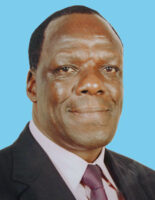
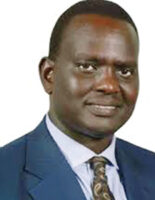
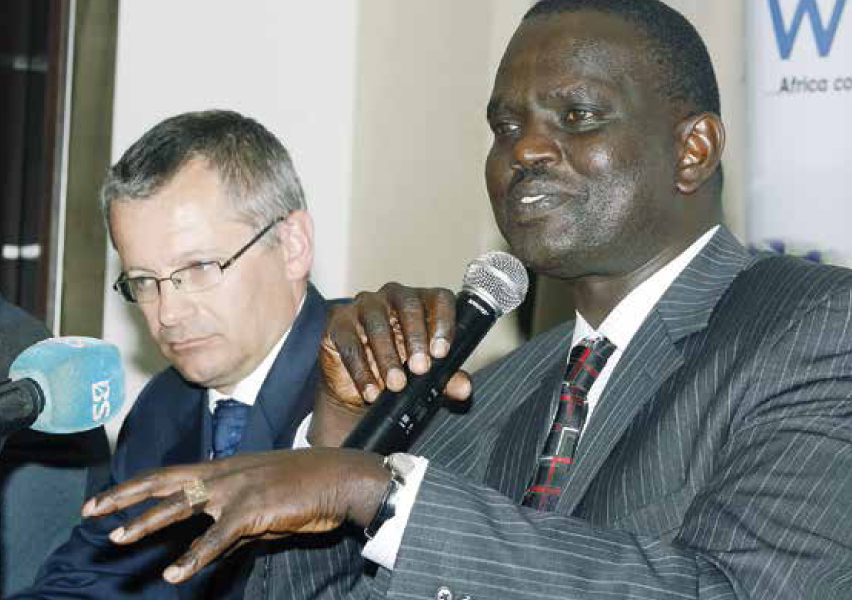
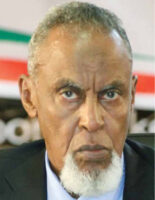
Yusuf Haji – Master of the balancing

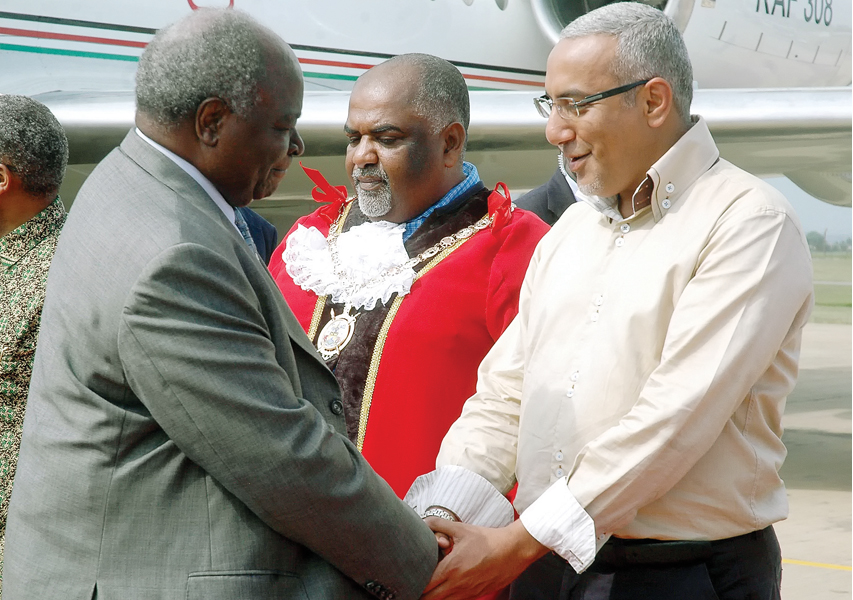
Mohammed Yusuf Haji sports the classic door-knocker beard. It is a style he adopted after he left the provincial administration in 1997, when he was nominated to Parliament by former President Daniel arap Moi. He has mellowed with age too, in a departure from times past – in June 1988, for instance, he earned international censure from human rights organisations when as a Provincial Commissioner he had a man jailed for refusing to give him a lift. Haji’s official car had broken down and he flagged down a Peter Makau, an electrician who responded, “Go and find a Government of Kenya vehicle. My car is not a government vehicle.”

Within hours, the PC had reported the matter to the Officer Commanding Police Division Eldoret and the electrician was arrested. He was jailed for three months the very next day by a magistrate who said he had behaved “in a very unsocial manner… government officials deserve respect. The accused lacked respect… (and a) deterrent sentence should be meted out as a lesson to those with such mind and unbecoming behaviour.”

Having joined the provincial administration in 1960, Haji had a colourful career as an administrator, legislator and then President Mwai Kibaki’s Minister for Defence. His entry into the Cabinet in 2008 followed the 2007 General Election in which he won the Ijara parliamentary seat on a Kenya African National Union (KANU) party ticket. At the time, KANU was one of the parties supporting Kibaki’s presidential candidacy on a Party of National Unity (PNU) ticket.

But the elections ended in chaos after the Orange Democratic Movement (ODM) led by Raila Odinga rejected the results, sparking violence in Nairobi, parts of Rift Valley and Nyanza provinces. The violence left about 1,400 people dead and 500,000 others displaced, prompting the international community to step in. Following mediation efforts, Kibaki and Odinga signed a power-sharing deal that resulted in a coalition government with Odinga as Prime Minister. The agreement also stated that they would share out Cabinet positions among their supporters. It was this arrangement that brought Haji into the Cabinet on Kibaki’s side of the coalition.

Soon after his Cabinet appointment, the Kenyan military faced an emerging Al-Shabaab militia in neighbouring Somalia. The militias had in 2008 strengthened relations with Al-Qaeda insurgents and were also carrying out soft-target attacks in Somalia. Their growing profile and notoriety posed a regional dilemma as various nations tried to strengthen Somalia’s internationally recognised Transitional Federal Government (TFG), which had been formed in Nairobi. The TFG had violently lost control of the country’s capital Mogadishu to the Islamic courts in 2006. In response, President Kibaki had expressed his government’s commitment to work closely with Inter-Governmental Authority for Development (IGAD) member states, the African Union and the TFG towards sustainable peace in Somalia.

Born in Garissa on 23 December 1940 to an Ogaden Darod family, Haji was best known for his stellar performance as an administrator, having served in various parts of the country under presidents Jomo Kenyatta, Moi, Kibaki and Uhuru Kenyatta – the latter two as a politician.

Unlike other administrators with university qualifications, Haji had only a secondary school certificate before he joined the government and sat for the 1970 Administrative Officers Course at the Kenya Institute of Administration. Then stationed in Maseno, Kisumu District, he was forced to re-sit five of the six courses after which he was appointed a District Officer. Later on, he did a short course at the University of Birmingham in the United Kingdom.

As a young administrator at a time when Kenya was going through the Shifta war, Haji always found himself on the receiving end of senior administrators. He would later tell Parliament of this experience. “I remember as a young District Officer in Kisumu, I was the DO Boma. The District Commissioner was Mr. J.P. Bondo in 1969, when the President of Somalia, Mr. (Abdirashid) Sharmarke, was shot. I went to the office of the DC in Winam, which was the headquarters, to brief him. When I entered his office, the greeting was: ‘Oh, pole Bwana Haji, for the death of your President.’ I was shocked. I asked him, ‘Which President?’ He said: ‘The President of Somalia.’”

Haji’s meteoric rise began in 1981, when he was promoted to become the Siaya District Commissioner. By then the district was a hotbed of Opposition politics, with Jaramogi Oginga Odinga controlling Nyanza politics from there. This was Haji’s second stint in Siaya, having served there in 1970 as a District Officer. His return to Siaya came three weeks after Odinga’s bid to enter Parliament as the Bondo MP had fallen flat after he allegedly described President Kenyatta as a land grabber. Although Odinga denied making such a remark, he was denied a chance to vie for the Bondo seat.

With left-wing politics taking shape and with district commissioners enjoying unfettered power, Haji had been thrown into stormy territory. But after only one year, he was moved to Kiambu District at a time when Moi was concerned about the emergence of underground groups such as Mwakenya. Kiambu was also the political base for Charles Njonjo, who in June 1980 had been appointed Minister for Home and Constitutional Affairs and whose influence within the body politic was widely known and feared.  More so, Moi had started a crackdown on radical MPs who included Koigi wa Wamwere, James Orengo, Abuya, Onyango Midika, Chibule wa Tsuma, Lawrence Sifuna and Mashengu wa Mwachofi.

Haji did not stay long in Kiambu; he was promoted in July 1982 to Senior District Commissioner in the Office of the President with the likes of Stanley Thuo and Anthony Oyier. But this appointment was cut short by the abortive 1982 coup, and Haji was appointed Provincial Commissioner for Western Province as Moi reorganised the provincial administration and security department.

The attempted coup also brought the Somali community closer to the Moi presidency as the insurgence was crushed by General Mahmoud Mohammed. Shortly after, Mohammed’s younger brother, Hussein Maalim Mohammed, was appointed Minister of State in the Office of the President. He was the first Kenyan of Somali descent to be appointed to the Cabinet.

With such networks, and years of building trust, Haji had by 1992 risen to become the Rift Valley Provincial Commissioner – a coveted position within the public administration. He was the first PC from the Kenyan-Somali community.

The reintroduction of multi-party politics in 1991 had ignited ethnic tensions in the Rift Valley and clashes between the Kikuyu and the Kalenjin communities had been witnessed in various parts. Haji found himself accused of doing little to stop the clashes. In Nairobi, Head of Civil Service Philip Mbithi blamed the Opposition for the skirmishes. Amid this criticism, Haji was sent to Western Province and replaced by Zachary Ogongo. But after a four-year stint in Kakamega District, he was moved back to Nakuru District to run the politically-sensitive province after Ogongo was accused of insulting Catholic Bishop Ndingi Mwana a’Nzeki who had raised various concerns on security and further flare-ups of ethnic tension in the province.

In 1997, Haji finally retired from the civil service and became Moi’s campaign coordinator in North-Eastern Province. After Moi’s victory against Kibaki in the 1997 General Election, he was nominated to Parliament by KANU and appointed Assistant Minister in the Office of the President.

In Parliament, Haji became a fervent defender of the Moi regime and often clashed with members of the Opposition. For instance, when James Orengo moved a motion of no confidence in the government in October 1998, Haji dismissed it as “out of place” and described Orengo as an “infidel”.

“The mover of the motion and those who support it are people who are short-sighted, and no wonder the mover is wearing glasses because he is also short-sighted… President Moi has provided solid, sober and pragmatic leadership to this country. Only somebody who is day-dreaming (would) dream of removing KANU from power.”
So powerful was Haji that he even influenced the creation of Ijara District, carved out of the larger Garissa, and it became one of the smallest districts in Kenya. Interestingly, the district had only one constituency.

But he was still a respectable figure and in June 1998, he was part of a committee of legislators from the parliaments of Kenya, Uganda and Tanzania established to prepare for the formation of the East African Legislative Assembly. The Kenyan delegation was represented by Francis ole Kaparo, Samuel Poghisio, Haji, Paul Kihara, George Ngure and David Musila.

In March 2002, as Moi prepared to exit from power, Haji was made the KANU National Treasurer, cementing his place among the Moi loyalists. But when many of his fellow party members defected – including heavyweights such as George Saitoti, Kalonzo Musyoka, Joseph Kamotho and Moody Awori – in protest over Moi’s choice of Uhuru Kenyatta as his successor, Haji opted to stay on and fight for the Ijara seat on a KANU ticket.

And when his boss, William ole Ntimama, resigned as Minister of State in the Office of the President, Moi appointed Haji, then Ntimama’s Assistant Minister, to take over.

Haji would then campaign for Uhuru Kenyatta in North-Eastern Province and even managed to lock Kibaki’s National Rainbow Alliance (NARC) out. KANU captured 10 of the 11 parliamentary seats and won 62 per cent of the votes cast. Haji also won Ijara by 4,177 votes against NARC’s Nur Ahmed Sul who got 1,573 votes.

As the country prepared for the 2007 elections, Kenyatta declared that he would side with President Kibaki, who had won the presidency in 2002, and that KANU would not field a presidential candidate. Haji once again vied for the Ijara seat on a KANU ticket.

In the expanded coalition government between President Kibaki and Prime Minister Odinga, Haji as Minister for Defence worked with Gen (Rtd) Joseph Nkaissery and former Provincial Commissioner David Musila. Haji’s Cabinet position also helped Kibaki consolidate his support in North-Eastern Province, where Odinga had made inroads with his ODM party.

Haji would play a formidable role in negotiating peace in Somalia and he would later reveal that Kenya was in Somalia for a long stay. He said Kenyan troops were “pushing Al-Shabaab away from our boundary and securing our border and we will go as far as we will go…”

Some scholars say Haji was the brains behind the Somalia invasion and that he played a critical role in stabilising the war-torn country. He also played a role in mediating between the Ogaden National Front and the Ethiopian government as chairman of the mediation committee between 2012 and 2018. Later, at the request of President Uhuru Kenyatta, he mediated between Somalia’s President Mohamed Farmajo and Jubaland President in Somalia, Ahmed Islam alias Ahmed Madobe.

So powerful was Haji that he even influenced the creation of Ijara District, carved out of the larger Garissa, and it became one of the smallest districts in Kenya. Interestingly, the district had only one constituency

At a time when his age mates were no longer seeking elective positions after Kibaki’s exit, Haji decided to contest the Garissa Senate seat in 2013 on a Jubilee ticket – this time with Kenyatta as the presidential candidate. After winning the seat, he was appointed a member of the Senate Defence and National Security Committee. Under his watch, the committee remained off-camera, as a result of which he clashed with the Media Council of Kenya for restricting the entry of journalists to cover committee sessions.

As a result of his long career as an administrator and as a politician, Haji was appointed chairman of the Building Bridges Initiative Task Force, which was mandated to guide public participation in the quest for national unity, inclusion and consolidation of the 2010 Constitution. In the push for further constitutional changes, he supported the introduction of a clause to allow Members of Parliament to be appointed to the Cabinet. Mohamed Yusuf Haji died at the Aga Khan Hospital, Nairobi on February 15 2021 aged 80.In his condolence message to the family President Uhuru Kenyatta called Haji “a highly respected leader and elder whose wisdom, deep knowledge of the Kenyan society and long experience as a public administrator enabled him to serve the country in various leadership roles with distinction for many years.”
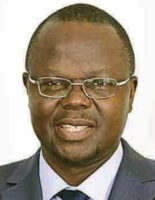
Ochilo Ayacko – Loyal lieutenant

When it comes to loyalty, few men exemplify it as much as Ochilo George Mbogo Ayacko, whose decision to stick with his political mentor, Raila Odinga, saw him demoted from a powerful ministry to a less influential one, and then fired from President Mwai Kibaki’s Cabinet one short year later.

The soft-spoken but fierce political operator was part of Kibaki’s Cabinet during its most wobbly period – when ministers exchanged harsh words on numerous occasions and almost succeeded in dividing the country in two.

“It was the worst environment to work in. Our divisions disappointed Kenyans, who had put a lot of faith in us,” Ayacko recalled with regret and bitterness about the happenings of his time in the Cabinet – from 2003 to 2005 when he was summarily dismissed.

“Kibaki was a wonderful President. He truly wanted to make this country great. He gave ministers the latitude to execute their mandate. All he wanted was for us to demonstrate how what we did impacted the livelihoods of the common man. Then issues started showing up,” he said.

Kibaki was a wonderful President. He truly wanted to make this country great. He gave ministers the latitude to execute their mandate. All he wanted was for us to demonstrate how what we did impacted the livelihoods of the common man.

Ayacko blamed the infighting among Cabinet members, the broken memorandum of understanding that dealt a blow to the National Rainbow Coalition (NARC) that had won Kibaki the presidency in 2002 and the emotive 2005 referendum on changing the Constitution of Kenya as the main factors that compromised the gains of the revolution that had ended the previous regime’s grip on Kenya.

“As Opposition leaders, we had chased KANU (the Kenya African National Union party) out of power with high hopes of changing the country. When NARC became unstable, it was very painful for those of us who had come together to change Kenya,” he said.

Ayacko’s political career is entangled with that of his political mentor, Odinga – his national politics story started with Odinga’s rise. After breaking away from FORD-Kenya and leaving it with a faction led by Kijana Wamalwa in the 1990s, Odinga reactivated the National Development Party (NDP). Within a few months, he had established NDP and its tractor symbol (“Tinga”) as a new political force that would become the most dominant party in Luo Nyanza from 1997 to around 2002.

In the 1997 General Election, Ayacko, then a political novice and a fresh law graduate from the University of Nairobi, was among the new faces in NDP. He also became the diminutive figure that felled a giant when he defeated the flamboyant, eloquent and wealthy KANU-nominated Minister, Dalmas Otieno, in Rongo Constituency.

That election also saw an end to the era of a few KANU bigwigs in the region. They included Otieno, Wilson Ndolo Ayah and Lazarus Ombayi Amayo. Whereas Otieno lost to Ayacko, the veteran Ayah lost his Kisumu Rural seat to another newcomer, Ochoro Ayoki. After his win, Ayacko became one of Odinga’s most trusted lieutenants in the region.

In 1998, he was among the NDP MPs who voted against a no-confidence motion that had been moved against the government of Kibaki’s predecessor, President Daniel arap Moi. They argued that supporting the motion would have jeopardised their party’s chances of ascending to power peacefully. The other NDP MPs were Otieno Kajwang, Owino Acholla, Tom Onyango, Odhiambo Omamba and Shem Ochuodho.

The motion had been sponsored by James Orengo, who was then in the Social Democratic Party.

Following this, Ayacko was picked to be part of a select team comprising Kibaki (then the Leader of Opposition), Odinga, Mukhisa Kituyi, Oloo Aringo, Jimmy Angwenyi and Norman Nyaga that was tasked with conducting parliamentary reforms. The team’s objective was to fight for the autonomy of Parliament so it would stop appearing as if it was an appendage of State House.

It was this team that helped to establish the Parliamentary Service Commission and introduced the provision of offices for all MPs.

Ayacko also worked with a team under former Ol Kalou MP Muriuki Karue to come up with the Constituency Development Fund and was the chairman of the powerful Parliamentary Investment Committee for two years.

In the 2002 General Election, he was re-elected to Parliament on a NARC ticket and thereafter appointed Minister for Energy. His Assistant Minister was Mwangi Kiunjuri and the Permanent Secretary was Patrick Wanyoike.

His short tenure in the Energy docket – from 2003 to 2004 – brought widespread reforms to the sector, some of which led to international donors and the World Bank restoring their support through the Energy Sector Recovery Project after several years of an imposed freeze on support that had been occasioned by reports of corruption during the previous regime.

Ayacko was also credited with strengthening the operations of the Kenya Electricity Generating Company PLC (KenGen) after its unbundling from Kenya Power Company, and setting the steps for the establishment of the Rural Electrification Authority, created to speed up implementation of the rural electrification programme.

He also spearheaded the phasing out of leaded petrol with an initial deadline of December 2005.

The former Minister said President Kibaki was interested in three things in the energy sector.

“First, he insisted that we work to ensure that the cost of electricity tariffs was not raised. Second, he pushed to ensure that the cost of petroleum products, including fuel, did not go up and (third), he worked hard to ensure an increase in connectivity of electricity in rural areas.”

He said Kibaki also insisted that the cost of electricity generation should not be passed on to consumers.

The Kibaki government would also come up with the Energy Regulatory Commission, whose mandate it was to regulate the petroleum, electricity and renewable energy sectors away from political interference.

Despite orchestrating several reforms in the ministry, Ayacko did not last long as the wrangles in NARC increased. On 30 June 2004, President Kibaki executed his first major government reshuffle in which he added 18 newcomers to his Cabinet, including MPs from FORD-People and KANU, which were Opposition parties.

Although he did not fire any ministers from the increasingly intransigent Liberal Democratic Party (one of the parties under NARC), he transferred a number of them to less influential departments.

FORD-People leader Simeon Nyachae was appointed the new Minister for Energy and Ayacko was transferred to the Ministry of Sports, Gender and Culture, where he would last only one year before being fired from the Cabinet.

In his new docket, Ayacko introduced the Sports Policy that culminated in the Sports Act, and the Gender Policy and Act that came into law and led to the establishment of the Gender Commission. He also initiated the establishment of the National Sports Stadia Management Board and was involved in the successful bid to have the 2011 World Athletics Championships held in Kenya.

The 2005 referendum debacle ended his Cabinet career after Kibaki sacked all the ministers who opposed the government-backed draft Constitution. Ayacko was among the seven ministers who drove the ‘No’ campaign that was led by Odinga and Kalonzo Musyoka. The others were Najib Balala, William ole Ntimama, Anyang’ Nyong’o and Linah Kilimo.

The government faced such an embarrassing defeat that on 23 November 2005, Kibaki dissolved the entire Cabinet midway through its term, the first time in Kenya’s history such a thing was happening.

In the 2007 General Election, Ayacko contested the Rongo parliamentary seat against Otieno Anyango and his old rival, Dalmas Otieno, in a hotly-contested election marred by violent confrontations. Anyango’s head of security, Oricho Nyandere, was killed by supporters allied to Ayacko, which saw him lose the election to Dalmas, who won some sympathy from the electorate.

After the election, the Kenya South Sudan Liaison Office seconded Ayacko to South Sudan as a legal adviser to President Salva Kiir on legislative and constitutional matters. No long afterwards, Kibaki and his new partner in government, Prime Minister Raila Odinga, appointed him Executive Chairman and CEO of the Kenya Nuclear Electricity Board where he served until 2013. During that period he was also appointed a director at the Lake Basin Development Authority.

He would also be appointed as a commissioner with the African Commission on Nuclear Energy based in Addis Ababa, Ethiopia, and was later on elected to chair the commission.

Ayacko made a return to politics in 2017, vying for the Migori governorship against Okoth Obado. He lost the race and challenged the outcome in the High Court of Kenya. He lost and moved to the Court of Appeal, where his petition was dismissed.

In 2018, he was listed among nominees for an ambassadorial position but he declined as he was keen to continue pursuing his political ambitions. After the death of Migori Senator Ben Oluoch, Ayacko contested the position in the by-election and won.

The Senator traces his entry into politics to his days as a law student at the University of Nairobi. He was among the student leaders who from 1990 pushed for the return of the Student Organisation of Nairobi University (SONU), which culminated in the revival of the giant students’ union in 1992.

“I remember fighting for the revival of SONU with the likes of Ruaraka MP T.J. Kajwang. Before that, all the SONU leaders had been expelled and a number of them detained. After SONU was revived, we handed it over to the likes of former Mukurweini MP Kabando wa Kabando,” he recalled.

Born on 10 September 1968, Ayacko studied at several primary schools in Migori District (present-day Migori County) before joining Homa Bay Secondary School for his O’ levels. After doing his A’ levels at Alliance High School, he joined the University of Nairobi to study law. He also has a Masters in Law from the University of Nairobi, a Masters in Nuclear Law from the University of Montpellier in France and a PhD in Leadership and Change Management from the United States International University-Africa.

Wycliffe Oparanya – Vision 2030 champion

With his unmistakable picture of calm and serenity even in stormy political meetings, Wycliffe Ambetsa Oparanya became President Mwai Kibaki’s alter ego in the tumultuous Government of National Unity formed after the disputed 2007 elections.

In the days of performance contracting in government during the President’s final term, the now 64-year-old Governor of Kakamega County, was often rated as the best-performing minister.

He had harnessed his grassroots mobilisation skills in 2002 to beat academic Amukowa Anangwe for the Butere seat once held by the maverick Martin Shikuku.
A stealthy strategist, he won the first election on Kijana Wamalwa’s Forum for the Restoration of Democracy-Kenya (Ford-Kenya) ticket in the National Rainbow Coalition, NARC. But Oparanya leaned closer to Raila Odinga’s Liberal Democratic Party (LDP) even as he remained ideologically aligned to Kibaki, with whom he has much in common.

While the Governor is a commerce graduate and a certified public accountant, he enrolled for a PhD in economics at the University of Dar es Salaam, but has never completed the studies.

Deceptively uncharismatic (his surname in Marama, his local dialect, means something very weak), Oparanya wormed his way into the hearts of Butere voters through football and welfare clubs.

Oparanya considers the adoption of Sessional Paper No.10 of 2012 on KenyaVision 2030 which he presented to the House on 4 December 2012 the tailend of the Kibaki Administration as one of his most important achievements

He actively supported, as patron, many football teams and women’s welfare groups. AFC Leopards (a national football team) playing local teams became a frequent Christmas/Boxing Day football fixture long before he first ran for an elective office.

Having had a stint in football management at AFC Leopards, the national football club with origins and popularity in the western part of the country, he launched a tournament called Oparanya Cup which dominated the constituency for many years.

He formed groups of 60 youths, 60 women and 60 mainstream committees to campaign for him in every sub-location, teams that exist to date, 20 years on.

Unlike the Kenya African National Union (KANU) candidate who used the party approach, Oparanya worked with organised groups such as the Kenya National Teachers’ Union (KNUT) and the Kenya football Federation (KFF) officials, becoming a frequent guest at their functions.

His eventual entry into Butere politics was therefore expected and long in coming, having been an ever-present figure in the body politic of the constituency in south-west Kakamega.

He was also at the right place at the right time, arriving on the scene when the ground was fatigued with KANU — and by extension with Anangwe, who became the Minister for Cooperative Development on his first entry to Parliament in the dying days of the independence party.

In the 10 years he was Member of Parliament (MP) for Butere, Oparanya was patron of a unique benevolent scheme that attended to the needs of professionals during funerals. Word of this welfare-centred approach spread like wildfire and went before him in his campaigns.

As MP, the Constituency Development Fund (CDF) management was lauded for its participatory approach that won the hearts of the constituents. He was known to get grassroots updates from his team daily, therefore figuring out beforehand how to react to each zone differently. With this pulse on the constituency his re-election was smooth.

And while he had spent his first term on the back bench in a region that produced many NARC luminaries such as Kijana Wamalwa, Moody Awori, Mukhisa Kituyi, Newton Kulundu, Musikari Kombo and Andrew Ligale — who all became ministers or assistant ministers in 2003 — Oparanya was destined for greater things in his second term.

His education and profession ranked him higher than other MPs from the larger western region, making him an easy pick for a ministerial post in the Government of National Unity.

It helped that he had aligned himself with Odinga who became Prime Minister in the arrangement.

His quiet mien also endeared him to the President, long acknowledged as the gentleman of Kenya’s politics. This, coupled with Oparanya’s solid corporate finance background, was a critical factor in getting him appointed as Minister for Planning, National Development and Vision 2030 — the beating heart of the President’s enduring legacy.

So close was Vision 2030 to the President’s heart that he used to call technical experts to take ministers through the blueprint during Cabinet meetings, according to recollections of ministers of that era.

Oparanya considers the adoption of Sessional Paper No.10 of 2012 on Kenya Vision 2030 which he presented to the House on 4 December 2012 — the tail end of the Kibaki Administration — as one of his most important achievements.

This paper sought to ensure the continuity of President Kibaki’s development legacy even as he left the scene. One of the broad goals of the Sessional Paper was to accelerate the ongoing infrastructural development, “focusing on quality, aesthetics and functionality of the infrastructure services developed”. Another was to develop infrastructure to support identified flagship projects to ensure contribution to economic growth and social equity goals.

The paper laid the foundation for continued infrastructural development under the Jubilee Party of Kenya Administration.

As Minister for Planning, National Development and Vision 2030, Oparanya also presided over the Kenya New Partnership for Africa’s Development (NEPAD) Secretariat that was coordinating the country’s position of the African Peer Review Mechanism (APRM).

Launched in 2002 by the African Union (AU) and established in 2003, the APRM is a tool for sharing experiences, reinforcing best practices, identifying deficiencies, and assessing capacity-building needs to foster policies, standards, and practices that lead to political stability, high economic growth, sustainable development, and accelerated sub-regional and continental economic integration.

The AU Assembly later extended the mandate of the APRM to include monitoring of the implementation of the AU Agenda 2063 and the United Nations Sustainable Development Goals (SDGs), Agenda 2030.

It was Opranya’s duty to prepare the country for peer review at a difficult time when Kenya was emerging from the 2007–2008 post-election violence. The period was characterised by volatile politics based on suspicion and division.

As a member of the Orange Democratic Movement Party (ODM), it was a major challenge for the Minister to rally the country towards a common agenda since there were groups that maintained that the government had done well in governance, while civil society was up in arms calling for the prosecution of the perpetrators of the post-election violence.

Oparanya’s confident, yet self-effacing demeanour, endeared him to members of the Party of National Unity (PNU) side of the Coalition, ensuring a smooth running of the Ministry that worked closely with such other critical dockets as Finance and the Office of the President.

As Minister, Oparanya was deputised by the Gatanga MP Peter Kenneth, another legislator who was celebrated for his prudent use of CDF cash. Completing the top tier at the ministry was Permanent Secretary Edward Sambili, the economist who had been Deputy Governor of the Central Bank of Kenya.

The Ministry of Planning, National Development and Vision 2030 and that of Finance, were instrumental in the dispersal of CDF monies which, before the advent of counties, was the first initiative of that magnitude to take resources directly to the people throughout Kenya.

It targeted all grassroots development projects such as putting up new water, health and education facilities in all parts of the country, including remote areas that had been marginalised for decades. The initiative went a long way towards combating poverty.

The Fund that began with a dispersal of KES 1.3 billion in the 2003/2004 financial year, had multiplied tenfold to reach KES 15 billion by the time President Kibaki was leaving State House in 2013.

The politician also presided over the 2009 census, the 6th in independent Kenya. .Ahead of the census, the Minister was in the spotlight in Parliament when MPs representing the pastoralist communities demanded to know how the government was going to capture data from those who had ventured outside their homes and across the borders to seek pasture.

Owing to the biting drought at the time, many pastoralists had moved to Tanzania, Somalia and Ethiopia. Oparanya, however, stood his ground and insisted that those outside the country were not going to be enumerated because the law did not allow it.

“We only enumerate people within Kenya borders during the census night. Legally, we are not supposed to include any part of the population found outside the country during the period. We have made Members of Parliament to be part of the District Census Committee, so that they are able to help in publicity and advocacy to ensure that they talk to their own constituents to make sure they are available during the census,” he told a jittery Parliament.

But even as a Minister, Oparanya did not shy away from pinpointing the shortcomings in government. In May 2009, donning the hat of the MP for Butere, Oparanya told Parliament that he found shortcomings within the Presidential Speech because he did not address the plight of the sugarcane industry.

“About six million Kenyans depend on sugarcane directly or indirectly, especially those people who reside in Western Kenya. This industry has been there. You will remember we had the Ramisi Sugar Company from the 1920s. It collapsed,” said Oparanya.

He took issue with huge debts that he said had saddled farmers for ages. “In the last Parliament, we said that the debt within the sugar industry was over Ksh20 billion with interest application being over Ksh25 billion by now. We have talked about it over and over again,” he fumed.

It was not usual for a member of the Front Bench in Parliament to criticise the President’s speech, but Oparanya, the shrewd operator, must have worried more about his voters in the sugar belt. In 2013 he left Parliamentary politics to run for the governorship of Kakamega County which he won comfortably. His calculated risk-taking had paid off.

Born in 1956, Oparanya first attended Mabole Primary School, then proceeded to Butere Boys Secondary School for his O’ level education. He did his A’ level at Kisii High School, before joining the University of Nairobi in 1977. He in 1980 with a Bachelor of Commerce.

In 1983 he became a Certified Public Accountant (CPA-K) before studying for an MBA in Finance from the University of Nairobi between 1999 and 2002. In 2006 he registered for a PhD in economics at the University of Dar es Salaam.

Before joining politics in 2002, Oparanya worked at Kenya Aerotech Ltd. Earlier, he worked at the audit firm Ernst & Young where he rose from Senior Audit Manager, Secretary to the Board, Finance Director and finally the Group Financial Controller.

In all he had more than 20 years’ experience in local and international finance management, audit and business consultancy.

In 2014 Oparanya was made a Fellow of the Institute of Certified Public Accountants of Kenya (FCPA), a prestigious award for his contribution to the accounting profession.

As MP for Butere, one of Oparanya’s landmark projects was the clearing of mud-walled schools in the constituency and facilitating scholarships specifically into China for his young constituents.

So was the tarmacking of the Ekero — Buyangu and Sigalagala — Butere roads, the first such infrastructural development in the constituency since the country’s independence in 1963. For this he remains a darling of Butere even after he left to serve as a governor for two terms.

Oparanya’s development agenda, which started during the Kibaki era, has continued into the devolution age. Even Amukowa Anangwe, his predecessor as MP and schoolmate at Butere High, grudgingly acknowledges Oparanya’s political acumen.

The Governor has built a stadium and a hospital, and has constructed modern markets in all the 12 sub-counties and at least 14 bridges. He has also launched OparanyaCare, a fairly successful medical scheme.

Njenga Karume – The faithful confidant

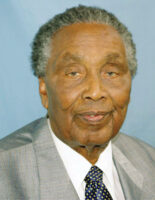
Njenga Karume and Mwai Kibaki were the best of friends. But how Karume, a Standard 4 primary school dropout, could hobnob with an economist, who had not only lectured at the prestigious Makerere University but also passed all his exams with a distinction at both Makerere and at the London School of Economics, was the mark of this friendship.

In June 2004, at a time when Kibaki was facing rebellion within his own government, he reached out to Karume, who was then a member of the ruling party, the Kenya African National Union (KANU), to join the National Rainbow Coalition (NARC) Cabinet under the Government of National Unity. They had met in State House Nairobi after Karume was summoned by Head of Civil Service and Secretary to the Cabinet, Francis Muthaura, from Mombasa. “I was quite surprised,” he would later say. “All along, speculation had been that Kibaki would appoint Paul Muite in order to include a Kiambu Member of Parliament (MP) in his Cabinet.”

But Karume had been selected to join an expanded Cabinet that included FORD-People’s (Forum for the Restoration of Democracy-People) Simeon Nyachae and KANU’s John Koech and William ole Ntimama in a bid to create a regional balance, to cater for regions that had not voted for NARC during the December 2002 General Election.

Karume was appointed to head the newly created Ministry of State in charge of Special Programmes. At the time, Kenya was facing severe drought and Karume’s task was to work with humanitarian agencies and liaise with other government departments to get food and water to the affected communities. An estimated 3.3 million people were facing starvation in 26 districts across the country and the country was seeking US$ 33 million in donor aid.

“I did not just sit in my office and wait for reports from my officers. I took an active role, and liaised with relevant ministries and humanitarian organisations as much as possible in order to ensure that people did not die of hunger,” he wrote later in his autobiography, Beyond Expectations.

It was during Karume’s tenure that Kenya joined six other countries in signing a United States government-sponsored Memorandum of Association for joint regional disaster management. Also, the Regional Disaster Management Centre with its headquarters in Kileleshwa, Nairobi, was opened.

Born in 1929 in Elmentaita in the Rift Valley, where his family had settled after emigrating from Kiambu, the young Karume dropped out of school early and was lucky to join Jean’s School Kabete, later Kenya Institute of Administration (now the Kenya School of Government), where he was a awarded a certificate in business studies. As such, he entered the business arena at an early age selling charcoal, timber, and hides and skins before venturing into liquor sales.

While it was in this beer business that Karume would make a mark as an entrepreneur having started to operate bars during the colonial period, it was his leadership of the quasi-political Gikuyu Embu Meru Association (GEMA) that would catapult him into the inner circle of the President Jomo Kenyatta-era politics.

GEMA had been formed in 1971 initially as a welfare organisation; Karume later become the face of the organisation. But GEMA was detested by some of President Jomo Kenyatta’s advisers, including Attorney General (AG) Charles Njonjo. Its interim officials were Gikonyo Kiano (Chiarman), Lucas Kamau (Secretary General), Kibaki (Treasurer) and Waruru Kanja (Organising Secretary). Karume was elected the chairman with Kihika Kimani as the Organising Secretary in 1973. Kibaki did not defend his seat and Jacob M’mwongo was elected in his place.

Karume would later claim that Kibaki’s decision to leave Nairobi, where he was Member of Parliament (MP) for Donholm to vie for the Othaya seat, was a result of pressure from GEMA.

It was this earlier dalliance with Kibaki that would shape their political relationship.

While Karume had not gone for elective politics, his position as GEMA chairman gave him immense power. That is the reason why he became a central figure during the 1977 Change-the-Constitution movement in which some politicians wanted to block Daniel arap Moi’s automatic ascension to the Presidency in case of Kenyatta’s death.

Opposition to Moi had begun in September 1976 when two huge rallies were held in Nakuru on 26 September and in Limuru on 3 October 1976. These were attended by among others, Cabinet ministers from GEMA who were demanding the removal of the provision for the Vice President’s automatic succession. Among the ministers were Jackson Angaine, James Gichuru, Paul Ngei and Taita Towett plus Njoroge Mungai, Karume and several Gusii MPs.

But Moi had Njonjo and Kibaki by his side and on 6 October, Njonjo issued a statement from Nakuru warning politicians, “it is a criminal offence for any person to compass, imagine, devise or intend the death or deposition of the President.”

It was the AG, according to Karume, who convinced him to stop supporting the Change-the-Constitution movement “since it was in bad taste”.

On 11 October 1976, the Cabinet met in Nakuru and endorsed Njonjo’s statement as law.

A year later and as Moi took the oath of office, he knew that the only politically vibrant group he had to deal with was GEMA. By then, Karume was a nominated MP. Although there were other smaller welfare groupings, such as the Luo Union and the Abaluhya Union, they confined themselves to welfare activities and were not as politically pronounced as GEMA.

Karume claims that, as chairman of GEMA, Moi called him to his Kabarnet Gardens home to ask his opinion on a suitable candidate for Vice President.

“Your Excellency, it is your prerogative, but I think Mwai Kibaki is best,” Karume replied.

After the 1979 General Election, Moi picked Kibaki as his Vice President and soon, after a leaders’ conference at the Kenya Institute of Administration in July 1980, the government decided to abolish all tribal unions in the country, in the interests of ‘peace, love and unity’. GEMA was proscribed, leaving Karume with no regional political platform.

But the cold war between Karume and Njonjo, over his earlier opposition to Moi and for his position within GEMA, continued unabated. And it extended to Kibaki, causing the emergence of political groupings within the ruling party that eventually led to Njonjo’s downfall.

Njonjo was branded a traitor after Moi claimed that foreign powers were grooming an unnamed person to take over the government.

Coming shortly after the abortive 1982 coup attempt led by the Kenya Air Force (KAF), which also helped Moi to consolidate his power base further, the fall of Njonjo led to the reorganisation of Moi’s inner circle. The President also called for early elections in 1983 in which almost all of Njonjo allies were removed from Parliament and government.

With Njonjo out, the President set about taming Kibaki and his allies, including Karume. Although he had won a seat in the 1983 General Election, the queue voting system for KANU positions in Kiambaa Constituency in 1988 turned into a national fiasco. Karume had been elected unopposed at the Cianda sub-branch, but the results showed he was by someone who was not even a candidate for the position.

A similar stunt was tried in Kibaki’s Othaya Consitituency, where Kibaki stopped the DC as he was announcing the results to inform him that the candidate he had named as a winner was deceased. “Even rigging requires some intelligence,” Kibaki told the DC.

After the 1988 General Election, Kibaki was dropped as Vice President and the position was given to Josephat Karanja. Kibaki was appointed as Minister for Health.

As a Cabinet Minister, Karume had become one of the trusted allies of President Kibaki, cementing a friendship that has started many years before

Moi was then under pressure to return the country to a multiparty system and bold politicians led by Oginga Odinga, Kenneth Matiba, Charles Rubia and George Anyona started pushing for the repeal of Section 2A of the Constitution, which made KANU the only party allowed in the country.

While most of these leaders coalesced around FORD, which was agitating for change, the grouping started to disintegrate due to power struggles.

According to Karume, he then approached Kibaki and John Keen and mooted the idea of starting a political party. This is how the idea to form Democratic Party of Kenya (DP) was born. Kibaki was slated to be the chairman and Keen the Secretary General. Karume then approached Eliud Mwamunga, a former Cabinet Minister, to give it a national outlook.

On 31 December 1991, Kibaki formally announced that he had left KANU for a new party much to the surprise of FORD supporters. But with the split of FORD into Odinga’s FORD-Kenya and Matiba’s FORD-Asili, there was a sudden Matiba wave that spread across Murang’a and Kiambu and all the DP candidates were defeated at the polls. Moi had accused DP of being GEMA in disguise, with KANU leaders suggesting that Karume was the real DP leader. The party was seen as conservative and elitist.

Karume lost his Kiambaa seat to a newcomer, Kamau Icharia. For the first time since 1974, when Karume was nominated by President Kenyatta into Parliament, he was now out and he decided to concentrate his business enterprises.

After losing two elections on a DP ticket in 1992 and 1997, Karume decided to abandon the party as Moi prepared to exit from power. Already, Moi had identified the young Uhuru Kenyatta as his successor while the Opposition had now joined hands and endorsed Kibaki as their candidate.

While the press regarded his departure to KANU as a betrayal of his friend, Karume’s relationship with Kibaki did not wither, as such and he would later become an important cog in Kibaki’s survival.

As Kibaki faced rebellion within NARC, he turned to KANU members in Kiambu for support. He called a leaders’ meeting at the Kiambu Institute of Science and Technology at which the leaders explained that they had no ill-will by supporting KANU.

Later, President Kibaki appointed Karume Minister for Special Programmes and after a few months transferred him to the Ministry of Defence.

During his tenure Karume renegotiated the training of British troops in Kenya. By that time, the relations between the British troops and the Samburu community had been damaged by media reports alleging rape and injuries caused by unexploded munitions left over from decades of exercises in Samburu and Laikipia.

As a Cabinet Minister, Karume had become one of the trusted allies of President Kibaki, cementing a friendship that has started many years before.

Najib Balala – Mr. charm with an edge

If ever the Mwai Kibaki administration that swept to power in 2003 needed a face to symbolise a new beginning, then Najib Balala, the former Mayor of Mombasa, fit the bill perfectly.

In picking the Member of Parliament (MP) for Mvita, Mombasa’s inner city, President Kibaki chose a performer and an early bloomer who had held senior elective positions in the country by the time he was joining Cabinet at 35.

Having just defeated Sharif Nassir, the Mombasa politician and defender-in-chief of the ancien régime that had just been swept aside after ruling the country for 40 years, the young politician was named Minister for Gender, Sports, Culture and Social Services.

Balala was — alongside Ochillo Ayacko (Rongo MP) and Raphael Tuju (Rarieda MP) — the youngest member of the Cabinet which was full of veterans many of whom, though advanced in age, had spent a long time on the backbench during the KANU (Kenya African National Union) era.

This deliberate attempt by the new government to infuse youth and drive and start with a clean slate attracted international acclaim.

Writing for the Woodrow Wilson International Center for Scholars in September 2003, high-ranking US diplomat Johnnie Carson commented on Kibaki’s takeover, pointing out that Kenya’s very successful Parliamentary and Presidential elections of December 2002 had opened the door for a new government and a new era in the country.

In his paper ‘From Moi to Kibaki: An Assessment of the Kenyan Transition., Carson, then Senior Vice-President, National Defense University, Washington, DC, said that Kibaki brought in a number of young, well educated, first-time ministers “who are likely to move ahead rapidly in the years to come”.

He then named Balala, Tuju, and Mukisa Kituyi as young and promising.

Balala considers the spearheading, from January 2003 to June 2004, of the Gender Commission Bill that helped mainstream women’s issues in the country, one of his most important contributions while in this docket.

Later, he was moved to the Ministry of National Heritage where he served from June to November 2005. His most important contribution from his time at this position was, he considers, the development of what became the Antiquities and Monuments Act, 2006.

He prides himself for securing the country’s cultural and archaeological resources which had largely been in the hands of a family of palaeontologists that had helped found it in the early 1900s.

Before this, the National Museums of Kenya (NMK) that was formally founded in 1910 — and whose role is to collect, preserve, study, document and present Kenya’s past and present cultural and natural heritage — was largely controlled by the Louis Leakey family.

The Act gave the government control over the rich national heritage and opened the door for the European Union to finance the framework of the National Museums of Kenya Support Programme (NMKSP) that changed the face of NMK as not only the custodian of national heritage, but an interactive ground for events and social gatherings.

The Act, for the first time, consolidated the laws relating to national museums and heritage to provide for the establishment, control, management and development of national museums and the identification, protection, conservation and transmission of the cultural and natural heritage of Kenya.

The rehabilitation changed the face of NMK from a backwater repository where mostly schoolchildren used to go and learn about the country’s history and material culture, to a modern and outward-looking institution that responds to a broader array of visitors’ needs while providing quality services and products.

Balala’s first stint in the Kibaki Cabinet, however, was soon cut short when he joined a group of rebels in the National Rainbow Coalition (NARC) government led by Raila Odinga that was opposed to the draft Constitution. The government fronted the document and all the ministers who campaigned against it were sacked following its defeat. They included Balala, Odinga, Kalonzo Musyoka and Anyang Nyong’o.

The campaign against the draft Constitution attracted so much following under the Orange symbol that it turned into a political party — the Orange Democratic Movement (ODM). Balala was the first to publicly announce that ODM was going to become a political party at a rally in Kisumu in 2005.

The MP later put up a brief, but spirited campaign for the ODM Presidential ticket running on the slogan Nina jibu (I have the solution), a play on his first name, Najib.

His opponents for the ODM party ticket were the current ODM leader, Odinga, former Vice President Musalia Mudavadi, Eldoret North MP (now Deputy President) William Ruto and former Cabinet Minister Joseph Nyagah.

While he later stood down in favour of Odinga, he mounted colourful campaigns with expensive billboards and flyers that dotted various parts of Nairobi.

While all along Balala had been a celebrated Mombasa leader, he had sprung to the national limelight in 2002 when he joined KANU rebels in opposing President Daniel arap Moi’s attempt to influence the choice of his successor.

These rebels formed the Liberal Democratic Party (LDP) which would later join Kibaki’s National Alliance of Kenya which had brought together the Democratic Party (DP), Charity Ngilu’s Social Democratic Party (SDP) and Kijana Wamalwa’s Forum for the Restoration of Democracy-Kenya (FORD-Kenya). All these hitherto disparate political outfits joined forces under NARC that defeated KANU and brought President Kibaki to power.

It was under NARC that Balala contested the Mvita seat against the coast KANU supremo Nassir. Balala won by a landslide in the first attempt.

His major advantage was that he had been elected Mayor of Mombasa in 1998 against a strong wind of Nassir’s influence, and had learnt how to win favour with Mombasa residents.

As the Mayor of Mombasa, Kenya’s second largest city, between 1998 and 1999 Balala initiated programmes to market the coastal city as a leading tourist destination. He started regular clean-up programmes and embarked on fighting the cartels that held Mombasa hostage.

While his modernisation programmes picked up, the deep-rooted cartels finally won as they soon bundled him out of Mombasa’s City Hall.

A Kenyan of Arab descent, Balala had emerged among the leading lights of the young generation of politicians that fought to take over the country’s leadership from the older generation that thrived in manipulating ethnic differences.

Yet despite these grand ideals, Balala did not escape accusations of ethnic profiling. After successfully defending the Mvita seat on an ODM ticket in 2007, he found himself in the spotlight for hate speech accusations.

Balala considers the spearheading, from January 2003 to June 2004 of the GenderCommission Bill that helped mainstream women’s issues in the country, one of his most important contributions while in this docket

In the heat of unrest that followed the contested election, Balala gave a press conference in which he suggested that areas that supported ODM — including Coast Province — could secede. He said Central and Eastern provinces that overwhelmingly voted for the Party of National Unity (PNU) would be isolated and the party’s sympathisers expelled from the coast.

So unsavoury were the remarks that when the International Criminal Court (ICC) prosecutors were searching for the perpetrators of the 2007–2008 post-election violence, many observers believed that Balala would be among the suspects. He, however, escaped the net unscathed.

Balala was part of the top decision-making body in ODM — the Pentagon — a vehicle on which he rode to Kibaki’s inner sanctum — again.

The other members were Odinga, Mudavadi, Ruto, Ngilu and Nyagah. They were all appointed to key ministerial positions in 2008 following the truce between President Kibaki and the ODM leader who became Prime Minister.

Balala was appointed the Minister for Tourism and was credited with reviving the sector that had been brought to its knees by the post-poll violence.

True to his word, he had a sterling career in the docket. As Minister in charge of Tourism from 2008 to 2012, Balala was elected Chairman of the United Nations World Tourism Organization (UNWTO) Commission for Africa (2011). In 2009 he had been voted the Best Tourism Minister in Africa by Africa Investor (AI), a lobby.

Along the way, the restless Balala fell out of favour with Odinga and gravitated towards Kibaki during the push and pull that characterised the Government of National Unity. He constantly chastised ODM for “lacking democracy and manipulating the party’s grassroots elections”.

Under the terms of the National Accord that brought together President Kibaki and Odinga, his challenger in the 2007 election, the Prime Minister had a say on who would serve in the Cabinet amongst members of his party.

And so in March 2012 Balala was sacked from his Cabinet job.

Odinga would later explain that he had no option but to let Balala go for failing to toe the party line, an accusation which the MP denied, insisting that he had lost his Cabinet post for standing by the truth that the party had no internal democracy.

In May 2012 Balala quit ODM and initially associated himself with the United Democratic Forum (UDF) party that had been formed by Mudavadi who had also quit ODM. At that time, he also hinted that he was ready to work with Ruto and Uhuru Kenyatta — who was then the chairman of KANU.

But in September 2012, Balala launched his own party, the Republican Congress Party of Kenya, on which he planned to contest the Mombasa Senate seat.

On realising that his political support had gone down with the emergence of new players and the continued strong presence of ODM at the coast, however, Balala joined hands with Kenyatta’s The National Alliance (TNA), Ruto’s United Republican Party (URP) and Ngilu’s NARC to form a loose working relationship.

He was, however, prevailed upon to abandon elective politics and support the Kenyatta-Ruto ticket in the 2013 elections. In return, he was promised the post of Cabinet Secretary (Minister).

True to promise, President Kenyatta appointed Balala Minister for Mining in May 2013. This was a new territory for the politician and he said as much in an interview. He is credited with delivering the Mining Bill in 2014. The Bill provided the first institutional framework review of Kenya’s mining sector since 1940.

Balala was moved to Tourism in 2015 and reappointed to Tourism and Wildlife after the 2017 General Election. He oversaw

the drafting and launch of both the National Tourism Blueprint (NTB) 2030 and National Wildlife Strategy (NWS) 2030. He is keen to improve and modernise Kenya’s wildlife conservation sector, which he says is important because it is responsible for 70 per cent of the tourism earnings.

Born in September 1967, Balala attended Serani Boys Primary School in Mombasa, before moving to Kakamega High School in western Kenya where he did both his O’ and A’ levels. He later attended the United States International University (USIU) where he did a Bachelor of Arts Degree in International Relations. He later moved to the University of Toronto in Canada where he studied International Urban Management, and later Business Administration at the John F. Kennedy School of Government at Harvard.

After college in the early 1990s, Balala worked in the tourism industry before he joined the family business that dealt in tea and coffee trade.

While in the private sector, Balala held many key positions. They include Secretary of the Swahili Cultural Centre from 1993–1996 and the Chairman of the Mombasa and Coast Tourist Association between 1996 and 1999. He also served as the Vice Chairman of the Kenya Tourism Board (KTB), and Chairman of the Chamber of Commerce and Industry (Mombasa Chapter) from 2000 to 2003.

At 30 years old, he became the youngest Mayor of Mombasa ever. He was also elected Chairman of the Association of Local Government Authorities of Kenya (ALGAK).

While his heart was always in tourism, Balala was forced to join national politics when he lost the mayoral position.

Today, true to Carson’s assessment, nearly two decades on, Balala and Tuju are Cabinet ministers in an administration that succeeded Kibaki’s while Kituyi is Secretary General of the United Nations Conference on Trade and Development (UNCTAD).

That Balala is still a Cabinet Minister and in charge of a docket he first served in nearly 20 years ago points to his political acumen that has enabled him to keep his ambition alive even as he humbles himself to serve under others.

His longevity is also testament to the wisdom of the man who first gave the first-term MP a Cabinet position, which he has mostly retained for 18 years.

William Samoei Ruto – Strange bedfellows

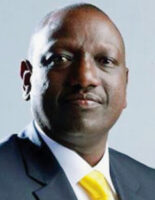
William Samoei Ruto’s entry into Mwai Kibaki’s Cabinet is one more instance proving that politics in Kenya is a spectacle of continuous experiments with various combinations and permutations of strange bedfellows. Indeed, as strange bedfellows go, none could be stranger, at first blush, than Kibaki and Ruto.

In his first term, Kibaki presided over a formidable coalition of heavyweights with whom he had swept into power with a commanding mandate. The coalition itself included a huge bough that had splintered from the Kenya African National Union (KANU), the ruling party that was subsequently handed a humiliating election defeat. This Cabinet therefore boasted a collection of newly-minted progressives who had, until recently, been KANU bigwigs.

Ruto’s path into ODM perhaps set the tone for his political performance for the ensuing decade

The remnants of KANU’s Parliamentary leadership found themselves in unfamiliar territory and did their best to serve as the Official Opposition, with William Ruto taking on an increasingly visible role alongside Uhuru Kenyatta. Kenyatta had the unenviable role of holding a well-regarded veteran from his backyard to account while leading the much-reviled KANU.

Predictably, matters got off to a feisty start, when the Official Opposition faced off with the government side over the plight of landless people in Mochongoi, Nakuru County. KANU leaders held demonstrations to protest eviction and tasted the bizarre experience of being forcefully dispersed by armed policemen, who lobbed teargas canisters at them. Not long afterwards, Ruto would be hauled before Nairobi Chief Magistrate, Uniter Kidulla, to face charges related to KANU’s unconventional fundraising scheme that involved privatising public land and selling it to a well-endowed parastatal to produce money for its ill-fated campaign. These experiences and hostility from several National Rainbow Coalition (NARC) ministers hardened Ruto as an intrepid oppositionist.

Conflict soon arose within NARC over a memorandum of understanding on power sharing that was agreed upon before the elections. While Raila Odinga and his team insisted that it be upheld, Kibaki’s side was happy to deny its existence. To counter the denial Odinga began a dalliance with KANU, whom he had been only too eager to jilt in the run up to the election, to deny Kibaki the ability to deliver a new Constitution.

At this point, Kenyatta was heavily conflicted and had begun to drift NARC-wards even as Odinga’s Liberal Democratic Party (LDP) drifted KANU-wards. Ruto was left leading the charge for the Opposition, and was only too glad for the reinforcement arising from Odinga’s grievances. The government Draft Constitution was defeated at the referendum, leading to a parting of ways between Kibaki and Odinga.

Kibaki summarily ejected Odinga and his allies from government and formed a broad-based government of national unity. KANU embraced the NARC outcasts and similarly formed an opposition of national unity, which was christened the Orange Democratic Movement (ODM) after the designated symbol of the ‘no’ side in the referendum. The next two years were a political contest waged between Kibaki’s Party of National Unity (PNU), which Kenyatta’s KANU joined, and ODM. Odinga won the ODM nomination to contest the Presidency against Kibaki and Ruto came into his own as a legitimate political heavyweight with presidential potential.

Ruto’s path into ODM perhaps set the tone for his political performance for the ensuing decade. He had witnessed what goes into national presidential politics from close quarters and he felt that he was ready to mount his inaugural bid for national political leadership. The ODM needed a plan to ensure the interests of its members were taken into account so that they party wouldn’t collapse before the 2007 General Election. The Forum for the Restoration of Democracy (FORD), the original giant of insurgent politics, had all the potential to run KANU out of State House and out of Nairobi, but was hobbled by fractious pursuit of undisciplined ambitions, leading to its division which ensured that none of the FORD splinter units could ever make a credible stab for power. NARC itself was a mélange of strange bedfellows, united only be the need to overthrow KANU and inspired by the fear of what happened to FORD.

Nomination to contest the Presidency is usually a key tipping point for many parties. ODM managed presidential ambitions by allowing each luminary to lobby delegates through nationwide campaigns in the run up to a nomination exercise. It also managed to secure commitments that each candidate would support the winner. Despite murmurs about serious irregularities, Odinga secured the first place finish, followed by Musalia Mudavadi. Ruto was third. He publicly committed to campaign hard for Odinga. Najib Balala and Joe Nyagah made similar commitments; this is how the ODM Pentagon was born.

The rivalry between ODM and PNU escalated during and after the elections in 2007, leading to civil unrest and widespread breakdown in law and order. Violent clashes between various communities led to over 1,000 deaths. Tens of thousands were injured and nearly one million people were displaced from their homes. Most of these casualties were victims of conflict between members of the Kikuyu and Kalenjin tribes living in various parts of the Rift Valley.

The US led the international community in coercing reluctant political foes to make peace and share political power. Ruto was nominated to represent the ODM during the negotiations alongside Sally Kosgey, Mudavadi and James Orengo. Ruto quickly distinguished himself as an astute negotiator, and formidable articulator of claims. Ultimately, PNU and ODM agreed to form a Government of National Unity.

These are the circumstances under which Ruto ended up in Cabinet, serving in the challenging and highly visible Agriculture portfolio. He found himself challenged to serve and please Kibaki.

Ruto hit the ground running, taking advantage of the decisional and operational leeway Kibaki accorded his ministers to register a succession of visible quick wins which endeared him to Kenyans and to the President. One of his first field tours as Minister was to Gatundu to address disenchanted tea farmers. Owing to a collapse in tea prices and mismanagement of tea factories, farmers in the district had angrily mobilised and were uprooting tea bushes in protest. The risk of a contagion effect would have denied Kenya a principal catchment of premium leaf. Such angry political mobilisation, likewise, could have presented serious problems to the government on many fronts. Nevertheless, from the standpoint of political optics, Ruto was the last person expected to step into the fray. The embers of a near-genocide had hardly cooled in the Rift Valley and emotions still ran high.

Yet go he did, and his tour was successful. He managed to pacify the growers, buying time for dispute resolution to be undertaken. More importantly, his plea for a chance to serve them as their servant on behalf of Kibaki and his clarity in addressing their issues elicited respect in Central Province. This intervention was the keynote of Ruto’s ministerial legacy in Agriculture.

In his approach to policy implementation, Ruto preferred to pursue combinations of interventions aimed at quickly achieving and sustaining specific programmes and policy goals. It was his stated aim to lead the agriculture sector to surplus production within his tenure. More emphatically, he vowed repeatedly that no Kenyans would face the indignity of famine and starvation while he was Minister. This explicitness naturally framed the challenge for his ministry and underscores both the urgency and standard of delivery. He also pursued pragmatic collaborations with his Cabinet colleagues to create the necessary institutional environment for the achievement of ambitious policy targets.

The entire agriculture sector required funding to restore and expand farm extension and mechanisation services, subsidies to lower farm input costs, refurbishment and revival of irrigation systems and agro-industrial processing mills. It was his great fortune that he had retained productive alliance with the Minister for Finance, Kenyatta. Ruto therefore turned to his old friend to secure necessary concessions and provisions to ensure that his programmes took off. He also enlisted Kenyatta’s good offices to secure audience with Kibaki in order to sign off on significant decisions and, more importantly, to preside over critical occasions in his docket.

Seed and fertiliser arrived on time each planting season, signifying a tremendous logistical undertaking. Diesel was subsidised to increase farmer margins and create incentives for farmers to expand area under production. More rice and cotton were grown under irrigation. In 2009 the Minister for Agriculture visited a farm in Hola, Tana River County, where he drove a tractor evacuating the inaugural delivery of maize to the local cereals depot, the first harvest in nearly a decade. In terms of the politics of delivery, this was by no means an insignificant milestone.

Ruto’s approach to ministerial delivery had paid off. Agriculture was the most visible and highly acclaimed government department. The results spoke for themselves. Famously reticent with his compliments, Kibaki made a singular exception of Ruto, signifying his approval of his performance. Not only did he publicly state his delight at working with Ruto, he made a point of presiding over the ministry’s gala events: the Agricultural Society of Kenya’s (ASK) annual shows in various regions of the country, including the Nairobi International Trade Fair. So close did Ruto become with his chief that in March 2010 at the Eldoret ASK Show, Kibaki invited Ruto to ride with him in the Commander-in-Chief’s parade mobile, an unprecedented display of approval. Ruto had exceeded highly exacting expectations, in the unlikeliest of places. This rapport caused discomfort in ODM, especially as Ruto had a role to play in key activities of great interest to the party, including serving in the Parliamentary Select Committee.

It was now time to contend with embedded and politically influential cartels in the food and agriculture sector in order to assure farmers of the best prices. By interposing themselves between the farmer and the market, these vicious cartels escalated input prices on one end and suppressed produce prices on the other, choking the farmer in a perpetual stranglehold of futile labour. Ruto deemed reforms overdue in nearly every subsector, and proceeded with zeal to implement them. The first target was the sugar industry, where the sugar regulations were bitterly contested through intense litigation and political mobilisation.

Less than a year after his appointment, Ruto’s approval ratings as Minister were high throughout the country. As his stock in Kibaki’s court rose, he began to fall out of favour with his party leader, Odinga, the man he had propelled to within touching distance of the Presidency. When the ‘maize scandal’ broke in 2010, Odinga emerged as Ruto’s most unrelenting critic, demanding that he ‘take political responsibility’ and step aside as Minister. Teaming up with Ruto’s political adversaries, Odinga rallied his troops to support a censure motion introduced in Parliament by FORD-Kenya’s Boni Khalwale. From a ‘blue-eyed boy’ and ‘rising star’ in government, Ruto was now a fallen angel, saddled with bad publicity and the acidic condemnation of his party boss. The fallout from the campaign against him culminated in Ruto’s redeployment to the Higher Education Ministry and the first signals of impending political realignment.

Ruto, committed as he was to the politics of high performance in service delivery, was certainly a target of several of his colleagues. In particular, he had a complicated relationship with Odinga, his party leader. As a result, Ruto’s position in government went from that of a potent technocratic favourite to one simultaneously embattled and besieged.

By late 2009 Ruto’s many enemies were sufficiently emboldened by his fraught relationship with Odinga to launch a subversive coalition. The maize scandal was used as an excuse to call for Ruto’s resignation and a censure motion in Parliament. When the censure motion was finally put to vote, it was defeated.

The fallout from the campaign against him culminated in Ruto’s redeployment to the Higher Education Ministry and the first signals of impending political realignment

In moving to swiftly and clinically dispatch Ruto from high-level politics and rallying a coalition of Ruto’s momentary enemies, Odinga had shown his hand. In defying his boss and obstinately resisting calls to resign, then mobilising a motley coalition of Odinga’s rivals and enemies, Ruto had also shown his. There would be no turning back, and a vicious contest was on that both parties would prosecute ruthlessly for the next decade, with Ruto scoring successive wins against Odinga, and inflicting significant damage to a once invincible march to power. Ruto established his credentials as a resilient survivor and scrappy contender in the wild terrain of Kenya’s politics.

Odinga’s next move, was to remove Ruto from government, citing powers granted to him as Prime Minister by the National Accord. This backfired, when Kibaki reversed Odinga’s action using his exclusive executive mandate.

The only concession for Odinga was the transfer of Ruto to Higher Education. In his new ministry, Ruto thrived, quickly setting in motion reforms that had been hampered by lack of political will. By collaborating with the academic community, he transformed the higher education sector, eliminating the waiting period for university entry, increasing the capitalisation of the Higher Education Loans Board to enable it expand the eligible categories of students and increase the loans available. This enabled unprecedented numbers of students to enrol for and complete their higher education and take advantage of emerging opportunities. Under his watch, the academic institutions intensified collaborations with government institutions, especially in research and innovation. It was at this time also that his engagement with what was to become a pet project would start. The village polytechnics and all technical, vocational and industrial education and training institutions attracted unprecedented government attention, in time completely overhauling the sector. Both as alternative paths to higher education and as training ground for artisans, craftsmen and technicians, the profile of technical and vocational education and training (TVET) institutions steadily rose to reclaim, then surpass their stature in the pre-structural adjustment programme era.

Ruto’s delivery strategy acquired impetus with the advent of the Kenya National Vision 2030, a transformative roadmap which he quickly embraced. As a long-term economic reform blueprint, this roadmap enabled Kibaki to align government activity for efficiency and to exploit strategic complementarities across sectors.
The key propositions of Vision 2030 were affirmed by the socio-political and economic implosion that rocked the country following the post-election crisis. The National Accord and Reconciliation Act in its Agenda Four mandated the effective resolution of ‘long-standing constitutional, legal and institutional reforms’ including the passage of a new Constitution. Ruto was destined to play a significant role as a member of the Parliamentary Select Committee on Constitutional Reform where he put his superior negotiating skills to good use. He distinguished himself as a relentless pragmatist, able to do a deal with his sworn enemies.

After intense bargaining at the Parliamentary Select Committee, the document was transmitted to the Committee of experts, who produced the Harmonised Draft for approval by the National Assembly as the Referendum Bill. When the referendum was launched, Ruto spearheaded a coalition of mainly conservative interest groups who had sought changes to the draft in vain, to oppose the passage of the proposed Constitution. Ultimately, it was a lost cause, as on 4 August 2010, a total of 68.55% of voters approved the document. Ruto’s effort garnered 2,795,059 votes, representing 31.45%. In this lost cause, Ruto emerged as a towering politician, his mobilisation credentials now properly established.

Two months later, President Kibaki announced that after consultations with Prime Minister Odinga, he had decided to suspend Ruto as Higher Education Minister after he lost a constitutional petition seeking to bar the magistrate’s court from trying him for fraud connected to the 2003 Ngong Forest land case.

Another two months later, Ruto was named alongside Cabinet colleagues Henry Kosgey, Francis Muthaura and Kenyatta, former Commissioner of Police Hussein Ali, and journalist Joshua Sang as the ‘Ocampo 6’, Kenyans alleged to have masterminded the post-election violence and thus, arraigned to face trial at the International Criminal Court for international crimes and crimes against humanity. His tour of service as a star turn in Kibaki’s Cabinet had come to a less than desirable end.

Dr. Naomi Namsi Shaban – From the shadows to glory

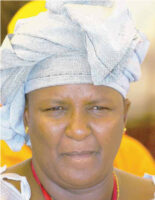
There is something steely about Naomi Namsi Shaban’s demeanour. It is as if underneath her trademark colourful head wraps lies an impenetrable steel helmet made to deflect missiles directed at her in her decades long career in politics. This was not just a character attributed to her, but to the Mwai Kibaki Presidency and to most of those who served in his Cabinet.

Since her formative years, Shaban has thrived on going against the grain in a hugely patriarchal society. She even, in her own words, stood firm against curses and threats from male elders to follow what she deeply believes to be an ordained path of service and leadership. But, like many paths that criss-cross the political landscape in Kenya, hers too has been characterised by loyalty, betrayal and everything in between, including the seemingly inevitable association of Kenyan politicians with graft at one point or another of their careers.

When all is said and done, however, Shaban still stands firm. Swayed by the tumultuous winds of bare-knuckle politics, bent by a constant barrage of pressure from coveters of the political throne she has occupied since 2002 when she was first elected Member of Parliament (MP), but never broken. On several occasions though, in her journey to being elected MP for Taveta, she came close to snapping.

The women in my constituency urged me to vie for a political seat. Fora while I was not convinced, but after consulting my family members, I eventually agreed… I received threats from elders who opposed a woman being incharge of the constituency.

Shaban was born in 1963. Through her formative schooling years at Mahoo Primary School in Taveta, she was always the shy girl in class who kept away from volunteering answers whenever a teacher asked a question. Her timidity, though, was not a sign of aloofness. Whenever she was compelled to respond, she always gave the right answer. With time though, her timidity faded, but her unmistakably thoughtful nature remained with her throughout her secondary education in Butere Girls High School and later at the University if Nairobi.

When she walked the university hallways, there were only two sides to existence. You were either pro-State of pro-opposition. Pro-opposition simply meant you were anti-State. Nowhere were these lines of alienation more pronounced than at institutions of higher learning. The University of Nairobi was a key battleground and breeding ground for these opposing ideologies.

Decades earlier, the man who would appoint her to Cabinet, President Kibaki, was in the same space at Makerere University. Organising, plotting, scheming for victory in a different kind of war — the battle for self-rule.

Shaban though, according to those who knew her then, somehow managed to sit on an invisible fence which separated the two sides. In some conversations she appeared pro-change, in others, she had her feet firmly set on defending the status quo, never burning bridges and mastering the art of pleasing both sides. Decades later, this skill would serve her well, ensuring she survived government purges and waves of political euphoria that soon characterised the country every election year.

The years of study did not prepare her for her next phase of life. She’d become quite successful as a government dentist, posted to various parts of the country and to Kenya’s largest referral hospital Kenyatta Hospital.

Like many who came before her, and many more who came after her, she soon set aside her call to civil service for a life of private practice. But this did not last. Soon, she began to feel the nudge that prompts a certain cadre of civil servants to serve as such. No matter how much she tried to ignore it, she couldn’t shed it let alone wish it away. There was something about serving the people that seemed like an addiction to her.

In 2001 when the country was deep in the throes of campaigns something happened that would squarely set the tone for the rest of her life.

For close to 10 years, the politics of Taveta had been defined by Basil Criticos, a rancher of Greek origin who dominated the Taveta political space through connections, money and a close association to power. He had represented the constituency as MP since the 1992 General Election and was almost completing his second term when, in an inexplicable huff, he abandoned his seat and fled the country leaving behind accusations of harassment and intimidation from the Kenya African National Union (KANU) government. Twice, Criticos had been elected on a KANU ticket. As this happened, the people of Taveta turned their attention to the young woman who had been turning up for harambees (fundraisers) and paying school fees for the destitute for years. “Could she step in,” perhaps they thought.

Soon, they approached Shaban in Nairobi, asking her to take up the challenge of being the area MP.

“The women in my constituency urged me to vie for a political seat. For a while I was not convinced, but after consulting my family members, I eventually agreed,” Shaban told an interviewer for a collection of essays on Women legislators published by the Association of Media Women in Kenya.

It wasn’t all rosy though.

“I received threats from elders who opposed a woman being in charge of the constituency.” She refused to back down. Hoping to frighten her into backing out, they pelted her mother and grandmother with stones.

“They took my three-year-old son and threatened to throw him into a pit latrine,” she said.

Although the people wanted her, she was still miles away from winning her first election.

First, she couldn’t secure a nomination ticket for her preferred party, KANU, after elders had convinced its top party leadership that a woman would not win an elective position in her community. Luckily though, she was nominated to vie for the seat on a Forum for the Restoration of Democracy-Kenya (Ford-Kenya) ticket.

But her baptism of fire birthed something else: a spontaneous reaction from women leaders who had gone through the same hurdles that she was now facing and most importantly, surmounted them.

Beth Mugo, whose family has interests in gemstone mining and owns huge tracts of land in the constituency funded her hurriedly assembled agents. Martha Karua threw her weight behind Shaban, abandoning her own candidate because Karua felt she identified more with Shaban than with her own party’s candidate.

Other pioneers came through for her has well. Long-time Maendeleo ya Wanawake chairperson sent her lesos to distribute to women. Pheobe Asiyo wrote a cheque that went a long way to building her brand.

By the time Taveta residents woke up to vote, Shaban, at least in her mind, was clearly headed for victory. It is the people who had come for her. Everywhere she went, she was assured of votes. A day after the elections though, she got her second lesson in politics. There are no guarantees. She lost the by-elections to Jackson Mwalulu. Coming a distant third.

The defeat in 2001 taught her one enduring lesson — that politics, like everything else she had done in life by then, needed preparation. So, she went to class.

First, was to leverage her unique position as one of the few women engaged in active politics back in the day. She needed to brand herself. She shed the dental scrubs for African attire and changed her messaging to become more people centred. Most importantly, she learnt to ignore side shows such as engaging male competitors on whether a woman could effectively represent the people and run a home at the same time.

For the next year and a half, she embedded herself in the community that had come out to seek her that day in 2001. When elections were called in 2002, amid euphoria for political change, Shaban stuck by her guns.

In the previous election, the people had asked her to vie for the seat on a KANU ticket. She remained loyal to them and sure enough secured the KANU ticket for the election. The trend at the time was to ditch KANU for the National Rainbow Alliance that was sure to win the Presidency.

This time she won with a huge majority and was one of the few legislators countrywide to survive the National Rainbow Coalition (NARC) euphoria that eventually ended Daniel Arap Moi’s 24-year-reign as President. Shaban had announced her arrival and domination for a seat that she has successfully retained over four elections.

No mean feat for a girl from Taveta whose education was a constant headache for a mother who gave her all to see the daughter achieve the education that she missed out on herself.

In numerous interviews with various media, Naomi has talked about the struggles she faced growing up light-years from privilege. Taveta, the place she calls home, is a paradox. It hosts some of the wealthiest landowners, some of the most exclusive safari destinations and is home to the country’s most important precious stone mines, including the world famous tsavorite.

Yet, amid this abundant wealth live some of the country’s poorest populations; poverty that transcend generations. When her father died when she was just a young girl, her family moved back to Taveta from Mombasa to live with her grandparents.

The family reunion though did not last long and soon her mother had to move to Nairobi to look for a job, eventually landing a menial job at a printing press. For Shaban, there could only be one sure way out of the life she was afraid of being trapped in — education — and she pursued it relentlessly.

On 13 April 2008, just four months after she had successfully defended her seat as MP for the second time, Shaban’s life seemed to have gone full circle. That day, after months of push and pull that had emanated from a bitter fallout over the Presidential election results of 2007 that resulted in spontaneous violence across the country, Shaban was named as one of the 40 Cabinet ministers that were to serve in Kibaki’s government. Her Assistant Minister was Mohamed Muhamud Ali.

In just five years in politics, she had moved from a novice, to MP to minister as one of the four appointees from KANU, which had shelved its presidential ambitions the previous year in favour of a Kibaki Presidency.

Shaban would serve in the newly created Ministry of Special Programmes whose first duty was to deal with the human suffering of internally displaced persons, victims of the violence of the previous year.

After two years in this position, she was moved to the Ministry of Gender and Children Affairs, again as minister. Her public life and her years as MP had before this reappointment been defined by fighting gender biases within her community and championing the importance of education for children. This proved a natural fit, and she served in this capacity until the end of Kibaki’s Presidency.

Shaban’s years in public light were not entirely scandal free.

On 11 August 2009, the brutal murder of a British miner was linked to her. It was alleged that Shaban’s uncle was part of a group of men who killed the miner at a disputed mine. In the course of the trial, Shaban was accused of providing bail for the accused and interfering with ongoing investigations into the case.

In 2014 Shaban appeared in court and defended her involvement in the case and has since distanced her name from any involvement over the death of Campbell Bridges, the gemstone minor. She, alongside the then Education Assistant Minister Calist Mwatela and former Central Bank Deputy Governor Jacinta Mwatela were named in court as accomplices by the geologist’s son, Bruce Bridges.

This, though, was not all. Shaban had earlier found herself in a far stickier situation, this time involving billions of shillings, in what was to become an infamous maize scandal.

The series of events leading up to the now infamous maize scam began in late 2008. At the time, the country was experiencing a severe maize shortage due to low yields and destruction of close to 3.5 million bags of maize during the post-election violence that also significantly reduced the area under production.

The crisis was worsened by the high prices of farm inputs including fertilisers and fuel. The country’s Strategic Grain Reserve was 1.6 million bags, well below the required 4 million bags, which placed the country in a precarious position. The maize shortage resulted in an increase in the prices of maize flour and related products, which shot up from KES 48 for a 2-kilogram packet of flour to as high as KES 130.

Under pressure from public protests, in October 2008, the government responded with measures that included directing the National Cereals and Produce Board (NCPB) to import some 3 million bags of maize to ease the shortage. The government also directed NCPB to sell maize only to millers at a subsidised price.

Under the scheme, selected millers with substantial milling capacity were allowed exclusive access to subsidised maize allocations from NCPB. In return, the selected millers were to sell flour to consumers at a reduced price jointly set with the government. Under these measures, hundreds of metric tonnes of maize were imported into the country and allocated to millers.

Contrary to intended policy expectations, allocations were made to companies and individuals, who in some instances were not millers. Some had no milling licenses, premises or capacity. These individuals and companies subsequently sold the maize off to genuine millers and in the process made exorbitant profits.

“There were some reports of at least one hundred thousand bags diverted in this way. This negatively affected the desired outcome of reducing prices,” rights Lobby Africog wrote at the time.

Consequently, allegations of impropriety, corruption and mismanagement implicating several personalities and government departments were made in Parliament and across the media. These allegations exposed underlying institutional and governance weaknesses not only in the maize sector and agriculture policy, but also in government disaster preparedness and the country’s overall food security.

At the time, the country’s disaster preparedness fell under Shaban’s Ministry of Special Programmes. On 25 February  2009, she became one of the dozens of government officials that were questioned by the Kenya Anti-Corruption Commission (now Ethics and Anti-Corruption Commission) over their involvement or knowledge of the scandal.

“Let us not make up stories of what we do not like or think. Let us look for solutions into these hunger problems because there is no scandal,” she said at the time, dismissing any notions that there was a scandal within her ministry.

“According to me it is too much of politics because procedure was followed. We need to now look for solutions.”

In 2012, she once again vied for the Parliamentary seat that she had occupied for 10 years.

While many of those who served as Cabinet ministers went for the more illustrious position of Governor, Shaban contested the MP seat. This she won on a The National Alliance (TNA) party ticket, which was part of the Jubilee coalition of parties that included her former party leader and would-be president Uhuru Kenyatta and his Deputy William Ruto, both of whom she had been with in KANU at different stages of their careers and served with in government in various capacities.

After the third consecutive five-year term, the lessons she had learnt early in her career started replaying in her mind again, the biggest of them being the loyalty test. In 48 hours, she quit the party that had taken her to Parliament in 2013 and returned to it.

“Someone was determined to get rid of me,” she said after the elections.

She stuck to her guns, that if party matters were not put right then she would quit.

“My mum always told me you started with Uhuru Kenyatta and you should end with him,” she told NTV in an interview.

The people who first took her to Parliament, put her back into the house for the fourth time. But her journey has also been characterised by the dark misogyny that sometimes surrounds female leaders. As a single mother she has been called names, some bearable others not flattering.

Through the years though, she has taken all these challenges head on and put her doubters in their place. Her journey has not been without personal tolls.

“I cried one time when my son, who was in class two, told me he wanted to go to boarding school because I wasn’t spending enough time with him,” she reflected in another interview.

The steely determination that was hidden somewhere inside her at a young age is now part of her armour. She wears it proudly, and as an active politician, she wears it loudly too. The shy little girl is no more. Instead, in this space sits a go-getter whose initial step of faith has made her serve her people for an entire generation.

William Ole Ntimama – The old wine in Kibaki’s new wineskin

Described by critics as a carryover from a bygone era, William Ronkorua ole Ntimama was another unlikely member of the Kibaki Cabinet. A self-educated man who used his power of the tongue and warlike posturing to sustain himself at the top of Maasai land political hierarchy, Ntimama was one of only three ex-KANU (Kenya African National Union) ministers who Kibaki did not include in his first Cabinet which he formed on 3 January 2003, as the new leader tried, to chart a new beginning.

Others excluded were Joseph Kamotho, who had been President Daniel arap Moi’s point-man in Central Province, an Opposition hotbed since the return of multiparty elections in 1991, and Joseph Nyagah, the son of independence politician Jeremiah Nyagah.

This slight — for a man who considered himself the king of the Maasai — was too much and he never seemed to recover from it.

After a year on the backbench —unfamiliar territory for a larger-than-life figure who had been Minister for virtually his entire Parliamentary career then spanning 15 years — Ntimama found his way into the Cabinet after Kajiado South Member of Parliament (MP) and Kibaki’s ally in Maasai land, Geoffrey Mepukori Parpai, died.
Fifteen years as chairman of the powerful Narok County Council and another 15 as MP and Minister had made Ntimama larger than life, and his word held sway  in many parts of Maasai land.

Unsurprisingly, the Public Service Minister was one of the seven ministers who campaigned against the proposed Constitution in the 2005 referendum that split the government down the middle.

Others were Raila Odinga (Public Works, Roads and Housing), Kalonzo Musyoka (Environment), Anyang’ Nyong’o (Planning), Ochillo Ayacko (Sports), Najib Balala (National Heritage and Culture) and Linah Jebii Kilimo (Immigration and Registration of Persons).

After the government lost the referendum, Kibaki sacked the entire Cabinet — a first in Kenya’s history — and excluded the Liberal Democratic Party (LDP) rebels on reconstituting it.

But if Ntimama missed the first Kibaki Cabinet by design, he found himself in the Government of National Unity, the coalition government formed in 2008 following a truce between the President and Odinga, his challenger in the 2007 General Election.

It would appear, however, that Ntimama never forgave Kibaki for the 2003 snub, saying in an interview in 2013 that  the coalition government achieved a lot, in spite of, not because of President Kibaki.

Ntimama’s harsh assessment was starkly different from that of the other ministers interviewed for this book, perhaps a pointer to how deeply hurt the ‘King of the Maasai’ was by Kibaki’s decision to exclude him from the first Cabinet despite his leadership of the National Rainbow Coalition (NARC) campaign in his region.
The man with deep infectious laughter had reasonable expectation that he would be appointed, if only for regional representation, seeing as Kajiado already had a Minister —George Saitoti, MP for Kajiado North and a former Vice President. Instead, Kibaki appointed Parpai, also from Kajiado, leaving Narok unrepresented.

Still, Ntimama considered the Kenya Heroes Bill 2012, which provided for the recognition of Kenyan heroes as one of the most important achievements during his time in the Kibaki Cabinet.

The Bill sought to establish criteria for the identification, selection and honouring of national heroes; to provide for the categories of heroes; and to provide for the establishment of the National Heroes Council and the building of National Heroes Acre at Uhuru Gardens in Langata in Nairobi.
Ntimama was also proud of the expansion of public libraries during his tenure. This was hardly surprising for a man who once held the unofficial record of having the biggest home library in Kenya.

“When I was the Minister of National Heritage we built a big library in Narok where I donated all the books. They are mostly history and literature books. If you go there, you will find them at Ntimama corner,” he told an interviewer in 2016.

He traced his outsized love for reading to his self-education. “What many Kenyans may not know is that I am a self-taught man. I never saw the inside of a secondary school class. I joined the teaching profession after my elementary school certificate.”

Born in 1927 in Melili area, Narok, Ntimama was raised in a polygamous family where his mother was the second wife. He attended Ole Sankale Primary School in Narok where he did Kenya African Primary Education examination (KAPE).

He later joined Kahuhia Teachers Training College and was deployed to teach Kiswahili and History at his former school—then known as Government Maasai School. He also taught elsewhere in the region even as he studied privately for his O’ level examination.

In 1953, he approached Carey Francis of Alliance High School to allow him to sit for the exam as a private candidate. He was allowed only four weeks to prepare, according to members of his family, but excelled, beating full-time students.

After Alliance High School, he went back to teaching and enrolled for a diploma course in Law in the UK through correspondence.

“I acquired a diploma in Legal Studies from Oxford University, which I studied by correspondence. It is this situation as a self-taught student which made me a voracious reader. Being an independent student, you have to be much disciplined. I stopped pursuing higher education when politics and family came in,” he said in an interview for the Daily Nation.

He later became a District Officer, a member of the African District Council, a member of the Legislative Council and chairman of the Narok County Council.

He ran against Justus Ole Tipis, in 1978 and 1983, for the Narok North seat, but was unsuccessful both times. Still, he continued his activism.

For his warlike utterances, Moi detained Ntimama in 1983 for 102 days. It took Tanzanian Prime Minister Edward Sokoine, a fellow Maasai, to get him released by trading him with the 1982 coup plotter, Hezekiah Ochuka, who had fled to Tanzania.

Even with this cloud of infamy hanging over his head, Moi appointed him chairman of various parastatals including the National Housing Corporation (NHC), the Kenya Grain Growers Cooperative Union (KGGCU) and the Industrial and Commercial Development Corporation (ICDC).

In 1988, during the infamous mlolongo (queue voting system), Ntimama finally defeated Tipis and was promptly appointed Supplies and Marketing Minister. This marked the beginning of his long journey in the Cabinet where his dockets included Local Government, Home Affairs, Transport and Communications and Office of the President in charge of Public Service.

Ntimama would team up with KANU stalwarts Kipkalya Kones, Nicholas Biwott and Henry Kosgey to rally the Rift Valley region against the return of pluralist politics.
They formed a pro-small-communities platform — called Kamatusa which stood for Kalenjin, Maasai, Turkana and Samburu — that advocated for federalism as a counter to the pro-multiparty agitation.

Despite his detention in 1983, his acerbic utterances continued to be a subject of investigations into the next decade and beyond. For example, the Report of the Judicial Commission Appointed to Inquire into Tribal Clashes in Kenya, popularly known as the Akiwumi Report after its chairman, named the politician as one of the masterminds of the orgy of killings in 1992 targeting the Kikuyu in Narok.

Ahead of that year’s General Election, about 300 families were evicted from Enoosupukia, with authorities claiming it was an illegal forest settlement and a water catchment area held in trust for the Maasai by the local county council. In truth, he wanted the residents to leave because their ethnicity suggested they would not vote for him.

Ntimama was also opposed to campaigns to have the Maasai plan their families, arguing that power was obtained through numerical strength.

“Those who are preaching to us about family planning should keep off. Our people will continue to give birth until they catch up with major tribes,” he would tell the media during rallies in Narok as the first multiparty election approached.

In January 1995, at the behest of some powerful forces in KANU, he teamed up with John Keen, another veteran politician, to give Saitoti a hard time in national and Kajiado politics. He was an on-again-off-again supporter of the VP whom he dismissed as a non-Maasai.

In 1996 the relationship between Ntimama and Moi started deteriorating, ostensibly after he was blamed for taking sides in a boundary dispute between his populous Purko and the Keekonyokie sections in Narok. Around this time, Moi dressed him down during a meeting at Ntulele.

After that incident, his access to Moi was curtailed, a development that was a blessing to Julius Sunkuli, the Kilgoris MP and an Assistant Minister in the Office of the President. Sunkuli was later transferred to the Internal Security Ministry as a Minister.

Ahead of the 1997 General Election, when his relationship with Moi was at an all-time low, he survived stiff competition from Jackson Mwanik during the KANU nominations.

As a KANU zone, Narok was among the electoral areas where one was assured of victory after winning the party nominations. But even after re-election, whenever Moi visited Narok, he would ask residents to work with Mwanik even in the presence of Ntimama, clearly illustrating how their once solid friendship had crumbled beyond redemption. Pundits from the region opine that Ntimama had become too powerful to be tamed — even by Moi.

Then came the proverbial straw that broke the camel’s back. After Moi chose Uhuru Kenyatta as his preferred successor in 2002, Ntimama openly rebelled and threw his support behind Kibaki who was the NARC flag bearer.

The Minister, who had wanted Saitoti, his foe-turned-friend to succeed Moi, resigned and galvanised the Maasai votes for NARC. He won in that election and again in 2007 on an Orange Democratic Movement (ODM) party ticket.

Ntimama lost the seat which he had held for 25 years to lawyer Moitalel Kenta in 2013. Ntimama would tell an interviewer that he regretted running in that election as it had broken his hitherto unbroken winning streak.

Explaining her father’s philosophy, Lydia Masikonte, also a politician, says Ntimama could be both fearless and fiercely loyal because one needed both to achieve one’s goals. For Ntimama these goals were Maasai land rights and the conservation of Mau Forest, the biggest water tower in the country — two causes on which he rode to remain at the top for a very long time.

One of the biggest newsmakers of the last 40 years, Ntimama was a darling of the press, not just for always making provocative statements that often made to page one, but also for never complaining of being misquoted.

Away from politics and farming, Ntimama liked watching football and wrestling besides visiting morans (traditional warriors) in manyattas (cultural villages). He encouraged moranism and differed with those who campaigned against saying it as an outdated cultural practice which stood in the way of education and development in the region.

It was with this baggage, therefore, that Ntimama arrived in the ninth Parliament, having won the 2002 election on the reformist NARC ticket, presenting President Kibaki with the dilemma of what to do with him.

Ntimama was the most senior Maa leader in NARC. However, he was too tainted to be accommodated in a government that laid claim to a new beginning.
Most of Kibaki’s associates believed that Ntimama — the warmonger — was not compatible with Kibaki, the gentleman of Kenyan politics.

It was with this in mind that Kibaki opted to appoint a little known, low-key politician from Kajiado South, a constituency that had stuck with him even during the heady KANU days.

Following the death of Parpai and the incessant grumbling from the LDP wing who complained that they had been short-changed in the sharing of Cabinet positions, Kibaki bowed to pressure and appointed Ntimama Minister for Public Service in 2004.

His stay in the Cabinet was, however, short-lived as he was kicked out with others in the Odinga group the next year as Kibaki purged the government of rebels.
After the 2007 General Election and the Government of National Unity that followed, Ntimama was again appointed Minister of State for National Heritage and Culture, courtesy of being in ODM. The post suited him as a self-styled defender of the cultural values of indigenous communities.

A chronicle of Ntimama’s contribution to President Kibaki’s legacy would, however, be incomplete if his biographer were to stick to his job description at the two ministries he served. Perhaps his more enduring role was to offer political backing for the conservation of Mau Forest, the country’s largest water tower which the KANU government kept dishing out for votes.

It was during the Kibaki Administration that the destruction of this forest, and others such as Embobut in Marakwet, was reversed.

The Minister applied pressure for those living in the forest to be evicted, arguing that 90 per cent of them were from “adjoining districts and have crossed boundaries, valleys and rivers to settle there illegally”.

Towards the end of his life in September 2016 aged 88, the Ntimama of old had mellowed and put on a more conciliatory aura. He, for example, took Maasai leaders to State House and promised to campaign for President Kenyatta ahead of the 2017 elections when Odinga, his bosom buddy and erstwhile political patron, was running.
Clearly, the metamorphosis of the man with indefatigable courage had come full circle. From an affirmed KANU stalwart, he became a rebel within and without government and in his last days he had returned to the fold.

So, while at the onset Kibaki had intended to form a  government from a clean slate, political realities soon forced him to back down. In the end, part of his Cabinet became a perfect case of old wine in a new wineskin.

Even though he had moved from KANU to NARC, which won the 2002 General Election, perhaps no member of the Kibaki Cabinet had as much baggage as Ntimama, the ebullient and eloquent defender of the old order.

Samwel Poghisio – The tech innovation crusader

Samuel Losuron Poghisio joined the Cabinet in 2008, during President Mwai Kibaki’s second term. He was appointed following the National Accord that established a coalition government after the disputed presidential election of 2007, in which Kibaki had been declared the winner.

Poghisio was given the influential docket of Information and Communication, which was surprising because this ministry is seen as the nerve centre of both government and private operations in Kenya, literally controlling information that Kenyans can access on whatever platform they choose. All this was now in the hands of a coalition partner.

The ministry covered key operations like the Communications Commission of Kenya (now Communications Authority of Kenya), which regulates telecommunications and broadcasting among other functions. Poghisio’s party leader, Kalonzo Musyoka, was Vice President and it was a given that he would get some substantive Cabinet positions for his allies, such as this one.

Poghisio took over the ministry at a critical time in Kenya’s history. Interesting – and sophisticated – things were happening in the country and across the globe. So much so that Poghisio was even given two assistant ministers to start with, George Khaniri and Dhadho Godhana. His Permanent Secretary was Bitange Ndemo, a veteran of the ICT sector.

Internet connectivity was expanding and subscriptions were growing as Kenyans learned to access the Internet through their mobile phones. At the time, mobile telephony penetration was at 47 per cent while only 10 per cent of Kenyans had access to the Internet, according to the Commission’s statistics.

Internet connectivity was expanding and subscriptions were growing as Kenyans learned to access the Internet through their mobile phones.

It was also a time when tensions between the government and the media were at boiling point. The State was out to control media operations, especially after the post-election violence that had rocked the country. Media houses were blamed for fanning negative ethnic passions by broadcasting live coverage of the bloody events that unfolded after the presidential election results were announced. One of Poghisio’s first assignments was to push through a law to ‘tame’ Kenyan media.

These were extraordinary times as the new Minister sought to strike a delicate balance between the people’s right to information, media freedom, and freedom of speech on the one hand, and the politics of a coalition comprising the country’s three biggest parties on the other.

In addition, the country was faced with numerous security challenges around mobile phone usage. Members of the public were the target of mobile phone crimes as lack of proper registration processes made it near impossible to trace dodgy transactions and thefts, which in turn eroded the credibility of mobile phone service providers. The only way to curb these vices was to have all mobile phone network subscribers officially registered. Poghisio took up the matter, arguing that it was a matter of both national and business interest as it would protect the public from the threats posed by terrorism, drug trafficking, money laundering, hate messages and other crimes committed via mobile phones.

The registration of SIM cards would assist law enforcement agencies in tracing criminals engaged in such activities as well as deal with the issue of stolen handsets. At the time, phone theft (by snatchers and armed criminals) was a menace. At least one out of every 10 mobile phone owner had lost their handset. The registration of SIM card subscribers was already standard global practice; subsequently, all current users as well as buyers of new SIM cards in Kenya were required to present their ID and address details to registered mobile phone network dealers by 30 July 2010.

The directive was implemented fully only after the government threatened to switch off all non-registered lines.

By his third year at the ministry, Poghisio, who had served as Assistant Minister for Higher Education, Science and Technology between 2000 and 2002, was charging ahead to make sure Kenya became the hub of ICTs in the East African region. The main hindrance was slow Internet speeds which, incidentally, came at a higher cost. The solution lay in fibre-optic cables, the basic infrastructure for international connection in terms of broadband.

Kenya would deliver this through the Indian Ocean, and other countries such as Uganda, Rwanda, Burundi, DR Congo, South Sudan and Ethiopia would then plug in. Poghisio led the government in setting up The East African Marine System (TEAMS), a 5,000-kilometre fibre-optic undersea cable that linked Mombasa on the Kenyan coast with Fujairah in the United Arab Emirates (UAE). It was built as a joint venture between the Government of Kenya and Kenyan operators, who hold 85 per cent shares, and UAE-based operator Etisalat, holding 15 per cent.

Construction began in January 2008 on the UAE side and arrived in Mombasa in June 2009. Construction was completed in August 2009 and went live for commercial service on 1 October. This marked a breakthrough in fibre-optic technology in Kenya, opening up the system to more projects such as the Eastern Africa Submarine Cable System (EASSy). Suddenly, Internet speeds increased for those who could afford the new fibre connection.

The 10,000-kilometre EASSy was deployed along the east and south coast of Africa to service the voice, data, video and Internet needs of the region. EASSy is one of the highest capacity systems serving Africa, linking South Africa with Sudan via landing points in Mozambique, Madagascar, the Comoros, Tanzania, Kenya, Somalia and Djibouti.

In the same year, SEACOM, a privately owned and operated firm, launched Africa’s first broadband submarine cable system along the continent’s eastern and southern coasts. The second Lower Indian Ocean Network submarine cable (LION2), which provides a direct link from Kenya to Madagascar, St. Paul Reunion, and Mauritius, went live in April 2012. The system also connects to the island of Mayotte, a France overseas department. The first LION cable gives Kenya alternative routes to Asia and South Africa.

These undersea cables are responsible for the high-speed Internet Kenya enjoys today. Now most buildings in major towns have fibre connection, growing not only Internet usage but also stimulating a boom in e-businesses. The growth in online shopping companies, websites and bloggers as well as an e-government system can be attributed to the advent of faster Internet connections delivered through these cables. In terms of impact and achievement, these projects stand out in Poghisio’s time at the Ministry of Information and Communication.

Building on this foundation, Kenya received its fifth undersea fibre-optic cable, which landed in Mombasa in March 2020. DARE1 delivers data speeds of 36-terabytes, which takes the crown as the fastest undersea cable in the country. The cable links Djibouti, Mombasa, and Mogadishu and Bosaso in Somalia.

Another policy he implemented to boost ICT penetration in the county was making computers more affordable by zero-rating taxes on imported hardware and accessories. Besides, the government initiated the Madaraka PC Project to build skills and capacity in the assembly of hardware components into complete PCs. To create demand for the locally assembled PCs, the ministry toyed with establishing ‘digital villages’, branded Pasha Centres, across the country to provide ICT access points in the rural areas besides enhancing IT skills in the country.

The plan was to have every constituency in the country get a minimum of eight workstations, equipped with either PCs or monitors hooked to PCs, and grouped within a 15-kilometre radius. Each digital village would also have a base station and was expected to form the basis for e-commerce in the country. Unfortunately, the project died at the pilot stage due to financing and logistical challenges.

In December 2009, Kenya activated digital signals that allowed people with converter set-top boxes to receive digital television, although a full migration to digital broadcasting was expected in 2012, when the regulator would switch off all analogue transmission. The planned shift would enable local broadcasters like KBC, NTV, KTN, Citizen and K24 to compete directly for pay-TV consumers with the likes of MultiChoice (DStv), the main operator at the time.

Poghisio missed the digital broadcast switch deadline due to preparedness concerns, as did his successor, Fred Matiang’i. The migration finally happened in February 2015. The shift to digital broadcasting, however, came at a cost and virtually turned the country into a pay-TV market, with most Kenyans required to not only buy set-top boxes or decoders but also pay subscription fees to watch free-to-air and other channels. This ‘new normal’ in the broadcast industry expanded the programming menu and also lowered entry requirements for entrepreneurs in the digital broadcast market.

Poghisio also operationalised the Kenya Yearbook Editorial Board (KYEB) in 2009 by appointing members of the board and a CEO. The Board had been established in 2007 through a Presidential Order to facilitate government communication through the Kenya Yearbook, a publication that helps Kenyans understand the national landscape better by promoting government projects and achievements.

In 2008, the government approved the creation of Konza Technology City as a flagship Kenya Vision 2030 project. Konza would be a sustainable, world-class technology hub and major economic driver for Kenya. It was initially conceived to capture the growing global Business Processing Outsourcing and Information Technology Enabled Services (BPO/ITES) sectors in Kenya.

In 2009, President Kibaki broke ground in Malili, marking the start of the development of Konza Technopolis. A Konza Technopolis Development Authority (KoTDA) board was appointed as a special purpose entity to facilitate the development.

Born in 1958, Poghisio attended primary and secondary school in Uganda before joining Makerere University in 1978 for his undergraduate studies in botany and zoology. In 1989 he went to Wheaton College for a master’s in communications before joining Lincolin University for another master’s, this time in divinity. But he has always worked in Kenya, first as a teacher at Chewoyet Secondary School and then as a lecturer at Daystar University before plunging into politics in 1988, when he was elected MP for Kacheliba Constituency on a Kenya African National Union (KANU) party ticket.

But Poghisio would be expelled from the ruling party and lose his seat just four months into his election, after he accused the government of President Daniel arap Moi of discriminating against his ethnic community, the Pokot, in resource allocation and distribution of relief food. His accomplice, Kapenguria MP Francis Lotodo, faced a similar fate.

As a Minister, one of the controversial things he will be remembered for is a law that sought to muzzle the media in Kenya. The Kenya Communications (Amendment) Bill 2008, presented by Poghisio, was passed by the 10th Parliament of Kenya and signed into law by President Kibaki on 2 January 2009. It was a contentious amendment of the Kenya Communications Act of 1998, which authorised the State to raid media houses, if necessary, and control the distribution of content. It also gave the government the right to penalise media infractions with heavy fines and prison terms, sole discretion in granting broadcast licences and control of programming content and broadcasts.

Protests by Kenyan journalists had Kibaki order a review of the Act to iron out the contentious areas. Even then, the law sticks out like a sore thumb in the Kibaki administration’s legacy.

There was also Poghisio’s decision to allow businessman Naushad Merali to sell 15 per cent of his shareholding in Zain Kenya, which at the time was Kenya’s second biggest mobile phone services operator, to Zain Group. The sale reduced local shareholding in the company to below the legal limit.

According to Kenyan law, it is mandatory to have at least 20 per cent of a telecommunications company’s shares owned by Kenyans. Merali was the only local shareholder in the company but Poghisio defended the decision, saying it was intended to make the company financially stable. However, Zain’s fortunes continued to dwindle and months later, in 2010, Bharti Airtel acquired Zain businesses in 15 African countries including Kenya.

Also of interest was the appointment of Major-General Hussein Ali as Postmaster General. Ali, a military man, had been Police Commissioner prior to this new posting. The announcement was made by President Kibaki rather than the Minister, attracting scrutiny from Parliament. The appointment was largely perceived to be more a means of creating a soft landing for Ali, who was facing headwinds in the police force, than a serious attempt to bring on board enhanced and relevant skills for the Postal Corporation of Kenya.

Besides a significant career in government, Poghisio’s involvement in politics saw him become the Senator for West Pokot County in 2017. He is also the current Senate Majority Leader.

Uhuru Kenyatta – The apprentice

When he was born to Ngina Muhoho and Mzee Jomo Kenyatta in the dying days of the colonial administration in October 1961, it was Mwai Kibaki, then the Kenya African National Union (Kanu) Executive Officer, who suggested that he be named ‘Uhuru’. That was in commemoration of the imminent dawn of uhuru or independence and the hope that freedom portended for the Kenyan people.

But when he named him Uhuru in 1961, Kibaki would never have guessed that in years to come, political karma would first set him and the toddler he held in his arms apart, before drawing them close in different and profound ways, or that the younger man would follow in his very footsteps in ways more than one.

For Uhuru Kenyatta was ‘the apprentice’. Spending his formative years with his father at airports and public functions, shaking hands with Cabinet ministers, security chiefs and senior government officials, and meeting foreign heads of State and ambassadors, young Kenyatta unconsciously observed the nuances and protocols of politics and government. Something rubbed off.

After his father died in 1978, Kenyatta remained in the shadows. Barring his annual appearances at Parliament Buildings in commemoration of his father’s death beside President Daniel arap Moi and members of the Kenyatta family, he fell off the radar, working briefly as a bank teller after graduating from university before founding Wilham Kenya Limited, through which he sourced and exported agricultural produce.

In the cloud of the vicious attacks that followed, Kenyatta strategically and quietly retreated. Nonetheless, Kenyans had taken note, and the question was not if, but when he would run for political office

Kenyatta would emerge, albeit fleetingly, 20 years later, through a press statement that ruffled feathers and hit national headlines.

President Moi was under siege at the time, his decade-long hold on power severely threatened by a restless nation and a group of battle-hardened politicians led by former Vice President Jaramogi Oginga Odinga who were demanding a return to multiparty democracy. Foreign ambassadors were batting in their corner. Foreign aid taps had all but dried up and the air was pregnant with political tension, impending change and the numbing fear of the unknown.

It is in this political powder keg that the press statement signed by Kenyatta and the sons of independence era politicians and Cabinet ministers, Tom Mboya and Argwings Kodhek landed. Time has come, they said, for the old order to give way to the new; for old leaders to pass the mantle to the young — for a rebirth of KANU and the nation.

The statement sent shockwaves across the country. It was deemed a direct attack against the person of President Moi, which was extremely brave considering Moi’s larger than life persona, the close, historical ties between the Moi and Kenyatta families and the excesses of the repressive KANU regime. The ruling party high command was livid, and its spokesmen lashed out at the young men saying they had been born with silver spoons in their mouths and were therefore out of touch with reality.

In the cloud of the vicious attacks that followed, Kenyatta strategically and quietly retreated. Nonetheless, Kenyans had taken note, and the question was not if, but when he would run for political office.

More shocking was when the powerful Kenyatta family issued a statement saying they would support former Vice President and Finance Minister Mwai Kibaki, who had resigned as Health Minister in December 1991 to found the Democratic Party (DP) and to challenge Moi in the 1992 multiparty General Election. The die was cast, it seemed; the ties between the Moi and Kenyatta families were irretrievably severed.

Kenyatta, surprisingly, did not run for the position of Gatundu Member of Parliament (MP) as was widely expected. And then Moi routed a divided opposition; Kenyatta fell off the radar once again.

But all indications were that fences had been mended when Kenyatta emerged in 1997 to run for the Gatundu South seat on a KANU ticket — not Kibaki’s DP as many had expected. In a political landscape where sons inheriting their father’s political seats was commonplace, his candidature, which was backed by the political name, might and the war chest of the Kenyatta family, seemed like a fait accompli.

It was not to be. Kenyatta lost the election in a situation where propaganda held sway and reinforced a false narrative of eventual victor Moses Mwihia, an ‘underdog from a peasant family’, being unfairly overrun by the scion of a moneyed and powerful political dynasty.

A little perspective is in order. The ruling party was not popular in central Kenya. The Gikuyu community had long borne the brunt of the authoritarian KANU regime and was firmly in the Opposition with Mwihia running on a Social Democratic Party (SDP) ticket associated with Anyang Nyong’o and Charity Ngilu. It didn’t help that Gatundu had been split into Gatundu north and south constituencies, creating the perception that it was Moi’s plan to offer his protégé Kenyatta a ‘safe seat’ on a silver platter. That notwithstanding, Kenyatta was the frontrunner by a mile. Until the tables suddenly and dramatically turned.

Pretending to be kidnapped and harmed, just three days before the election, Mwihia, an Opposition candidate, used this false information to gain sympathy votes. It was a bitter and devastating loss for Kenyatta; a loss that would be difficult to surmount, pundits ruled.

Once again, Kenyatta retreated until 1999 when seemingly out of the blue, Moi, the self-styled professor of politics, appointed him Chairman of the Kenya Tourism Board. Kenyatta was a youthful 38, and looked the part.

Predictably, there was mumbling within Opposition quarters that he didn’t merit the appointment; that he lacked the experience to chair such a strategic and critical national parastatal. Never mind that Kenyatta was relatively familiar with matters tourism on account of his family’s expansive investments in the tourism and hospitality sector.

Those who understood President Moi’s Machiavellian chessboard, however, suspected something bigger: the professor of politics was reinventing ‘Candidate Uhuru’”. To paraphrase Jaramogi Odinga in his book Not Yet Uhuru, Moi, the giraffe with a long neck that sees far, was testing the waters and preparing to insert the unknown and unheralded striker into the rough and tumble of the Kenyan political game. To what end, only time, and Moi, himself knew.

From then, it was game on. In 2001, Mark Too, ‘resigned’ as a nominated MP, his slot was taken up by Kenyatta who was quickly appointed Local Government Minister by President Moi. Superintending over Nairobi City Council and all municipalities, Local Government was a powerful perch whose tentacles spread into every nook and cranny of the country. It was the perfect launching pad into the national political arena.

The following year, Moi, who was retiring as President, announced that Kenyatta was his chosen successor and would be KANU’s flag bearer in the 2002 Presidential election. In so doing, he not only caused a furore that split his party into ‘old’ and ‘New KANU’, but placed Kenyatta in the crosshairs of his ‘father’, Kibaki — the Opposition candidate who had named him as a baby and whose children were Kenyatta’s friends.

It was a mismatch. Here was political greenhorn backed only by Moi’s fanatic Rift Valley following in a party that had lost favour taking on one of Kenya’s most consummate, astute and experienced politicians — an erudite policy wonk and cunning political fox at the helm of a massive national wave that wanted KANU dead and buried.

Not surprisingly, when the last ballot was counted, Kibaki was president. It was a 70 per cent rout that nonetheless thrust Kenyatta, now MP for Gatundu South, into Kibaki’s former front bench seat in Parliament as Official Leader of Opposition.

It was not yet Uhuru, but ‘the apprentice’ was back.

The Opposition benches were unfamiliar turf for KANU and its new, young leader. Long associated with kleptocracy and incompetence, it now fell upon the maligned independence party to call out the excesses of government, a role that Kenyatta took up with gusto. This role, however, placed him once more on opposite ends of the table with Kibaki, each time he challenged the government as Opposition chief.

As time went by, his position as KANU chairman became tenuous. He had beaten powerful Moi era Cabinet Minister Nicholas Biwott to the post in 2005. However, as the 2007 poll approached, remnants of ‘old KANU’ politicians, still smarting from being stood over by Moi in in 2002, wanted him replaced. They were dying to present a Presidential candidate, but Kenyatta had strategically calculated to sit it out knowing that to run against Kibaki — who now enjoyed the advantage of incumbency — for the second time would be committing political suicide. It was virtually impossible to garner the crucial Gikuyu vote, and foolhardy to challenge the combined might of two of the senior most Kenyan politicians of the time: President Kibaki and Orange Democratic Movement (ODM-Kenya) party leader, Raila Odinga.

In any case, the ground had long shifted. Rift Valley, the bedrock of KANU, was now in the hands of Odinga and William Ruto after they were fired from the Cabinet for teaming up with KANU and Kenyatta to vote ‘No’ during the 2005 Constitutional referendum, which the government lost. With Rift Valley gone, Kenyatta knew, KANU had little hope of winning the election.

‘The apprentice’ had clearly learnt crucial lessons from his 1992 debacle.

But ‘old KANU’ wanted its way, and in 2006, Kenyatta was replaced as party chairman by Biwott. It took a court ruling the following year to reinstate him.
Now firmly back in the saddle, and to the chagrin of KANU diehards, Kenyatta announced that the party would be supporting President Kibaki’s Party of National Unity (PNU) in the 2007 General Election.

For the first time in 15 years, Kibaki and Kenyatta would be sitting at the same table and pulling in the same direction.

The 2007 election results were bitterly contested and on 17 April 2008, a coalition government, the Government of National Unity, was formed with Kenyatta, the former Official Leader of Opposition, sworn in as Deputy Prime Minister and Minister for Trade, with James Omingo Magara as his deputy. In January 2009, he was appointed Finance Minister to replace Amos Kimunya.

At the Treasury, where Kibaki, the University of London-trained economist had served long stints as Finance Minister, Kenyatta became ‘the apprentice’ once more.
The post-election violence that followed the disputed poll had literally flattened the economy and obliterated the gains made during Kibaki’s first term of office. The spiral needed to be urgently stemmed and measures put in place to spur economic growth.

Kenyatta’s two budgets as Finance Minister were, at near a trillion, not only the biggest in Kenya’s history but a reflection of Kibaki’s economic philosophy. He poured billions of shillings into sectors that would shift the gears of economic development and give the common mwananchi (citizen) a leg up and the opportunity to create wealth and access markets. The budgets reflect a singular focus on revamping agriculture, water and irrigation and investing in education, infrastructure development, reducing the cost of power and expanding access to affordable energy supply for Kenyans.

Yet in spite of flirting with an unprecedented trillion-shilling mark, the budgets still reflected Kibaki’s famed frugality and a disdain for foreign loans to breach deficits.
The 2010 budget, for example, outlined the need to maintain a stable macroeconomic environment and create an enabling environment for business; developing key infrastructure facilities and public works countrywide to stimulate growth, create employment and reduce poverty; promoting equitable regional and social development for stability; investing in environment and food security; and strengthening governance to improve public service delivery.

And by cutting excise duty on cosmetics and beauty products by half to 5 per cent because “…beautiful women are the face of a healthy society,” ‘The apprentice’ not only aptly captured Kibaki’s wit, but profound sense of detail as well.

An 18 February 2011 Reuters profile of Kenyatta the Finance Minister sums his tenure thus: “Kenyatta has overseen unprecedented spending on infrastructure. In his budget speech for the fiscal year ending in June, the finance minister allocated 182 billion shillings, or 18 per cent of the government’s spending plan, for road, railway and energy projects.”

“He has tried to implement some measure of austerity at the Treasury with limited success. He suggested that ministers and high ranking officials downgrade to vehicles with lower engine capacities and mooted the idea that parliamentarians should pay tax (in his 2009/2010 Budget Speech)…” Reuters reported.
MPs and Cabinet ministers rejected the austerity measures, but right there, once more, lay Kibaki’s famed frugality.

But all the while, the International Criminal Court (ICC) Chief Prosecutor Luis Moreno Ocampo and the dark cloud of the 2007–2008 post-election violence hung ominously over Kenyatta’s head.

In December 2010, he was named alongside suspended Education Minister Ruto, Industrialisation Minister Henry Kosgey, Secretary to the Cabinet Francis Kirimi Muthaura, former police chief Mohammed Hussein Ali and radio journalist Joshua Arap Sang by the ICC as a suspect for instigating the 2007–2008 post-election violence in which about 1,500 Kenyans died and 350,000 were displaced.

As a result, Kenyatta resigned from his position as Finance Minister, but retained the portfolio of Deputy Prime Minister.

Faced with the possibility of living out the rest of his years in the menacing shackles of an international prison, Kenyatta’s life and political career seemed done and dusted.

But far from cowering with fear, Kenyatta and Ruto joined The National Alliance (TNA) — a political party run by a band of youthful Kenyans — and set sail for a seemingly perilous journey and improbable destination.

To the shock of Kenyans, when that boat docked at the 2013 General Election, it had out-sailed Prime Minister, Opposition Leader and perceived frontrunner Odinga and ODM. Uhuru Kenyatta became the fourth President of the Republic of Kenya.

It was no longer not yet Uhuru. ‘The apprentice’ had come of age.