About Us

Peter Anyang Nyong’o – Economic recovery strategist

Nyong’o had fallen out with Raila Odinga and refused to join his National Development Party (NDP) that swept nearly all the Parliamentary seats in Luo Nyanza. The two were part of a group of Young Turks who worked with elders such as Jaramogi Oginga, Masinde Muliro and Ahmed Bamahriz to found the FORD party. The others in the group were Mukhisa Kituyi, Paul Muite and Gitobu Imanyara.

After the original FORD broke up ahead of the 1992 elections, the political scientist found a natural and ideological home in Jaramogi’s FORD-Kenya and was elected as the Member of Parliament (MP) for Kisumu Rural.

But the fallout in FORD-Kenya pitting Odinga and Wamalwa — who had become the party chairman after Jaramogi’s death in 1993 — against each other forced Nyong’o to team up with ideologues in the league of Apollo Njonjo to found the Social Democratic Party (SDP) in 1996. Nyong’o and Njonjo had taught together at the University of Nairobi.

The quarrels in FORD-Kenya started immediately after the death of Jaramogi and an attempt by Odinga to take over the party that was unsuccessful.

The SDP, as Thandika Mkandawire the respected Malawian economist and public intellectual would probably argue, was meant to assemble progressive intelligentsia to mobilise democratic social forces to struggle intellectually and politically — to develop national democratic and developmental states.

According to Nyong’o, who had established himself in the Kenyan public space as a radical progressive scholar, the party was meant to articulate the interests of the Kenya working class peasants away from the suffocation of populist, sectarian and even tribal interests that have characterised political movements in Kenya since independence. He argues that SDP was purely an ideological party that “would eschew tribalism as an organizing principle for political party formation in Kenya”. They then approached Charity Ngilu to be the Presidential candidate but she emerged fourth in the 1997 contest won by Daniel arap Moi, followed by Kibaki and Odinga.

“In hindsight the mistake we made was to enter the presidential election in the first place,” he wrote in The Star newspaper in 2019.

“Although our candidate, Charity Ngilu was a marketable candidate, the choice of a President in Kenya is, however, more influenced by tribe or a coalition of tribes more than any other factor.”

“Ngilu therefore became more of a Mkamba candidate than an SDP candidate in the political psyche of the ordinary Kenyans. In a parliamentary democracy with proportional representation, we would have done much better,” he avers.

And true, for not supporting Odinga, a son of Nyanza, who was running for State House and supporting a rival Presidential candidate, voters in Kisumu Rural Constituency punished him by kicking him out Parliament.

But Nyong’o got a lifeline when SDP nominated him to Parliament, an easy decision because he was the chairman of the party’s politburo. This background is significant because it helps explain why the nominated MP was in Kibaki’s corner while other Luo politicians formed part of the March 2002 Kenya African National Union (KANU)-NDP merger and eventually moved to the Liberal Democratic Party (LDP) after Odinga fell out with Moi. Having working with many of the politicians in LDP which was chaired by then Kisumu Town MP, Joab Omino, Kibaki found an invaluable ‘errand man and comrade’ between himelf and LDP as the Opposition searched for a single Presidential candidate under intense pressure from Kenyans who wanted KANU kicked out of power.

Odinga had inspired a mass exodus of politicians from the KANU government and founded LDP while Kibaki was leading the umbrella opposition NAK party. Simeon Nyachae had also fallen out with President Moi, joining FORD-People. FORD-People and the LDP signed a political alliance and were set to announce the deal at a rally in Nairobi’s Uhuru Park. Teams from the two parties were meeting at Serena Hotel, just adjacent to the rally venue and Nyong’o had been tasked to persuade Kibaki to attend. The general feeling was an Odinga-led revolution was fast unfolding with Kibaki still out of reach.

Wamalwa, his old friend, had proposed Nyong’o as the chairman of the NAK negotiating team with the LDP. It helped that Omino, another Nyong’o friend, was the LDP chairman.

“We were aware that major political differences were unfolding and we felt that the NAK leaders were being left behind. We wanted Kibaki to go to Serena where the other leaders were meeting but he was very reluctant. He simply didn’t want to go,” recalls Nyong’o.

“I called Ngilu but Kibaki insisted that we could not go to Serena without Wamalwa who could not be found on phone. We managed to find Wamalwa through Musikari Kombo. It then took a rant by Ngilu for Kibaki to agree to meet the LDP leaders at Serena.”

That is how the Democratic Party (DP) chairman ended up being declared the Opposition Presidential candidate at Uhuru Park and went ahead to win the historic 2002 Presidential election. Nyong’o would thereafter be appointed the Minister in charge of Planning and National Development.

The economy was battered due to plunder and corruption by the Moi regime. The new Minister had the onerous task of helping the newly elected President to steer the new government’s economic recovery strategy and he thinks he did a good job.

“The agitation for election of the NARC government revolved around expansion of democracy and we had to make it the centerpiece of our manifesto. Our idea was that people had to benefit from democracy. That what was contained in our manifesto which I drafted with former Mathira MP Matu Wamae. We thought that people must write their own history. It was supposed to be a balance between democracy and people empowerment,” he recalls.

When he was appointed to the ministry, Nyong’o says he was astounded to learn that there was no document to guide planning. There was a document from the World Bank on poverty reduction which civil servants led by Permanent Secretary (PS) Joseph Kinyua wanted implemented.

“I said we can’t implement a World Bank document as policy. The civil servants were baffled. Once elected, we had the challenge and responsibility of turning the promises in the document on which we had been elected into reality by changing it into a policy and an action plan,” he says.

Nyong’o then assembled at a team of technocrats, consisting of Harry Mule, a former PS who had worked under independence Planning Minister Tom Mboya and Kibaki. Others were economist David Ndii and Caleb Upon who was Nyongo’s research assistant at the Africa Academy of Sciences. They helped craft the Economic Recovery Strategy for Wealth and Employment Creation (ERS) which was launched in June 2003 by Kibaki. Nyong’o also credits his PS, David Nalo, for helping steer the recovery process at the ministry. The strategy revolved around three main pillars.

First, sound micro-economic management of the economy which entailed keeping the currency stable, reducing inflation to single digits and maintaining a prudent debt profile by reducing domestic borrowing.

The other was rehabilitation and improvement of physical infrastructure including roads, harbours, ports, railway and ICT through public private sector investments.

There was also a keenness to revitalise the agriculture, livestock, fishing and environment sectors and to entrench democracy and good governance. They also developed a special programme for the arid and semi-arid areas.

One of the key planks for the success of the ERS was the involvement of the private sector. Nyong’o called a meeting of actors in the sector in Mombasa and explained his vision for economic recovery. That is how the Kenya Private Sector Alliance was born with industrialist Manu Chandaria as the founding chairman.

“My ministry mobilised the nation as well as development partners and rallied them behind the economic strategy which eventually proved to be to be a major success of the Kibaki presidency,” he writes in a Leap Into the Future, a Vision for Kenya’s Social Political Transformation.

“I had very good ideas on how we could reach double digit growth within the fifth year of our government but this required very bold steps; heavy investment in public works, a radical reform in the civil service and drastic cuts in public consumption. We also needed to take democratic governance seriously and not use the language of democratic governance as rhetoric,” he writes.

The recovery strategy was a huge success. He says the government stopped borrowing from banks by floating treasury bills and bonds whose interest rates were not very attractive. Banks and mortgage houses became awash with cash.

The real estate sector grew by leaps and bounds. According to Nyong’o, there was an unprecedented bonanza in the growth of the housing sector in Kenya.

But a major point must be made here. There was economic recovery, but he argues that the desired economic growth and employment creation was disrupted by corruption driven by the power elite around Kibaki. The major one was the Anglo-Leasing scandal that was unearthed by then Ethics and Governance PS John Githongo in which Kenya lost billions of shillings to fictitious tendering of security contracts. The net effect of the scam was that it ended donor confidence in the NARC government and created divisions in Cabinet ahead of an equally polarising referendum on a proposed Constitution. Nyong’o thinks that corruption, poor governance and lack of trust emanating from the ignored pre-election agreement with LDP greatly hampered the recovery effort. He reckons that had there not been fissures in the coalition perhaps Kenya would have leapt into the future sooner.

Nyong’o served in the first Kibaki Cabinet for only three years. He was among the group of Cabinet ministers sacked by Kibaki after the 2005 Constitutional referendum. He became the secretary-general of the Orange Democratic Movement (ODM) that almost removed Kibaki from power in the highly disputed 2007 Presidential election that resulted in bloodshed.

ODM felt strongly that it had won the election. The dispute that ensued would be mediated by former United Nations Secretary General, Kofi Annan. It resulted in a power sharing agreement between Odinga and Kibaki. Nyong’o would return to the Cabinet — for the second time — in the Government of National Unity, this time as the Minister for Medical Services. But the circumstances leading to the election and ensuing violence had strained relationships between the ODM group and the Kibaki side. The coalition government was like a forced marriage with Kibaki and Odinga picking members for a shared Cabinet.

“I asked Raila to consider me for another ministry. I knew that if I went to Planning I will be forced to work closely with the President in the poisonous environment that had been brought about by the election outcome,” he recalls.

As ODM secretary general, Nyong’o has always denied fuelling the 2008 protests by his persistent calls for mass action saying he did not incite any violent action.

A cancer survivor, Nyong’o says he thrust his energies and focus in reforms in the health sector. He cites access to comprehensive medical insurance for inpatients as one of his major successes.

It would be remembered that the Government of National Unity had the onerous task of implementing the Agenda Four issues that had been identified by the Annan-led Serena Team, including enactment of the 2010 Constitution that gave birth to devolution and new legislative units, notably the Senate and County assemblies.

A strong champion of devolution in 2013, Nyong’o vied for the Kisumu Senate seat and won ending up as the chair of the Public Accounts and Investments Committee. In 2017 he was elected Governor of Kisumu County. The son of Canon Hesbon Nyong’o, a poet, the prolific writer gives lectures at universities while serving as governor.

Professor Nyong’o, a political scientist, has made a strong pitch that portends a radical departure from the current status quo — a parliamentary system of government.

He argues that the presidential system is ‘an ugly beast’ which Kenyans should abandon. The Governor proposes a Parliamentary system, saying it would improve Kenya’s political stability as elections under this model are not a cut-throat affair.

According to Nyong’o, the Presidential system promotes tribal political thinking that thrives on ethnic sentiments, fear-mongering rhetoric and a daredevil determination to remain in power at all costs.

He argues that there has not been a single Presidential election in Kenya’s history where most Kenyans have come out without being politically, morally or physically injured, except in 2002.

He cited the 2007 presidential poll which he says “will go down in history as the worst in terms of mismanagement, loss of life and near-total breakdown in the ability of the government to rule legitimately.”

“Some of us who have been involved in the democratic struggle for close to four decades strongly feel that Kenya cannot go on like this into the future. As I have argued, only insects and animals keep on doing the same thing every day.”

Born in Ratta, Kisumu, in October 1945, Nyong’o completed his undergraduate studies at Uganda’s Makerere University, where he was awarded a 1st class honours degree in political science. He served as the Student Guild president between 1969 and 1970. He thereafter proceeded to pursue graduate and postgraduate studies at the University of Chicago in the US, obtaining master’s and PhD degrees in political science.

Nyong’o then returned home and landed a teaching job the University of Nairobi, where he was a professor of political science and a visiting professor in universities in Mexico and Addis Ababa until 1987, before taking up the position of head of programs at the African Academy of Sciences.

While undergoing cancer treatment in the US in 2013, Nyong’o was a Brundtland Senior Leadership Fellow at the Harvard T.H. Chan School of Public Health. He taught a course in the Department of Global Health and Population titled ‘Leadership Development in Global Health and Policy-Making in Kenya: The Case of Four Parastatals’.

Away from the public eye, Nyong’o is a dedicated family man, deeply committed to his friends, beholden to Christian teachings, cultured and humble. It was surprising to learn that Woud Nyong’o, as his friends call him, wrote some of Anglican Bishop Henry Okullu’s much-quoted sermons, speeches for Jaramogi and the acclaimed speech by Vice President Wamalwa in 2003 at a retreat for MPs in Nanyuki following squabbles in the Rainbow Alliance. The speech was cobbled together in Wamalwa’s house and he promised to read it word for word. The VP, celebrated for his Queen’s English and who would die months later, delivered the speech with admirable precision and intonation — word for word.
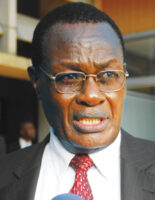
Christopher Obure – Commissar who ran cowboy contractors out of town

This was not Obure’s first stint in government, having been a powerful Minister under former President Daniel arap Moi, who picked him at the tail end of his regime to replace Chris Okemo as Minister for Finance following an outcry from international donors. At the time, the BBC reported that the reshuffle was “an attempt by President Moi to get a more diplomatic minister to front negotiations with the World Bank and IMF (International Monetary Fund) in a bid to convince them to release funds that they had been withholding”.

The same reshuffle saw Kenya’s fourth President, Uhuru Kenyatta, appointed to the Cabinet for the first time. Obure is now the Chief Administrative Secretary in the Ministry of Transport and Infrastructure, appointed by President Kenyatta.
As Minister for Public Works, he is credited with dealing with cowboy contractors and leading the ministry out of the woods after years of being in shambles due to corruption, rogue practitioners, poor capacity, low funding and irregularities. Obure championed the formation of the National Construction Authority (NCA) through sponsoring the National Construction Authority Bill 2011, which gave NCA powers to sanction and blacklist rogue contractors who in the past had cost the government billions of shillings in losses.

The Minister also spearheaded the enactment of the Quantity Surveyors Act, which allowed the creation of a Quantity Surveyors Registration Board with powers to register high-quality surveyors. Obure first joined government in 1984, as Assistant Minister for Labour under the late Robert Ouko. He was first elected to Parliament as the representative for the former Machoge-Bassi Constituency in the snap General Election of 1983. Obure had unsuccessfully vied for the seat in 1969, when he emerged second after Zephania Mogunde Anyieni. He was also placed second in the 1979 General Election.
Machoge-Bassi was later split to form Bomachoge and Bobasi constituencies and in 1988, Obure became the first MP for Bobasi, winning unopposed in the infamous mlolongo (queue) voting method in the Kenya African National Union (KANU) party primaries, beating Stephen Manoti. In the 1992 General Election, he lost to Manoti.

In his master’s degree thesis titled Gusii Politics in the Era of Multi-Partyism in Kenya, 1992-2007, Walter Ongeri writes: “In Bobasi, Obure, who had beaten Manoti in the first poll, lost the KANU nomination in the repeat primaries to Manoti who was firmly in the (Simeon) Nyachae team. Actually, Obure did not participate in the second round of KANU nominations. He insisted he had clearly won the nominations in the first round but was recorded as having lost. According to the KANU headquarters, the true result was ‘unclear’ and (they) ordered new elections, which Obure boycotted consequently losing the KANU ticket.”
In the 1997 elections, Obure beat Manoti and was thereafter appointed Assistant Minister for Transport and Communications. Following Nyachae’s resignation from the Cabinet to protest his transfer from the influential Ministry of Finance to the less glamorous Industrial Development docket, Moi appointed Obure Minister for Industrial Development.

In 2000, he was appointed Minister for Industrialisation and shortly after was moved to the Ministry of Cooperatives in the same capacity. Following a rationalisation of ministries that reduced their number to 15, he was appointed Minister for Agriculture, Livestock and Fisheries, where he said he undertook several reforms to boost various sub-sectors. And in a 2001 Cabinet reshuffle, Moi moved Obure to Foreign Affairs and International Cooperation, where he stayed less than a year before another transfer to the Ministry of Finance.

“In 2002 we did a lot of adjustments. It was a very difficult year,” Obure said in a past interview. “There was a lot of repositioning in politics and this gave us problems. The economy was performing very badly due to the political uncertainties, so tax revenue was very low. Donors were not providing loans. I don’t know how we survived. But as Minister for Finance, I had to hold hard to ensure the economy did not collapse.”

When Obure was voted out of Parliament in 2002, the game of musical chairs continued with Manoti regaining the seat through the Ford-People party. Obure stayed out in the political cold until 2007 when he won back the seat via the Orange Democratic Movement party ticket. In the 2013 General Election, the first under a devolved system of government, Obure opted to vie for a seat in the Senate, becoming the first senator of Kisii County.

Despite a colourful public service career, his tenure in government was tainted by the Anglo Leasing scandal in which shadowy companies were set to be paid billions of shillings to supply the Government of Kenya with technology to print new passports as well as supply naval ships and forensic laboratories. In March 2015, Obure became the most senior government official to be charged in court over the Anglo Leasing scam.

“This is the first serious prosecution of senior politicians accused of corruption in modern Kenyan history. One Western diplomat calls it ‘a revolution’ in the fight against graft,” the Economist reported. The former Minister would later be cleared of the charges.

Aside from politics and public service, Obure also had a history with football. Perhaps as a testimony to his skills on the field, he adopted the sport as his trademark in the game of politics. A popular chant during his election campaigns was “Mpira!” (meaning ball), which boosted his reputation as a man intent on building sports skills among youths.

Obure once played as a winger for the Bata Bullets, Gor Mahia and even the national team, Harambee Stars, albeit very briefly. When Gor Mahia was formed in 1968 as a community club, Obure joined as the first non-Luo player, playing in right wing in the team’s inaugural season. At the time, he was a Bachelor of Commerce student at the University of Nairobi.

Other notable players of that era included Joe Kadenge, James Sianga, Peter Ouma, Nicodemus Arudhi and Fred Siranga.
The former Minister’s name is also synonymous with football management. The story begins with the Kenya Football Association (KFA), the body in charge of football in Kenya at the time. In 1973, a majority of football clubs playing in the top-tier league announced that they were tired of KFA, which at the time was riddled with corruption and mismanagement.
In response, Kenneth Matiba, a wealthy businessman, formed the Kenya Football Federation (KFF) with himself as chairman and Obure as the secretary general.

Born in September 1943, Obure began his education at Kereri Primary School in Bobasi before joining Kamagambo SDA Secondary School in South Nyanza District. “I used to walk 12 kilometres to and from Kereri Primary School every day for eight years. It was tough. The paths were rough and most of the time, there was a lot of rain. What that environment did to you was harden your determination. It emboldens you to work hard and succeed,” he said in a past interview.

After his secondary school education, Obure worked as an untrained teacher at Riosiri Primary School in South Mugirango Constituency. The government had just introduced the Higher Certificate of Education, so Obure left his teaching job to enroll at Kisii High School for his A’ levels. “I found excellent facilities and teachers who were trained and committed, and so I finished forms 5 and 6 in one year instead of two. I did this by enrolling for the London GCSE (A’ level),” he said.

He joined the University of Nairobi in 1965 to study for a Bachelor of Commerce degree. At the university, he was elected Vice President and Minister for Campus Affairs in the student body, with former Gem MP Horace Ongili as President.
“At the time, the Cold War was raging and students became a target group. We were invited to visit the USSR (Union of Soviet Socialist Republics) and other countries in Eastern Europe. We met many student leaders. It was an inciting moment,” Obure said.

At the university, he also studied for a professional course offered by the Chartered Institute of Secretaries and Administrators of the UK, which would later prove vital for his career. “The student population was very small and we were in demand by various institutions, including government. There were many job offers but I chose the East African Bata Shoe Company. I was being prepared for a four-year programme through which they wanted me to go to the UK, but I already had a professional course. They were training Kenyans to take over from departing expatriates. Hence my six-year waiting period was reduced to two years. I was appointed Company Secretary in 1970,” he recalled.

He worked at the shoe company until June 1984 after which he took up an offer at Kenya Breweries Ltd (KBL) to work in a similar capacity. After two years, he was appointed Group Company Secretary with East African Breweries Ltd but still retained his KBL job. In 1982, he was appointed a director at KBL.

Amos Kimunya – The comeback kid

In 2002, a Finance prodigy made an important decision. He would make a move from the private sector where he was already excelling and throw his hat into the political arena. Perhaps he needed the challenge, perhaps he realized his talents could benefit his country; whatever the case, in the year he turned 40, Amos Muhinga Kimunya was in the race, seeking to represent Kipipiri Constituency in Parliament.

Kipipiri made sense; it was where he had always called home, for although Kimunya was born in Kiambu, his parents had made the move to Nyandarua County (then Nyandarua District) and made a home there. It was there that a young Kimunya had studied until his ‘O’ levels, which he completed at Njabini High School before venturing out beyond his childhood home for further studies. And study he would, for it is clear his resolve regarding matters education was singular. No wonder he went all the way to PhD level.

But now back to Kipipiri in 2002, in a Constituency that wasn’t getting left behind now that the new dispensation had finally arrived. These were heady times for Kenya. Although the second liberation had begun in December 1991 with the repeal of Section 2(A) of the Kenya Constitution essentially re-introducing multiparty politics, the country was about to taste the fruits of that victory. The election of Mwai Kibaki, who was taking over from Moi’s 24-year reign was accompanied by great hope and jubilation. NARC was the vehicle in which Kibaki had arrived at the top seat, and it was the very same vehicle in which the nascent Member of Parliament for Kipipiri landed.

It was Economics Genius meets Finance Prodigy moment. Kibaki had graduated top of his class at Makerere in 1955 before heading to the London School of Economics. Kimunya would be the top student in his class when he received his Global Executive Masters of Business Administration (GEMBA) from USIU in 2014.

“You have asked me to lead this nation out of the present wilderness and malaise onto the Promised Land. And I shall,” Kibaki promised when he took office, just days after his inauguration, as he outlined his goals―key among them, economic reconstruction.

The Commander had spoken. But he would need some Generals.

And when Kibaki’s first Cabinet was announced in 2003, Kimunya made it to the list as Minister for Lands and Settlement. Completing this team in this Ministry were Assistant Minister Orwa Ojode and Permanent Secretary Francis Baya. In 2005 when the Ministry was reconstituted as the Ministry of Lands and Housing, from the original team, only Kimunya remained as Minister, with a new team of Assistant Minister for Lands Asman Kamama, Assistant Minister for Housing Betty Tett, and Permanent Secretary Stephen Mwero. Among Kimunya’s accomplishments in this first cabinet post, he enabled squatters in Geta area in his Kipipiri constituency to acquire and settle on their own land.

Lands has never been a light docket given the keen—if inordinately enormous —significance placed on land ownership by Kenyans. And it would not be light one for Kimunya either. As Minister for Lands, he was responsible for dealing with a particularly sensitive matter―the eviction of residents of the Mau Forest. Kimunya canceled 10,000 land titles for parcels in the forest after the Ndung’u Report termed the land allocations illegal and recommended their revocation.

The forced eviction from the forest in the government’s attempt to save the country’s largest water tower has spanned decades, beginning in 2004 and still ongoing in 2020. It has resulted in the displacement of thousands of families, including the predominantly hunter gatherer Ogiek community. The Mau evictions were a matter of international concern, involving a coalition of national and international human rights organizations. Forced evictions have been described as a “gross violation of human rights” by the former UN Human Rights Commission (now the Human Rights Council). In 2017, a landmark ruling by the African Court on Human and Peoples’ Rights affirmed the Ogiek’s right to live in the forest.

In 2006, Kimunya was appointed Minister for Finance, a crucial Ministry in light of Kibaki’s goal to resuscitate the economy. Finance was a Ministry Kibaki knew exceedingly well, having served as Finance Minister himself in both the Jomo Kenyatta and Moi governments from 1969 to 1982. This made Kibaki the longest serving, and arguably the best performing Minister in that docket. Hence, Kimunya’s appointment to the Finance Ministry was all the more poignant because it was made by Kibaki.

What was it that Kibaki saw in Kimunya, that he would trust the Parliament first-timer with such a critical Ministry? Did he see something of himself? No doubt, there were some things in common. Like the understanding of matters finance. Kimunya had excelled academically, and besides, had solid work experience in the development sector, with special emphasis on financial management.

Like Kibaki, Kimunya was from a humble background and stood out on his own merit. He had attended Njabini and Shimo La Tewa High Schools solid but not top schools and he had excelled regardless; a trait that seemed to run in the family. Kimunya has said that his late father, Samuel Kimunya “did not attend any school, yet he read the papers, spoke fairly good English, and documented his entire life of 85 years.”

Then there was their shared passion for golf. Kibaki, has been the Patron of the Kenya Golf Union for decades and an avid player for much longer. His former caddy, who carried his clubs for ten years, says that Kibaki played 9 holes every day, back before his accident and before he was elected president. Kibaki was inducted into the Kenya Open Golf Limited Hall of Fame in 2018 for his significant contribution to the sport. Kimunya is not only an avid golfer, but a talented one as well. A former team captain and chairman at Muthaiga Golf Club, he would have rubbed shoulders with Kibaki there over the years.

But there was more. Like Kibaki, Kimunya’s style was understated. Less-talk-more-work. He was performance-oriented.

Kimunya’s performed well in the Finance Ministry. With his team of Assistant Minister Oburu Odinga and Permanent Secretary Joseph Kinyua, he maintained the economic growth that Kenya had enjoyed since Kibaki took the reins in 2002. He presided over the privatisation of Telkom Kenya, concluded successfully in November 2007 with the sale of a 51% share to France Telecom.

Kimunya also directed the Safaricom IPO, Kenya’s biggest share offering, which was launched in March 2008, standing firm to move ahead despite a recommendation by the Parliamentary Investments Committee to shelve it. The IPO was massively oversubscribed, bringing a ray of hope to a nation that had staggered under the shock of post election violence. And although the shares initially declined in value, investors who held on reaped the benefits of record highs in the long term.

Earnest about economic growth, Kimunya earned himself some opposition from among his colleagues for another reason. He was the first Finance Minister in Kenya’s history to suggest that his colleagues in parliament pay tax on their allowances. He first broached the matter in his inaugural Budget Speech in 2006―as a request―and was summarily rebuffed. But he was determined. It simply made sense. So in June 2008 the proposal was back in his Budget Speech.

“The other interesting item which I expect to get more comments on from honourable Members, as we discuss these tax proposals, is the issue that touches on all of us here, which is the taxation of the allowances that are paid to us as honourable members and constitutional office holders. In effect, we are saying that nobody in Kenya, from the President to the lowest paid public officer, will be exempted from the national duty of paying their taxes,” said Kimunya on June 26 that year, during debate on the budget.

But before the tax on MPs matters could find a resolution, a storm hit.

Kimunya may not have been looking for the limelight, but it found him. The Finance Ministry is not one that lends itself easily to obscurity. Indeed Kimunya had been appointed to the Ministry in the aftermath of the mega Anglo-Leasing Scandal that had seen his predecessor, David Mwiraria, resign from the post.

And now Kimunya was in the eye of another huge storm. Named in a scandal involving the sale of the government-owned Grand Regency Hotel at far below its value, he denied any wrongdoing and, amidst calls for his resignation, declared that he would “rather die than resign.” However, within two days of his statement, he did in fact resign. Parliament had already passed a vote of no confidence in him and, caught between swallowing his words and waiting to be fired, on July 8, 2008 he made the difficult announcement that he was stepping aside to facilitate the inquiry. He, however, maintained that he was innocent.

It may have looked like the end for Kimunya ― censured by the House, forced to swallow his words and resign from his Cabinet position. But he had more than one life. Kimunya was cleared of wrongdoing by an independent commission in August that same year, and by January 2009 he had been re-appointed to the Cabinet as Minister for Trade in an acting capacity, a position he held until 2010 when he was appointed Minister for Transport.

Kimunya had made his debut into politics as Kipipiri MP in 2002, and had held that seat for ten years. Then the unexpected happened. He lost Kipipiri in 2013 to Samuel Gichigi, who had previously campaigned for him. Kimunya had come in at the beginning of the Kibaki era, and now he seemed to be exiting with it.

Kipipiri Constituency, along with sister constituencies Kinangop, Ol Kalau, Ol Joro Jok and Ndaragwa, make up Nyandarua County, scenic home of the rolling Aberdare Ranges. Indeed the ranges themselves gave the name to the county, a reference to the hills that resemble hides laid out to dry in the sun; until colonialists changed the name in honor of a Lord Aberdare. Rich soil and plentiful rainfall makes Nyandarua a serious bread basket where potatoes, cabbage, maize and beans abound. Good, healthy, simple food. Nothing out of the ordinary. Still, Nyandarua has some surprises to offer. Like hikers paradise Mt Kipipiri and beautiful Lake Ol Bollosat, the only Lake in Central Kenya; one that forms the headwaters for River Ewaso Nyiro.

High up in the Aberdares, six or seven caves that served as operational bases for Mau Mau fighters are now a tourist attraction. The cave walls protected the fighters by repelling colonialists’ bullets, and gave them shelter from the ice-cold winds. Wild fruits in the brush land and honey from wild bees supplemented their diet.

Whether from caves such as these or elsewhere, freedom fighters across the country struggled to wrest the country from the claws of colonialists. And Amos Kimunya’s father, Mzee Samuel Kimunya Gikang’a, was one of these brave men, an active freedom fighter who fought for Kenya’s independence. In Kibaki’s condolence message at Mzee Kimunya’s funeral service in July 2011, he said of him: “I am proud of the contribution he made for this country and in particular for the struggle for our independence.”

When he relocated his family to what was then Nyndarua District, Mzee Kimunya couldn’t possibly have imagined that his son, just a boy then, would one day represent one of its constituencies in parliament for more than a decade. The people of Kipipiri did indeed place their hopes in Kimunya time and again, perhaps recognising in him some great qualities.

That the Constituency lagged in infrastructure development, despite Kimunya’s indubitable expertise in matters management and development is a paradox. The constituency’s roads have been a letdown to farmers seeking to get their produce to market. The ample rainfall that is a blessing to the farmers unfortunately also renders some roads which are in disrepair impassable, affecting access to schools and hospitals.

Until 2013, Kenya’s Cabinet Ministers were picked from among elected Members of Parliament and proceeded to serve in both capacities. This was the case for Kimunya, who served in various Cabinet positions during the ten years begining in 2002 that he was the elected representative for Kipipiri. Under the 2010 Constitution, Cabinet Secretaries (who replaced Cabinet Ministers) may not be Members of Parliament. They are nominated professionals who have to be vetted by a parliamentary committee before their appointment. Perhaps there is great wisdom in this change, which took effect in 2013. Cabinet Ministers prior to this had two jobs to do, and may have struggled to do both effectively.

At any rate, in 2013 Kimunya was out of Cabinet and out of parliament. But he was not at a loose end. There was an issue he had become particularly passionate about during his ten years as Kipipipiri Member of Parliament. He and his wife Lucy realised that there were many bright but economically and socially disadvantaged children who lacked access to quality education. They registered the Kimunya Trust and began sponsoring children through High School using funds from family income and occasional wellwishers. For three years they also sponsored a two-week tuition and mentoring programme that benefited hundreds of Form 4 candidates from schools in Kipipiri, all of whom later joined various universities.

Now Kimunya was out of public office, he had the opportunity to focus on serving his community by helping young people get a good education.

“It is clear that as a country, we have shifted our attitudes and expectations of leadership, away from the noble goals of service to mankind,” Kimunya has written on the website for the school which was born of the passion he and his wife had developed for education. The goal of the Foothills School Kipipiri is to provide quality education and servant leadership skills to boys regardless of their social and economic background.

In 2017, Kimunya was re-elected as Member of Parliament for Kipipiri on a Jubilee Party ticket. He was back! They say it never rains but it pours; Kimunya had had his share of rain. But now it seemed the season was turning for him and the sunshine was getting warmer. Kimunya, had been appointed vice chair of the House education committee, a fitting appointment given his interest and experience in the field. Then on June 2, 2020 in a Parliamentary Group Meeting at State House, Kimunya was appointed Secretary of the Jubilee Coalition Joint Parliamentary Group. And just 20 days later, at another Jubilee Parliamentary Group meeting chaired by President Uhuru, he was appointed Leader of the Majority Party in the National Assembly, taking over from Aden Duale, who had held the position for eight years.

Amos Muhinga Kimunya truly is the comeback kid―a seasoned politician who has weathered political storms and repeatedly returned from the edge, victorious. His poise, experience and proven abilities have shone through, making him an unmistakable pick, first by Kibaki and now by Uhuru.

Kalonzo Musyoka – Kibaki’s term two assignee

On the eve of New Year, 2008, at a church in the Rift Valley town of Eldoret, marauding youths besieged the Kenya Assemblies of God Church at Kiambaa. They killed 35 men, women and children that had sought refuge in the House of God. Pastor Stephen Mburu, who witnessed and survived the attack, described to the media the terrifying scenes.

The Saturday Nation of 1 March 2008, captured the pastor’s description of the assailants spearing victims that tried to flee the blaze. Others were flung back into the embers. He retold how he pleaded with the attackers who struck him several times, pushing him into the inferno. He had no recollection of how he escaped, but he lost eight teeth.

As soon as Mwai Kibaki was declared the winner in the 2007 General Election, violence broke out in the Rift Valley, spewing into the western Kenya, Lake Victoria and coastal regions. What followed was mayhem. It manifested in systematic killings, rapes, arson attacks, looting and the destruction of property.

At that point, Kibaki reached out to Stephen Kalonzo Musyoka.

It took the former United Nations Secretary General, Kofi Annan, to broker a deal that established a coalition called the Government of National Unity.

In his memoirs, Seasons of Hope, the former Kitui Senator and Kalonzo confidant, David Musila, reckons that as the violence escalated, wisdom persuaded them to join the Kibaki side to help stabilise the country. Soon a working formula of a partnership between Kibaki’s Party of National Unity (PNU) and Kalonzo’s Orange Democratic Movement-Kenya (ODM-K) was drafted. Kalonzo and his party joined government and he was immediately appointed Vice President.

On Thursday 28 February 2008 Kibaki and Raila Odinga, signed a pact at Nairobi’s Harambee House at a ceremony witnessed by, among others, Kofi Annan, Tanzania President Jakaya Kikwete and former Tanzania President William Benjamin Mkapa. The two Kenyan leaders agreed to lay aside their adversarial stance, promising to restore peace in Kenya and stability in the region.

Kalonzo took the moral high ground even as he was castigated for joining Kibaki. Indeed, some of his critics called him a traitor. Others called him selfish while others even claimed that he was a political project of Kibaki and former President Daniel arap Moi.

The day he was appointed Kenya’s 10th Vice President, Tuesday 8 January 2008, remains unforgettable. However, he said of that action that earned him enemies and friends in equal number: “I do not regret my decision then, just as I do not regret my decision to re-join Raila under the Coalition for Reforms and Democracy (CORD), in the 2013 elections, and under NASA in 2017. In 2008, I played the crucial role of peacemaker. Kenya might have slid further into anarchy had I joined ODM.”

Another compelling reason for joining Kibaki, was to save the lives of hundreds of Kikuyu families in his Ukambani, homeland. With the violence taking on an ugly ethnic angle, he sensed that he would have endangered their lives had he joined forces with ODM.

In 2003 Kibaki as took over the instruments of power, he promised to deliver a new Constitution. Moi had presided over a vibrant process at the Bomas of Kenya where Kenyans from all walks of life had reviewed the Constitution of Kenya. A small clique of politicians from Central Province coalesced around President Kibaki, excluding Odinga and Kalonzo from Kibaki’s affairs.

Despite the diminishing of a cordial relationship between Kibaki and Kalonzo, the Vice President enjoyed his stint as Foreign Affairs Minister under Kibaki’s first term. He was doing what he loved most, banking on years of experience and travel that had transformed him into a skilled diplomat, negotiator and mediator.

Kibaki tasked him with the duty of uniting the people of South Sudan and Somalia respectively. The Sudan People’s Liberation Army (SPLA) in South Sudan had waged a fierce war against the Muslim north whose leadership was keen to forcibly impose Islamic Sharia law in the mainly Christian and animist south. Millions had died after years of a bloody war led by John DeMabior Garang in the south against the Khartoum government.

Kalonzo had sharpened his skills from the time he was first appointed Foreign Affairs Minister after the 1992 General Election during Moi’s tenure. He began chairing peace negotiations through the Intergovernmental Authority on Development (IGAD). After the 2002 elections Kalonzo went back to familiar territory in the Foreign Affairs Ministry. Once again, he took over the peace process that had been expertly led by General Lazarus Sumbeiywo.

Kalonzo believes that the breakthrough in the Sudanese peace process arrived when Kibaki dispatched him to President Bashir in Khartoum and Egyptian President Hosni Mubarak, with goodwill messages. Kalonzo briefed both presidents on the peace process. Due to the importance of River Nile to their country’s livelihood, Egyptians had become key players in the negotiations.

“I got a call from Sumbeiywo soon after arriving in Cairo. He told me that the Sudanese talks at Mt. Kenya Safari Club were stuck and we needed to bring both Vice President Taha and John Garang on board,” recalls Kalonzo with a smile

While the tension-packed talks were taking place, Kenya was mourning the death of Vice President Michael Wamalwa. “I assured Bashir that I was willing to put my career and reputation on the line by taking the risk of bringing Garang and Taha together at the peace table. I told him, ‘Mr. President, in the event that John refuses to meet Taha, Kenya is mourning the passing on of our vice president. May I humbly suggest that your vice president attends the State funeral? In the event that John refuses to see him, he will at least represent you at the funeral’.” Taha flew to Kenya and drove straight to Wamalwa’s home in Runda, Nairobi.

The parties waited for Garang who eventually arrived after two days. The talks were back on track. By bringing Garang and Taha to the negotiating table, Kalonzo had given the Sudanese peace process a major dose of confidence and a chance at survival.

The Secretary General of the United Nations, Kofi Annan, wrote to Kibaki requesting that given the advanced stage in the Sudanese talks, that Kalonzo be given the chance to complete the process. Kalonzo received a letter asking him to continue, however, a month later he received yet another letter asking him to hand over to John Koech. He was devastated.

Kalonzo’s dream was, however, realised with the eventual birth of South Sudan as a new nation following the referendum in early 2011 on its marriage to the north. He was delighted to see the peace efforts bearing fruit. Then in July 2019, President Uhuru Kenyatta appointed Kalonzo as a Special Envoy to the Republic of South Sudan.

To date, Kalonzo has no idea why Kibaki moved him to the Ministry of Environment and Natural Resources in 2004, but the appointment came with many blessings. He took up his new job with enthusiasm. He was soon traversing the country, planting trees; fighting environmental pollution; and educating Kenyans on the impact of bad environmental practices.

Kalonzo acknowledges that the Environment docket tested his ego, humility and diplomacy to the limits: “I was given a deputy who was more qualified in environmental and development issues than I will ever be,” he recalls. “Indeed, she should have been my boss.” In her own right, Nobel Laureate Wangari Maathai was a highly acclaimed global citizen, whom Kalonzo accompanied to Oslo, Norway, to receive the Nobel Peace Prize.

He learnt a lot from his interactions with Maathai and his work in the Ministry. He put all this to work by overseeing the transformation of his home in Karen and in Yatta by planting plenty of indigenous trees.

The year 2005 was politically a volatile one. This is the year Kenyans rejected a draft Constitution that the government supported. For decades, Kenyans had fought for and agitated for constitutional changes that would offer them an assurance of their basic and human rights while taming the powers of the Executive. Ever since the era of President Jomo Kenyatta, through to Moi, the Presidency had become extremely powerful and prone to abuse.

Kenyans in their thousands met for months at the Bomas of Kenya under the Constitutional of Kenya Review Commission (CKRC), to deliberate on the Constitution they wanted.

The Bomas Draft Constitution was born with a draft proposal for a less powerful President. It proposed that there be a Deputy President who would be the President’s running mate during elections. The Bomas draft allowed for the establishment of the office of the Prime Minister (PM) with executive authority. The PM would be the Head of Government and Leader of Government Business in Parliament. The President would appoint the PM from the majority party or parties which formed the government.

The Kibaki administration suddenly withdrew from the Bomas conference and later, through the then Attorney General (AG) Amos Wako, came up with a draft Constitution that came to be known as the Wako draft. The Wako draft differed greatly from the Bomas one, especially on the Presidency. It retained an executive President enjoying all authority as provided for in the Constitution at the time.

The Wako draft provided for a non-executive PM, who would be appointed and fired by the President. The Prime Minister’s main function would be Leader of Government Business in Parliament and would be assisted by two deputy premiers, also appointed by the President. The PM could be appointed from among Members of Parliament (MPs) of a party or parties on the government side, and not necessarily from the party with the majority in Parliament. The Wako draft proposed a two-tier system of government where there would be a central government and a devolved one at the district level.

A new Bill was drafted by the AG and a team of lawyers. Wako unveiled the draft on 24 August 2005 to be subjected to a referendum.

The Christian religious leaders were opposed to the inclusion of religious courts in the new Constitution, arguing that Kenya was a secular state and as such should not have religious courts entrenched in its Constitution.

Kalonzo linked up with KANU’s Uhuru Kenyatta, Odinga and a host of other MPs in opposing the new Constitution. On 27 August, the Liberal Democratic Party (LDP) and KANU announced that they would jointly campaign against the proposed Constitution. The parties said that they could not break pledges made to the electorate during the 2002 General Election. Meanwhile, Kalonzo and his Cabinet colleagues Odinga, Anyang’ Nyong’o, Najib Balala and Ochillo Ayacko issued a press statement declaring their opposition to the draft Constitution.

The Electoral Commission of Kenya (ECK), picked 21 November 2005 as the day of the referendum. It also released the symbols that would stand for ‘yes’ and ‘no’ on the ballot papers, a banana and an orange respectively. On 8 September, the ‘no’ camp officially launched its campaign. They cautioned Kibaki that he was endangering the survival of his government by supporting the new Constitution. Kalonzo dared him to sack the five ‘rebel’ ministers who had opposed the proposed Constitution.

On 21 November, millions of Kenyans voted in the referendum, and on 23 November, it was apparent that the ‘no’ team had won. The proposed new Constitution was rejected. The tally stood at 3,548,477 Kenyans (57% of the entire vote) who voted no, against 2,532,918 Kenyans (43% of the total vote) that polled yes.

On 24 November, Kalonzo, Odinga, Balala, Nyong’o, and Ayacko were fired from the Cabinet, and Kalonzo suddenly found himself in unfamiliar territory on the back bench.

Kalonzo argues that unlike Moi, President Kibaki was difficult to understand and even more difficult to predict. He kept to himself and only allowed very few people into his inner sanctum to share his thoughts. He posits that, had the wrangles that put the LDP–NAK marriage asunder and had the missteps that followed thereafter not occurred, perhaps Kibaki would have become the greatest President Kenya ever had.

The Vice President’s office was the biggest and most influential that Kalonzo has ever held. However, occupying the office was not a walk in the park. The position came with the Home Affairs docket which is responsible for the Kenya Prisons Services. Kalonzo had to continue with the prison reforms that Moody Awori initiated when he was Kibaki’s Vice President between 2003 and 2007.

Kalonzo said that as Kibaki’s deputy, he was kept very busy with local and international assignments. “But I must say he was very good at delegation. As his VP, Kibaki gave me a lot of assignments to carry out on his behalf but I noted that he personally handled all the major ones himself. He also gave me a relatively free hand to operate and I would hold sessions with him once a week.”

Kalonzo and his PS Ludeki Chweya, worked hard on their Prisons and Betting Control docket. Although his office should have been in charge of cohesion and reconciliation, he never got the portfolio.

Due to Kibaki’s nature, many would approach Kalonzo to speak on their behalf whenever they had issues that required the President’s ear.

There were also occasions when he would make certain pleas: “During one formal Cabinet meeting I requested Kibaki to forgive 4,000 prisoners on death row. I do not believe in the death penalty. I convinced Kibaki to remit the 4,000 to life imprisonment,” Kalonzo said.

Whereas President Moi regularly called his ministers, Kibaki never once called Kalonzo for the entire period served as his principal assistant. Kalonzo says he would occasionally call Kibaki on the hotline.

During their last days in office, Kalonzo wanted to see him on a matter he considered critical. The Truth Justice and Reconciliation Commission under Bethwel Kiplagat, had released a report which wrongly mentioned Kalonzo adversely. He desperately wanted to talk to the President about it but never got the chance. Kalonzo wondered how the report with such glaring factual gaps could have been allowed to pass.

Kalonzo took a long and silent pause when what he calls his most misunderstood assignment, the ICC (International Criminal Court) shuttle diplomacy, was brought up during the interview for this article. The assignment earned him numerous friends and plenty of foes.

“I have gone on the record several time defending my much-maligned efforts to have Kenyan cases at the ICC deferred. My efforts were aimed at safeguarding Kenya’s sovereignty while allowing for thorough investigations to ensure that even suspects not included in the list prepared by Justice Phillip Waki and handed to the ICC were brought to justice,” he said.

He added that his efforts were never meant to save the ‘Ocampo Six’ (Kenyatta, William Ruto, Joshua arap Sang, Hussein Ali, Francis Muthaura and Henry Kosgey); neither were they meant to win him political glory.

He was accused of ignoring the plight of post-election victims who lost their loved ones and property. It was also said that he eagerly took on the deferral mission in the hope of being endorsed as Kibaki’s successor. However, he postulates that Kibaki’s endorsement of his candidature, if it ever came, would have been a matter of agreement following the support he gave him in 2008. The ICC assignment was part of his duty to assist the President. He traversed the world, and especially Africa, to convince leaders to push for an African Union (AU) joint resolution requesting deferral of the Kenya cases at the ICC. The Kibaki government declared his mission a success as the AU later resolved to support Kenya’s request for a 12-month deferral to allow the country to finalise reforms and initiate local trials.

Opposition grew against his flurry of diplomatic activity. Some objected to public funds being spent in a quest to protect ‘six individuals facing private prosecution’.

Kalonzo reflectively looks at his tour of duty in the Kibaki administration: “My time as Kibaki’s principal assistance came with many memorable lessons, some of which changed my perspective of politics and art of governance for ever.”

Esther Murugi – The pocket rocket


Esther Murugi Mathenge is like an African red bullet chilly, small physically but packs the hardest of punches. And those who have gone head-to-head with her in the political arena have realised — but mostly too late — that often, a swing from her results in the end of the bout. In her years within President Mwai Kibaki’s Cabinet, she was the perfect velvet glove that cushioned an iron fist, a quality that made that time worthwhile but, more so, memorable.

Like many politicians in Kibaki’s government, Murugi too has a backstory. Away from the threats to strip naked and spontaneous jigs at political events, the silver haired legislator — a combination of age and genetics — has earned her place not only in the hearts of those she served, but also in the country’s history.

Murugi’s story does not start in 2007 when many Kenyans first heard of her after that year’s general elections. In fact, it goes way back to 1997 when she first lost vied for and lost a Parliamentary seat. She lost again in 2002.

From an early age, Murugi always aspired to be something greater. Something that would see her leave Githiru Village in Nyeri and move away from the already beaten paths that those who came before her trod. She wanted to accomplish a whole load of earthly assignments. And she wanted them this side of heaven.

Her formative years were spent not far from home. Alongside friends and neighbours, Murugi was first introduced to education at the Githiru Primary School before joining Highlands Secondary School — today’s Moi Girls Eldoret — for her secondary education. She then enrolled at the University of Nairobi in 1973 for a Land Economics degree course.

At the time, Land Economics was a preserve of men. Records from the University of Nairobi show that her class of 40 only had 2 female students. It might not have looked it then, but the years she spent in that class and later delving into an industry that was skewed against women was something of a preparation for her years in politics.

Upon her graduation after four years, Murugi was quickly absorbed into the public sector, joining the Ministry of Lands as a Lands Officer in 1977. Here she worked diligently for the public sector for three years, but somehow, Ardhi House, where the ministry was based, wasn’t enough of a challenge for her. Soon, the private sector came calling, and like many of her peers, it was too enticing to ignore. She left public service, only to return years later. Her journey back to public service though, was littered with a trailblazing career in business and the aid world.

After the government job, she joined Nairobi Homes as Property Manager before starting Mugi Property Consultants a year later. After another year, she moved to Milligan &Co Ltd — again as Property Manager. In 1989, Murugi founded Lustman & Co Ltd, a registered estate agent where she has served as director. But even this didn’t prove enough for the ambitious woman. The booming of her real estate business corresponded with a historic moment for the country.

The democratic space was opening up, and President Daniel Arap Moi was beginning to loosen the grip that he previously had on the country. Individuals with contrary political opinions were slowly finding their voices after decades of being muzzled.

Granted, the danger of openly criticising the government was still a reality, but a few brave individuals still shouted at the top of their voices. Murugi may not have been one of them, but the noise that was being made across the country got to her. And when the second multiparty elections came around in 1997, she was ready to throw her hat and heart into the ring. Or so she thought. “In my first attempt, I thought that all I needed to do was to let the voters know my plan,” she said in an interview in 86 and Counting, a publication on women leaders in the 11th Parliament. But in front of her was what seemed an unbeatable opponent. Wanyiri Kihoro too wanted that seat. And at a time of ferocious political views, and the rise of an opposition movement that promised to transform Central Kenya into a bedrock of opposition politics, Kihoro had the battle scars to show. He, like many others during that time had suffered detention, a sad chapter of his life that he wore on his sleeve unashamedly. There was little that Murugi could do to prevent a Kihoro win. That year she tasted the first of what would be many defeats in her political career.

She bided her time for five more years and in 2002, she contested the Nyeri Town Parliamentary seat again. At the time, it all seemed to go according to plan. There was a certain euphoria going on in the country and she seemed to be headed for victory. Kihoro was no longer as strong a contender as he had been in the previous election.
But there was one key difference between the two elections. This time, a party nomination for the hypnotic National Rainbow Coalition (NARC) — a unified coalition of opposition parties — seemed certain to take power from the Kenya African National Union (KANU), Kenya’s independence party.

Before she made the move for NARC, whose Presidential candidate was Kibaki, Peter Gichohi Mureithi beat her to the ticket and won the seat in a landslide victory. At that point, after two unsuccessful attempts to win the seat, the fate of Murugi’s political career seemed sealed. However, something kept her going. Throughout her losses, some of which were humiliating enough, Murugi remained loyal to her cause, treating her defeats as mere bumps along a road to a preordained destination that only she could see. This loyalty would become beneficial in the next election cycle.

Although she lost, Murugi had been a vocal campaigner for NARC’s candidate Kibaki in the 2002 General election. She was no longer an unknown entity in Nyeri Town, a constituency that the incoming President had familial ties to and remained fond of. Even after Kibaki’s successful bid, she remained within earshot of the President. Making official visits to his homes in Othaya and Nyeri whenever an opportunity arose. She found her way easily to the President’s side. She remained visible and relevant to the powers of the day. And in 2007, during the next General Election, Murugi had already cemented herself as the best Member of Parliament (MP) Nyeri Town had never voted for. Plus, she had built up a relationship with the President, becoming a key ally in his re-election bid that year. In 2007, she became third time lucky and made it to Parliament and claimed her own corner of history while at it.

A highly charged campaign period saw the men in the Parliamentary race gang up against her, making her victory all the sweeter. She had, among other things, overcome a well-orchestrated campaign against a woman candidate by male candidates who colluded to edge her out by organising male-only Party of National Unity (PNU) political campaign onslaughts. In an interview with the Kenya Women Parliamentary Association (KEWOPA), she described the fall out from that election:
“We are yet to mend fences. They begrudge me just because I beat them. Didn’t a woman have the right to win the Nyeri seat,” she explained. That was not all though. Her loyalty and perseverance earned her a spot in the Cabinet. Suddenly, all the years of hard work culminated in her being named as a minister in the Government of National Unity. “I never thought I could have a chance. There were so many competing interests and coming from the President’s backyard only diminished the slightest hope,” she said in an interview with a local daily soon after the naming of the Cabinet.

There were other perks that came with the job too. She was named as a Deputy National Women Leader at PNU. Her years as a Kibaki insider started just four months after her election when she was named Minister of Gender and Children’s Affairs, a role that fitted her perfectly. Her Assistant Minister was Atanas Keya Manyala. Away from the clichés that might come with a woman heading the Gender and Children’s Affairs docket, her past had prepared her for the role she was to play in this space.
While she ran her business, Murugi also worked for an international non-governmental organisation that focussed on the welfare of women and children. This not only cemented her grassroots connections but played a crucial part in providing first-hand knowledge of the needs of the category of citizens the Gender and Children’s Affairs Ministry was created to serve.

People and service have always been at the centre of her existence — a trait that Kibaki also exhibited. While at the Ministry of Gender and Children’s Affairs, Murugi was credited with institutionalising the creation of a database of women professionals and of women who wished to vie for political positions. “I wanted to have a one-stop shop where we could have all relevant information about aspiring women candidates. We would then see what challenges they were facing and seek ways to help them as per their specific needs,” she said in a 2011 interview. The mechanics of government made sure she didn’t get too comfortable at her job. Midway through Kibaki’s second term, she was moved to another service-oriented ministry — Special Programmes — where she soon found herself in the middle of an international storm that had her as minister and the entire government in the middle of a storm.

In 2011 Kenya suffered one of the worst droughts in its history. The resulting famine claimed thousands of human lives. Crops failed. Pastures dried up and livestock — the bedrock of the existence of pastoralist communities — were dying in large numbers. Yet, there seemed to be a very muted response from government on the matter. When the international community started to mount pressure on the government to do more, Murugi came out guns blazing, defending the position of the State.

“Currently, we are feeding 4.4 million Kenyans,” she said in an interview with American broadcaster Voice of America (VOA). “Northern Kenya had more famine than any other part because they are pastoralists and their animals have perished, so they have no livelihood. But currently the government is providing food for all vulnerable persons.” At the time, critics said the administration had failed to prepare for a possible drought or famine, despite repeated warnings. Murugi, standing by her government, denied the charge. “We warned the pastoralists as early as October last year. We advised them to sell their animals before they lose their body weight so that they can have some money to restock when the weather is good. I think the government is doing as much as it can,” she said.

Those who served in Parliament with Murugi said she was always a straight shooter who never shied away from controversy. They said she never liked pretending and would always tell it as it was, a trait that she perhaps derived from her strong Catholic beliefs. Underneath her religious beliefs lay a shrewd politician. Her motherly look often fooled people into believing she was soft and easily malleable. In front of crowds though, Murugi often metamorphosed into many characters. She could play choirmaster, cheerleader or loyal defender all at once. Today she would speak into the heavy policy bottlenecks that prevent Kenya from becoming a middle-income country, tomorrow she would throw all sense to the wind and promise the absurd. For example, in 2011, after the naming of a number of Kenyans by the International Criminal Court (ICC) over their alleged involvement in the political chaos that rocked the country following the 2007 polls, Murugi went off on a tangent at a political rally, warning ICC of dire consequences were they to detain President Uhuru Kenyatta at the courts when he appeared for mention. “We are in your full support, and even if it means undressing, we will do it for your sake,” the Nyeri Town MP stated while teasingly holding her dress during a public rally attended by Kenyatta. She never did. What she did though was get re-elected in the 2013 General Election, becoming the first MP to capture the Nyeri Town seat for a second term since the advent of multiparty elections in Kenya.

“Learn what works for you,” she said during the 86 And Counting interview. “I mean, I’m not many things. I’m not much of a ‘shouter’. And guess what? I have come to learn that you don’t have to shout to be heard. I’m not a big talker either, and I’ve also learnt that you don’t have to promise voters heaven and earth to be elected.”
Murugi, the first born in a family of 11 children, she lost the Nyeri Town seat after serving as MP for two terms. Not bad for someone who harboured little ambition of getting into politics.

In hindsight, however, it seems that she was almost pre-ordained to walk the path she chose to walk. Her aunts and grandmother were community leaders at different levels. “I had never thought I would end up in politics. My only concern for people was their welfare,” she said in an interview with KEWOPA.
Today, Murugi spends her time with the other loves of her life: business, farming, swimming and reading.

David Mwiraria – President’s ally and confidant

David — and to some simply Daudi — Mwiraria, the numbers man, veteran technocrat and politician is arguably Kenya’s most formidable Treasury chief after Mwai Kibaki. He died of bone cancer in 2017.

Describing him as a ‘friend, confidant, co-worker and trusted ally’, Kibaki, his former teacher at Makerere University and long-standing boss, celebrated his former Finance Minister’s brilliance and grasp of economics, and his diligence, humility and forthrightness. “He commanded respect across the board effortlessly. Kenya has lost an illustrious public servant whose focus was on delivering the best for the good of all. May his soul rest in eternal peace,” Kibaki said.
It was difficult not to respect Mwiraria, even if you were of a different political persuasion. A soft spoken and bespectacled gentleman, his relatively small frame was overshadowed by his towering intellect, deep knowledge of government and public service, and, above all, the authority and ease with which he weaved development and economic policy. The man simply oozed competence.

There was something even more profound about Mwiraria. The three-time North Imenti Member of Parliament (MP) was a gentleman. He steered clear of crass insults, shameless lies and empty sloganeering of siasa za kumalizana — the politics of life and death. Instead, he cut the image of a reluctant politician; a thinker who chose to argue in a political field where those who shout the loudest and foulest often get their way. But then Mwiraria, to quote his Alliance High School classmate, the veteran journalist Philip Ochieng’, was “an educated mind”; a professorial who spent his entire working life engineering and executing government policy and shuffling facts and figures.

Listen to Raila Odinga:
“I had the honour to serve with Hon. Mwiraria as (a) fellow Member of Parliament and later as members of the Cabinet. He was an honest and diligent public servant with the interests of the nation at heart.  I will remember fondly the work we did together of reforming critical institutions like the Kenya Revenue Authority, public procurement and infrastructure financing and delivery when the National Rainbow Coalition took power in 2002. It is Hon. Mwiraria’s diligence and commitment as Finance Minister that made all the difference with regard to delivering NARC’s promises on key sectors of the economy as we raced to fulfil our pledges against a background of an economy that had gone to the dogs…”

He didn’t come across as a leader who spent time in dark pubs conjuring up schemes to steal from the government, either. Nothing about Kibaki’s Finance Minister, or his famously frugal lifestyle, pointed at the rapacious appetite associated with some members of Kenya’s political elite. In Imenti North Constituency, which he represented in Parliament for three terms, he was known as Kangumu (the stingy one) because of his aversion, just like Kibaki, to hand-outs. Retired intelligence officer and Democratic Party (DP) founder member Essau Kioni explains that Mwiraria, known for prudent management of his personal resources, believed in individuals working hard for themselves and not looking for hand-outs from leaders.

This portrait hardly fits the profile of the typical nouveau riche corrupt Kenyan whose signature is extravagance, showmanship and, not surprisingly, endless financial squabbles with friends and associates in court. Which is why 2006 news reports linking Mwiraria to the Anglo-Leasing corruption scandal shook the government and hit the country like a bombshell. Anglo Leasing and Finance Ltd, a foreign phantom company, was paid about KES 55 billion to supply the Kenya Government with a system to print new high-technology passports. Other fictitious companies involved in the scam were given money to supply naval ships and forensic laboratories. None of the contracts were honoured. It was John Githongo who dropped the bombshell. Appointed Permanent Secretary (PS) in charge of Governance and Ethics in 2003 by President Kibaki to spearhead anti-corruption efforts, he went into exile after exposing the scandal. And now he was alleging that he was in possession of audio recordings implicating Mwiraria in a cover-up.

It must have been a difficult moment for President Kibaki, who ordered that all payments be halted and the people behind Anglo Leasing exposed when Githongo brought the matter to his attention. The National Rainbow Coalition (NARC) had collapsed a year earlier, forcing him to fire all ministers and reconstitute the Cabinet by drawing in members of the Opposition. His former allies from the Liberal Democratic Party (LDP) wing of NARC had jumped ship and formed an astute and persistent opposition within government. The country was in feverish political mode, with the General Election barely a year away. What’s more, Mwiraria, as Finance chief, was not only the fulcrum of Kibaki’s national economy revival strategy, but he too was in all likelihood one of the President’s closest and most trusted lieutenants in government. The two gentlemen had known each other from Makerere before Kenya became independent. Mwiraria was PS to Kibaki in the Finance Minister in 1991, and with a closely knit circle of friends, helped found DP. What’s more, both Kibaki and Mwiraria shared a love for golf. These allegations therefore unwittingly turned Mwiraria, Kibaki’s buddy and trusted ally into a constant punching bag for the Opposition whose members went for him with guns blazing. What followed was unthinkable. Mwiraria stepped down from office, becoming the first public official to resign because of corruption allegations since Kenya’s independence in 1963. Previously, Kenyans public officials would remain in office until they were fired or the chargers faded away.

Not Mwiraria:
“In order that my name be cleared and to protect the integrity of the President, the government and our country, Kenya, I hereby voluntarily step aside,” he announced.
His resignation was not only a measure of class, but the respect and integrity with which he held public office. “Hon Mwiraria was an epitome of humility. Even when faced with adversity, he was never confrontational, preferring instead to handle matters with unparalleled diplomacy and calmness,” former Vice President Kalonzo Musyoka would say when Mwiraria died years later. A subsequent investigation cleared Mwiraria of wrongdoing following which he was reinstated to the Cabinet as Minister for Environment.

Who was this man, this career technocrat, a gentleman of Kenyan politics and giant of Kenya’s historic economic revival?

Mwiraria was born in 1938 in Meru. He went to Kaaga and Alliance High School before proceeding to Makerere University in 1956 where he graduated with a BA in Mathematics in 1962. Thereafter, he enrolled at the Nairobi University College, a constituent college of the University of East Africa, graduating with a Master’s in Statistics. Aged 26, he was the first MA student to graduate at what would become the University of Nairobi. Such sterling academic credentials at the turn of independence made him a hot cake. His first port of call was the prestigious East African Community, which he served as Director of Statistical Department and, later, Secretary of the Common Market until 1977 when he was appointed PS, Ministry of Finance, in Kenya. He served as PS in several ministries for 11 years, including Home Affairs — a position that inadvertently placed him at the centre of the infamous Wagalla massacre.

A plan to disarm warring clans and diffuse ethnic tensions in Wajir went awfully wrong when Kenya Army personnel rounded up thousands of local citizens and detained them for four days in the scorching sun without food or water at Wagalla Airstrip. The citizens, of Somali ethnicity, were reportedly tortured, beaten and executed to prise information about Shifta insurgents allegedly operating in their midst. The matter was hushed up. Government reports would later put the number of the dead at 57 while local leaders claimed thousands died or were maimed, some for life. The massacre put Mwiraria on the spot because he had flown to Wagalla with members of the National Intelligence Committee the previous day to assess plans to ‘resolve the Shifta movement in north eastern Province’. Their visit was, however, interpreted to mean that they had gone to enforce a premeditated massacre. In 2011 Mwiraria told the Truth and Reconciliation Commission that the massacre could have been carried out by the army without the knowledge of the Ministry of Home Affairs because the district security team had the discretion to detain young men. Mwiraria also denied attending any meeting to plan and execute the massacre, stating that the only request his ministry received was that the province was an operation area and needed more police reinforcement. He then apologised to the victims, saying the Wagalla massacre was a tragedy that should never have been allowed to happen. “In the context in which we were operating, it was risky to speak out your mind. One could be detained or killed for telling what happened,” he told the Commission in respect of the cover-up that followed.

It is worth noting that the chain of command within the armed forces is cast in stone, which makes the complicity of Mwiraria, who was in charge of police, in directing a military operation and the subsequent cover-up a matter of conjecture. Nonetheless, this was the first blot in Mwiraria’s otherwise illustrious career in the public service.

Mwiraria left government two years later in 1986 and went into private business. He re-emerged as the clamour for multiparty politics hit fever pitch in 1991 when Health Minister and former Vice President Kibaki resigned from government to form DP in readiness for the 1992 General Election. Kioni says Mwiraria was in the group of trusted confidants that convinced Kibaki leave the Kenya African National Union (KANU) and launch DP. “When we set out to establish DP, Mwiraria was very clear that we were setting up a party for the future,” Kioni said in a Standard newspaper report.

The following year, Mwiraria ran for the North Imenti Parliamentary seat on a DP ticket and won, defeating KANU’s Lands Minister and self-styled King of the Ameru, Jackson Harvester Angaine. Mwiraria joined his party leader Kibaki, who had come third in the polls after President Moi and Kenneth Matiba, on the back bench.
But it is after the 1997 election that his intellectual powers came to the fore. Kibaki became the Official Leader of Opposition and appointed him Shadow Agriculture Minister. The dexterity and authority with which he critiqued government agriculture policy, an area in which he had neither training nor experience, was not only a reflection of the fluidity of his mind and knowledge of government but the mark of a man accustomed to burning the midnight oil.

The best was yet to come. When Kibaki was sworn in as President in 2002, any keen analyst would have guessed the obvious: Mwiraria would be his Finance Minister.
Kibaki had made, among other things, revival of the economy, which was in ruins, a pillar of his campaign for President. The infrastructure was tattered, to the extent that vehicle manufacturers tested their prototypes for strength on Kenya’s potholed roads. International donors had given the country the cold shoulder on account of corruption and human rights violations. The Kenya Revenue Authority (KRA) was collecting peanuts, with taxes either stolen or not collected at all. The national budget stood at about KES 220 billion, government employment had been frozen and the labour movement was rife with strikes. Kibaki needed a trusted hand to reboot the economy and get money flowing into KRA to enable him fulfil campaign pledges, key among them the provision of free primary school education. The job fell to the math wizard, Mwiraria, with Joseph Magari — and later Joseph Kinyua — as PS. Kibaki had worked with both men when he was Finance Minister. He knew their abilities and could trust them to understand his philosophy and get the job done.

Mwiraria’s first budget hit the KES 1 trillion mark. It was a mind-boggling figure. Sceptics, including the International Monetary Fund (IMF) and the World Bank officials whom he reportedly threw out of his office when asked to check his budget before he could present it in Parliament, wondered where the colossal amounts of cash would come from. But with Michael Waweru, another trusted Kibaki confidant, as Commissioner General, KRA underwent massive reforms and sealed the leaking taps. ‘Tulipe Ushuru Tujitegemee’ became a national war cry and the number of registered taxpayers rose exponentially. In short, Kenya was able to finance that colossal budget from internal revenues.

Mwiraria, the prudent bean counter, was in his element. He stabilised Kenya’s fluctuating interest rates, zero-rated computers to boost ICT development, allocated massive funds for an undersea fibre optic project, instilled financial discipline in government and overhauled the pensions sector. He also concentrated on the basics — reducing government borrowing from commercial banks, forcing them to turn to ordinary Kenyans with loan offers. These measures were a game changer. Kenya suddenly became a huge construction site. The government was carrying out massive infrastructure development projects, wananchi (citizens) were borrowing money from banks and investing in real estate and all manner of businesses. The economic boom was not only reflected in the data streaming out the Treasury but the spring with which Kenyans strutted on the street — a spring that signified a change of fortunes, hope and money in the pocket.

It is instructive to note that Mwiraria, the bespectacled mathematician achieved this in only four years — before the Anglo Leasing demons came calling. But so firm was the foundation he had laid, with assistant ministers Mutua Katuku, Peter Kenneth and Zadock Syongoh, that despite the disruptions associated with the 2007–2008 post-election violence, which shrank economic growth back to KANU government times, the economy had leapt from KES 1 trillion in 2002 to KES 3 trillion in 2013 when Kibaki left office.

Mwiraria served the brief remainder of his time in Cabinet as Environment Minister. He lost at the polls in 2007, whereupon Kibaki appointed him Chairman of the Kenya Wildlife Service Board of Trustees. Coincidentally, few Kenyans know that Mwiraria was intimately familiar with the Service, having helped established the organisation’s financial management systems in the late 1980s. His retirement was, however, rudely disrupted when he was charged along with nine others in 2015 for corruption related to the Anglo Leasing scandal. Mwiraria pleaded no to the charges from a hospital bed.

Two years later, Mwiraria died. A reading of his will reveals not the massive wealth expected of a corrupt mogul, but a tidy estate built over decades with a bean counter’s frugality and prudence. A stickler for detail, the will even set aside money for his funeral. For those who knew him personally and Kenyans who had followed his career in public service, there was, however, a sense of injustice about his death: that Mwiraria would never rest in peace because he died before arguing out his case about the Anglo Leasing scandal in court. “Let us all put pressure on the investigative agencies to fully investigate Anglo Leasing, arrest and charge the real culprits. If people had not played politics, Mwiraria would not have been prosecuted and probably he would be alive today,” Uhuru Kenyatta, who was Official Leader of Opposition when the scandal erupted, said.

Was Mwiraria guilty? That will never be known. Be that as it may, the matter of David Mwiraria versus the Republic will forever remain an injustice because his was a case of justice delayed and justice denied.

Dalmas Otieno – The level headed veteran

A longtime KANU stalwart in the Moi era, Dalmas Anyango Otieno was perceived as an opportunist among opposition politicians. But when President Mwai Kibaki appointed him minister for Public Service in the Grand Coalition Government, he was tapping into one of the most experienced politicians and bureaucrats well versed in the business of statecraft.

Having been a minister for nearly 10 years, Mr Otieno knew the nooks and crannies of the civil service well enough to fix where it was broken.
Even though he had been a KANU loyalist nearly all his life, he understood that he was serving a reformist government and he went about initiating changes, the most important of which was digitising government services.

Mr Otieno joined Mr Odinga’s Orange Democratic Movement (ODM) in 2007 as the easier route back to politics after staying out in the political cold for five years. That calculation earned him back his old Cabinet seat – this time in the Grand Coalition Government that was formed after the disputed 2007 elections. His party affiliation notwithstanding, it was easy for Mr Kibaki to embrace him because of his wide experience in government and gentlemanly mien. And he did not disappoint. His success was reflected in the many reforms he introduced in the key Ministry of Public Service that Mr Kibaki entrusted him with. Because Mr Otieno was an excellent performer and a stickler for proper procedures and discipline, it was not surprising that Mr Kibaki chose him to head the Ministry of Public Service, which was still bedeviled by corruption and lethargy since the KANU days, the independence party having been trounced only five years earlier.

Mr Otieno knew very well where the rot lay, having been a longtime strategist for President Daniel arap Moi. In an interview for this project, the 75-year-old leader said that under Mr Kibaki, there was much emphasis on performance and productivity, and that he applied the same principles to ensure efficiency in public service. He noted that working under Mr Kibaki was a different ball game in that every issue and project was analysed professionally before implementation and the work had to be completed within the stipulated budget. “There was no room for people creating projects outside the laid-down plans for every ministry,” he said, recalling that Mr Kibaki approached every issue professionally.

Since Public Service ministry was based at Harambee House, Mr Otieno — who was deputised by Assistant Minister Major (Rtd) Aden Ahmed Sugow, with Titus Ndambuki as Permanent Secretary — was in contact with Mr Kibaki virtually every day to consult and exchange views on issues related to his ministry. The towering MP for Rongo in South Nyanza headed the ministries of Industrialisation between 1988 and 1991, Labour and Human Resource Development (1991) and Transport (1991 to 1996.)

Away from administration, Mr Otieno is also a respected boardroom negotiator. In early 2008, when there was an impasse over the division of ministries between Mr Kibaki’s Party of National Unity (PNU) and Raila Odinga’s Orange Democratic Movement (ODM), Mr Otieno came in handy for the latter, their earlier political differences notwithstanding. To get away from the political jostling and wrangling between the two coalition partners for key ministries, President Kibaki and Mr Odinga went for a retreat at Sagana State Lodge, with the President’s trusted ally Francis Muthaura tugging along, while the Prime Minister picked Mr Otieno for the negotiations over portfolio balance.

It was at Sagana that the coalition partners reached a compromise and agreed to share several ministries, even though the ODM rank and file still felt shortchanged in the power-sharing arrangement because PNU retained the key ministries of Finance, Internal Security, Constitutional Affairs, Defence and Foreign Affairs. Some ODM members complained that they had been allocated mere “departments”. But Mr Otieno insists that they worked hard to give every ministry enough portfolio at the Sagana retreat. “Though the Cabinet was large because of the coalition, we ensured that every ministry was assigned some services and that there was no ministry for the sake of it,” he said.

Another illustration of Mr Otieno’s skills in boardroom negotiations was in December 2011 when reports filtered through that he and then Medical Services Minister Prof Anyang Nyong’o had faced off in the Cabinet over the medical insurance scheme for civil servants. Mr Otieno — who had stood in as the Medical Services minister in February 2011 when Prof Nyong’o was undergoing medical treatment in the US — had overturned a medical cover scheme for outpatients that had been put in place by Prof Nyong’o. Appearing before a parliamentary committee on health, Mr Otieno argued that the proposed National Hospital Insurance Fund (NHIF) scheme needed careful analysis because pilot surveys in Mumias and Nairobi alone were not representative. “I am a statistician, and that sample is inadequate,” Mr Otieno, who has a background in insurance, told the committee. “We needed a professionally arranged sample. The scheme must go on because Kenyans need a healthy nation, but in a manner appreciated by the members of the Fund. It has such heavy inbuilt risks.” He further explained that the scheme needed adequate consultations with stakeholders before it could be rolled out, because most Kenyans were not in gainful employment and sustaining the scheme would be difficult. When the issue went to the Cabinet, Prof Nyong’o was of the view that the scheme should be run by NHIF, while Mr Otieno wanted the scheme to be administered by a consortium of at least five private underwriters. The Cabinet voted for Mr Otieno’s version.

One of his landmark achievements as Public Service minister came in December 2011, when he launched digitised government services under the Integrated Records Management System (IRMS), the first step towards paperless record management to deal with the problems of missing files and failure by the government to respond to correspondence from citizens. The IRMS tracked mail and files in the public service, enabling officers to receive files on their desks, access and download the information and move the letter on the system. Under the integrated system, officers were to transfer information in hard copy into the system easily and indicate what action was to be taken or had been taken. Senior officers, including Permanent Secretaries, were then able to monitor whether work had been done or was still pending.
“This is to ensure that Government activities are documented and maintained, with officials getting the right information at the right time and at the least possible cost. The system will enable the protection of Government’s interests, and reduce the risk associated with missing information, and thereby creating opportunities for corruption,” Mr Otieno said when he launched the IRMS at the Kenyatta International Convention Centre on December 19, 2011.

The introduction of the electronic records management system was a great leap in the journey towards creating paperless public service as envisaged in Vision 2030.
But Mr Otieno’s footprints were not confined to Kenya. When neighbouring South Sudan gained its independence in July 2011, his ministry was tasked with helping build a public service for the new nation that was emerging from a debilitating war. To do this, he deployed 72 civil servants to Juba to train South Sudanese personnel so that they could manage their affairs effectively, helping President Kibaki to stamp Kenya’s authority as the big boy of the region.

Mr Otieno was born on April 19, 1945, an eventful year that on the global front marked the end of World War II. Other leaders born in the same year, and who would play influential roles in independent Kenya, include veteran opposition leader Raila Odinga, who was Prime Minister between 2008 and 2013; the late Prof George Saitoti, the country’s longest-serving vice-president; Prof Anyang Nyong’o, a former minister and now governor of Kisumu County; Chirau Mwakwere, also a former minister; as well as Paul Muite, a senior lawyer and former legislator who was key in the Second Liberation movement.

A typical Luo grandee who carries himself with pride and high-society mannerisms, Mr Otieno graduated from the prestigious Makerere University with a Bachelor of Science degree in Applied Economics in 1971. He considered himself a cut above the rest in his Kengeso village in Kamagambo – the Seventh Day Adventists’ hotbed in South Nyanza – and carried himself as such, walking tall and always impeccably dressed. Between 1971 and 1982, the Strathmore College alumnus worked as an accounts manager at the Insurance Agency Management before joining Kenya Commercial Bank as its chairman and director between 1982 and 1985. He had earlier qualified as a Fellow of the Chartered Insurance Institute, London. He then founded Tasley Consultants, of which he was chairman between 1998 and 2001. Earlier, he was treasurer of the Kenyatta University Council from 1983 to 1987.

In 1988, Mr Otieno plunged into politics and won the newly created Rongo Constituency under the ruling party KANU, though he triumphed under the cloud of the controversial queue-voting system. As a statistician, he calculates his political moves carefully, always siding with the powers that be to curve out for himself a place in the politics of the day.

Having been elected in 1988, the first MP for Rongo, which was curved out of Homa Bay Constituency that year, he quickly worked his way into President Moi’s heart, employing his gift of the gab and gentlemanly demeanour to become one of the Head of State’s most trusted stalwarts outside of his Kalenjin inner circle. But come 1992, during the first multiparty elections, Mr Otieno — who still stuck with KANU despite his Nyanza province trooping to the opposition — lost his seat to his uncle Linus Aluoch Polo of Ford Kenya, headed by Jaramogi Oginga Odinga. In 1997, he lost again – this time to newcomer Ochilo Ayacko, who was running on an NDP ticket.

A favourite of President Moi’s, however, Mr Otieno was to remain in Parliament as a nominated MP and minister, in the same manner that the hawkish Joseph Kamotho, from the fiercely opposition stronghold of central Kenya, was perennially appointed minister – for regional representation. Back on his Nyanza turf, Mr Otieno was accused of working with the provincial administration to keep alive the Suba question in a desperate divide-and-rule tactic so KANU could win at least a seat in the strong Ford Kenya zone.

The Suba are a Bantu group who mostly occupy the southern region of Homa Bay County even though they have been assimilated by the more dominant Nilotic Luo for over 200 years, making any effort to evoke nationalistic sentiments in them futile. A relentless Mr Otieno was to play a leading role in keeping the Kuria, another Bantu community, a distinct political hegemony by ensuring it was given its own district out of the larger Migori. The district was for a long time to provide the only KANU seat in the four regions of Migori, Kisumu, Siaya and Homa Bay. Having failed to neutralize Mr Odinga’s influence in Nyanza, Mr Otieno was one of the brains behind the KANU merger with the former’s National Development Party (NDP) in March 2002, as Mr Moi desperately tried to stop a swelling opposition tide that would nonetheless sweep KANU out of power that year. In that election, Mr Otieno lost too to Mr Ayacko of NARC, having stuck with KANU and supported the candidacy of Uhuru Kenyatta. This time he would stay in the political cold as his patron, Mr Moi, had left power and retired and his old KANU party had been vanquished at the polls.

After the routing of KANU, Mr Otieno fell back on his insurance company until 2007, when he joined ODM and edged out Mr Ayacko during the party nominations. He successfully defended his seat in 2013 on an ODM ticket. Viewed all along as a Johnny-come-lately and an opportunist, Mr Otieno’s political fortunes started to plummet in 2014 when he was accused by some ODM leaders of working closely with the government of President Kenyatta, who had defeated Mr Odinga at the polls, earning him the tag of a “mole”. “Dalmas has never been really on our side. He has always been on the other side and he joined us pretending to be sincere but has turned his back on us after we helped him,” Oburu Oginga, Mr Odinga’s elder brother, told a meeting in 2014.

Mr Otieno was among four MPs removed by ODM from their committee assignments for their “cooperation” with the government. Others were Samuel Arama (Nakuru Town West), Ken Obura (Kisumu Central) and Zainab Chidzuga (Kwale County woman rep). However, the four survived when the motion was defeated on the floor of the House. For a man who considered himself an alternative leader in the restive Nyanza region, Mr Otieno never fully embraced Mr Odinga, the de facto leader of his community, even after joining his party, ODM. He was briefly associated with a movement called Kalausi, Dholuo for whirlwind, which tried to sweep Odingaism out of Nyanza ahead of the 2017 elections. But the movement, which also included former Kasipul Kabondo MP Oyugi Magwanga in its ranks, failed to take off, with the two leaders getting punished by voters at the ballot – Mr Otieno in his attempt to retain his old Rongo constituency seat, and Mr Magwanga in his bid to wrest the Homa Bay governorship from the ohangla-loving Cyprian Awiti.

Mr Otieno had said his new party would challenge Odingaism and focus mainly on the development of the region, which had “lagged behind in development because of perpetual political agitation”. The party was, however, never to be. In a recent interview, the 75-year-old politician said that he had never had sour relations with Mr Odinga and that he was just challenging the grassroots to focus on development projects rather than constant politicking.

A moderate on the national political front, Mr Otieno served on the Speaker’s Panel (a pool from which a temporary House Speaker could be picked at any time) between 2008 and 2013. For his moderate demeanour, extensive public service career and old KANU connections, President Kenyatta appointed Mr Otieno his Special Envoy on South Sudan in February 2014, even though he was a senior member of the opposition. As 2017 approached, Mr Otieno started moving closer to Mr Odinga and even competed in ODM primaries in his bid to recapture the Rongo seat, but he lost to Paul Abuor. He proceeded to contest as an independent candidate but lost again.

Following the death of Migori Senator Ben Oluoch Okello in June 2018, Mr Otieno initially expressed interest in contesting the seat on a National Liberal Party (NLP) ticket. He, however, withdrew from the by-election race, settling instead for an appointment to the Salaries and Remuneration Commission (SRC). Mr Otieno argued that he had a personal connection to the SRC because he was the one who established it as minister for Public Service to help manage the public wage bill. He became the vice-chairperson of the commission in September 2018 and has set his eyes on the Migori governor’s seat.

Away from this political juggling, a history of the movers and shakers in President Kibaki’s reformist government will rank Dalmas Otieno, a committed and knowledgeable minister, among the best.

Charity Ngilu – The rainbow siren


“You are joking. You are crazy, obviously!” These were the words of a small town businesswoman back in 1992, when the subject of stepping into the world of politics was first broached to her. Who would have thought that just a few years later, she would not only be a seasoned politician, but the very first Kenyan woman ever to throw her hat into the ring for the presidential race at the heady start of multiparty politics?

When Charity Kaluki Ngilu ran for President in 1997, she and Nobel Laureate Wangari Maathai became the first Kenyan women to do more than just dream about such a thing. Internationally, women icons such as India’s Indira Gandhi, Corazon Aquino of the Philippines, the United Kingdom’s Margaret Thatcher and Pakistan’s Benazir Bhutto had ascended to the top seat, but Kenyan women were still testing the waters. At the time, there was just one woman in the Cabinet, Nyiva Mwendwa, who had been appointed to the Ministry of Culture and Social Services in 1995, becoming the first female Cabinet Minister in Kenya. Coincidentally, Mwendwa is also from Kitui and an alumnus of Alliance Girls High School. Besides Mwendwa there was only a handful of women in Parliament. Indeed, the country’s history boasted few women in powerful positions; women like mayors Grace Onyango and Margaret Kenyatta, who were exceptions to the rule. And now the possibility of a woman president hung on ‘Mama Rainbow’, as Kenyans had dubbed Ngilu, a reference to her National Rainbow Coalition party.

Running for president took formidable courage. Just days after she announced her candidacy, Ngilu was attacked and wounded by machete-wielding thugs she believed to be youth wingers from the Kenya African National Union (KANU). That was after speaking at a political rally. Later she received a threatening phone call from someone who said, “So, you are still running for this after what happened on Saturday,” Ngilu said in a New York Times interview in 1998. But she was a woman with a dream. She wanted to see Kenya liberated from the Moi era security laws, and a new Constitution in place that would give the president less power, and create a system of checks and balances. ‘’Presidents are to serve and not to be served. I am demystifying that office,’’ she said. She was unsuccessful in her bid, taking 5th position out of 15 candidates in the race with 469,807 votes. This was not a minor accomplishment given the times and the formidable opponents she faced, who included the sitting president, Daniel Arap Moi, who had been in power all of 20 years, and political giants such as Mwai Kibaki, Raila Odinga and Michael Wamalwa.

It may have been a loss at the polls, but Ngilu’s attempt was a win for Kenyan women and girls. It dared them to hope, and showed them how. This may have planted a seed in Kenyan women that year that began to sprout, and finally matured in 2017, two decades after Ngilu’s presidential candidacy, when a record number of women won various seats in the elections. They included the first three women governors and the first three women senators in Kenya’s history. Ngilu was among the three governors. Besides, 22 women were elected to the National Assembly. Although the two-thirds gender constitutional requirement was yet to be met, with women accounting for just 23 per cent of the National Assembly and Senate, it is a giant leap forward from the handful of women in the National Assembly when Ngilu ran for President in 1997.

“You are joking. You are crazy, obviously,” had been Ngilu’s response to the women who had first approached her with the request to run for the position. The mother of three explained in the New York Times interview that she had been washing dishes, her mind on matters domestic, when the women approached her, so she was clearly taken aback. But it turned out they were not crazy after all, as Ngilu, once she had wrapped her mind around their request and acceded, went ahead to win a Parliamentary seat. It was 1992 and Kenya would never be the same again. The country had transitioned to a multiparty system the previous year. The first multiparty elections were coming up at the end of the year, on 29 December, postponed from 7 December. But the country had waited this long; what was a few more weeks? It was an important first for Ngilu, running for her debut term in Parliament under Mwai Kibaki’s opposition Democratic Party (DP). And she won, not just that first election, but every single one after that, representing Kitui Central Constituency in Parliament until 2013 when she ran for and was elected Governor of Kitui County. As to the presidential race, KANU under President Moi, would win that and the next one, amidst much dissension, but Kenya now had a fledgling opposition in Parliament, and Ngilu was among them.

In 2002, when Mwai Kibaki was elected President, he picked his first Cabinet with great care, for he had important development goals to achieve and promises to keep.
The Health Ministry was Ngilu’s first appointment in the Kibaki Cabinet in 2002 with Gideon Konchella as Assistant Minister and Joseph Meme as Permanent Secretary (PS). Ngilu’s appointment to that ministry was renewed for a second term in 2005, this time with Assistant Minister for Medical Services Wilfred Machage and Assistant Minister for Public Health Samuel Moroto. PS Hezron Nyagito — an excellent economist who later became Deputy Governor of the Central Bank of Kenya — completed the team.

Ngilu’s interest in healthcare goes back to before her days as a politician, when she helped fundraise in Kitui for local clinics to provide basic health services. This was one of the projects that had endeared her constituents to her and caused them to seek her out as their representative. Why the health portfolio for Ngilu, who had no medical background? President Kibaki, himself an economist, had served in this very ministry from 1988 to 1991, at a time when the HIV/AIDS pandemic was at its height. Kibaki therefore had first-hand understanding of what qualities were needed in a health minister. Putting a woman at the helm of health was a strategic decision that served to refocus the ministry to women’s healthcare, which was in dire need of attention. Besides, Ngilu’s background enabled her to understand the struggles of ordinary people in obtaining health care. One of her ambitions as Minister for Health was to achieve universal health care for the country, an ambition she unfortunately failed to achieve, but one she is achieving now for Kitui County. The Kitui County Health Insurance Cover (K-CHIC), launched in 2018, is a subsidised health insurance cover that seeks to provide healthcare services to all residents and visitors in the county. After serving two terms in the Health Ministry, Ngilu was appointed Minister for Water and Irrigation in 2008.

Kitui County, whose slogan is ‘the land of untapped abundance’ is one of those places where the value of water is more than just a passing thought. Kitui is in a semi-arid area 170 km to the south-east of Nairobi City. Access to water is a major challenge in this hot, drought-prone county. Born and raised in Kitui, Ngilu grew up fully appreciating the importance of water, the precious commodity that had to be fetched and ferried long distances. She personally experienced the weight of a barrel of water numerous times as a girl. She had worn the shoe, walked in it and knew where it pinched. No wonder she was already raising money to build wells and water systems to bring water closer to homes even before she ventured into politics. Ngilu has said that transformational leadership “is about ensuring that water goes to find women nearer their homes, not women walking to find water far away from their homes”.

Running for president took formidable courage. Just days after she announced her candidacy, Ngilu was attacked and wounded by machete-wielding thugs she believed to be youth wingers from KANU

When President Kibaki appointed Ngilu as the Water Minister, he found a lieutenant who was and had been passionate about the commodity and its provision for a long time. To an undiscerning observer, the water appointment after Ngilu’s previous position in the Ministry of Health might seem like a great change. But water is as closely linked to health as it is to agriculture. In the absence of adequate and clean water, diseases like typhoid and cholera are merciless killers, as is diarrhoea, which  “remains a leading killer of young children”, according to UNICEF. With this in mind, the person placed at the helm of water management in the country would literally be responsible for saving lives. Ngilu’s first-hand experience with water scarcity placed her in a good position to tackle the issue.

As the person responsible for the Water docket, Ngilu formed a team with Assistant Minister Mwangi Kiunjuri and PS David Stower. It was during Kibaki’s presidency that a major change was made to the management of water supply. Until then, the National Water Conservation and Pipeline Corporation and a few local utilities had been solely responsible for the water supply in the whole country. This changed, through Water Act No. 8 of 2002, when the responsibility for water supply was devolved to 91 local water service providers (WSPs) linked to 8 regional water services boards (WSBs). The Act also created a national regulatory board to monitor performance. This clear separation of policy making, regulation and service provision significantly improved water resources management and water services delivery in the country.

Recall Ngilu’s dream when she had run for President in 1992? She had wanted to help bring about constitutional reforms such as reduction of presidential powers. But her presidential bid failed. Now in 2010, her dreams of participating in constitutional reform were realised with the promulgation of the Kenya Constitution 2010. Among the outstanding reforms was the inclusion of the right to clean and safe water in adequate quantities in the Bill of Rights. As Minister for Water and Irrigation, it now fell squarely upon Ngilu and her team to make this a reality. But nobody is invincible. Unfortunately, the Water Ministry was hit by a corruption scandal during her tenure, with Ngilu and her assistant trading bitter allegations. Indeed, corruption allegations have plagued Ngilu throughout her tenure in Parliament and even as Governor of Kitui. Her final Cabinet appointment in 2013 to the Ministry of Lands, Housing and Urban Development, by President Uhuru Kenyatta, actually ended early due to a land scandal that resulted in her suspension and later with her being charged with obstructing investigations, alongside seven other people. Ngilu was cleared in March 2017 when the anti- corruption court withdrew the charges against her.

It has not been an easy political run for Ngilu. She has certainly had her ups and downs, but although she may have been bent now and again, she has not been crushed or broken. She continues to carry herself with the same dignity and courage as when she took her first steps into the public eye.

What makes her tick? Ngilu’s values are evident in her Twitter profile, which reads: ‘Proud Mother and Grandmother,’ before it makes reference to ‘Governor of Kitui County’. Family first. Her dignified manner and earnest expression affirm this. She strikes the image of a woman upon whom girls can model themselves and her accomplishments back her up.

One of the things that makes Ngilu such an awesome role model for girls is that she grew up in a humble home. Who are the parents that raised the little girl that would grow up to be the first woman to run for President of Kenya? Ngilu was the 9th of 13 children raised by a father who was a Christian church minister and a mother who fulfilled the traditional role of a stay-at-home mother and wife. It was here that she learnt the value of family that has stood the test of time. Perhaps it was here too that she learnt how to stand up for herself. Ngilu has said that her father taught her how to stand up for her beliefs (1997 New York Times interview). At any rate, any child who has grown up amongst the younger of more than 10 siblings learns how to stand up for herself. And Ngilu is no pushover.

It takes a strong woman to thrive in the male-dominated world of politics; and thrive she has. Indeed, she has a bit of a fiery side, which has come to the fore on more than one occasion, when provoked. During her run for president, when she found a KANU official trying to disqualify some Kitui Central voters, she confronted him, grabbing him by the lapels. The next day the headlines read: ‘Ngilu Beats Up Official’. In 2018 she landed herself in hot water when a charcoal trade lorry was burnt by youths in Kitui after she made a public remark telling her audience to burn lorries found ferrying charcoal in her county. Ngilu had banned charcoal trade in the county in an attempt to save the sparse forest cover left.

The last word on Ngilu perhaps, is ‘passion’. No one can deny that she is passionate about her work, passionate about helping the less fortunate, passionate about development. It was her passion for development that pushed her into politics, that propelled her through her years as a member of the Cabinet, and that keeps her working to tap Kitui County’s untapped abundance.

Beth Mugo – Champion of women’s empowerment

Beth Wambui Mugo is an early inductee to the inner sanctums of power, as she was a favourite of Mzee Jomo Kenyatta. She clearly stayed the course, becoming Nairobi’s first ever woman Member of Parliament (MP) in 1997.

Before her foray into politics, where she left ineradicable mark in human rights, and in the education and health sectors, Mugo excelled in the fields of business, social justice, women’s empowerment and mass media. She served as headmistress at Kiganjo Primary School from 1958 to 1959, before joining Voice of Kenya Television, now the Kenya Broadcasting Corporation, where she held various top positions between 1964 and 1970.

In 1972, in partnership with others, Mugo and her husband, Nicholas Muratha Mugo, established Beth Ltd, a company dealing with jewellery and African artefacts. The business is still operational. Her knack for business would later land her a post as an executive director at Hobby Hotels and other directorship roles in the private sector.

Mugo, a breast cancer survivor, embodies stoicism, resilience and unyielding pursuit for women’s empowerment

At the time most leadership positions in Kenya were held almost exclusively by men. Mugo’s quest to challenge the inequitable distribution of power, money and resources saw her serve as a director of the Kenya Women Finance Trust, a national outfit committed to providing easy business loans to women. Mugo, a breast cancer survivor, embodies stoicism, resilience and unyielding pursuit for women’s empowerment. Perhaps these traits earned her a Cabinet post in President Mwai Kibaki’s administration. Being a public figure, she was the second, after professor Anyang Nyong’o, to disclose publicly her cancer diagnosis. Mugo is not one to back down from a good fight. She is the woman President Kibaki entrusted with checking the tobacco industry, through the implementation of the Tobacco Control Act in 2008.

As the Public Health and Sanitation Minister, while overseeing the enactment of the Act to control smoking, she would later urge the Finance Ministry to formulate a tobacco taxation policy that would ensure annual increments in tobacco taxation. “This will provide price elasticity to motivate smokers to quit and deter those who intend to start smoking,” she said at the time.

The Act made smoking illegal in public places ranging from disco halls, cinemas, offices, hospitals, factories, bars and eateries to shopping malls, public transport and residential houses. The Act also saw the introduction of regulations already existent in most of the Western world, such as pictorial and text warnings on cigarette packets and designated smoking areas in public places. It also addressed the prohibition of tobacco promotion, advertising and sponsorship.

Her outwardly calm demeanour conceals steely fortitude. Mugo is an active member of the Presbyterian Church of East Africa (PCEA), St. Andrews Church, Nairobi, where she is also a member of the Women’s Guild. She is the mother of three daughters and one son. The first child in a family of 12, Mugo was born to James Muigai Ngengi and Minneh Ngina Muigai at Ichaweri Village, Gatundu, Kiambu County. She lived with her parents and siblings in an extended family that included the founding father of Kenya, Mzee Kenyatta.

Mugo pursued her elementary education at Kahugu-ini and Ng’enda Primary schools in the present-day Gatundu South Constituency before proceeding to Mambere in Kikuyu, Kiambu County. She joined Kambui Teachers College in 1956 where she acquired a National Teachers’ Certificate in 1957. In 1959, following her marriage, Mugo left for the USA to pursue further education. She was a beneficiary of the Airlift Africa project, pioneered by Tom Mboya and Julius Gikonyo Kiano in collaboration with the former President of the United States, J.F. Kennedy.

While in the US, Mugo studied for a Diploma in Business Management from Goldey Beacom College, Delaware. Much later in 2005, while serving as an Assistant Minister for Education, she went back to the USA for study for an Executive Education Programme at Harvard University. The programme specialised in ‘Leadership and Development in Managing Political and Economic Reform’.

Her passion for women’s empowerment is apparent in her career, even before she became a politician. In 1985 Mugo became the Founder Chairperson of the Kenya Business and Professional Women’s Club (KBPWC), the Kenya Chapter of the International Federation of Business and Professional Women. During her tenure, she founded 11 branches across the country. She also initiated a programme to empower businesswomen with management skills in collaboration with the International Labour Organization (ILO). “Through this programme women learnt business skills and also found a platform for networking. Our objectives were to promote the interests of business and professional women. This went hand in hand with promoting education for girls and women and championing for equality and equal opportunities for women in the economic, civil and political life among others,” she explains.

In an effort to promote these objectives, Mugo led a delegation of 26 members drawn from all KBPWC branches in the country to the 18th International Federation of Business and Professional Women (IFBPW) congress at The Hague in August 1987. During this congress she was re-elected the African Region Coordinator, for another two years. Kenya was also voted to host the 1991 IFBPW congress. This is how in 1991, Mugo hosted the congress of the IFBPW, which was the first ever to be held in Africa. Between 1989 and 1993 she served as the Vice President of the IFBPW and as UN Liaison Officer (IFBPW Ambassador to the UN). Her winning streak in women’s empowerment did not fizzle out. In 1994 Mugo was elected President of the Council for Economic Empowerment of Women in Africa (CEEWA) in Dakar, Senegal. CEEWA is a regional non-governmental organisation that campaigns for the economic justice of women, by advocating for the mainstreaming and inclusion of gender-friendly frameworks into policies. Indeed, under her leadership, CEEWA prepared one of the key thematic areas for the 1995 World Conference of Women in Beijing in 1995, the Economic Empowerment.

In joining politics, she yearned to further her strong advocacy for democratic governance which upholds ‘human rights and fundamental values of life’. Her first attempt to join Parliament was in 1992 under the umbrella of Kibaki’s party, the Democratic Party (DP), of which she was one of the founder members and the only woman in the interim National Executive Committee (NEC) when DP was founded. However, during the 1992 elections there was strong support for the Forum for the Restoration of Democracy-Asili (FORD–Asili) party in Nairobi and Central Kenya. She did not make it to Parliament that year. In the 1997 General Election she contested on a Social Democratic Party (SDP) ticket, a party whose Presidential candidate was Charity Ngilu. Although the rest of Nairobi was united under DP, she won the Dagoretti Parliamentary seat with a landslide, becoming the first woman to be elected to Parliament in Kenya’s capital.

The 1997 elections culminated in a record nine women MPs. However, this was a paltry 0.04% women representation in a male-dominated house comprising 222 members. Women MPs came together and established the Kenya Women Parliamentary Group. The founding chairperson for the group was Mugo while the Secretary and the Treasurer were Martha Karua and Grace Mwewa respectively. “The main objectives were to champion for increased women representation in elective offices and the top decision making levels of governance and agitate for the rights of women, especially towards the elimination of retrogressive cultural practices such as Female Gender Mutilation (FGM) and forced early marriages for girls,” she explains.

In 2002 the whole country was united under the National Rainbow Coalition (NARC). However, before the birth of NARC, she was a key player in The National Alliance of Kenya (NAK) that changed its name to the National Alliance Party of Kenya (NAPK). Some of the SDP strategy meetings that supported the National Alliance were held in her private office. She was again overwhelmingly elected to Parliament in 2002 on a NARC ticket and appointed an Assistant Minister for Tourism and Wildlife. She was later moved to the Ministry of Education as an Assistant Minister in Charge of Basic Education. The NARC government had been elected on a platform of providing Free Primary Education and the roll out of this programme resulted in an increase in primary school enrolment by one million children. She successfully defended her Parliamentary seat on a Party of National Unity (PNU) ticket in 2007. John Kiare, the Orange Democratic Movement (ODM) candidate, filed a petition against her re-election. In his petition, Kiarie had contended that Mugo, S.K. Njuguna, the returning officer for Dagoretti and the Electoral Commission of Kenya had committed several electoral breaches and malpractices during the Parliamentary elections in Dagoretti Constituency. The petition was later dismissed for lack of sufficient evidence with the court ruling that voting and counting of votes at the polling stations was free and fair.

After elections, Kibaki named her Cabinet Minister for Public Health and Sanitation in the Government of National Unity. Her last position in PNU was the National chairperson of the PNU Women Committee and the Patron of the PNU Alliance that brought together PNU, Kalonzo Musyoka’s ODM-Kenya and other PNU affiliate parties in the coalition government. After the disputed 2007 General Election, the country was plunged into unprecedented post-election violence that took international mediation to resolve. The mediation was led by the former United Nations Secretary General Kofi Annan together with other eminent Africans, among them Graça Machel and President Benjamin Mpaka. At the end of the political mediation, the coalition Government of National Unity was formed in which Cabinet members were drawn from across the political divide. “This is how I landed a Cabinet position,” Mugo said.

When she was appointed to the Cabinet her first Permanent Secretary (PS) was James Nyikal who previously served as the Director of Medical Services. However, the PS lasted in that Ministry for just a couple of months before being moved to another docket. “The person I served with for the full term was Mark Bor, a career civil servant who aptly understood the workings of government. I had a very good working relationship my Permanent Secretary and our tenure was scandal-free and we were able to achieve a lot as articulated elsewhere”.

As Minister for Public Health and Sanitation, Mugo steered multiple initiatives aimed at disease prevention and control, reduction of maternal and child mortality and taking health services closer to the population.  Some of the initiatives included rolling out a campaign against maternal mortality in Africa-Kenya Chapter, and construction of model health centres in every rural constituency, 200 in total, each containing a maternity and paediatric ward.
Other outstanding achievements at the Health Ministry included the introduction of the pneumococcal vaccine into the routine immunisation schedule, introduction of affordable medicines for malaria, home-based counselling and testing of HIV and other unconventional testing initiatives like moonlight testing aimed at counselling and testing commercial sex workers by night. During her tenure as Minister for Public Health and Sanitation, Kenya was twice awarded the Karen Styblo award for tuberculosis (TB) control and the ALMA award for banning monotherapies and eliminating tariffs and taxes on malaria commodities.

As a Minister, Mugo held international portfolios of repute. She leveraged this international network to implement projects dear to her in her ministerial positions. For example, between 2011 and 2012, she was the Chairperson of the East Central and Southern Africa Health Community (ECSA) which comprises 10 member states and 2 observers. This is a regional body of Commonwealth countries in the Africa region that sought to harmonise health policies and systems to enable the region to lobby for health resolutions at global forums that are beneficial to Member States.

Mugo also served as the representative for the Intergovernmental Authority on Development (IGAD) countries on the Roll Back Malaria Partnership Board. As a Board member representing a malaria endemic region, she successfully sponsored a Board resolution to support local manufacturing of malaria medicines and commodities in endemic and poor countries in order to bring down the costs of medical commodities and provide employment opportunities for local communities. She was also the co-chair of the inaugural Board of the African Network for Drugs and Diagnostics initiative (ANDi). This World Health Organization (WHO) initiative promotes, with the aim of sustaining, African-led product research and development innovation through the discovery, development and delivery of affordable new tools, including those based on traditional medicines. From 2009 Mugo lobbied African Ministers of Health to embrace the ANDi initiative by hosting side meetings at the World Health Assemblies. In January 2011 the ANDI Board was launched and Mugo was unanimously elected to chair it. ANDi has two co-chairs, a move which was aimed at bringing together the health sectors and science and technology sectors of Africa.

During Mugo’s tenure in the Health docket, there was a rapid scale up of interventions to address major causes of ill health and death, particularly for mothers and children with the support of partners such as the Global Fund. She happens to be a member of the Policy and Strategy Committee of the Global Fund Board, representing Eastern and Southern Africa Constituency of the Global Fund for HIV/AIDS, TB and Malaria. The Global Fund is a, public-private partnership and international financing institution dedicated to attracting and disbursing additional resources to prevent and treat HIV and AIDS, TB and malaria. From May 2011 to 2012, she served in the Policy and Strategy Committee (PSC) of the Global Fund Board. The PSC is responsible for Strategy Development and formulating policies for Governance by the Board which is the supreme oversight organ of the Global Fund. From May 2009 to May 2011, Mugo was the alternate Board Member for the Eastern and Southern Africa Region on the Global Fund Board. It was during this period that the Global Fund was facing funding constraints and the Board Secretariat requested Mugo to lobby the European governments through the European Union Parliament in Brussels, Belgium, not to withdraw funding from the Global Fund, a role she successfully accomplished.

People think we were born with a silver spoon in our mouths just because we arem from the Kenyatta’s family. It’s by God’s grace and hard work that we are where we are. We did casual jobs in US.  I washed dishes while Nick was a gardener.” Though her achievements, both local and international, have had far reaching impacts on Kenyan families while empowering Kenyan women, she is always keen to point out that her journey has had its own vicissitudes. In a past interview with a local newspaper she narrated, “people think we were born with a silver spoon in our mouths just because we are from the Kenyatta’s family. It’s by God’s grace and hard work that we are where we are. We did casual jobs in US. I washed dishes while Nick was a gardener. We have grown together from one level to another. No favours or anything of sort.”

Ahmed Khalif – Kibaki’s shortest-serving minister

In appointing Khalif Minister for Labour and Manpower Development in 2003, Kibaki had brought to his government one of the most iconic leaders of the Second Liberation movement from northern Kenya — a region not associated at the time with mainstream opposition politics.

The pride of Wajir, he became the first Cabinet minister from the county and only the second from the North Eastern region after Hussein Maalim Mohammed from neighbouring Garissa County.

A journalist who had worked with the British Broadcasting Corporation (BBC) before joining politics, Khalif came from a long line of leaders, most of them of a stubborn streak.

His father was one of the first African inspectors of police in Kenya and later a chief while his eldest brother, Abdirashid Khalif, had been to the Lancaster independence talks, as a special representative of the Northern Frontier District (NFD).

And while the talks, held in February 1962, were largely a duel that pitted KANU against the Kenya African Democratic Union (KADU) on a new constitutional framework, Abdirashid took the conference by surprise when he said he was for neither of the two dominant parties.

He argued that NFD should secede and be united with the Republic of Somalia because the region had always been isolated and marginalised. Laws passed between 1902 and 1934 restricted movement of persons entering or leaving the six districts of Isiolo, Garissa, Mandera, Marsabit, Moyale and Wajir.

While an ensuing referendum on the matter won when five out of the six districts (80% of the population) voted to secede, the British administration did not approve the results.

This led to what was termed the Shifta War, a secessionist conflict in which ethnic Somalis from NFD sought to secede from Kenya and join Somalia.

Khalif’s other brother, Abdisitar Khalif, whose mantle he took in the family leadership, had been an MP since independence — on and off — becoming a major thorn in the side of Mzee Jomo Kenyatta.

Having aligned himself with Jaramogi Oginga Odinga in his ideological turf war with Mzee Kenyatta, Abdisitar fled to Somalia following the crackdown on the Kenya People’s Union (KPU) of which he was a leading light.

Prevailed upon to return to Kenya and join KANU to contest during the 1969 General Election after Mzee Kenyatta forgave him, Abdisitar agreed. He won the election and was appointed Assistant Minister for Finance. But he quickly fell back to his rebellious ways, forgetting the principle of collective responsibility by which ministers are traditionally expected to abide. He told the country that as an Assistant Minister for Finance he knew the President’s salary and he felt that it was too much, given the country’s poverty level.

For his audacious remarks, he was moved from the Finance docket to the less influential Housing and Social Services docket. But he continued to rabble-rouse, rubbing the Attorney General (AG) Charles Njonjo the wrong way. The AG warned him to stop his attacks on the government or face arrest.

Soon Abdisitar was arrested in Mombasa and jailed for one year, thereby losing his seat. He rejoined Jaramogi on his release, but could not run for the elections under a proscribed party.

It was to this chequered heritage that Ahmed Khalif arrived on the political scene in 1979, aged 29, having been prevailed upon by elders to step into the place of his brother who had been expelled from KANU.

Khalif was re-elected in 1983 and was soon embroiled in the heated politics following the Wagalla Massacre. One of the lowest moments in independent Kenya’s history, the carnage started when on 10 February 1984, members of the Degodia clan of the Somali were gathered by security forces, held at the Wajir Airstrip and hordes of them killed under the guise of a security operation to weed out bandits.

Khalif, a member of the Degodia clan and the local MP, became the face of the outcry, telling Parliament the following week that more than 1,000 people starved to death following the inhuman conditions under which they were held at the airstrip.

He was again the face of the resistance against the so-called Red Cards, special identification documents which Kenyan Somalis were required to carry to distinguish them from those of Ethiopia and Somalia. Khalif opposed it as unconstitutional and hired lawyer Mohammed Ibrahim, now Supreme Court Judge. He won the case and became a hero among his constituents and the Somali community.

As expected, he joined other opposition stalwarts ahead of the first multiparty elections in 1992. But feeling threatened by the onslaught from the likes of Kenneth Matiba, Oginga and Kibaki, President Moi pleaded with Degodia elders to prevail upon Khalif to return to KANU.

Hassan Ndzovu in his 2014 book, Muslims in Kenyan Politics, also suggests another reason for Khalif’s failure to join the Forum for the Restoration of Democracy (FORD) despite his push for the re-introduction of political pluralism. He argues that when FORD leaders sought to recruit Khalif as its representative for the North Eastern Province, he declined the offer because he did not want to embarrass his colleagues in the Supreme Council of Kenya Muslims (Supkem) who had positions in the Moi government.

Thus Khalif, the erstwhile harsh government critic, ran on a KANU ticket in 1992 and was appointed Assistant Minister for Finance on winning the election. In 1997 he was defeated by Weliye Adan Keynan of Safina but would bounce back in 2002.

Ahead of the historic elections Khalif had, from 2000, become an active member of the Ufungamano Initiative that was pushing for the constitutional reforms amid strong resistance from the Moi government.

He rode on this campaign and on memories of his defence of the community during the Wagalla Massacre and subsequent clamour for Somalis to carry special identity cards to win the seat despite running on as a NARC candidate, a new and fringe party (at least in his region).

After his win, Khalif was appointed Minister, the only one from the North Eastern Province. This ultimate admission to the centre of government after decades of struggle in the peripheries were cut short when he died in a plane crash that also killed two pilots in Busia on 24 January 2003.

Three other ministers — Martha Karua, Raphael Tuju and Jebii Kilimo — were injured when their chartered aircraft hit power lines and crashed into a residential estate shortly after take-off.

Other ministers and senior officials who had been on the plane from Nairobi had decided to spend the night in Busia rather than take the return flight on the ill-fated aircraft.

Officials said the 24-seater Gulfstream failed to gain sufficient height because the airstrip had a short runway, forcing it to hit two houses and a power line.

The officials were visiting Busia — the home of then Home Affairs Minister Moody Awori — as part of the celebrations for the NARC election victory.

Khalif died shortly after reaching hospital, having been minister for barely 20 days, becoming the shortest-serving minister, not just in the Kibaki Cabinet, but perhaps in Kenya’s history.

Khalif’s Assistant Minister was Peter Odoyo, then MP for Nyakach in Nyanza region and a former economist at the United Nations Children’s Fund (UNICEF) and the US Agency for International Development (USAID).

Khalif’s death dampened the mood of great optimism that was reigning in Kenya since NARC’s victory, three weeks earlier, which had swept away KANU, the independence party responsible for years of economic stagnation and political oppression.

The death also came at a fragile time for the Kibaki government whose leader was frail following a car accident ahead of the elections. His Vice President, Kijana Wamalwa, had also just returned from London where he had been hospitalised for an illness that would later that year take his life.

In 2009 the High Court sitting in Nairobi declined to compensate Khalif’s family on grounds that they were time-barred in seeking compensation for his death. During the case, Khalif’s son, Mohammed, and wife Fatuma Garore, had sued Africa Commuter Services and MIA International Ltd for allegedly causing the death of the minister through negligence.

The Busia incident cut short the career of a Cabinet minister who was the senior-most politician from Wajir at a time when those from the Ogaden clan in Garissa dominated the politics of the region.

In the ensuing by-election, Khalif was succeeded by his 23-year-old son Mohammed Khalif who became Assistant Minister.

Born in 1950 in Wajir, Khalif — one of the few trained journalists to have come from North Eastern Province — attended Wajir Government School for his primary education. He later went to Wajir Secondary and Nairobi High schools before joining the University of Nairobi for a Journalism course.

He thereafter had a career in the civil service as an information officer before joining BBC from where he joined politics.

Perhaps his training and practice as a journalist shaped his politics, sharpening him as a crusader against oppression. Khalif was always in the forefront of defending Muslims, especially against Garissa politicians whom he believed were misleading Moi on the state of security in the region. The so-called Somali Probe Committee had called for a much wider screening of Somalis in which the Immigration Department held little sway.

Believing this ‘Red Card’ policy to be the Kenyan version of the Jim Crow laws that enforced racial segregation in the southern United States, Khalif wrote a letter to Moi stating that that some politicians from North Eastern had for a long time called for screening of the people of the region in order to harass other members of the community on account of tribal, political and business considerations.

Khalif maintained that the culprits in the matter of poaching and banditry were members of the business community mainly based in Nairobi and especially those engaged in the transport industry.

For this, some Kenyan Somali MPs attacked Khalif, accusing him and other protesters of sympathising with aliens. He was soon hounded out of Supkem and was threatened with expulsion from KANU.

Yet unlike his brother who had fought for the secession of the NFD the veteran politician was eager to demonstrate that Muslims were as Kenyan as anyone else.

For instance, following the 1998 bombing of the US embassies in Nairobi and Dar es Salaam, Khalif led the region and Muslims in condemning the terrorist act.

“We believe that no Kenyan Muslim was involved is such a dastardly act. We know that there is political tension in the country and Muslims have been oppressed for decades. But that does not justify killing, maiming and destruction of property,” Khalif said in an interview.

That statement set the mood for other Muslims to come out and be seen as part of the concerned citizens at a time when the anti-Muslim sentiments were on the rise because to the actions of Osama Bin Laden, the founder of the pan-Islamic militant organisation al-Qaeda.

Despite his disagreements with other Muslim leaders, the physical fitness enthusiast was to his last days dedicated to Supkem of which he was once Secretary General.

We will never know how Khalif, the former journalist, would have performed in his docket that requires hard-nosed managers to deal with unending demands from trade unionists, but in retrospect it appears a plateful awaited him.

While he was in the office for only three weeks, Khalif had taken over the ministry at a time when there were calls for reforms of archaic labour laws.

Moi had kept a tight leash on the labour movements with trade union officials routinely arrested for agitating for workers’ rights and it fell on the Kibaki government that swept to power on a reform agenda, to change things for the better.

It was also a time when the International Labour Organisation (ILO) had launched a programme to eradicate child labour in the world, especially in the agriculture, construction, cross-border trade, domestic service, fishing, hotel and tourism, as well as quarrying and mining sectors.

Kenya had participated in an ILO regional programme that sought to withdraw, rehabilitate, and prevent children from engaging in hazardous work in the commercial agriculture sector in East Africa.

Kenya was with other African countries in the campaign for adoption of uniform labour laws within the New Partnership for African Development (Nepad) to enable them to collectively tackle serious problems facing the continent such as runaway unemployment, poverty as well as HIV/AIDS.

All this fell on Khalif’s successor Newton Kulundu, the MP for Lurambi, who served as Labour Minister from 2003 to 2007.

A conversation with the late Minister’s constituents, as well as other leaders who knew Khalif, revealed a man of moral courage who was dedicated to the expansion of Kenya’s democratic space.

“He was a towering figure, both physically and metaphorically, pristine in behaviour and values,” said journalist and socio-political commentator Hassan Diriye, from the neighbouring Wajir South Constituency.

Diriye described Khalif as a cut above his contemporaries; a principled man at a time leaders from the region kowtowed to the powers that be to get favours.

Be that as it may, there is no knowing which side Khalif would have taken in the upheaval that soon engulfed the NARC government after some members of the Cabinet alleged they had been short-changed in the sharing of government positions.

But one thing is for sure: in appointing the 53-year-old Ahmed Khalif to the Cabinet, President Kibaki had picked a principled man and a reformist leader who came to his court highly recommended.