About Us

Raphael Tuju: The suave politician with full portfolio

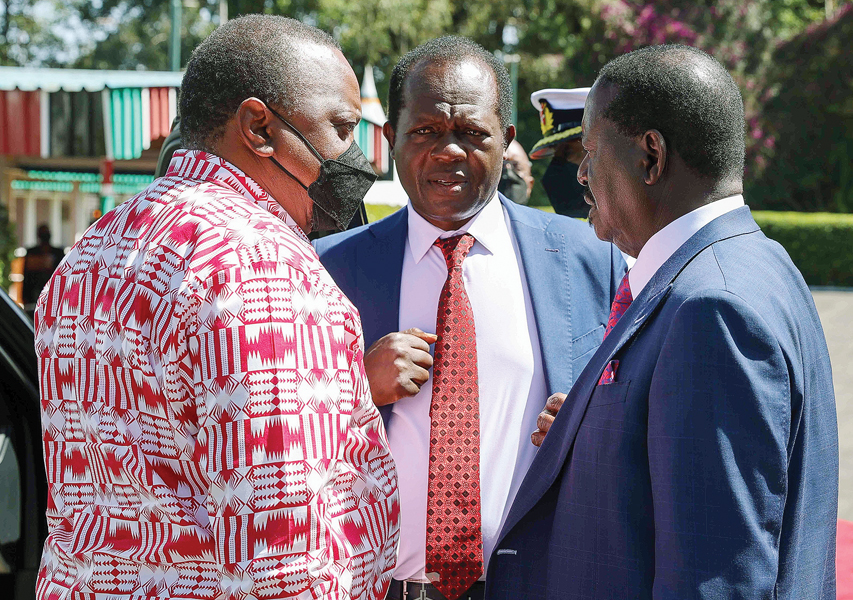
Raphael Tuju with President Uhuru Kenyatta former Prime Minister Raila Odinga (right)

On 12 February 2020, President Uhuru Kenyatta’s Cabinet Secretary without portfolio, Raphael Tuju, almost died – again. He was strapped in and fast asleep in the front passenger seat of his official vehicle on this cold, wet early morning as his driver cruised towards Nakuru County, where the CS was expected to join the President and fellow Cabinet secretaries for the funeral of Kenya’s second President, Daniel arap Moi.

In Kijabe, barely 60 kilometres out of Nairobi, a matatu with its headlights on full beam came hurtling round a bend on the wrong side of the road and collided head-on with Tuju’s vehicle. Cabinet Secretary Amina Mohamed (Sports, Heritage and Culture), whose car was trailing Tuju’s, was among the first responders. She kept him conscious by talking to him while he was evacuated from the accident scene into an ambulance to the nearby Kijabe Mission Hospital.

Senior government officials present at the hospital demanded that Tuju be immediately airlifted to Nairobi for treatment, but the doctors would have none of it. They insisted that their patient required immediate surgery without which he was unlikely to survive the helicopter dash to a better equipped facility in Nairobi.

By putting their foot down, a trait shared with their famous patient, the surgeons led by Dr. Peter Bird, an Australian missionary, saved his life. Besides 18 fractured bones, one of Tuju’s broken ribs had pierced and collapsed his right lung, causing heavy internal bleeding and laboured breathing. It was a close call. Tuju spent eight days at the Karen Hospital Intensive Care Unit before being flown to the United Kingdom for specialised treatment on the President’s personal intervention. It would take two to three months for him to heal, his doctors said.

This was not Tuju’s first brush with death. Seventeen years earlier, on 22 January 2003, a 24-seater plane carrying senior members of newly elected President Mwai Kibaki’s Cabinet crashed into a house after hitting a power line on take-off from Busia in western Kenya. Minister for Labour Ahmad Mohammed Khalif died shortly after being admitted to a nearby hospital. Tuju, the Minister for Tourism, Linah Kilimo, Minister of State in the Office of the President, and Martha Karua, Minister for Water, were airlifted to Nairobi in critical condition.

It would take months of intensive physiotherapy following the Kijabe crash for Tuju’s broken limbs to heal so he could walk again. That he was able to stage a 52-kilometre charity walk after his recovery in aid of the hospital that saved his life is testimony to the stubborn spirit that has defined the life and times of a man born into poverty and who raised himself by the bootstraps to the rarefied world of wealth, influence and political power.

Unlike many whose poverty in their formative years remains permanently etched on their faces despite any wealth and power they manage to acquire later in life, Tuju could easily be mistaken for one who was born with a silver spoon in his mouth. Suave, gentlemanly, well spoken – even posh, he always came across as a man more at ease in boardrooms than at a Kenyan political rally. But make no mistake, this man with a taste for the finer things in life had a reputation for being a political brawler of repute.

Born on 20 March 1959 to Mama Mary and Mzee Henry Odiyo Tuju, he was your typical rural child who nonetheless was slightly more privileged to experience the pulse of Kenya as he moved from station to station when his father worked for East African Harbours and Railways.

When his mother died in 2011, Tuju explained that she had fallen sick when he was born, and that he was breastfed by her co-wife (his stepmother) who had just lost a baby. It was his mother, who incidentally wanted him to be a priest, and whom he accompanied to the market where she sold wares from the time he was nine years old, that he credited for his business acumen.

“She taught me coping mechanisms. She taught me wealth creation at a tender age. She never depended on anyone,” he said.

After his primary school education at Majiwa and Nakuru West schools, Tuju joined Starehe Boys Centre and School in Nairobi, the national school famed for admitting needy but brilliant boys. Bright, paying students – often the sons of prominent people — were also admitted. This cocktail of rich and poor offered young, humble Tuju a better glimpse into the world he would straddle as an adult.

It was at Starehe that Tuju first wore underwear, a gift from the school founder, Dr. Geoffrey William Griffin.

“I never wore inner wear until I came to Starehe. I came here bare … I was a miserable, poor little boy and my first inner wear was given to me by Dr. Griffin. I’ll never ever underestimate the contribution that Starehe Boys has made in my life,” Tuju said during the school’s 60th anniversary celebrations.

One might say it was also at Starehe, an institution that prides itself as a centre of excellence, that Tuju became a refined, cultured go-getter, no doubt inspired by the school motto, ‘Natulenge Juu’ (Let Us Aim High). He also seems to have carried with him an empathy for the poor; one he would later demonstrate as a Member of Parliament.

After school, a career in broadcast journalism beckoned and he became a household name and national celebrity, first at the Kenya Broadcasting Corporation (KBC) and later as a pioneer news anchor with the Kenya Television Network (KTN). But it was the HIV and AIDS pandemic that saw Tuju become a millionaire entrepreneur with interests in media, communications, hotels and real estate, and set him on the path to politics.

He was later to go to the University of Leicester where he obtained a Master of Arts degree Mass Communication that anchored his credentials as a leading communication consultant both locally and internationally. Unbeknownst to Kenyans, Tuju is a respected communication expert whose consultancy practice, especially for international clientele until today, pays him more money than his Cabinet salary. That is besides being a director to businesses in the hospitality and real estate sectors.

Noting the miscommunication that led to a numbing fear of HIV and Aids among many as well as stigmatisation of the affected and afflicted, Tuju launched ACE Communications to demystify what was then known as a ‘killer disease’. Besides consulting for the World Health Organisation, the UK’s Department for International Development and the United Nations Development Programme, ACE Communications made history by becoming the first Kenyan media company to win the prestigious Emmy Award – one of four major American awards for performing arts and entertainment. The Emmy was for a UNICEF 2001 ‘Say Yes for the Children’ campaign video featuring his Talia Oyando and his twin daughters.

Having not only set the bar but also scaled the peak of his journalistic career, Tuju, like most gifted individuals, would require a new challenge. So it was no surprise when he ran for the Rarieda parliamentary seat the following year via Raila Odinga’s Liberal Democratic Party (LDP), which was part of the National Rainbow Coalition (NARC), and won. He was a breath of fresh air — youthful, dapper, eloquent and wealthy, with impressive organisational, oratory and campaign skills. What’s more, he enjoyed national recognition on account of his many years on television. Keen political observers were of the mind that his eyes appeared set beyond his backwater Rarieda Constituency; it was an observation that would set Tuju against Raila in years to come.
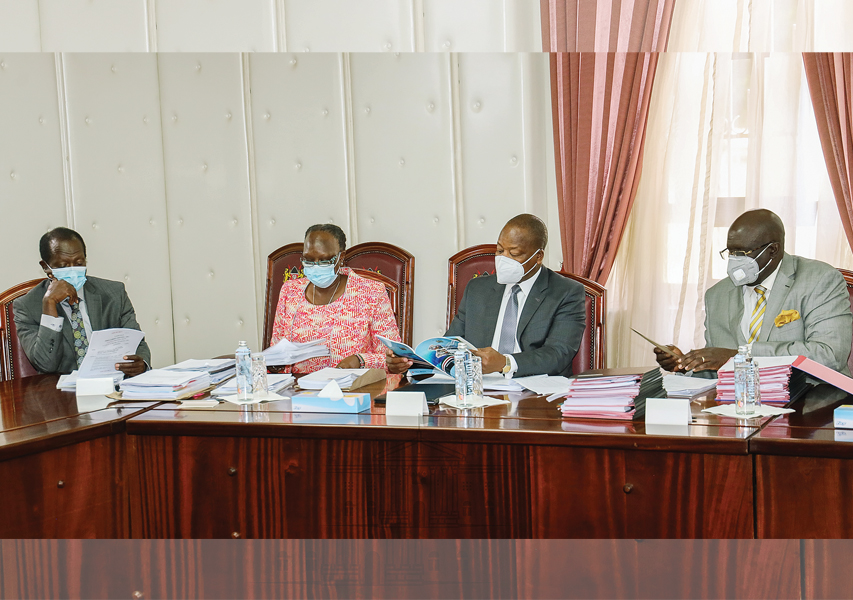
Raphael Tuju (left) with cabinet colleagues, Betty Maina, Mutahi Kagwe and George Magoha(right), at a cabinet meeting.

Upon his election, he was appointed Minister for Information and Communication, and Minister for Tourism and Wildlife between 2003 and 2005. He is credited with wresting the iconic Kenyatta International Conference Centre, which had been illegally appropriated by the Kenya African National Union, the ruling party of a past era, and bestowing its ownership back to the public. He also received praise for enabling the proliferation of privately-owned radio and TV stations, and the broadcasting of more local content, a directive that created employment for hundreds of Kenyan artistes.

Meanwhile, Tuju was tapping his international networks to secure funding for development projects in his constituency. His areas of focus were health, water, electricity, schools, women groups and AIDS orphans. A mobile health clinic funded by an Italian philanthropist and unveiled by President Kibaki particularly captured national attention because of its ingenuity.

Ironically, these efforts — launching water projects, roads, fish refrigeration facilities at landing sites, introducing ferry services between Uyoma, Karachuonyo, Asembo Bay and Mbita in Suba District — and his apparent quest to make Rarieda a model constituency, were raising eyebrows within Nyanza region. Was he trying to upstage Raila or position himself as the next Luo leader? It didn’t help that NARC had turned out to be a quarrelsome and divided coalition, with one faction led by Kibaki and the other by Raila.

When over half the country voted against the 2005 constitutional referendum in a heated charge led by Raila, President Kibaki dissolved his Cabinet. Tuju, who had not only switched allegiance from LDP and Raila to Kibaki, but had also supported the referendum opposed by his party and party leader, was appointed to the powerful Ministry of Foreign Affairs in the new Cabinet. The Luo community was livid. No Luo politician had so far dared take on Raila without meeting their Waterloo at the polls, and Tuju was no exception. His development record notwithstanding, he was beaten hands down in 2007 when he vied to defend his seat via his People’s Progressive Party (PPP).

But Tuju did not sink into political oblivion. Kibaki named him Special Envoy and Presidential Advisor on Media and Management of Diversity of Ethic Relations, a position he held until 2011, when he resigned to form the Party of Action (POA) and announced his intention to run for President in 2013. The announcement elicited vicious trolls on social media platforms from members of the Luo community. His own Rarieda constituents, for whose interests he had championed as MP between 2002 and 2007, yet who had never forgiven him for ‘abandoning Raila’ in 2005, scornfully chided him to take his ‘maendeleo (progressive) projects’ away.

Not that the math added up for a Tuju presidency anyway. Uhuru was firmly in the saddle, with his Central Kenya and Rift Valley political bases intact. Raila, on the other hand, had a firm handle on his traditional Nyanza, Western and Coast bases. A Tuju run wouldn’t have registered a wee toot on the political Richter scale; after scanning the landscape, he wisely chose not to run for President.

Still, the people in his village assigned his mother, driver and a relative the three votes Uhuru got at the local polling station. Like her son, she became a pariah. By his own admission, she was unable to visit his magnificent rural home due to the local hostility. He however said this never affected his relationship with Raila, with whom he later reconciled and teamed up in the run-up to the 2022 General Election.

“My late mother, who was born in Sakwa (where the Odingas come from), always reminded me that I might differ with Raila in politics but I must never disrespect him as he is my uncle,” he explained after her death. After the 2013 election, Tuju immersed himself in his private businesses until 2017, when he reemerged as Secretary General for Jubilee Party, which was Uhuru’s campaign vehicle for the 2017 presidential race. It was a vantage perch, one that allowed him to exploit his leadership, professional, political and managerial skills while at the same time helping him become the senior-most Luo politician with the closest access to the Jubilee presidential candidate. When Uhuru won, it was widely expected that Tuju would be allocated a senior Cabinet position to represent the Luo community in government. Instead, Uhuru appointed him Cabinet Secretary without portfolio, a position that Presidents Jomo Kenyatta and Daniel arap Moi often used to reward party loyalists.

Why would a man with Tuju’s gifts be treated thus despite the obvious friendship he shared with Uhuru? Besides flying the ministerial flag on his official vehicle, how did he spend his working day?

What Kenyans didn’t realise was that Tuju’s ‘without portfolio’ docket actually came with a truckload of portfolio and that behind the scenes, he wielded great influence in Uhuru’s government. With a brief to coordinate the implementation of the 2017 Jubilee manifesto, which was anchored on the pillars of Transforming Lives, Transforming Society and Transforming the Nation, his tentacles spread across ministries, making him, in football terms, Team Uhuru’s political box-to-box midfielder.

It was a fitting choice. Tuju, diplomatic but firm — stubborn even — had the confident air of a man accustomed to order and getting things done. Tuju’s hidden hand also lay in the Big Four Agenda legacy projects that were implemented at dizzying speeds during Uhuru’s second term.

As Uhuru’s presidency drew to a close, Tuju was among several Cabinet secretaries who resigned, first as the Jubilee Secretary General and later as CS, fuelling speculation that he was pursuing an electoral seat as either a governor or a senator. Having reconciled with Raila, such a move would have been warmly received by voters in Siaya County.

“I am a political animal. I have been a politician since I was elected MP for Rarieda. I now want to go back to the people and seek their mandate. I will not say which position I’m going for because as a political animal, I don’t want to alert my political foes when I will strike,” he announced when he resigned from Jubilee. In the end, he took up the position of Executive Director of Azimio la Umoja (Raila’s newest campaign vehicle), which essentially meant taking charge of efforts to ensure that Uhuru’s preferred successor (Raila) became the fifth President of Kenya.
Rashid Echesa: From among bucolics to high national duty

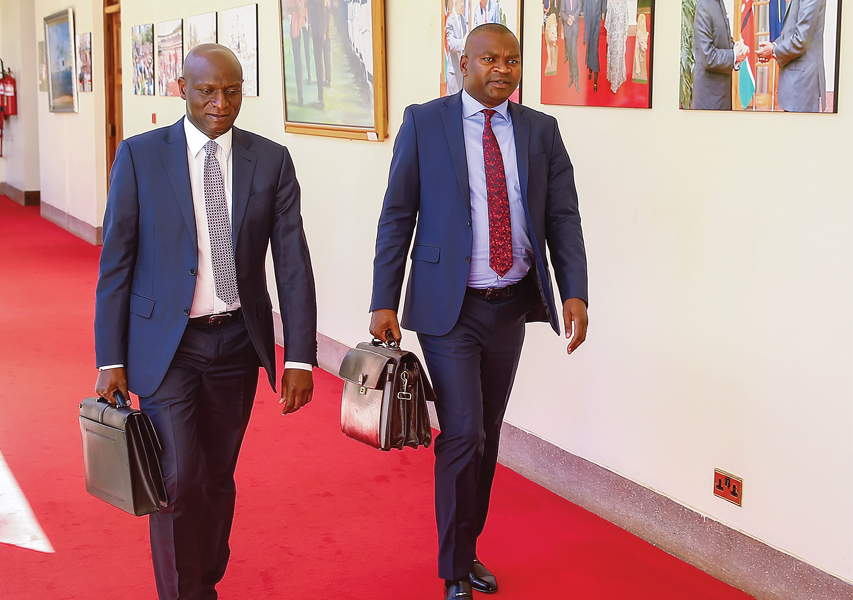
Rashid Echesa with his cabinet colleague Charles Keter attending a Cabinet meeting at State House Nairobi.

Few people of Rashid Mohammed Echesa’s social and educational background have had the good fortune to rise to national prominence at his age. Echesa, the son of a respected company driver Mohammed Lukungu, was born in a modest family in the neighbourhood of Mumias Sugar Company in Western Kenya.

He was by all accounts an ordinary child from an ordinary family, with a future that was not particularly bright, given the region’s rampant cases of material deprivation. According to some media reports, Echesa’s father was a truck driver who also burned charcoal to supplement his meager earnings to support his family, and his mother was a banana vendor in Shibale market.

Echesa’s gloomy prospects would be compounded when, only a few years later, he abandoned formal education to pursue itinerant trade and other menial engagements in Shibale, an informal neighborhood that housed some of the sugar company’s low cadre employees.

Echesa eventually found his way to Mumias Sugar Company as a manual laborer, an experience that exposed him to both current politics and some form of trade unionism, which he would later use to mobilize common sentiment among the region’s youth.

With the general Kakamega region, and particularly Mumias, being a key political battleground for leading politicians, it wasn’t long before some political luminaries recognized Echesa’s leadership and mobilisation abilities, his tenacity and bravery, all of which were considered valuable traits in the adversarial politics of the region then.
It was then that Echesa tasted power, albeit in crude, unrefined, and informal forms, but power nonetheless, allowing him to socialise with the political elite of the day. Rashid wormed his way into youth leadership of the Orange Democratic Movement, which was then the political party of choice in the wider Mumias area, courtesy of Raila Odinga’s enigmatic hold on the region’s general thinking, around 2007.

Invoking some distant kinship with Odinga, Echesa’s Wanga compatriots could not stomach extending their political support to his then-most compelling opponent, President Mwai Kibaki, and so Echesa’s alliance with Raila distinguished him as a possible future leader of the region.

Following Raila’s defeat in the 2007 elections and the ensuing political rethinking in the region, Echesa shifted his and his young followers’ support to a different camp, this time led by Uhuru Kenyatta and William Ruto, Raila’s most recent political rivals. Once again, Echesa’s mobilization skills paid off, as he was able to secure a sizable chunk of votes in favor of his newfound political patrons. Come 2017, Echesa stuck it out with the two again—although more inclined to Deputy President William Ruto’s wing of the ruling coalition—and saw his influence grow bigger and his fortunes better.

Following the 2017 general elections and subsequent presidential elections, President Uhuru nominated Rashid Mohamed Echesa as his Cabinet Secretary in charge of Sports, Culture, and Heritage – the last word replacing ‘arts’ in the predecessor ministry.

However, in the context of Kenya’s political order, which is based on ethnic sensitivities and regional claims of entitlement or allegations of exclusion from the mainstream government, Echesa’s appointment as cabinet secretary was widely criticized by some opposition members. These critics argued that Western Kenya had many more educated and refined leaders who could better’represent’ the region in cabinet than the modestly educated, combative Echesa. In a sense, this allegation drew its rationale from the fact that, even with the scanty details about Echesa’s previous life, a minor detail stood out—his previous adventures in street pugilism in Mumias township—something that signaled, supposedly, an inclination towards spontaneous thuggery.

Regardless, Echesa breezed through parliamentary vetting, where the question of how he would manage the ministry despite his limited education was answered by referring to the fact that, as is customary, ministries are run by technocrats, including highly educated Permanent Secretaries—also the accounting officers—on whom Echesa expected to rely to compensate for his educational deficit. Simultaneously, Echesa used his vetting to thank President Uhuru for believing in him—and in all sons of humble origins—in a calculated move meant to remind the vetting board that the entire vetting should, in fact, consider the constitutional imperative of inclusivity in government rather than the elitism that, in his opinion, informed his critics’ sentiments. Later, he was quoted in a daily newspaper saying that “The President appointed me because I’m a child of the poor. He knew that by appointing me, I would uplift another poor kid.”

But overcoming the vetting challenge was the easy part; Echesa quickly discovered that running a sports ministry is fraught with many potential pitfalls, including never-ending wrangling, novel ways for cartels to evade detection and handling, and multiple competing interests that dominate virtually all domains of the entire docket.

The ministry, like other government entities, saw itself as playing a critical role in the affairs of the country, as reflected in the bold value, vision, and mission statements. The ministry’s vision was and continues to be “…to be a global leader in the provision of sports, arts and cultural services and promotion of the Kenyan film industry for sustainable growth and employment creation”, driven by mission “…to develop, promote, preserve and disseminate Kenya’s cultural and arts heritage; promotion of sports; through formation and implementation of policies, programmes and projects for mproved livelihood of the Kenyan people.”

Echesa was expected to oversee a number of functions under the State Department for Sports, as outlined in Executive Order No. 1 of 2018. The functions included developing, managing, and implementing a sports policy; enforcing and implementing the World Anti-Doping Code and the Convention against Doping; promoting and coordinating sports training education; regulating sports; expanding the sports industry for sustainable livelihood; developing and managing sports facilities; and establishing and managing sports academies to nurture talent.

To accomplish all of this, Echesa had to be the titular head of the operationalizing structures within the sports department. Among the structures he oversaw were the sports stadium management board and the Kenya Sports Authority (as established by the Kenya Sports Authority Act of 2012); Kenya Anti-Doping Agency; Sports Kenya (from Sports Act No 25 of 2013); National Sports Fund (under the Kenya Academy of Sports Act of 2013); and the Registrar of Sports. Echesa’s jurisdiction included the Sports Tribunal.

Then there was the less visible Department of Culture and Heritage, which was part of the same ministry. The primary functions of this department included oversight of National Heritage Policy and Management, National Archives and Public Records Management, and management of national museums and monuments. Others were the management of historical sites, oversight of national library services to the general public, music research and conservation, culture policy management, and policy for the development of fine, creative, and performing arts.
Working with critical knowledge-based institutions within the ministry in general, and the Department of Culture and Heritage in particular, was unavoidable.

The National Museums of Kenya, established under the National Museums and Heritage Act of 2006; the Kenya National Library Services Board (given legal life by the Kenya National Library Service Act, Cap 225); the Kenya National Commission for Culture and Social Services; and the Kenya Cultural Centre were among the institutions (informed by the Kenya Cultural Centre Act, Cap 218).

Other institutions were the Permanent Presidential Music Commission; the Kenya National Theatre; the Nairobi Music Society; and the Kenya Conservatoire of Music; the British Council in Kenya; H.H. the Aga Khan Ismailia Provincial Council; and the St John Ambulance Association.

Even with these structures in place, Echesa’s performance in the ministry left much to be desired, and he was rebuked on some basic issues by a visibly disappointed President Kenyatta. In 2018, President Kenyatta visited Raila Odinga’s home in Bondo to lay a wreath on the mausoleum of Raila’s late father, who was also Kenya’s first vice-president after independence.

When President Uhuru visited Bondo in December 2018, he went to lay a wreath at Jaramogi Oginga Odinga’s mausoleum and was unhappy with its state. As the minister in charge, Echesa struggled to explain why the historical site at Kang’o ka Jaramogi was in such disrepair.”

Even with the support of technocrats throughout the ministry and the government, it was clear that Echesa was at his wits end, making blunder after blunder and failing in some very basic aspects of protocol while remaining voluble in political pronouncements – perhaps unaware that cabinet secretaries were constitutionally barred from politicking.

In January 2018, local media reported that the government had deported eight Pakistani women who had come to Kenya to work as dancers. The eight were allegedly helpless victims of a human trafficking syndicate, but had been smuggled into the country under the guise of promoting transnational culture, a claim the ministry denied. “The only role played by the Ministry of Sports and Heritage was to support the Pakistani Nationals application for special passes to participate in an Indian cultural festival via issuance of a ‘Letter of No Objection’ to the Director of Immigration Services as part of the Ministry’s mandate in promoting cultural integration,” said Charles Wambia, the then Director of Administration at the Sports, Culture and Heritage ministry.

This, among many other adverse reports implicating Echesa eventually led to his dismissal in early 2020, after serving as cabinet secretary for a whole of thirteen months. In an executive order issued on the last day of February 2020, it emerged that “…in accordance with Article 152(5) of the Constitution, as read together with Article 152(1)(d) of the Constitution, the appointment of Mr. Rashid Echesa Mohamed, as a Cabinet Secretary has been vacated.” As is the tradition with such developments, no reasons were given for vacating Echesa’s appointment as a cabinet secretary, although his below-par performance at the ministry was somewhat known by many.

Despite Rashid Echesa’s many gaffes, the echnocrats in the ministry and President Kenyatta made certain that the ministry delivered some critical achievements during Echesa’s tenure as cabinet secretary.

Among the accomplishments was Kenya’s continued participation in international sporting extravaganzas, such as the March 2018 Commonwealth Games in Gold Coast, Australia. Kenya was represented by a 300-strong delegation comprised of teams from various sports, including athletics, golf, rugby, cricket, and hockey, at that event, one of the first on Echesa’s watch. During his tenure, Kenya also competed in the IAAF Championships in Doha, Qatar.

Notably, President Kenyatta expressed personal concern about how the ministry would handle the Kenyan teams in the event. According to the Presidential Press Unit, the president directed the ministry’s sports federations to ensure that what was owed to Kenyan athletes was paid. According to the PSCU, “The President directed the Cabinet Secretary of Sports and Heritage Rashid Echesa and other senior ministry officials to ensure that the team is well taken care of before and after the games.”

Local sports cultures and events continued, albeit with the usual difficulties. Football leagues, as well as rugby and gold tournaments, continued. The flow of these leagues keeps Kenya on the global sporting calendar, while also opening doors for potential career opportunities for the youth.

This is related to the fact that Harambee Stars, the national football team coached by French national Sebastien Migne, qualified for the Africa Cup of Nations Finals during Echesa’s tenure. Although the team faced numerous challenges, including the coach going without pay for extended periods of time, it gave Kenyans hope that the country’s most popular sport was returning to its former glory.

In terms of expanding sports infrastructure, it was during Echesa’s tenure at the ministry that Nyayo Stadium was renovated. And, while the process took far longer than expected – until well after he left office— he is credited with kicking off what had previously been nothing more than wishful thinking. Of course, President Kenyatta was also eager to fulfill his campaign promise of expanding Kenya’s sports infrastructure.

The Ministry of Sports, Culture, and Heritage also awarded contracts to developers to renovate the Kipchoge Keino and Kamariny stadiums in Eldoret and Iten, respectively, during his tenure.

In relation to this, the other major stadium, Kasarani International Sports Centre, not only remained operational, but also hosted a number of sporting events during Echesa’s tenure. The stadium had previously been renovated to host the 2017 International Associations of Athletics Federation (IAAF) U18 Championships, and it served as the default venue for local and international sporting events in 2018 and 2019.

The ministry’s hosting of the IAAF’s U18 Championships under Echesa was so successful that Kenya was awarded the hosting rights for the 2020 World U20 Championship. Echesa immediately mobilised a whopping Ksh1.5 billion for fiesta preparations.

Despite entering the ministry under cloudy circumstances and succeeding Hassan Wario, whose tenure was either controversial or colourless, objective observers began to admit that Echesa had made significant progress. In a January 2019 Daily Nation editorial, the respected daily wrote that “…having been in office for approximately 10 months now, Sports Cabinet Secretary Rashid Mohammed Echesa has made commendable progress.”

The same editorial added that “…to his credit, Echesa has done well to, inter alia, reduce uppercuts unleashed by warring boxing officials, make some headway in trying to have cricket leaders play with a straight bat and successfully, albeit in fits and starts, kick-start refurbishment of our worn-out stadiums.”

Echesa oversaw and officiated the KEPSA Sports, Culture, and Arts Sector Board Participates in State Department Stakeholder Workshop, which took place in Nanyuki’s Aberdare’s Country Club in June 2018.

Echesa also toured and initiated value-added projects around Kenyan heritage sites in terms of heritage and culture. His visit to the Kit Mikayi Museum in Kisumu, for example, prompted him to pledge that the ministry would build a five-star hotel to attract more visitors.

Similar initiatives happened with regard to the department of arts and heritage, for which Echesa hardly gets due credit perhaps because his hypervisibility in unsavoury public sideshows tends to obscure his achievements at the ministry. In the end, however, the tenure of Rashid Echesa in the Ministry of Sports, Culture and Heritage is not entirely different from that of his colleagues who preceded or succeeded him. His unlikely arrival and expected exit from the ministry at the time that he did were quite in line with the nature of politics and government in Kenya, and must be read as such.

Simon Chelugui: The hesitant Baron

Simon Chelugui and UK’s Secretary of State for Health Sajid Javid, are cheered by President Uhuru Kenyatta after signing a Memorandum of Understanding (MoU) on Health Workforce Collaboration between the two countries

At 46, Simon Kiprono Chelugui was one of the youngest Cabinet secretaries to join President Uhuru Kenyatta’s Cabinet in January 2018. The soft-spoken entrepreneur from Baringo County was picked to head the Ministry of Water, Sanitation and Irrigation, a docket that was poised to play a crucial role in the attainment of the President’s Big Four Agenda legacy projects.

In its 2017 campaign manifesto, the Jubilee administration acknowledged that water was the source of livelihoods and was instrumental in conserving the environment as well as promoting agriculture, industry and the generation of hydro-electric power.

Even though Kenya’s economy depends primarily on agriculture — the sector provides about one-third of the country’s income — the country is largely dry, with about 80 per cent classified as arid and semi-arid. The country’s high-potential agricultural land amounts to only 17 per cent yet it sustains a disproportionate 75 per cent of the population. Experts have also pointed out that up to 15 million Kenyans have no access to clean water. This unstainable state of affairs called for innovative solutions such as more inventive water harvesting-cum-storage facilities, which previous administrations seemed not to really been able to initiate. To improve the health and quality of life in Kenya, the Jubilee Party had promised on the campaign trail to provide sustainable access to safe water, enhance sewerage systems and expand acreage under irrigation.

The expectation behind Chelugui’s nomination and subsequent appointment would therefore have been that he would tap into his wealth of training and experience in corporate governance, policy formulation and entrepreneurship to bring these ambitious promises to life. Chelugui had a master’s degree in finance, investment and strategic management under his belt, and by the time of his appointment he had also earned his stripes leading different institutions, including the Betting Control and Licensing Board, the Constituency Development Fund (CDF) Board and companies dealing with water engineering works.

The new CS took to his new position like a fish to water, promising to complete construction of all the 57 dams promised in the Jubilee manifesto and increase water coverage in the country from 60 to 80 per cent. By the time he left office, however, it was not clear how much of this had been achieved, although he did take pride in having initiated reforms under the Water Act 2016 that he said had “transformed the water sector agencies”. These reforms included renaming the different water boards as water works, and the National Water and Sewerage Corporation became the National Water Harvesting Authority. “The institutions will be responsible for the design and construction of water storage and harvesting bodies,” he said.

He had also pledged to, in conjunction with the Ministry of Infrastructure, establish a water salination plant in Lamu County to purify water from the Indian Ocean and distribute it for domestic use in the coast region.

Born in 1971 in Kisanana Village in Mogotio, Baringo County, Chelugui was a wealthy investor with a keen eye for business opportunities. This entrepreneurial bug bit him while he was still a Bachelor of Commerce student at the University of Nairobi. During his vetting by the National Assembly Committee on Appointments following his nomination to the Cabinet, Chelugui shocked the panelists when he estimated his net worth at about KES 796 million, easily making him the richest Cabinet nominee at that time. He said the wealth included real estate, farming and moveable assets.

Although he had put his foot forward to test the political waters of Mogotio Constituency and Baringo County in past election cycles, Chelugui came across as more of a technocrat than a dyed-in-the-wool politician. So it was not surprising that in the run-up to the 2022 General Election, he chose to remain in Uhuru’s outgoing administration despite media speculation that he would be among several government leaders expected to resign and run for elective positions on 9 August.

Chelugui had had mixed fortunes in elective politics. He first tried his hand in 1997, straight after graduating from university. At the time, Mogotio had just been hived off Koibatek District and Mogotio Constituency split from Eldama Ravine Constituency. Chelugui faced off with the ‘big boys’, among them William Morogo, the incumbent MP and Minister for Transport in President Daniel arap Moi’s administration. Suffice to say that he lost to the more experienced politician.

Little was heard of him after that until he was appointed Director of the CDF Board in 2008 where he would serve until 2011. In the 2013 General Election, which also included county government positions courtesy of the 2010 Constitution, Chelugui expressed interest in the Baringo governorship but lost in the United Republican Party (URP) primaries. He jumped ship and teamed up with Stanley Kiptis, who was contesting the governor’s seat on a Kenya African National Union ticket, as his running mate. They lost to Benjamin Cheboi, the former Chief Executive Officer of the Higher Education Loans Board and URP candidate.

Two years later, he was appointed as a director of the Betting Control and Licensing Board. He left in 2017 to prepare the ground for his second bid at the Baringo governorship but changed his mind and ran for the senatorial seat against the incumbent, Gideon Moi, who trounced the Moi Kabarak High School alumnus by a clear margin — Gideon garnered 116,201 votes against Chelugui’s 70,182.

As the President and Deputy President, William Ruto, embarked on their second and final term in office, something in their relationship shifted fundamentally. As the glue that once held them together began to melt and the chips began to fall spectacularly, Cabinet secretaries and other senior government officials were increasingly profiled as being either pro-Uhuru or pro-Ruto. Chelugui was perceived as being among those allied to the DP.

Then in 2019 reports emerged of corruption scandals in some of the mega water projects around the country. The claims surrounding Itare Dam in Nakuru County and Kimwarer and Arror dams in Elgeyo Marakwet County threatened to consume Chelugui and he had to defend himself both at the Directorate of Criminal Investigations, where he recorded a statement, and in Parliament where he was grilled by MPs. Chelugui denied involvement in the Kimwarer and Arror contracts, saying his ministry was not mandated with implementation since the two projects fell under the Ministry of Devolution.

Although he survived the looming imbroglio that would have swept him out of the Cabinet, things would degenerate so much that in January 2020, the President reshuffled the Cabinet in a move deemed to whittle down Ruto’s influence in the Executive. Two CSs thought to be allied to the Deputy President, Mwangi Kiunjuri (Agriculture) and Rashid Echesa (Sports and Culture) were purged from the Cabinet and others moved to other ministries. Chelugui was transferred to the Ministry of Labour and Social Protection, taking over from Ukur Yattani, who moved to the National Treasury. As the new head of the Labour docket, he promised to continue championing the cause of vulnerable groups, which had been started by his predecessors who included Phyllis Kandie. This was in reference to the ‘Inua Jamii’ cash transfer programme meant to benefit society’s most vulnerable groups.

Chelugui also promised to enhance the sourcing of employment opportunities from other countries. One such endeavour came to fruition in 2022, when 19 Kenyan nurses were recruited to work in the United Kingdom. This was the culmination of bilateral talks and the signing of an agreement between the President and British Prime Minster Boris Johnson to have Kenyan nurses employed by Britain’s National Health Service.

Simon Chelugui meets labour union leaders ahead of Labour Day 2022 celebrations.

The CS took over the Labour docket when various trade unions were threatening to have their members go on strike over disagreements with their employers. In June 2021, several trade unions in the public sector issued a joint notice of strike against a decision by the Salaries and Remuneration Commission to freeze all salary increases and any signing of Collective Bargaining Agreements for two years because of the effects of the Covid-19 pandemic.

Among the unions that signed the notice were the Central Organisation of Trade Unions, Kenya Union of Domestic, Hotels, Educational Institutions, Hospitals and Allied Workers, Kenya Medical Practitioners and Dentists Union, Kenya Union of Clinical Officers and Kenya Union of Special Needs Education Teachers. Others were the Kenya University Staff Union and Union of National Research Institutes Staff of Kenya.

There was also the matter of Kenyan citizens employed as domestic workers in the Middle East being tortured and subjected to inhumane conditions by their employers. There was a public outcry that many workers, particularly those working in Saudi Arabia, were suffering mistreatment and some had even died in mysterious circumstances.

Appearing before the Parliamentary Committee on Labour Relations, Chelugui and his Principal Secretary, Dr. Peter Tum, told the MPs that a fact-finding report by the ministry had revealed that 93 Kenyan migrants had died in Saudi Arabia since 2019. The report indicated that they were among the 87,784 Kenyans working in the region and whose employment the ministry had facilitated.

The CS said while the government was investigating the reported deaths with help from the host countries, care was also being taken not to jeopardise the safety and work of other Kenyan migrants in the host countries. He said the government, under the President’s stewardship, had established a migrant workers’ fund and that the ministry had also increased the number of Labour attaches in the region and set up temporary rescue homes to cater for workers’ emergency needs.

But the greatest challenge to face the CS was the Covid-19 pandemic, which cost the labour sector dearly because of the ensuing lockdown. According to an International Labour Organisation report, the pandemic had a heavy and immediate toll on labour markets as the drastic containment measures caused an unprecedented collapse in employment and working hours. First to be affected were workers in the hospitality, manufacturing and processing sectors as organisations shut down their operations.

In a report by Private Enterprise Development in Low-Income Countries, it was estimated that in just one month of Covid-19 in Kenya, “overall formal employment fell by 16 per cent between March and April 2020”. During the Labour Day celebrations on 1 May 2022, Chelugui recounted meetings with partners and stakeholders seeking to mitigate the impact of the virus on workers’ lives and livelihoods.

“Upon the onset of Covid-19, we sat down with stakeholders and social partners and signed a memorandum of understanding that enabled employers to let employees work from home or share responsibilities in the timetable,” he said during the ceremony that was also attended by the President at the Nyayo National Stadium. The CS thanked the President for leading the country through the crisis by instituting measures to cushion Kenyan workers from the adverse effects of the pandemic.

Noting that the country was picking up from the aftershock of the virus, Chelugui urged Kenyans to conduct themselves peacefully during and after the 9 August 2022 General Election to maintain the gains made in the recovery process.

“We have just recovered from the effects of Covid-19, and my hope is that we don’t do anything that would be disruptive to this progress,” he said.

In the final analysis, owing to a multiplicity of issues that included the graft allegations around the dams in the Rift Valley and the protracted investigations; the hangover of the failed Galana-Kulalu Irrigation Scheme; the shuffling of ministries and departments; and the ebb and flow of politics, it is difficult to substantively measure Chelugui’s contribution to the Water and Labour dockets.

Amb. Amina Mohammed: Long-serving lawyer turned diplomat

Amina Mohammed with president Uhuru Kenyatta at State House, Nairobi.

Amina Chawahir Mohamed Jibril is the epitome of the ideal Kenyan bureaucrat. Hers is the quintessential story of an African woman who rose from a humble background to become one of Kenya’s leading diplomats and a public servant in three different regimes.

Over the long span of her public service career, Mohamed distinguished herself as an able and assiduous professional, rising from the position of legal officer in various ministries to become Permanent Secretary and finally Cabinet Secretary.

The dimpled career diplomat was born on 5 October 1961 in present-day Kakamega County in the western part of Kenya. She spent much of her childhood in a modest household in Kakamega Town where her family survived on a shoestring budget and had no such luxuries as television or even radio. She spent most of her time reading detective series; only later would she develop an interest in international affairs.

Mohamed attended Township Primary School in Kakamega before joining Butere Girls High School and Highlands Academy where she was one of the tiniest and youngest students. “I had to have my uniform stitched at home because the available sizes were always too big for me,” she was once quoted as saying. Her mother, to whom she attributes her success, strongly believed in the value of formal education and would frequently pop into school to see how her daughter was doing. She believed that given the chance, her daughter could break all barriers. She was right.
After high school Mohamed got a scholarship to the University of Taras Shevchenko in Kiev, Ukraine, where she got a master’s degree in international law. She thereafter obtained a post-graduate diploma in international relations from the University of Oxford. Later she would get a fellowship from the United Nations Institute for Training and Research. This exposure essentially launched her diplomatic and legal careers.

In 1985, as an advocate of the High Court of Kenya, Mohamed was a legal officer in the Ministry of Local Government. She moved to the Ministry of Foreign Affairs in the same capacity and was tasked with drafting and negotiating various bilateral and international treaties. Among these were the Bilateral Air Services Agreement with the United Arab Emirates, Oman, Iran and the UK as well as the African Convention on the Rights of the Child. In 1990 she became the legal adviser to Kenya’s Mission at the UN Head Office in Geneva, Switzerland. She worked alongside the International Labour Organisation (ILO), World Health Organisation (WHO) and General Agreement on Tariffs and Trade as well as the World Trade Organisation (WTO).

Mohamed seemed poised to operate in international circles. In 1997 she worked as the legal adviser to the Kenyan delegation at the UN Security Council. Between 2000 and 2006 she worked as the Ambassador and Permanent Representative for the Kenyan Diplomatic Mission in Geneva. She was also Chairperson of the African Group in WTO’s Human Rights Commission. She was the first woman to chair the WTO General Council in 2005 and the Dispute Settlement Body. In 2003 she chaired the Trade Policy Review.

As General Council Chairperson, Mohamed brokered an agreement of major importance to developing countries; this was an amendment to the TRIPS Agreement to assist countries with insufficient manufacturing capacities in the production of essential drugs to treat diseases such as HIV and AIDS, and tuberculosis.

In 2002 she was Acting President of the Conference on Disarmament and was appointed the first female chairperson of the International Organisation of Migration.

At the time, Kenya was the only African country included in the organisation. When she was approached to take up the position, she agreed on condition that the organisation opened up to more African countries.

From 2001 to 2005, Mohamed was also a member of the executive boards and committees of the World Intellectual Property Organisation (WIPO), ILO, WHO, United Nations Conference on Trade and Development (UNCTAD), United Nations High Commissioner for Refugees (UNHCR) and the United Nations Programme on HIV and AIDS (UNAIDS). Between 2006 and 2007 acted as director for Europe and Commonwealth countries as well as Diaspora Issues in Kenya. She also chaired the Department of Foreign Trade and Economic Affairs Committee on Strengthening and Restructuring.

Amina Mohammed attends a Grade 2 English class at Kiamaina Primary School in Nakuru County to monitor progress of the CBC implementation.

In 2008, Mohamed decided to deploy her skills at home. She rejoined the government as the Permanent Secretary in the Ministry of Justice, National Cohesion and Constitutional Affairs in President Mwai Kibaki’s administration. She served in this role until 2011. This was a momentous assignment that entailed supervising the redrafting of the Constitution of Kenya, a task that eventually birthed a new Constitution.

Meanwhile, she continued with her international roles — between 2010 and 2011 she served as President of the United Nations Conference on Transnational Crime in Vienna. In 2011, she was named Assistant Secretary General and Deputy Executive Director of the United Nations Environment Programme where she worked until 2013.

When Uhuru Kenyatta was elected President in 2013, he tapped Mohamed as the first Cabinet Secretary for Foreign Affairs and International Trade in his government. Mohamed was sworn in at the Sagana State Lodge on 20 May 2013 alongside 17 other members of the Cabinet that formed Uhuru’s inaugural regime. She immediately employed her experience and skills in ensuring that the new President and the new Deputy President, William Ruto, were accepted in the international community. This was important because at the time, the two leaders had a case at the International Criminal Court (ICC), which, to all practical purposes, posed a threat to their hold on power.
The CS embarked on a shuttle diplomacy exercise, traversing the globe to meet with and convince world leaders that Uhuru and Ruto were innocent of the charges they faced at the ICC. The eventual collapse of the case is widely credited to her diplomatic manoeuvring.

However, Mohamed’s tenure at the Ministry of Foreign Affairs was not devoid of criticism. For one, her detractors accused her of remaining tight-lipped over the suffering of Kenyan detainees in Ethiopia. And when in December 2016 she stated that Kenya supported the Sahrawi Arab Democratic Republic’s quest for self-rule and membership in the African Union, she stirred a diplomatic hornet’s nest. Many countries in the Arab world considered her views deeply controversial and duly protested.

Nevertheless, Uhuru maintained his faith in Mohamed and in 2017, nominated her for the chairperson position of the African Commission Union (ACU). Despite intense lobbying by the government, she lost to Chad’s Minister for Foreign Affairs, Moussa Mahamat, by 26 votes to 38. The loss created a frisson of tension in the East African region, with Uganda, Tanzania, Burundi and Djibouti being accused by Kenya of not supporting Mohamed’s bid. They all refuted the accusation.

On 9 May 2017 the Government of Japan honoured Mohamed at the Imperial Palace for “promoting economic relations between Kenya and Japan”. She was the only African to be personally invested with the award known as the Grand Cordon of the Order of the Rising Sun. This is one of the oldest awards granted by Japan to those who have made distinguished achievements in international relations, promotion of Japanese culture or preservation of the environment.

During her tenure at Foreign Affairs she had a series of meetings with US government officials such as Senator Bob Corker, Tom Shannon and Constance Hamilton during which she urged the US to continue interacting with Kenya for mutual benefits. She was also reported to have met with Russia’s Foreign Minister, Sergei Lavrov, in Beijing, signaling possible renewed engagements between Kenya and Russia. In many ways Mohamed became one of the most visible Foreign Affairs ministers Kenya had seen in years.

In January 2018 the President moved her to the Ministry of Education, Science and Technology to replace Dr. Fred Matiang’i, who was moved to the Ministry of Interior and Coordination of National Government. Her Principal Secretary at Foreign Affairs, Dr. Monica Juma, was appointed to replace her. In her new posting, Mohamed would be lauded for the successful administration of the 2018 national examinations. She also achieved a 93 per cent transition rate of pupils finishing primary school to join high school. It was the highest transition rate in the country’s history. She was also credited with devising and implementing a Special Needs Education Policy and restructuring the Higher Education Loans Board (HELB), and was instrumental in reenergising vocational training centres as well as piloting and completing the Competency Based Curriculum (CBC).

Ironically, it was the CBC that almost proved to be her bane, as she was heavily criticised for delaying implementation in 2019. The President offered a public apology to the nation for the failure to launch. The CS drew further criticism for suggesting that former students who defaulted on loan repayments to HELB should be arrested. Her decision to lower the entry grade for teacher training colleges to D was also overturned by the High Court of Kenya. These decisions were a blot on an otherwise illustrious career and were thought to be largely responsible for her move from the Education docket to the Ministry of Sports, Culture and Heritage in March 2019. She had been in Education for just over one year.

At Sports and Culture she replaced Rashid Echesa, who had been sacked. The ministry had gained the dubious reputation of being messy and corrupt, and the new CS began by kicking out of office the Football Kenya Federation (FKF) President, Nick Mwendwa, and later disbanding the organisation. Her action followed a list of recommendations by an inspectorate committee that had been constituted by the ministry to review the undertakings of FKF following what was referred to as “an extended deterioration of the state of football management in Kenya”.

Following the disbandment of FKF, the CS appointed a caretaker committee. This decision created an uproar in FIFA, the world football governing body, which responded by threatening to ban Kenya from participating in FIFA events. The CS refused to be cowed and FIFA eventually made good on the threat.

Mohamed turned her attention to improving sports management in the country. Besides cleaning up the management of football, she set up a nine-member ministerial committee on gender welfare in sports. This followed growing concerns about the treatment of women in sports.

She also sought to mainstream cultural matters in national affairs, and appeared personally at many cultural events to underscore the government’s commitment to promoting culture. She also campaigned incessantly for more funding for the ministry from the National Treasury.

Perhaps to underscore his enduring faith in his CS, the President on 7 July 2020 nominated Mohamed for the position of World Trade Organisation Director General. In his statement of nomination, he wrote: “As a firm believer in the strengthening of international multilateral institutions, Kenya is convinced of the urgent need to revitalise the WTO to better serve the needs of all nations, large and small. We also believe that it is time Africa took up her responsibility of serving at the helm of WTO. Kenya offers Amina C. Mohamed, a uniquely qualified person, to lead the WTO at this critical time. If selected, she would be the first African and indeed, the first woman to serve at the helm of the World Trade Organisation.”

Although Mohamed made it to the second round of the selection process, she lost to two finalists, Ngozi Okonjo-Iweala and Yoo Myung-hee. But this loss in no way diminished the several accolades she had already earned over the years. These included Elder of the Order of the Golden Heart of Kenya (EGH); Chief of the Order of the Burning Spear (CBS); Knight of the Order of the Star of Italian Solidarity (Cav.O.S.S.I); Life Member of the Red Cross Society; Grand Cordon of the Order of the Rising Sun; Member of the World Economic Forum’s Global Agenda Council on the Arctic; and Member of the Life and Peace Institute.

Betty Maina: The master multitasker

She seemed destined for greatness right from the start. Betty Maina attended the prestigious Alliance Girls High School before joining the University of Nairobi for a degree in Land Economics, followed by a stint at University College London, from which she emerged with an MSc in Development Administration and Planning in 1998. Still, nothing could have prepared Maina for the astonishingly eventful career she was embarking upon.

For more than a decade, beginning in 2004, Maina was at the helm of the Kenya Association of Manufacturers (KAM). The Association was established in 1959 to unite industrialists and offer a common voice for businesses, representing the views and concerns of its members to the relevant authorities. Leading an Association that has more than 800 members, including Kenya’s leading industrial investors is no mean feat. Advocating on behalf of industry within Kenya, regionally and beyond, Maina gradually became an expert in matters trade and industry, establishing networks and amassing skills and experience that would make her an invaluable asset in Kenya’s public sector in the not too distant future.

Maina’s Public Service career began at the Ministry of Industrialisation in 2010 when she was appointed Director of the Anti-Counterfeit Authority. She had the wherewithal to understand the effect of counterfeit goods on the manufacturing industry, making her an ideal person for the job. At this time, she was still Chief Executive Officer (CEO) of KAM, so she had a one foot in the private sector and the other in public service.

The Anti-Counterfeit Authority, which is a State Corporation, was established under the Anti-Counterfeit Act 2008. It came into force on 1 July 2009 while the agency itself began operations in June 2010. Maina was the pioneer Director of the agency. The mandate of the agency is to enlighten and inform the public on matters relating to counterfeiting, and to combat counterfeiting, trade and other dealings in counterfeit goods and devices. It also promotes training programmes to combat counterfeiting and coordinates with organisations involved in combating counterfeiting nationally, regionally and internationally.

Counterfeit goods have cost the country’s economy a colossal amount of money over the years. In 2013 a report commissioned by KAM indicated that the East Africa Community (EAC) was losing up to USD 600 million annually to counterfeit and pirated goods, most of them produced in China. Maina was already lobbying for uniform laws across the region to identify counterfeit goods and prosecute those found guilty of shipping them in, allowing them to get cleared and those selling them.

It was going to be an uphill battle for the new Anti-Counterfeit Authority. In 2014, for example, two major Kenyan manufacturers — Cadbury Kenya and Eveready East Africa — shut down their plants, citing counterfeits and cheap imports that had flooded the market as the reason for the closures. Betty Maina was appointed PS East African Community in 2015 and then Industrialisation, Trade and Enterprise Development in 2018, where her CS was Adan Mohamed. Later, in 2019, she was moved to Environment under CS Keriako Tobiko.

Betty Maina accompanies President Uhuru Kenyatta, during a tour of the factory floor of MAS Intimates Kenya Limited at the Athi River EPZ Complex in Machakos County during the company’s official opening.

In 2020, Maina, now CS for Industrialisation, Trade and Enterprise Development, was still dealing with the issue of counterfeit goods in the country. It was a particularly delicate year, as unscrupulous businesspersons took advantage of the pandemic to import counterfeit goods into a market hungry for products needed in the war against Covid-19. The world had been caught unprepared and there was great demand for a whole array of items, from the most basic, such as face masks and hand sanitiser, to more delicate electronic items. In June 2020, the Anti-Counterfeit Authority destroyed an assortment of sham goods worth KES 27 million at Athi River the week before the World Anti-Counterfeit Day.

“As government, we are on a daily basis fighting the war on illicit trade and counterfeit products as it greatly affects genuine economic activity, contributes to reduced essential tax revenue, impacts on foreign direct investment prospects and contributes to serious health risks,” Maina explained.

The fight against counterfeit goods continues, with Kenya losing between KES 85 and 100 billion annually to counterfeiting activities, according to the Authority’s figures as of 2022.

In December 2018, Maina was appointed Principal Secretary (PS) in the Ministry of Industrialisation, Trade and Enterprise Development, joining the team led by Cabinet Secretary (CS) Adan Mohamed and later Peter Munya. In February 2020, Munya was transferred to the Ministry of Agriculture and Maina was appointed CS for Industrialisation, Trade and Enterprise Development.

Maina was the first woman to head this ministry in the history of Kenya. She was supported by a team, namely Chief Administrative Secretary (CAS) David Osiany and CAS Lawrence Karanja, and PS Ambassador Peter Kaberia and PS Ambassador Johnson Weru, and Industrialisation Secretary Hezekiah Okeyo.

Among the ministry’s most impressive accomplishments during Maina’s management is the launch of the Kenya–USA Free Trade Agreement (FTA) which will allow duty-free access for Kenya to the US market, and the negotiations for a bilateral Trade and Economic Partnership Agreement between Kenya and the United Kingdom.

But to truly understand the magnitude of Maina’s accomplishments, a special lens is necessary. That lens is about the timing of her appointment to head Kenya’s quest for industrialisation at a point when manufacturing had been declared one of the pillars of the Big Four Agenda in President Uhuru Kenyatta’s administration (the other three being Food Security, Affordable Housing and Universal Health Coverage). Even more critical, just a month after she took the reins, the World Health Organization declared Covid-19 a pandemic. A few days later, the virus arrived in Kenya leading to curfew and movement restrictions that could spell doom for trade and industry. No amount of experience could have prepared Maina for the task she was facing in this situation.

The Covid-19 pandemic seemed to have a knack for bringing out both the worst and the best in the trade and industry sector. There were unscrupulous businesspeople, as we have seen, and then there were the innovators — people set on finding solutions to the very urgent needs and market opportunities. Kitui County Textile Centre was running as a 24-hour production house, manufacturing 30,000 face masks daily.

In Eldoret, Rivatex was running mass production of face masks while Dedan Kimathi University of Technology was making personal protection gear. And it was not just face masks and protection equipment. Homegrown solutions included locally assembled ventilators, contact-tracing apps and automated testing kits. As Kenya embraced local innovations, the country achieved a 4 per cent reduction in its trade balance from this initial foray into manufacturing of basic devices.

In April 2020, Maina witnessed the unveiling of the first prototype ventilator made by the KAM Automotive Sector in response to the government’s call to manufacturers to join the war against Covid-19. She pledged government support to innovators in new areas of industrial development, including manufacturing of medical equipment to the highest level. “I am confident that should we need critical medical equipment in the wake of coronavirus, Kenya shall stand up to the challenge,” she said.

Meanwhile, the shortage of ventilators had inspired 16 engineering and medical students to fill this need that was literally a matter of life and death. In an unprecedented collaboration between academia, the private sector and government, Kenyatta University provided mentors, the Chandaria Business Incubation and Innovation Centre provided the workspace, and government officials guided and helped the young inventors meet the requisite standards.

The pandemic seemed to have catapulted Kenya headlong into the very place it had been aiming all along — industrialisation.

And it was not just the innovation as a response to medical necessity that was thriving. The ministry’s innovative approach to trade in a time of Covid-19 was impressive. It was during the pandemic that Maina’s ministry clinched the largest order for coffee beans on behalf of Kenyan farmers from South Korea. The occasion and venue? It was a Coffee Expo in Seoul, South Korea, in 2021, where the CS herself was in attendance despite the pandemic.

Maina Betty, PS Amb. Kaberia and Amb. Manoah Esipisu, in UK during a working trip to promote the UK-Kenya Business, Trade and Investment relationship.

Any coffee connoisseur will confirm that one cup of coffee is not the same as another. The climate, soil, elevation and processing, are all factors that contribute to the flavour of the coffee beans that make your delectable cup of coffee. The flavour and aroma of Kenyan coffee, with its unique berry flavour notes, is well known globally. And if the enormously successful Coffee Expo held in July 2021 is anything to go by, Kenyan coffee is set to become hugely popular in Seoul, opening other coffee markets across Asia and beyond.

Since coffee is Kenya’s biggest export into South Korea, the invitation to be the guest country at the Expo was significant. It provided an opportunity to strengthen existing relationships with stakeholders in Korea, to establish new networks, and to promote and boost direct trade between Kenyan farmers and Korean importers. The Expo also provided a timely platform to raise the profile of Brand Kenya in Korea and to promote other authentic Kenyan goods and services by optimising the good publicity provided by the wide acceptability of Kenyan AA coffee as a premium product in Korea.

Trade between Kenya and South Korea had grown from KES 8.47 billion in 2008 to KES 22.82 billion in 2020, representing a 169.4 per cent growth in 13 years. For Maina this was just a tip of the iceberg. During the Seoul Coffee Expo, she commented on her social media, “83% of Korean’s drink coffee. Kenya sold USD 20 million worth of coffee to Korea in 2019. We must do better. We are seeking opportunities to do this at the 2021 Coffee Expo in Seoul this week.” By 2022, the fruits of these efforts were being reaped by Kenyan coffee farmers.

In May 2022, Kikpelion District Cooperative Union Limited exported a consignment of seven containers, approximately 134 metric tons of Kenyan coffee, to Good Bean Coffee Company in South Korea. The order was the result of Kenya’s participation and marketing initiatives during the July 2021 Seoul Coffee Expo. The introduction of new regulations now allows farmers to negotiate prices for their produce with potential buyers directly, cutting out middlemen. Previously farmers had no say in determining the price of their coffee once they handed it over to millers, who also acted as marketing agents. Direct export has enabled farmers to earn a fair price for their hard work.

For Maina, who held several meetings on the sidelines of the Seoul Coffee Expo, her visit was not about just coffee. It was an opportunity to establish new networks and strengthen Kenya’s foothold in the Korean market. For example, she signed an agreement with South Korea for Kenya to export avocados to the Asian nation for the first time, beginning in 2022.

The Covid-19 pandemic is unforgettable for all who lived through it. Life as the world had known changed, and yet life went on. A poet once wrote “In a world of grief and pain flowers bloom — even then.” Literally, flowers did continue to bloom in Kenya’s flower farms, but the world was in lockdown, international flights were restricted and the flowers were ending up in garbage heaps. Flower sales earned Kenya USD 960 million in foreign exchange in 2019, according to the Kenya Flower Council. Kenya is the world’s third-largest exporter of cut flowers. The flower industry contributes 1 per cent of the country’s gross domestic product (GDP) and directly employs 150,000 people. Dumping flowers was therefore a big deal, and many wondered whether the industry would ever rebound.

The airport was closed to passengers on 15 March 2020 but the government, conscious of the plight of hundreds of thousands of workers in the flower industry and in the horticulture industry at large, worked with industry players — including the Kenya Private Sector Alliance, the Kenya Flower Council, the Fresh Produce Exporters Association and national carrier Kenya Airways — to keep fresh produce supplies moving by converting passenger planes into cargo freighters. By keeping the produce on the shelves in European supermarkets during the crisis, Kenya not only retained its markets but gained some new ones as well. As a result, the country’s export earnings between January and May 2020, went up to KES 72 billion, compared to KES 65 billion for the same period in 2019 — an 11 per cent increase.

And in a brilliant but somewhat controversial marketing strategy, the President sent flowers from Kenya and a message of hope to the UK. In a campaign dubbed ‘The Caravan of Hope’, flowers wrapped in sleeves printed with the flag of Kenya and signed by the President were sent to hospitals and care homes in the UK, to appreciate and encourage healthcare workers there. The message read: “It is exactly at moments such as this that we must display our humanity, perseverance and hope. Whatever the adversity, no matter the foe, we shall triumph together. We stand united. Tuko Pamoja. From Kenya, with love.”

Speaking at the Kenya Export Strategy 2020 Webinar organised by the Kenya Export Promotion and Branding Agency, a State Corporation under her ministry, Maina expressed the sentiments of many when she said, “Our export sector did Kenya proud. We expected the worst but our earnings are up, an indication of Kenya’s potential to protect its markets by ensuring products reached the markets in a challenging environment.”

In February 2022, Maina was appointed acting CS for East African Community and Regional Development, taking over from Adan Mohamed, who resigned to run for political office. She was now responsible for two ministries, coincidentally, both taken over from Mohamed. But really it was not so much coincidence as design. The Uhuru administration, set on professionalising the Cabinet, had identified experienced and capable professionals who were excelling in their careers, and who had a passion for public service, to up the management game in top ministries. In this case, Mohamed had been picked from the banking industry and Maina from the manufacturing industry, both sharp business minds ideal for guiding the country and region’s trade and industrialisation matters.

In her acting position, Maina was supported by CAS Ken Obura and two PSs — Dr. Kevit Desai in the State Department for East African Community and Dr. Richard Belio Kipsang in the State Department for Regional and Northern Corridor Development.

In March 2022, Maina was sworn in as an ex-officio member of the East African Legislative Assembly. Ex-officio members include one minister responsible for EAC Affairs from each Partner State, the Secretary General of the EAC and the Counsel to the Community. Maina was also appointed to chair the EAC Council of Ministers, the central decision-making and governing organ of the EAC, whose membership also comprises ministers from Partner States responsible for regional cooperation. The Council elects a chairperson by rotation annually to serve a one-year term.
The three original Partner States of EAC — Kenya, Tanzania and Uganda — were joined by Rwanda and Burundi in 2007, by South Sudan in 2016, and most recently by the Democratic Republic of the Congo (DRC), which acceded to the treaty in April 2022 and is set to ratify it by September 2022. DRC joined the EAC just a couple of months after Maina took over as acting CS. As Chairperson of the EAC Council of Ministers, Maina gave an assurance that the Council would walk with DRC through the journey of integration.

But Maina’s involvement in DRC is not new. As CS for Industrialisation, she was closely engaged in the effort aimed at deepening trade relations between Kenya and DRC. In November 2021, the two countries partnered with Equity Group to hold a two-week trade mission to promote regional trade and business growth with a focus on agriculture, education, health, sports and tourism. The mission mobilised entrepreneurs and matched businesses with their counterparts in the two countries. Now, with the entry of DRC into the EAC, the fruits of the mission are awaited.

Charity Ngilu: Politician with a penchant for self-reinvention

The wheels of fortune turn in peculiar ways for certain people. If anyone had suggested in the 1980s that Charity Kaluki Ngilu would one day be one of Kenya’s most prominent female politicians, few would have believed it. There was nothing extraordinary about her early life to suggest this.

But by sheer force of will and an obdurate pursuit of her ambitions, Ngilu rose from a young, almost nondescript apolitical girl from a non-political family to become a political maestro not just in the Ukambani region where she was born but at national level. Ngilu was born in 1952 in Mbooni, Makueni District (now Makueni County) in the eastern part of Kenya. The 9th of 13 children, she was raised by a housewife mother and itinerant gospel preacher father, from whom she is said to have inherited her oratory skills. Ngilu grew up like many children in rural Kenya — helping her mother fetch water in containers that she would carry on her back. Piped water in the village was nothing but a pipe dream back then.

Perhaps fortuitously, Ngilu’s parents believed in education at a time when rural communities in many parts of the country did not believe there was any point in educating girls. But from an early age, she had distinguished herself as a bright student, her humble background notwithstanding. It was no wonder then that she would go on to join one of the most prestigious high schools in the country, Alliance Girls High School. This was the dream of many primary school girls as it was generally assumed that those who joined the school would automatically go on to university.

This, however, did not apply to Ngilu. She did not attain the marks required to join university after high school. But rather than dim her hopes, this small hiccup motivated her to aspire to higher things. She joined the Kenya Institute of Administration and did a secretarial course that enabled her to get a job as a secretary with the Central Bank of Kenya, working as the Personal Assistant to the then Governor of Central Bank, Duncan Ndegwa. From there she joined Chase Manhattan Bank in Nairobi as an administrative manager. Her failure to acquire a degree earlier was remedied when she joined St. Paul’s University and graduated with a bachelor’s in leadership and management.
In 1989 she quit formal employment to run the family business, a bakery and restaurant in Machakos Town. She would later join a larger family business, Ani Plastics Ltd., which manufactured plastic pipes and electrical conduits. During this time she interacted with many women from her rural home and came face to face with the problems they faced mainly because the area was generally lacking in infrastructural development. She started to organise women’s health groups in efforts to create awareness and seek solutions to their myriad health problems. This was the genesis of her political career.

At the time, women in politics were acutely limited in number so this was a truly dizzying step. More dizzying was the fact that she chose to challenge George Ndotto, then a Cabinet minister in President Daniel arap Moi’s government, for the Kitui Central parliamentary seat.

Ngilu’s plunge into politics via the Democratic Party hardly caused a ripple at first. Few believed that a woman could wrestle a political giant and win. But her own belief in her abilities escaped their attention. Undaunted by Ndotto’s political stature she battled him relentlessly — and won, sending a political juggernaut into political oblivion and becoming not only the first female Member of Parliament for Kitui Central but also one of only five female MPs at the time. This was in 1992, during a season of change in Kenya, when multiparty democracy was starting to take root after many years of single-party rule under the Kenya African National Union (KANU) party.

Ngilu easily demonstrated that she was not only an activist for a good cause but also a reformist. She rubbed the KANU government the wrong way often and soon discovered the steep price that wading into the rough-and-tumble of politics came with. In July 1997 she was attacked by a machete-wielding mob widely thought to be made up of KANU supporters and was left nursing injuries. In another incident, she once confronted a KANU official who was reportedly trying to disqualify voters in her constituency. Grabbing him by the lapels, Ngilu told him in no uncertain terms what he was and what he was not. The next day, newspaper headlines ran with “Ngilu beats up official.” Yet another time she was tear gassed by police at a political rally. One of the most enduring newspaper photos of Ngilu showed her fleeing hell for leather with baton-wielding policemen in hot pursuit.

Here was someone who was not afraid to confront Moi at a time when even the thought of challenging the President on any matter was anathema. She particularly resented corruption in government and the lip service paid to the fight against this vice by the government of the day. In one of her boldest statements, she told a group of reporters, “You cannot touch or take anybody to court over corruption when you yourself are corrupt.” She was referring to the movers and shakers in Moi’s government.

As a Member of Parliament, Ngilu was eloquent and decisive, and she never shied away from taking on the Executive. After all, she was a backbencher, a political greenhorn who had to prove that she had the grit required to be a political leader. If anyone wondered where her political star was headed, the answer was provided in one of the most daring political moves Ngilu was to pull in 1997. She decided to challenge Moi for the presidency.

Many Kenyans wondered whether she had gone mad but in fact, she was dead serious. Under the banner of Safina Party, Ngilu became one of the two female politicians gunning for the top seat, the other being the late Wangari Maathai. Her political symbol was a clock and her slogan, “Masaa ni ya Ngilu (This is Ngilu’s hour)”, which soon became a rallying call for her supporters.

It was not expected that Ngilu would win. In fact, she was ranked number five behind Moi, Stanley Matiba, Mwai Kibaki and Raila Odinga. But the loss was a triumph in many other ways — Ngilu had become a national figure and her political trajectory was now unstoppable.

While Ngilu never ran for the presidency again, she could no longer be ignored. At the height of the 2002 General Election campaigns, she joined the National Rainbow Coalition that eventually toppled KANU from power. She became fondly known as Mama Rainbow owing to her colourful campaigning prowess and her acidic attack on the government.

For her troubles, President Mwai Kibaki, who won the election, rewarded Ngilu with a Minister for Health appointment. This was her debut into the Cabinet and she would become even more powerful in this new role. She proved to be a political maverick as she continued to rub the Executive the wrong way. For instance, in a country that is rabidly Christian, she called for the liberalisation of Kenya’s abortion laws, which left church leaders around the country scratching their heads.

When a vocally reckless politician rubbished a proposed anti-rape measure in Parliament by saying that women were never serious when they turned down sexual overtures and that a woman’s “no” actually meant “yes”, Ngilu led a walk-out of female MPs.

As Minister for Health, Ngilu believed every citizen should have a medical cover and she set out to inaugurate a national health insurance programme. It is said that she was motivated to do this when she witnessed a young boy almost die in a rural hospital because the family could not afford the medical fees. But her healthcare programme ran into headwinds before it could be realised. Many in government felt it was too expensive and that the country could not, at that particular time, afford it. Ngilu chose to keep up the pressure and urged Kenyans in the rural areas to demand medical care in their hospitals.

The issue was so dear to her that the government sometimes construed her persistence as rebellion to collective responsibility and government policy. But it won her accolades and attention from the common person and the international community. Writing in the New York Times on 4 June 2005, journalist Hellene Cooper remarked, “What the rich world should be talking about is how to give money to Charity Kaluki Ngilu.”

In Parliament, Ngilu gave as much as she took. When she was challenged about a cholera outbreak that had affected some parts of the country and the apparent failure by the government to provide potable water, her answers were confident and defensive of her ministry’s policies. Challenged to confirm the number of deaths reported in the country as a result of a water shortage, she responded, “My ministry cannot confirm that 194 Kenyans have died between January and November 2009 from cholera or diarrhoea caused by acute water shortage. This is because we have no competency to determine causes of death. In addition, cases of cholera cannot be attributed to water alone. There are several points along the cholera transmission path at which it can spread, including, food, personal hygiene, contaminated materials and contact between infected persons.”

Whether grudgingly or otherwise, many MPs lauded the way she handled questions in Parliament.
In many ways, Ngilu’s tenure in Kibaki’s government was a shifty one. The health programme that failed to win the President’s support was one of the contentious points in their relationship. As an astute politician she knew that when one crossed paths with the boss, one’s goose was practically cooked. And hers was. Not long after, Kibaki fired Ngilu.

Politicians have an uncanny ability to reinvent themselves. Like the proverbial phoenix rising from the ashes of its own immolation, Ngilu reinvented herself and crossed over to the side of Raila Odinga, an enduring political figure she claimed to immensely admire. She became a key member of the Coalition for Reforms and Democracy (CORD) and a vociferous Raila supporter.

She retained her parliamentary seat in 2007 even though her party lost the presidency according to official results, which CORD disputed. What followed was a political crisis that forced Kibaki to form a coalition government with Raila’s CORD. Once again, Ngilu was in the right place at the right time. As part of the understanding between Kibaki and Raila, she was appointed Minister for Water and Sanitation, a position she held until the end of Kibaki’s tenure in 2013.

The wheel of fortune would turn again for Ngilu after the 2013 General Election when newly elected President Uhuru Kenyatta appointed her Cabinet Secretary for Lands, Housing and Urban Development. At first the sailing was smooth for the combative politician. After all, she was not new to government and was banking on her experience and political prowess to perform her duties.

Charity Ngilu with President Uhuru Kenyatta at the lands offices in Nairobi.

But she soon found herself sailing against fierce political winds arising mainly from powerful individuals who resisted her efforts to introduce reforms. Land is a political hot potato in Kenya and anyone appointed to head the Lands docket must navigate the choppy waters of powerful political interests and an intricate web of well-connected cartels. Ngilu’s intention was to cut off the cartels that had for a long time held sway over operations at the ministry. Unsurprisingly, her efforts did not go down well in some circles and she found herself battling power barons and politicians who felt she was throwing her weight around recklessly.

There were those who felt that the CS was a lone ranger; that she was sidestepping her Principal Secretary, Mariam El Maawy; that she had little regard for the Public Service Commission and the National Land Commission. Whether these allegations were true or politically instigated did not seem to matter. Ngilu found herself dragged through a parliamentary committee censure that pilloried her in public and levelled potshots at the way she was running the ministry.

More intriguing was the fact that a joint committee of the National Assembly that was dominated by members of the President’s Jubilee Party recommended the censure motion against a CS from the same party.

The House backed the committee’s report to censure the CS and also approved an amendment to make Ngilu take full responsibility for the constitutional violations she had been accused of when she appointed Peter Kahuho as Director General for Lands and granted him authority to sign title deeds.

Aden Duale, the Leader of Majority, threw his weight behind the report, saying, “Nobody in this government should break the law. Those who think that it is their job to protect those who break the law are living in the old days. Ngilu is not from heaven. She must follow the law. If that is how she operated when she served as Minister in the coalition government, she should know that this is a new dispensation. Things have changed. The President and the Deputy President will not condone people who operate outside the law.”

There was also talk of a motion being worked out in Parliament to remove Ngilu from office. But most members felt the message had already gone out and there was no need for her removal. They were right — before the report was tabled in Parliament, Ngilu read the signs of the times and promptly revoked Kahuho’s appointment. This is probably what saved her from impeachment.

However, calls for her resignation grew by the day. Charles Nyachae, the then Chairperson of the Commission for the Implementation of the Constitution (CIC), was especially critical of her. He accused her of being a stumbling block to far-reaching reforms in the lands sector. She fought back, accusing Nyachae of unprofessionalism for conducting his business through the media instead of directly engaging her and her staff at the ministry.

“Since I came into office in 2013, I have never seen Nyachae even attempting to have a meeting with us to raise any issues he might have. We only hear him in the media making irresponsible comments about us,” she countered.
In spite of the onslaught, Ngilu held on to her job. But it was becoming increasingly clear that she was hanging by a thread. Her luck finally ran out when she was forced to resign on 29 March 2015 alongside Felix Koskei, who was the CS for Agriculture, Michael Kamau (Infrastructure and Transport), Davis Chirchir (Energy and Petroleum) and Kazungu Kambi (Labour and Social Services) following allegations of corruption.

Characteristically this was not the last nail in Ngilu’s coffin, if there ever was one. She went on to run for the Kitui County governorship and became one of only three female governors in the country, thus ensuring that her political star kept shining despite the many detractors who wished for her political demise.

Felix Koskei: The ephemeral monitor

Felix Koskei (left) with Governor Jackson Mandago (right) at a past event.

Felix Kiptarus Kosgei served in President Uhuru Kenyatta’s Cabinet between April 2013 and March 2015 as the Cabinet Secretary (CS) for Agriculture, Livestock and Fisheries. As he formed his first Cabinet in 2013, the President was faced with the unsettling fact that Kenya’s agriculture sector was slowly failing to sustain the nation’s food security.

Just a year before his exit, President Mwai Kibaki presided over the unveiling of the ISO 9001:2008 Certificate to the Ministry of Agriculture. He urged the ministry through then Minister, Dr. Sally Kosgey, to ensure quality management of systems at all levels to ensure that the country faced no hunger threats.

This was a tall order because consistent growth in the sector had remained elusive over the years. In fact, the sector had recorded negative growth at least twice between 2007 and 2011.

For a sector that was contributing nearly a quarter of the country’s gross domestic product (GDP) and employing nearly 80 per cent of the population directly and indirectly, Uhuru had to move quickly to salvage the country by appointing a person he deemed equal to the task of restoring the dignity of the sector.

Another key consideration at the time was devolution of agriculture as per the 2010 Constitution. The Constitution envisaged an all-region approach to bringing out the full agricultural potential of the country. In the new dispensation, the national government retained responsibility for agricultural policies while the county governments took over the implementation roles for crop and animal husbandry, plant and animal disease control, and livestock sale yards.

At the critical piloting stage of the country’s most dependable sector, the President was keen to find the perfect profile for the task. Definitely, he needed a strategic manager with a good understanding of policy formulation for a country at the brink of starvation.

On 25 May 2013, he nominated Koskei as the CS for Agriculture, Fisheries and Livestock. Although a new face like most of Uhuru’s first-term CSs, Koskei was not new to public service.

Before his nomination, he had served in several public corporations, commissions and parastatals, including Kenya Posts and Telecommunications Corporation, Kenya Anti-Corruption Commission, Kenya Civil Aviation Authority and Kenya National Highways Authority (KeNHA). Uhuru’s diagnosis of the issues in the agriculture sector was lack of proper policy formulation and strategic implementation and no one, at least seemingly, fit the bill better than his nominee, Koskei.

Born in the vast agriculturally active county of Uasin Gishu, Koskei represented the plights of most Kenyan maize farmers from his own home county. At the time of his appointment, the maize farmers were lamenting the low market prices claiming that they were selling produce at throwaway prices. Koskei had an upper hand in understanding these issues, having worked closely with maize farmers in Uasin Gishu in his youth as an environmentalist. In appointing him to the Agriculture docket, the President was demonstrating to the farmers that it was time to have one of their own at the apex. Indeed, while introducing himself to the public, Koskei committed that he would embrace the challenges and provide answers to farmers and Kenyans at large.

But there was more to him than hailing from one of Kenya’s most agriculturally endowed regions. The President must also have considered Koskei’s unmatched record in Strategic Management, Public Procurement and Policy Expertise. With all its potential and its critical role in Kenya’s economy, the Ministry of Agriculture was yearning for a hands-on strategic manager. No doubt, someone with a taintless view of the impacts of policies on farmers and on food availability, access and cost, was the ideal candidate.

Koskei had had adequate training and a long career in Strategic Management and Public Procurement that demonstrated these qualities. His record spoke to Uhuru’s ideal profile for the task. A holder of Bachelor of Science and Master of Business Administration with specialty in Strategic Management from Nairobi University, Koskei was a founding member of Purchasing and Supply as a key function in Finance and Administration. Besides his academic qualifications, he also boasted of a plethora of career specific courses and trainings. He had a graduate diploma certificate in Purchasing and Supplies from the Chartered Institute of Procurement and Supply (CIPS). He was trained in Enhancing Integrity in Procurement Training in Accra, Ghana.

Thanks to the experience he had gathered from his stints in several corporations and commissions, Koskei had earned himself admiration among his peers as a leader who always left a mark. At the Kenya Post and Telecommunication State Corporation, he played an instrumental role in preparing for the successful splinter of the Corporation and into Kenya Posta and Telkom Kenya Limited. He went ahead to streamline sound purchasing and supplies practices at Telkom Kenya Limited.

His stint at KeNHA also earned him accolades as a policy expert after he developing a Policy and Regulatory Framework for attaining the institution’s mandate, mission and vision. Koskei’s demonstrated knowledge in purchasing and procurement laws and strict adherence was undoubtedly necessary for a government that had an ambitious plan to reengineer agriculture in Kenya.

CS Kosgei got behind the wheel and while addressing his first function only a week after being sworn in, he put all staff at the ministry on notice, asserting that the task ahead would not spare “lazy officials”. He outlined the ministry’s vision to ensure that Kenya becomes a food secure nation in three years, emphasising that to achieve the vision, they had to prioritise farmers and their issues. “If you want to work with me, change of attitude will be very important. Our boss is the farmers and we have to put in all the structures to ensure that they produce enough produce for the country,” he said, speaking at the Agricultural Finance Corporation.

Koskei spoke convincingly about the real issues that needed to be streamlined. He touched on land policy that was rendering extensive farming almost impossible. With commendable awareness and a detailed scope, he raised concerns over diminishing value of land, citing his home county of Uasin Gishu and Trans Nzoia where maize fields were being subdivided into smaller portions. The CS outlined the government’s vision to ensure availability and access to farm inputs and finance. and to improve land tenure. He assured farmers and key stakeholders of the government’s full commitment to improve road networks and other vital agricultural infrastructure to reduce post-handling complexities that were costing the country 40 per cent losses.

As he took over the ministry in May 2013, Koskei had his job cut out. The Jubilee manifesto, crafted around the Kenya Vision 2030, spelled out the ambitious plan to increase efficiency in agricultural production through mechanisation and use of modern farming technology. The manifesto also sought to double and diversify the national strategic food reserves from 22 per cent in 2012 to 40 per cent. However, the most ambitious and strategic plan extracted from Kenya Vision 2030 was to put a million acres of land under modern irrigation and expand agricultural production within five years.

Among the priority projects in the Kenya Vision 2030 and which the President picked up almost immediately was the Galana Kulalu Food Security Project Model Farm. The KES 7.29 billion project in Tana River and Kilifi counties was considered a game-changer in enhancing large-scale food production, improving smallholder productivity and reducing the cost of food for all.

The existing statistics pointed to such a project. At the time, Kenya largely depended on rain-fed agriculture with less than half a million acres under irrigation. In fact, the country trailed behind its African peers with Nigeria, South Africa, Mali and Sudan practising more irrigation-fed agriculture. In the Maputo Declaration, African countries considered agriculture the solution to food shortage in the continent. Kenya, being a signatory, committed, among other things, to avail funds for massive agricultural projects. The requirement was for all countries to allocate 10% of their national budget to the sector each financial year. With Kenya’s population projected to increase by 30 per cent by 2030, the gap between food production and consumption was naturally expected to widen, rendering most of the population food insecure.

As a strategic remedy, the Galana Kulalu Project aimed to bring 1 million acres of land under irrigation. The plan was to put 500,000 acres under maize, reserve 200,000 acres for sugar-cane and use 150, 000 acres to raise beef and game. The remaining 50,000 acres was to be set aside for horticulture and dairy animals. To fully reduce the overdependence on rain-fed agriculture, the project included water storage through small dams for community use and large dams for State projects. The projection was to harvest surface run-off water to a cumulative volume of 125 million cubic metres by 2023. The project also aimed at fully utilising natural water sources, such as rivers Tana and Galana, to sustain the viable crop, livestock and fisheries enterprises.

The President instructed the National Treasury to prioritise the project and asked the CS treasury to avail funds to the concerned ministries. The hectic and often conflict-prone task of tendering and procurement for the project now demanded Koskei’s vast experience in this area.

After a rigorous process involving the National Irrigation Board and legal guidance from the Public Procurement and Disposal Act 2005 and Public Procurement and Disposal Regulations, the tender was eventually awarded to Green Arava. The Israeli company was tasked to: (1) construct two intakes from River Galana and instal pipelines linked to 24 irrigation systems serving 4,000 acres reserved for maize; (2) install a drip irrigation system for the remaining 6,000 acres; and (3) construct a logistics centre for housing a maize mill, drier, garage and a training facility within 30 months.

By January 2014, Kenya launched one of the largest agricultural projects in Africa. Coincidentally, the African Union and Year of Family Farming declared 2014 the Year of Agriculture by United Nations. In his speech during the commissioning of the first 10,000 acres of the project, the President was optimistic that Galana Kulalu would yield returns and grant Kenya the level of food security it deserved.

“With this programme, we aim to produce enough food crops, livestock and fish to feed our people while generating revenue and employment. We are here to address challenges of food security with associated high cost of living, rising food driven inflation, poverty and growing social and political instability,” Uhuru said He spoke passionately, adding that his government was committed to mechanise and modernise agriculture to boost the efficiency of the project.

But the project experienced friction from various factions. Most Kenyans were unaware it existed and many pessimists criticised the government for investing over KES 500 billion in a start-up venture. Local political and community leaders also vehemently opposed the project accusing the government of plotting to strangle the smallholder farming in the region.

Kosgei set out to popularise the project and win public support and confidence by assuring the country that it would solve the problems of the people. In an exclusive interview with The Star newspaper in April 2014, Kosgei explained how the multi-billion public–private partnership projects would be beneficial to both the local community and to the country. He added that the project would cater for the local pastoralist communities by providing corridors for watering their animals.

The project included an elaborate plan to construct water pans for the animals to support the fight against tsetse fly. Distribution of 50 Borana bulls to the local communities to boost their livestock farming was also part of the government’s plan for the local communities. For the smallholder farmers in Kilifi and Tana River counties, the government planned to donate greenhouses and dairy cows to youth and women.

In a bid to elaborate the intended impact of the project to Kenyans, Koskei gave an exclusive interview with Citizen TV’s Julie Gichuru in January 2014 where he emphasised that the project would double the maize production in the country from 42 million bags to about 90 million. Two seasons of production every year, the soft-spoken CS assured Kenyans of significant reductions in food prices. The project was considered a potential employer to over two million Kenyans despite its highly mechanised model.

Away from the colossal task of overseeing the implementing the Galana Kulalu project to fruition, Koskei’s expertise in strategic management and procurement was still demanded in other sections of the ministry. Farmers from counties other than Kilifi and Tana River protested poor market prices and exploitation by tea marketing agencies. For example, small-scale tea farmers, through their lobby the Kenya Union of Small Scale Tea Owners (Kussto), complained that tea prices in 2014 should have been revised 6 years earlier. Yet here was no indication of improvement. The Tea Industry Status Report 2014 revealed that tea agencies, especially Kenya Tea Development Agency (KTDA) was colluding with brokers to fix prices and deprive small-scale farmers.

The impasse revealed Koskei’s bold and assertive character. He moved swiftly to save small-scale tea farmers who he had promised to defend. In one stakeholder conference in Mombasa, Kosgei called out the bullish and defensive character of KTDA bosses, promising to fully implement the 2014 report. He demonstrated considerable connection with issues of small-scale tea farmers calling some KTDA offices “clubs” where bosses met to plan how to fleece farmers. “We have started to take action based on the report and more will come,” he told the conference assuring attendees that the ministry will be more accountable to farmers.

In 2015, the CS stepped in to resolve a standoff between maize farmers and the National Cereals and Produce Board (NCPB). For weeks, farmers went on the rampage. Among the complaints was that NCPB had failed to set funds aside to purchase their produce. The farmers also boycotted the low prices which the Board was proposing to use in buying their produce. The farmers complained that they had been forced to go hungry despite their unwavering commitment to feed the country. The Parliamentary Committee on Agriculture summoned the CS to explain the circumstances under which a national board had failed to secure funds to stock the silo. He was categorical in his response, stating that matters were uniform for all the famers. He cited the cases of Kitale, Eldoret and Moi’s Bridge where the government silos were already full and that the government was working on relocation logistics. He also admitted that in other areas, NCPB had applied to the Treasury to fund further purchase. However, the standoff would reveal to the legislators some of the complexities of the devolved functions in the agriculture sector, a matter that the CS fluently highlighted.

Koskei demonstrated his commitment to securing the President’s food security enhancement legacy. Unfortunately, his tender and procurement-intensive docket undertook some irregular and questionable transactions that caught the attention of the Ethics and Anti-Corruption Commission. Taking responsibility for these anomalies, the CS stepped aside to pave to way for investigations. He was eventually acquitted in 2018. He restarted his active role in public policy, procurement and strategic management as a commissioner at the Judicial Service Commission.


Charles Keter: Jubilee’s lighting paladin

Charles Cheruiyot Keter was not among the first choices for Cabinet slots when Jubilee Party came to power in 2013. However, he would go on to become one of the longest-serving Cabinet secretaries for Energy despite joining the government slightly over two years after its inauguration.

Charles Cheruiyot Keter was not among the first choices for Cabinet slots when Jubilee Party came to power in 2013. However, despite joining the government slightly over two years after its inauguration, he would go on to become one of the longest-serving Cabinet Secretaries for Energy and Petroleum since Kenya gained independence.

By the time he was moved to the Ministry of Devolution in October 2021, the Kericho-born veteran politician had served for close to seven years in the Energy docket, becoming one of its longest occupants since Kenya gained independence.

He would not stay long in Devolution as he quit four months later to vie for the Kericho governorship.
The Kericho-born veteran joined politics after resigning from a managerial position in Kenya Posts and Telecommunications Corporation. He contested for the parliamentary seat for Belgut Consitutency and won, defeating his predecessor Charles Kirui who was a two-term MP for Belgut.

Although he was still in the shadows of more prominent political figures in the South Rift such as the Late Kipkalya Kones, Franklin Bett and John Koech, Keter would slowly carve out a political niche that enabled him to defend the seat in 2007 with ease.

During this period, he had forged a close friendship with William Ruto and was also working closely with Uhuru Kenyatta in the Public Accounts Committee in Parliament. They, together with other senior political figures from the region, had joined the Orange Democratic Movement (ODM) led by Raila Odinga, and become a party pillar in the Rift Valley. As part of the power-sharing pact between President Mwai Kibaki and Raila following the 2007 post-election chaos,

Keter was included in the coalition government, as the Assistant Minister for Energy, but he lost his job courtesy of political differences between Ruto and Raila over conservation issues in Mau Forest and cases to do with post-election violence that had been brought before the International Criminal Court. Ahead of the 2013 General Election, Keter, opted to vie for the Kericho County senatorial seat instead of trying his luck with the uncertain government positions if Jubilee won the polls. He won the seat easily, trouncing notable competitors.

Less than two years into the new administration, however, a corruption scandal saw a number of Cabinet Secretaries relieved of their duties, among them; Davis Chirchir, the Cabinet Secretary for Energy and Petroleum, Felix Koskei (Agriculture), Charity Ngilu (Lands), Michael Kamau (Transport) and Kazungu Kambi (Labour).

With the apparent lack of senior political figures from the South Rift region, Keter was plucked from the Senate and implored to resign to take up the vacant position in the Ministry of Energy and Petroleum. Keter enjoyed the added advantage of having already served as Assistant Minister for Energy between 2008 and 2010 and completed ‘the face of Kenya’, as the President and his deputy were still eager not to upset the balance of power sharing in their support bases that they had sought to include in their Cabinet.

Ahead of the 2013 General Election, Keter was one of the founders of the United Republican Party (URP), which joined hands with Uhuru Kenyatta’s The National Alliance (TNA) to form the Jubilee Alliance that formed the government after the elections.

Keter was, therefore, an obvious pick for CS, although the choice was met with resistance from some who questioned the need to spend billions of shillings on a by-election to replace him in the Senate. Keter formally resigned from the Senate on 17 December 2015 and was replaced by Aaron Cheruiyot, who being a first-time politician trounced a respectable field of aspirants in a hotly contested by-election.

Keter’s appointment to Cabinet came at a time when Uhuru as President had experimented with a technocratic Cabinet — a demand of the 2010 Constitution — and had expressed a desire to inject some political mastery into the mix by including formerly elected leaders as Cabinet Secretaries.

The former Kericho Senator was joining former Mvita MP Najib Balala, who had been appointed at the beginning of the Jubilee administration in 2013 and Ngilu, who ended up stepping aside as CS for Lands.

At the Ministry, Keter found Dr. Joseph Njoroge as the Principal Secretary (formerly KPLC MD & CEO). Njoroge had been picked by Uhuru in 2013.

The two would work together until they were both transferred in October 2021. Upon taking over, the CS was immediately entrusted with the implementation of flagship projects of the Jubilee Administration: The Last Mile Connectivity project, The Public Streetlighting project, power generation projects, key transmission lines and the Electrification of Public Primary Schools (which supported the Digital Learning Program). In the Petroleum docket there were the critical pipelines under KPC (Line 5, Mombasa-Nairobi and Line 6, Sinendet-Kisumu), the Crude Oil Pipeline (which later introduced the Early Oil Project) and the Kisumu Oil Jetty. Keter, proved to be a practical hands-on CS who completed most of the projects he inherited and others during his tenure.

Frequently seeing him at the project sites with engineers and contractors was a sight that the sector had become accustomed to. The Last Mile Connectivity, sought to connect thousands of Kenyans, especially those from humble backgrounds in the remotest hamlets, to the national power grid. It was quite an ambitious programme that hoped to have at least 70 per cent of all Kenyans connected by the end of 2017.

The project recorded almost instant success as the number of households connected to electricity increased from 2.3 million in 2013 to 6.2 million during Uhuru’s first term in office. By at the end of his second term, connection was to 8.5 million households which accounted for over 75 per cent connectivity, that surpassing the target of 70 per cent access. The Public Street Lighting Project saw all the major towns in Kenya enjoy a 24-hour economy, a project that saw the crime rates notably reduce. The stability and reliability of power was also significantly enhanced by the completion of several critical transmission lines, the major ones being the Nairobi-Mombasa line and the Olkaria-Lessos-Kisumu lines which opened up the Coast and Western region to a higher reliability and uptake of power.

Keter’s tenure also saw Kenya’s energy sector launched onto the global map, other than for the tremendous progress in electricity access. To begin with, through the increase of KenGen geothermal power plants, Kenya moved from position nine to six globally in geothermal power development. The commissioning of the largest wind farm and the largest solar plant in Eastern Africa (Lake Turkana Wind Power and Garissa Solar Plant) in addition to the geothermal power illuminated Kenya to becoming the few countries globally to be utilizing 90 per cent of renewable energy on their power grid, a commitment made and fulfilled by President Kenyatta during the United Nations General Assemblies and the UN Climate Change Conferences.

On the flipside, Keter’s tenure at Energy was ridden with dozens of scandals that put the CS on the spot although he was never personally fingered for any of them. In 2018, Keter faced the biggest challenge of his stint as the Energy CS when the government began a renewed crackdown on graft within State Departments and Agencies. Kenya Power and Kenya Pipeline Company, both parastatals under the Ministry of Energy and Petroleum, were some of the agencies on the investigators’ radar.

In July of that year, the newly appointed Director of Public Prosecutions (DPP), Noordin Haji, ordered the arrest and prosecution of senior Kenya Power officials who had been accused of conspiring to acquire faulty transformers that cost the utility firm an estimated KES 4.5 billion in losses.

On top of having top executives — including Managing Director Ken Tarus, his predecessor Dr. Ben Chumo and the Company Secretary, Beatrice Meso — arrested, the DPP also ordered the prosecution of 33 directors of firms that were awarded questionable tenders.

In July 2018, Kenya Pipeline Company Managing Director Joe Sang was also shown the door following an alleged oil spillage scandal. But perhaps the most notable scandal during Keter’s tenure was the reported manipulation of Kenya Power bills that emerged in 2020, and that was said to have led to the overcharging or undercharging of customers by rogue staffers. The staff tasked with developing monthly bills were blamed for working in cahoots with senior officials to generate fake electricity tokens. A total of Ksh1 billion could have been lost.

In October 2021, the President made changes at the ministry. The mini-reshuffle saw Keter replaced by Monica Juma, who moved from the Ministry of Defence. The changes to the Energy docket followed an Executive Order on the reduction of energy costs following a public outcry about the high costs of electricity in the middle of the Covid-19 pandemic. The President issued the order after receiving a report and recommendations by the Presidential Taskforce on Power Purchase Agreements (PPA).

Among the recommendations in the report was a reexamination of agreements between Kenya Power and Independent Power Producers found to have been highly skewed in favour of the latter. It was against this backdrop that the President was advised to make changes at the ministry to ensure smooth implementation of the report recommendations.

Kenya is one of the global leaders in sustainable power. But despite improvements in customer connections, the uptake of renewable energy – which is more than three times the global average – and high capital investment, high pricing was hurting the country’s transition to an energy-secure state.

Njoroge, Keter’s PS, was replaced by Gordon Kihalangwa who was moved from the Ministry of Public Works where he served in a similar capacity. At the Ministry of Devolution, Keter replaced Eugene Wamalwa, who had been moved to Defence to take over from Juma. The CS resigned shortly after his new appointment to run for the governorship of Kericho County.

As he quit government once again to rejoin politics in February 2022, he awarded himself excellent marks for his performance at the Ministry of Energy, saying he had achieved what he had been assigned to do.

“I wish to sincerely thank the President for according me the opportunity to serve in his Cabinet since 2015. With diligence, commitment and determination, I served as Cabinet Secretary for Energy and Petroleum until 2018, when I was reappointed to the Energy portfolio. During my tenure, tremendous increase in electricity access (over 75 per cent), increased power generation (2,912 MW) and construction of transmission lines were recorded,” said the CS in a statement he issued on 8 February 2022.

At the end of the day, when the story of lighting up Kenya is told —most of it under the Uhuru presidency — the story of one Charles Cheruiyot Keter’s contribution will be more than just a footnote.

Adan Mohamed: The resolute achiever

Adan Mohammed with British High Commissioner Jane Marriott during the launch of ease of doing business report in Kenya.

If ‘stick-with-it-ness’ were a word, it would perfectly describe the career of Adan Mohamed. He is one of the few Cabinet secretaries who served in the same ministry for the entirety of each of President Uhuru Kenyatta’s government terms: first in Industrialisation and Trade, then in East African Community and Regional Development.

Before that he had worked at Barclays Bank for a good 13 years and was at the pinnacle of his career when public service came calling.

Mohamed started at the top in government because he was already a top manager. Now, after eight years in government, he’s seeking to start at the top in a brand new career — politics — in his bid for the Mandera gubernatorial seat. And no matter what anyone may say about this career change, it is unlikely that one would recommend the bottom ranks for a man who has already risen to the top and excelled.

What makes Mohamed’s achievements so impressive is that he is a self-made man. He started at the very bottom. Born in the early 1960s in Elwak, Mandera County (previously Mandera District), the son of an assistant chief whose greatest ambition for his son was that he would become a District Officer, Mohamed showed signs of excelling even as a boy. He was one of the few students from Mandera Primary School who made it to secondary school, eventually studying at Kangaru High School in Embu, about 800 km away from his home. Excellent grades in his A’ levels earned him a place at the University of Nairobi where he studied commerce, graduating in 1989 with first class honours.

Mohamed’s star was shining bright, and it was destined to shine even brighter. An opportunity to work at PricewaterhouseCoopers, where he started as an audit assistant and rose through the ranks to Senior Management Consultant, led to his training and qualifying as a Chartered Accountant in London. Later he graduated from the Harvard Business School with an MBA. The sky seemed to be the limit for this brilliant young man. In 2000, after eight years at PricewaterhouseCoopers, Mohamed joined Barclays Bank as a Chief Finance Officer and, by 2013, he had risen to Chief Administrative Officer, responsible for Barclays businesses in Kenya, Uganda, Tanzania, Seychelles, Mozambique, Zimbabwe, Namibia, Ghana and Nigeria.

In 2013, Mohamed was faced with a life-changing decision. As a top manager at Barclays, he had had occasion to meet Uhuru Kenyatta, who served as Finance Secretary in President Mwai Kibaki’s government. Uhuru had clearly taken note of the transformation that such a professional could make if his acumen was applied to the public sector for the country’s benefit. When Uhuru took office and named his Cabinet in 2013, Mohamed was appointed Cabinet Secretary (CS) in the Ministry of Industrialisation Trade and Enterprise Development, a position he saw as an opportunity to serve the country, even though leaving the private sector meant taking a hefty pay cut.

The national goal of transforming Kenya into a middle-income industrialising economy providing a high quality of life to all its citizens by 2030 was hinged on this ministry’s success. With Mohamed at the helm, assisted by Principal Secretary (PS) Dr. Wilson Songa, and later by Betty Maina, the plan was set in motion: accelerate industrial growth and mobilise foreign and local investments into the sector. The ministry’s strategic plan emphasised uplifting the manufacturing sector, in particular by supporting the micro, small and medium enterprises (MSMEs), where the bulk of Kenya’s industries belong.

Uhuru recognised immediately that a major reason for the low investment in manufacturing by the private sector was the lack of a conducive business environment. Kenya ranked 136th in the World Bank’s Ease of Doing Business Report in 2014. That year, the President decided enough was enough. He set the ambitious target of reaching the top-50 in the global ranking, a feat that would require serious reforms to achieve. By fostering a conducive business environment, the government intended to attract investments, hence accelerating economic growth and helping create purposeful employment. A Business Environment Delivery Unit was established in 2014, with membership from various ministries, departments and agencies to implement business reforms in partnership with the private sector. In addition, the President established the Department of Business Reforms and Transformation in 2018 to implement initiatives that make Kenya more competitive both locally and internationally.

Mohamed has headed the Government’s Ease of Doing Business agenda since its inception in 2014. With his experience and expertise from a successful career in the private sector, in just five years, Kenya was among the most improved countries in the world, ranking 56th in the 2019 Ease of Doing Business Report.

Among the reforms that have transformed the business environment is the ease of registering a company. This was accomplished through automation of the registration process, with access through the online e-citizen portal reducing the number of steps as well as the cost and ease of making payment. This and other measures resulted in increasing the number of companies registered daily from 30 in 2014, to 200 by 2020, counting as a win for the government in terms of revenue collection as well. By 2020, the revenue collected by the registry was KES 1 billion, 5 times more than the 200 million collected in 2014. This and several other legal and regulatory reforms have greatly enhanced Kenya’s business environment for the private sector.

Having a CS such as Mohamed who came in from the private sector to head this initiative was the right thing to do. He provided the perfect bridge between the private sector and government.

In 2017, the UK-Africa Trade and Investment Forum awarded Mohamed the African Leadership Excellence Award for his role in advancing Kenya as a trade and investment hub. The Forum is an international trade and investment platform that seeks to strengthen trade and investment links between Africa and global economies.

Mr. Mohamed, was declared the winner for his “…solid work as one of Africa’s most innovative revenue generations developmental thought leaders whose able leadership and wealth of experience has strategically positioned Kenya as a trade hub and investment destination of choice for investors from across the globe.”

In March 2015, the Ethics and Anti-Corruption Commission made allegations against 175 government officials, among them, the four Cabinet secretaries (Agriculture, Transport, Labour and Energy) in a report on corruption. Although each said they were innocent, the President, who had made known his zero tolerance on graft policy, ordered them to vacate their posts during investigations. In the meantime, he appointed four Cabinet secretaries who were already heading other ministries to stand in. Mohamed was one of the four appointed to hold brief for an additional ministry. He was appointed to take over the Agriculture docket, a role he undertook for a year alongside running affairs at the Industrialisation Ministry.

The Agriculture docket is a major and extremely important portfolio. Besides providing food to ensure a strong and healthy nation, it is the country’s chief money maker. Horticulture has maintained its lead as Kenya’s top foreign exchange earner to date. Agriculture is also a ministry that has been prone to scandals and allegations of scandal. This time sugar was at the centre of the tumult with allegations made that permits had been issued to some importers without going through open tendering, which is against procurement laws and COMESA (Common Market for Eastern and Southern Africa) rules.

The new ministry became a fairly hot seat for Mohamed. In August of that year, he was summoned before the Parliamentary Agriculture Committee to respond to allegations that the President had signed a sugar importation deal while on a visit to Uganda, leaving Kenyan sugar farmers in a compromised situation.

Adan Mohamed (2nd from left) follows deliberations during a Kenyan delegation bilateral talks with their Tanzanian counterparts at State House, Dar es Salaam.

After Mohamed clarified that the President had signed no such agreement with Uganda, he gave an indication of the government’s direction for the industry as well as his adversity to mediocrity in matters business. “Over the last five years, privately owned sugar companies have had better yields and better production than government-owned ones, and the government has made it very clear that we want to privatise some of these sugar mills that have been operating at sub-optimal level,” he asserted, speaking to the press. In May 2015, the government had approved the sale of its stakes in five sugar companies, two of which were under receivership, and expected to sell 75 per cent stakes within a year. The process, which has been riddled with controversy, is ongoing.

In December 2015, after Mohamed had held fort at the Ministry of Agriculture for about seven months, Willy Bett was appointed CS. Bett took over the docket while Mohamed concentrated on delivering Jubilee promises at the Industrialisation Ministry until 2018 when a new CS took over after the President reorganised the government that July.

The Ministry of East African Community and Regional Development was established with the reorganisation and Mohamed was named CS. Until this reorganisation, the State Department of East African Community Affairs had been under the Ministry of East African Affairs, Labour and Social Protection, while Regional Development had been coordinated by the Ministry of Devolution and Planning. At his new post, Mohamed was assisted by Chief Administrative Secretary (CAS) Ken Obura and two principal secretaries — Dr. Kevit Desai in the State Department for East African Community and Dr. Margaret Mwakima (and later Dr. Richard Belio Kipsang) in the State Department for Regional and Northern Corridor Development.

The East African Community (EAC) was home to about 177 million citizens by 2019. The original three Partner States — Kenya, Tanzania and Uganda — were joined by Rwanda and Burundi in 2007, by South Sudan in 2016, and most recently by the Democratic Republic of the Congo (DRC), which acceded to the treaty in April 2022 and is in the process of ratifying it by September 2022. The entry of DRC increased the region’s combined gross domestic product (GDP) by 22 per cent and its geographical area by 79%.

Mohamed’s last assignment on 8 February 2022, his last day as CS, was one close to his heart — the recommendation that DRC be admitted into the bloc. The EAC Council of Ministers made this recommendation during its 46th Extra-Ordinary meeting that was held virtually on 8 February 2022 under the chairmanship of Mohamed. DRC, which has a population of more than 90 million, shares borders with five of the EAC Partner States — Tanzania, Burundi, Rwanda, Uganda and South Sudan — and is therefore geographically well placed for intra trade within the regional bloc.

Mohamed’s role in attaining and maintaining duty free trade access to the European Union (EU) market for Kenya is a major achievement for the country. The Economic Partnership Agreement (EPA) that provides for duty free-quota free access to the EU market for EAC countries was negotiated in 2014, and Kenya started benefiting from it. However, things fell apart when some of the other EAC member countries declined to sign the pact. Kenya is the only member of the EAC that is ranked as a low-middle income country, and therefore the only one that would have had to pay the duty. As they are categorised as poorer nations, the other EAC member states got free access whether or not the EPA was signed at least for as long as they retained their ‘Least Developed Countries’ status.

Kenya had signed and ratified the agreement by the October 2016 deadline, but all the EAC bloc countries also had to do so for the agreement to become effective. In 2016, Mohamed negotiated a pact with the EU on behalf of Kenya that allowed the country continued duty free access. By 2021 when the EAC Heads of State Summit concluded that members who wished to implement the EPA could engage with the EU bilaterally, Kenya was already ahead of the game and has since signed an interim EPA with the EU.

Mandera County sits on the north-eastern horn of Kenya, bordering Ethiopia to the north, Somalia to the east and Wajir County to the south-west. Mandera is a large county, stretching over 25,991 km2, with a projected population of just about 1.6 million people. The County’s slogan — A county with unlimited opportunities and endless possibilities — gives hope to a region that historically has suffered economically. The absolute poverty level in Mandera is 89.1% compared to the national average of 46%, making the county’s residents among the poorest in the country.

It is thought that the name Mandera comes from the cordia sinensis fruit, an egg-shaped, yolk-coloured fruit locally known as madheer, that is ubiquitous in the drier regions of Kenya. the fruit is known as mkamasi in Kiswahili, mkayukayu in Giriama, kithea in Kamba, nokirwet in Kipsigis and saucer berry in English. About 95 per cent of Mandera County is semi-arid. Pastoralism is the predominant activity, though in recent times beekeeping and irrigation-aided agriculture along the Daua River have gained a foothold.

Mohamed — who will celebrate his 60th birthday in 2023 — is running for Governor of Mandera County in the 2022 elections. This is his first foray into politics after a hugely successful career in both the private and public sectors. What would induce Mohamed to leave a high profile Cabinet position for politics?

Clearly, Mohamed is not unaccustomed to making major transitions when they are necessary to meet his objectives. He is ready now to start over in a new career, to help turn around the lives and fortunes of the residents of Mandera. Mohamed is aware of the dire need for economic empowerment of the people of Mandera, for whom livestock production is the predominant sub-sector, employing over 84% of the entire population. These pastoralists experience recurring drought, yet no lasting solutions have been instituted. It is only recently that devolved government has empowered the people to become the architects of their own progress.

“Devolution means a lot more to counties like Mandera and those in the north than many others. Economic empowerment of the communities is what eradicates poverty,” Mohamed said during an interview with Citizen TV in May 2022.

The man who has played a major role in opening up Kenya for business with the world, midwifing a growth in foreign direct investment in the country from USD 300 million to USD 2 billion, now wants to apply his knowledge and experience to the county where his roots and heart are; a county which holds great potential, but has yet to achieve it.

Sicily Kariuki: The finicky honcho

In the years just preceding the advent of the Uhuru Kenyatta administration, something refreshing was brewing at the Tea Board of Kenya. And its Managing Director, Sicily Kariuki, had everything to do with it.

The beverage has become part of the Kenyan identity. And in a country that produces one of the highest quality teas in the world, where “any time is teatime”, and where to fail to offer guests a cuppa is considered just plain rude, tea matters. While some areas like Tigoni (named for its tea estates), Kericho, and Nandi are famous for their tea farms, a carpet of tea bushes paints the highlands a luscious bright green year-round in a whopping 19 tea growing counties of Kenya.

It’s no surprise then that the tea industry makes an important contribution to the Kenyan economy and is one of the leading sources of livelihood in the country. According to the Kenya Tea Directorate, tea contributes about 23 per cent of Kenya’s total foreign exchange earnings and 2 per cent of the agricultural GDP. The country produces over 450 million kilogrammes of tea, which brings in over Ksh120 billion in export earnings, and Ksh22 billion from local sales.

But at the start of 2016 the tea industry was floundering. In 2015, Kenya had produced 328.5 million kilogrammes of tea, earning Ksh42.3 billion from it. In the first quarter of 2006 the region suffered a severe drought that did not bode well for the industry. Output fell and, predictably so did exports. Could fresh management salvage the situation?

Enter Sicily Kariuki, who was appointed Managing Director of the Kenya Tea Board in June 2006. She had worked for the Fresh Produce Exporters Association of Kenya for eight years prior, and risen to the helm, heading the organisation as CEO. Her management skills not only turned things around at the Tea Board, but also catapulted it into the leading foreign exchange earner in the country. During her tenure at the Tea Board, Kenya’s tea earnings rose from Ksh44 billion annually to Ksh120 billion, a feat that saw her awarded the Moran of the Burning Spear (MBS) by President Mwai Kibaki in 2008.

By 2013, Kariuki was a rising star. A new government was in place; one determined to professionalise the Public Service. Sicily was appointed Principal Secretary for Agriculture, a fitting assignment after steering the Tea Board to laudable success in close to eight years. Kariuki was at the forefront – with the support of the Cabinet Secretary, Felix Koskei – of coming up with modalities of devolving the agriculture sector from the centre to the counties.
Within just two years, in November 2015 to be precise, Kariuki was elevated to Cabinet Secretary in the newly formed Public Service, Youth and Gender Affairs ministry.

This was a surprise appointment in a Cabinet reorganisation that she learned about in a media announcement along with the rest of the country. The Youth docket, which had previously been under the Devolution ministry, was going through a difficult period following a mega corruption scandal at the National Youth Service (NYS). What had been the Ministry of Devolution had effectively been split into two. The task presented to Kariuki, while a sign of great confidence in her, was, no doubt, arduous. She had, in effect, been thrust into a hot seat. As Cabinet Secretary of the brand new Ministry of Public Service, Youth and Gender Affairs, Kariuki had no Chief Administrative Secretary until 2017 when Rachel Shebesh was appointed. In her team were Principal Secretary, State Department for Gender Affairs Zeinab Hussein, and Principal Secretary, State Department for Public Service and Youth Lillian Omollo, who was suspended as a result of corruption allegations and later replaced by Dr Francis Owino.

It was during her time in the ministry that the government developed the first ever policy on the youth agenda as well as a critical policy framework for gender issues.

In contrast to the ageing populations of developed nations, Kenya boasts one of the most youthful populations in the world. The East Africa Institute reported in its Whole Youth Development in Kenya Report that the median age of Kenyans was estimated at around 19 years in 2019. About 78 per cent of Kenya’s population is under 35 years old, a resource with a huge potential for the good of the nation.

The value of the youth, who constitute the majority of the population of those privileged to be called Kenyans, has become increasingly evident. Their value has not escaped the heads of our government over the decades. From President Moi’s Nyayo school milk programme to aid in the health and nutrition of school children, to President Kibaki’s free primary education, the focus on this important demographic was apparent.

Matters relating to youth have been manifestly important for the Kenyatta administration, as it has worked to achieve one of its most important objectives – youth empowerment. President Kenyatta’s development blueprint, the Big Four Agenda, includes programmes structured to support the development of education, infrastructure, information communication technology, the arts, culture, and sports, among other sectors, all aimed at benefiting the youth.

The first order of business for Kariuki was to get the NYS back on its feet. After some major reorganisation of its management, it was soon up, running, and thriving. Saccos were set up countrywide under NYS. New courses were introduced to equip the youth with entrepreneurial skills. The youth intake at the Gilgil NYS College grew threefold, from admitting 4,000 students a year to 12,000.

As they say, sometimes when it rains, it pours. A second NYS scandal broke out in 2018, with claims of the loss of an estimated Ksh9 billion. Forty-three suspects were initially summoned for questioning in the case that has dragged on in court. Some MPs called for the CS to step aside or be fired, since the scandal had happened on her watch, but she was never personally accused of any wrongdoing despite what she described as “political noise”.

By this time Kariuki was CS for Health following the 2017 elections and the Cabinet reorganisation that ensued at the dawn of 2018. She was now in charge of the healthcare of the entire Kenyan population at a time of radical reforms in the sector, universal health coverage being one of the Kenyatta administration’s Big Four Agenda.

Sicily Kariuki joins First Lady Margaret Kenyatta for the 5th Conference on global public health nursing which creates a platform for sharing knowledge, experiences and innovations for health promotion.

In the two years that Kariuki served as Cabinet Secretary in the Ministry of Health, with the assistance of CAS Rashid Aman and PS Peter Tum, there were a number of memorable developments. Perhaps one of the most publicised was the flying in of 100 Cuban doctors to work in the counties. There were complaints, and even a lawsuit over it, but in the end the Cuban doctors reported to their duty stations at various county hospitals. In exchange, a similar number of Kenyan medical personnel were welcomed by Cuba for training. The 53 family doctors and 47 specialists included cardiologists, nephrologists, radiologists, plastic and reconstructive surgeons, orthopaedic surgeons, trauma specialists, general surgeons, neurologists, urologists, neurosurgeons, anaesthetists, endocrinologists, a maxillofacial surgeon, dermatologist, ophthalmologist and gastroenterologist. Their arrival meant that every single county got two specialists; a big deal for counties that had none at all prior to the posting of the Cuban doctors.

Cuba may not rank as an economic powerhouse, but when it comes to healthcare, the country’s achievements speak for themselves. The country achieved a ratio of 58 family doctors per 10,000 people back in 2001, compared to the 1.5 doctors per 10,000 people in Kenya in 2018. Some counties had less than one doctor per 10,000 people, a clear indication of a yawning gap that needed to be filled.

Kenya’s cooperation with Cuba in this area continues. In 2021, 90 Kenyan doctors arrived back in the country from Cuba after receiving specialised training and are being absorbed into county hospitals. And still more Cuban health professionals arrived in the country to help map key mosquito breeding sites across the country as part of measures to control malaria.

Mental health was another deprived medical area that Kariuki tackled during her tenure, beginning with the establishment of a national task force on mental health. A rising number of mental health-related cases in the country had caused such concern that in 2019, President Kenyatta ordered that the task force be formed to study the status of mental health in the country. Reports by the World Health Organisation indicated that the number of suicides in Kenya had risen by 58 per cent between 2008 and 2017, culminating in a record 421 suicide cases in 2017.
The task force, which comprised a multi-sectoral team from the Ministry of Health and other agencies under the leadership of psychiatrist Dr Frank Njenga, recommended in its final report that mental health be declared a national emergency, and that a mental health commission be established to advise, coordinate, and continually monitor the status of mental health.

As the task force undertook its work as mandated, Kariuki initiated the upgrading of Mathari Mental Hospital to a semi-autonomous government agency. That gave the hospital the capacity to upscale the delivery of services. What the CS began is clearly maturing. Plans are underway for the construction of a Mathari National Teaching and Referral Hospital on 200 acres in Karen, modelled on the San Raffaele Research Hospital located in Milan, Italy. The Universal Health Coverage (UHC) agenda, which was piloted in four counties – Kisumu, Machakos, Nyeri, and Isiolo – under Kariuki’s stewardship, also has mental health as a priority area of focus.

Governor, Mutahi Kahiga displays his card after he was registered for the UHC at the Nyeri Health Center during launch of the registration exercise overseen by CS Sicily Kariuki

There’s no exaggeration to the statement that water is life; no matter how many times it is repeated. Nearly 97 per cent of the world’s water is salty or otherwise undrinkable. Another 2 per cent is locked up in ice caps and glaciers. That leaves just 1 per cent for all of humanity’s needs — all its agricultural, domestic, manufacturing, community, and personal needs. Water regulates the earth’s temperature. It also regulates the temperature of the human body, carries nutrients and oxygen to cells, cushions joints, protects organs and tissues, and removes waste. A person can live about a month without food, but only about a week without water. Clean water is essential for good health. It is argued that 80 per cent of all illnesses in the developing world are water-related.

In a Cabinet reorganisation announced on January 14, 2020, Sicily Kariuki was transferred from the Health Ministry to head the Ministry of Water, Sanitation and Irrigation, leading a team that included Chief Administrative Secretary Dr Andrew Tuimur and Principal Secretary Dr Joseph Irungu. The ministry, as it is constituted, came into being in April 2015 when the then Ministry of Environment Water and Natural Resources was split up, giving recognition to the crucial role played by irrigation in a country where more than 80 per cent of the land is arid and semi-arid (ASAL). Kenya’s ASAL area cuts across 29 counties and is home to almost 20 per cent of country’s population, according to the Food and Agriculture Organisation.

On March 11, 2020, the World Health Organisation declared the Covid-19 outbreak a global pandemic and the following day, March 12, 2020, the first case was confirmed in Kenya. In the subsequent months as the war against the virus progressed, with the rallying call to wash hands and sanitise, keep social distance and wear face masks, it became clear that water was among the most important weapons in the war against Covid-19. Kariuki, who was the outgoing Health Cabinet Secretary by just a few months, was now responsible for this most important commodity. Access to clean water was taking on life-and-death significance. The CS set a target to achieve 80 per cent access to safe water and 40 per cent access to sanitation services across Kenya by the end of 2022.

The drive to supply sufficient water was embarked on. Kariuki issued a circular to all water institutions directing them to ensure that adequate handwashing points were installed within all urban areas, including in market centres, bus stations, and shopping malls. “In addition, all the Water Works Development agencies are to ensure that all public water points within their respective towns/city centres are fully operational for effective hand washing services,” she directed. In Nairobi County, before the end of March 2020, Athi Water Works Development Agency, in partnership with the Nairobi City Water and Sewerage Company, had installed 500 free public handwashing points with the rest of the counties following suit.

In recognition of her leadership accomplishments in expanding health access, strengthening the Kenyan health system, and helping to support Kenya’s Covid-19 response through access to water, Kariuki was awarded the annual Harvard Ministerial Medal of Achievement.

During her tenure at the Water ministry, Kariuki oversaw the actualisation of the Sessional Paper No.1 on National Water Policy. This brought closure to water reforms that had been pending for many years. Some life-changing irrigation projects were also completed.

One of the major ones is the Bura Irrigation Scheme, as a result of which 0ver 3,600 acres of land in Tana River County is currently under rice production for the first time, successfully growing the new high-yielding Komboka variety. Green grams, commercial maize, watermelon, bulb onions, cotton, and other crops are also grown at Bura Irrigation Scheme.

The other major water project worth mentioning is the giant Thwake Multipurpose Dam that is now nearly 80 per cent complete The dam is a priority project under the Kenya Vision 2030 and is set to transform the semi-arid lower Eastern region of Kenya. The 80.5m high multi-purpose dam has a storage capacity of 688 million cubic meters of water. It will be managed by the Tana Athi Water Services Board.

In West Pokot, irrigation has contributed to food security and peace. Residents, who are traditionally pastoralists, are farming crops such as maize, green gram, and sorghum for the first time in the country’s history. Irrigation in semi-arid Turkana has also enabled residents to grow fruits and vegetables for domestic consumption and for sale to neighbouring counties.

Sicily Kariuki was born in Embu County to a modest family, the sixth of seven siblings. She attended primary school in Embu, then in Thika, where her father worked, before joining Maryhill Girls High School for her O-levels and Kangaru School for A-levels, after which she joined the University of Nairobi, where she attained a Bachelor of Commerce degree.

She has a Master of Business Administration from the Eastern and Southern African Management Institute in conjunction with Maastricht School of Management in the Netherlands. She also has a Postgraduate Diploma in Law and Regulation, from Michigan State University in the United States.

Coincidentally, Kariuki’s sister, Loise Njeru, served as Managing Director at the Coffee Board of Kenya from 2007, during the same period that Kariuki served as Managing Director of the Tea Board.

Both sisters proved to be exemplary managers. Both the Coffee Board and the Tea Board were merged into directorates under the Agriculture and Food Authority in 2014, alongside others including the Kenya Sugar Board, the Coconut Development Authority, the Cotton Development Authority, the Sisal Board of Kenya, the Pyrethrum Board of Kenya, and the Horticultural Crops Development Authority.

In an interview with The Standard newspaper in 2013, Njeru gave credit to their father, himself a coffee farmer, who she revealed referred to all his children as “his boys” and pushed them to excel. Sicily is married to Zabby Kariuki and the couple have four children.

In 2022, Kariuki declared her interest in the Nyandarua gubernatorial election. She resigned from her position as Water Cabinet Secretary on February 9, 2022. “This follows months of listening to the people of Nyandarua, who have come to trust me and my concern for them; my vision, my commitment, dedication and capability to accelerate development,” she said at the time.

However, in April 2022, she withdrew her bid, allowing the incumbent, Governor Francis Kimemia, to carry the flag for Jubilee – the party to which they both pledge allegiance. “There comes a time when a nation is more important than an individual,” has been Kariuki’s discerning observation regarding her reluctance to cause divisions in Nyandarua because of politics. Where will Sicily Kariuki, the finicky honcho who has sat in so many hot seats, find herself next? Only time will tell.