About Us

Dr Hassan Wario: From anthropologist to administrator

Before coming to the national limelight, Hassan Gurach Wario Arero cut his teeth in academic research, accumulating experience from Kenya and England, where he had also earned one of his academic accomplishments as a Chevening Scholar at the University of East Anglia.

A social anthropologist by training, Wario’s place in the public sphere represented many groups — the youth who traditionally had been pushed to the fringes of national government, people from the wider north-eastern communities that similarly lived on the peripheries of the political limelight, and the academics plying their trade outside the university system.

Such was the anticipation among many that Wario’s youthful outlook, charming demeanour and razor-edge intellect would inject something new into the Ministry of Sports, Culture and the Arts, which he was appointed to head soon after President Uhuru Kenyatta’s hard-fought victory in the presidential race.

It was a new era into which Wario walked as he learnt the ropes of senior government administration, overseeing an amalgamated and omnibus ministry that was simultaneously associated with the youthful athleticism of sports, and the reactionary conservatism of patriarchal traditions of yore, enveloped in the ambivalent term of culture, both intersecting at the complicated terrain called the arts.

Born in 1970 during the last decade of Jomo Kenyatta’s presidency, Wario came of age, coincidentally, in the last decade of President Daniel Moi’s regime when he, Wario, graduated in 1995 from the University of Nairobi with a Bachelor of Arts Degree in Anthropology.

It is conceivable that, being a university student during the tumultuous days of the multiparty struggle had exposed him to a pro-change and pro-youth perception — a different perspective of the same point, really — with which he went on to chart his career path.

At the time Wario graduated from the University of Nairobi, academia had witnessed and survived shifts in trade unionism among the intellectuals, whose luminaries such as Korwa Adar, Walter Oyugi and Kilemi Mwiria — who later joined elective politics and served in President Mwai Kibaki’s Cabinet — among others, had been fire-breathing advocates of a human rights approach to national discourses.

From the early 1990s onwards, the winds of change that blew across the whole spectrum of public life in Kenya could well have been a key factor that persuaded Wario and many of his generation to consider further studies as a pathway to a career in academia.

It is also plausible that the global media attention to the persecution of the academics such as Adar and Mwiria, who sought to mobilise university lecturers under a recognised trade union, also sparked the generosity of spirit among many institutions of higher learning in Europe, America, South Africa and the rest of the world.

Indeed, and not to take away from Wario’s intellect, he benefited from a scholarship and proceeded to the University of East Anglia for a master’s degree that he earned in 1998 and, in 2002, a doctorate in Social Anthropology.
Between 1995 and 2002, Wario worked at the National Museums of Kenya as the Head of Ethnography, tasked with the duty to identify, document and preserve aspects of material culture from different communities in Kenya. Not only did he initiate a policy on curating material cultures from across the country but he also imbued a sense of contemporaneity to a profession that had been associated with archaism.

Armed with such skills and propelled by this presencing of the past, Wario proceeded to serve as the Keeper of Anthropology at the Horniman Museum in London between 2002 and 2007, and then as the Curator of African collections at the venerated British Museum in London between 2007 and 2010. Only then did he return to Kenya to his previous employer where he now served as the Director of Museums.

It was from this position that Wario was deployed as Cabinet Secretary (CS) to the Ministry of Sports, Culture and the Arts.

As it was conceptualised, the ministry had a wide scope that touched on diverse interests. It was meant to develop and coordinate sports, promote and develop sports facilities, develop sports industry policy, and see to the development of a sports academy in Kenya with a view to expanding the sports industry in general. The ministry was also tasked to promote and diversify sports in Kenya beyond the most popular ones and formulate a policy on sports management.

In the realm of material culture, the ministry’s mandate included: to formulate a policy on national culture and promotion; design and develop a national heritage policy, and another policy on effective running of the Kenya National Archives and the management of public records in general. On heritage, the ministry was charged with managing the national museums and monuments, and historical sites.

Similarly, in terms of intangible and creative cultures, the ministry had the mandate to develop fine, creative and performing arts; the film industry; and lead in the formulation and implementation of the film development policy geared at promotion of local content. All these would then intersect at the points of promoting library services and research and conservation of music.

Viewed broadly from this standpoint, the appointment of Wario to this ministry was an extension of the same domain of knowledge industry in which he had worked all his life. The only difference was that, while at the ministry, he had the benefit of drawing on the experience of veteran administrators in the persons of Joe Okudo, who served as the Permanent Secretary for Sports, and Josephta Mukobe, the then Permanent Secretary in charge of Culture and the Arts.

Wario’s work was, in this manner, well cut out. He was entrusted with a ministry that had a way broader mandate than the ‘traditional’ sports portfolios, perhaps partly due to the strictures of the 2010 Constitution that prescribed the maximum number of ministries that a government could have.

That is how the Ministry of Sports, Culture and the Arts was structured around several departments, while ceding remarkable ground — which it oversaw nonetheless — to some semi-autonomous agencies, notably Sports Kenya, Kenya Academy of Sports, National Sports Fund, National Museums of Kenya, Kenya Cultural Centre and the Kenya National Library Service. Others were the National Heroes Council and the Anti-Doping Agency Kenya.

Not only was Wario expected to navigate the rather messy trenches of sports politics in their local and international contours, but he was also expected to breathe life into new departments within his ministry that had been somewhat dormant. A particular challenge was in harmonising the rather diverse interests and traditions that the diverse departments were traditionally associated with, while ensuring that the general public’s interests in these departments were met.

A particular challenge related to dwindling fortunes of national teams in some the most popular sports, including athletics, football, rugby and swimming. While the dipping performance of national teams in these sports could be explained by the rising influences of other variables, stock accusations of lacklustre government support highlighted what Wario and his team were doing to ensure that Kenya regained its pride of place as a sports powerhouse in the region.
At the time, self-help remedies in sporting activities had become so rampant that they entrenched the narrative of government abdication in supporting sporting activities, and fanned the flames of nostalgia among those who were old enough to recall bygone days when government support for sports was, in their view, without doubt.

This outlook had seen certain sports, mainly football and athletics, transform to theatres of big boy egos, cartels and varying forms of racketeering that had stained the image of these sports as social events, healthy spaces of socialisation, and potential career pathways for Kenya’s youth.

It was also the time when European football, complete with its complementary cultures, had superimposed itself on the national psyche of youthful and not-so-youthful Kenyans, perhaps to fill the gap that had been left by slackening standards in sports generally, but in football and athletics especially.

At the same time, there were lingering questions in the hearts and minds of another demographic of Kenyans, those who plied their trades in the humanistic scholarship — practitioners and teachers of music, film, theatre and performance, among others — who lamented the continued marginalisation of their areas of expertise from national debates on development and nation formation.

As part of the debates on where Kenya lost its soul in the aftermath of the 2007 elections, it became apparent that the arts, whether in film or music, play a critical role in imbuing among us a sense of togetherness, of a shared belonging, and of collective mutual implication in the plight of Kenya should anything happen to the country. All such practitioners and academics in the creative arts and keepers of national memory — as well as the consumers of their products — wanted was a chance to mainstream their thoughts and deeds in everyday national debates and business of government. For all these people, the mere act of having a ministry with the words ‘culture’ and ‘arts’ was a turning point in redefining the roles of these critical aspects of our being in the context of nation building. It was a moment of abundant hope for all these players.

All these dynamics comprised the stark reality that confronted Wario when he was appointed as CS of Sports, Culture and the Arts. He was well aware of the urgent need to align his pedigree as an academic-turned-administrator of a government department with the new government’s determination to put sports, culture and the arts at the centre of government — including turning the tide of perception of these sectors as tangential to national economic development — and of national discourses.

In practical terms, Wario’s task boiled down to heading a ministry that would help Kenya reclaim her slot in the international community as a sporting country of no mean pedigree, by restructuring the way sports was conceptualised and operated. He was also tasked to boost the place of culture and the arts in upholding Kenyans’ view of themselves, and generally nurture creativity and innovation across sports and cultural engagements by formulating and implementing progressive policies.

Apart from addressing the routine challenges of sports infrastructure, Wario was also expected to confront the software issues afflicting sports in general. Not least among these were the issues that characterised every sport by way of all kinds of corruption, accusations of favouritism, cartels, sabotage from within, and increasing bad press regarding the seemingly routine accusations levelled against Kenyan athletes of involvement in dubious schemes of steroid-assisted victories.

Also expected was the delivery on the ambitious commitment by the Uhuru government to deliver stadiums across all the counties in Kenya, building some from scratch, while refurbishing others to modern standards. Some of these were done, notably the Nyayo National Stadium and the Kasarani International Sports Centre, both in Nairobi. Others were the Bukhungu Stadium in Kakamega.

These facilities spoke favourably of a regime that took sports seriously, a statement also made by the fact of Kenya’s presence on the international arena where, despite several hiccups, the country continued to assert its presence.
Wario also leveraged on the Uhuru government policy pronouncements to deliver on his mandate. For example, to address the perennial problem of underfunding for national teams in sports, the government established the National Sports Fund through the Sports Act 2013 (Section 12 of Part III), which played a critical role in fundraising to support sporting activities through underwriting a cash-award scheme for exemplary performance, training sports personnel, and the general growth and development of sports. At the same time, the fund was deliberately linked to Vision 2030 and mainstreamed in the first and second Medium Term Plans, an indication of the Uhuru government’s commitment to boost the sports industry in the context of wider economic development policies and programmes.

With the help of the National Sports Fund, Kenya continued to participate in larger numbers in major international championships including regional (CECAFA, for example), continental and world championships, such as the Commonwealth and Olympic games, and paralympics and deaflympics.

Also noteworthy is that the fund, under the leadership of Wario, contributed to the diversification into sporting disciplines, including ‘the Yego phenomenon’ in javelin.

Backed up by the expertise of then Okudo, the CS oversaw these developments that, sadly, would later be overshadowed by unbecoming conduct by some senior officials during the 2016 Summer Olympics in Rio di Janeiro. Not only did the misconduct highlight the challenges of organising national participation at that level of a sporting extravaganza but it was also a chance for government agency’s to demonstrate the President’s determination to strike the hydra-headed menace of corruption and its attendant downsides, mediocrity and all.

Obviously, some of the challenges that Wario encountered at the ministry outlived him there, and comprise the bulk of criticism regarding the seemingly endless moral decadence that is associated with sports management in Kenya. However, the Uhuru government purposefully adopted a zero-tolerance stance towards such malfeasance, and now individuals are being held accountable for their preconceived or inadvertent errors in character.

In the culture department, Wario’s tenure was equally busy in recognising and enabling the traditional institutions of cultural affirmation for the country in general. As was the case during his tenure at the National Museums of Kenya, the CS recognised immediately the value of people’s involvement in collective expression through their material, social and creative cultures.

In this regard, Wario’s tenure at the ministry saw a strategic revamping of institutions of culture and memory, including the whole Department of Culture, the Kenya Cultural Centre, and the National Archives and Documentation Services that, among other things, is the custodian of cultural and artistic artefacts of great historical and heritage value to the country. For example, the art collections associated with former Vice President Joseph Murumbi were curated and placed at an exhibition during Wario’s tenure; the Kenya National Library Services broadened its network and spruced up the facilities available, and the Kenya Film Commission partnered with players in other line ministries and academia to launch the annual schools, colleges and universities film festival as a filmic variant of the more established Kenya Schools and Colleges Drama Festival.

Other initiatives stood out, including the refurbishment of the Kenya National Theatre and its reintroduction to the national imaginary as the central space for cultural thought leadership and repository of creative memory; the broadening of collaborative networks to entrench film as part of Kenya’s creative cultures; and the involvement of the Kenya Film Committee in amplifying the opportunities within film for the youth and other Kenyans.

In all these, the traditional associations of this ministry with dreary activities of the everyday life gave way to more contemporaneous reckoning with topical issues of the day. This is how, as part of national debates on the question of our national values, some criticism arose targeting some of the regulatory interventions overseen by departments of government that are domiciled in the ministry.

For illustration, some people argued that the Kenya Film Classification Board and the National Cohesion and Integration Commission, which called out some artists for either indulging in hate speech or obscenities, were merely a decoy for the reintroduction of censorship, encroachment on the freedoms of expression, and an imposition on everyone an outdated form of morality upon a people more connected with the rest of the free world.

Other critics lamented that such agencies were merely playing to the political gallery of correctness while completely ignoring the creativity that went into these works, or being ignorant of how art works.

Whatever position one takes, it is clear that the mere merging of the ministry with aspects of arts and culture was a critical move in creating visibility for areas that had for long been subsumed in more established portfolios, such as education. Perhaps, it was the reification of these departments within the ministry that explains the phenomenal growth in the arts and how they dovetail into memory making, nation formation and the like.

The developments in the three priority areas of sports, culture and heritage, and of library and records, have been tremendous since Wario was appointed as CS in charge, and even after his departure to join the diplomatic service.

Amb. Raychelle Omamo: Kenya’s first female Defence CS

Raychelle Omamo ,SC, EGH, Omamo gives a speech at Statehouse Nairobi, where President Uhuru Kenyatta was presented with a gender award, for his gender championing role.

Raychelle Awuor Omamo could easily escape the attention of anyone studying President Uhuru Kenyatta’s Cabinet owing to her successful quest to keep a low and non-scandalous profile in the 10 years she has served.

From day one, when she was appointed in 2013, she went about her duties quietly, without attracting the scrutiny of the media, unlike most of those she served with.

Despite her low profile, however, she proved to be a trusted hand in the Kenyatta Cabinet as she was entrusted with key portfolios and was rarely moved.

The country’s first female Defence Cabinet Secretary, her appointment to a hitherto male-dominated docket was greeted with excitement, a signal that President Kenyatta was ready to walk the talk of including women in key positions, a diktat of the 2010 Constitution.

President Kenyatta also appointed Amina Mohamed, again the first female to the Foreign Affairs docket. Other women who joined the Cabinet then were veteran politician Charity Ngilu (Lands, Housing and Urban Development), Phyllis Kandie (East African Affairs, Commerce and Tourism), Prof Judi Wakhungu (Environment), Sicily Kariuki (Public Service, Youth and Gender Affairs), and Anne Waiguru (Devolution).

More women would later join the Cabinet, further strengthening President Kenyatta’s gender equity score. They were Betty Maina (Trade and Enterprise Development), Farida Karoney (Lands and Physical Planning), and Prof Margaret Kobia (Public Service and Gender Affairs).

The appointments were a fulfilment of a promise the President had given to women during the campaigns when he assured Kenyans that he would witness greater gender balance in key decision-making organs in his Jubilee administration. Besides her quiet demeanour, however, Omamo is an outstanding lawyer recording many firsts and bagging several awards for her career. She became the first, and thus far only, female lawyer to become the chairperson of the influential Law Society of Kenya (LSK), serving between 2001 and 2003. Earlier, between 1996 and 2006, she was Kenya’s ambassador to France – again, the first woman to serve in the post.

She would also serve in other diplomatic posts in Portugal, The Holy See and Serbia, as well as the Permanent Delegate of Kenya to the United Nations Educational, Scientific and Cultural Organisation (Unesco).

Notwithstanding these high qualifications, political pundits still credited her appointment to the Cabinet to the widely known long-standing relationship between the Kenyatta family and that of Omamo’s father – William Odongo Omamo, who was a minister in the governments of Jomo Kenyatta (Uhuru’s father) and his successor, Daniel arap Moi.

This view gained credence in 2016 when the president’s eldest son, Jomo Kenyatta Jr, married Fiona Achola Ngobi – a daughter of Omamo’s sister who is married in Uganda.

Before the appointment of Raphael Tuju as CS without portfolio and later Prof George Magoha (Education), Omamo was the only minister from the Luo Nyanza region, which had voted nearly to a man for Raila Odinga, President Kenyatta’s competitor in the 2013 and 2017 elections.

She was tasked with overseeing Kenya’s troops in Somalia, where they had been for four years before she took over the ministry. From time to time, she could be seen inspecting a guard of honour, a novelty in Kenya and the region.
Kenyan troops deployed in Somalia in 2011 in defence of its territory following incessant attacks by terrorist group Al Shaabab, which has its base in the neighbouring country.

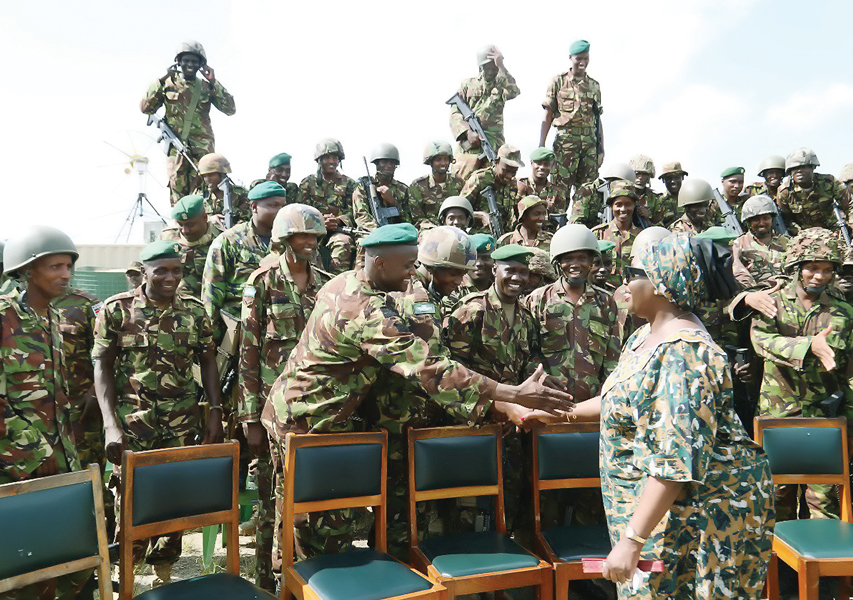
Amb. Raychelle Omamo , SC, EGH, interacts with the Kenya Defence Forces troops serving in various Operation Bases.

As Omamo was still settling in the key docket, Al Shabaab insurgents launched one of the deadliest attacks in Kenya on September 21, 2013. Armed members of the group attacked Westgate Shopping Mall in upmarket Westlands, Nairobi, and laid a siege that would last for three days, killing 68 people before security officers took back control after neutralising all the attackers.

The raid happened as President Kenyatta’s administration was still settling into office, having only taken power six months before. The uncoordinated response to the attack was heavily faulted as it was apparent there was no orderly response to the attack by both the military and the police.

Omamo also came under scrutiny following claims that KDF soldiers had looted shops within the mall.
“KDF operational training and doctrine do not condone any unprofessional conduct. All KDF personnel found culpable will be firmly dealt with according to the law,” she said, responding to the outrage.

Other attacks, such as that on the Garissa University College in April 2015, which claimed 148 people, most of them students, and the January 2016 ambush of Kenyan soldiers in El Adde, southern Somalia, in which more than 100 soldiers were killed, remained a blot on Omamo’s stint. But she brought a uniquely feminine touch to the ministry. A picture of her hugging survivors of the El Adde ambush when they returned home was one of the highlights of her time at Defence. President Uhuru trusted her to steer the docket. He would reappoint her to the docket after the 2017 elections.

She served for more than seven years, being moved only in January 2020, when she swapped places with Dr Monica Juma of Foreign Affairs. Omamo came to Foreign Affairs at a time Kenya was grappling with the maritime border dispute with Somalia at the International Court of Justice (ICJ).

Many analysts felt that, considering her extensive service as ambassador, including in Paris, complete with her excellent command of French, Foreign Affairs was the most befitting appointment.

But Omamo was coming into the eye of a storm and it would not be a smooth sailing for her initially. Dr Juma had been unhappy with her PS, Macharia Kamau, whom she had accused of commenting on the Somalia issues liberally without consulting her.

The loss of diplomatic privileges for workers was another example of the radical changes that had taken place and caused tension in the ministry. One of the austerity measures implemented by the ministry was the elimination of abroad per diem rates and training sustenance allowances for its diplomatic workers. Ministry insiders said Dr Juma and Kamau had also been divided on the appointment of Mwende Mwinzi as envoy to South Korea. Mwinzi is a dual citizen of Kenya and the US, and Kamau is said to have believed that his boss had misadvised President Kenyatta. The Constitution of Kenya bars dual citizens from holding ambassadorial positions.

Dr Juma, according to those close to the president then, had struggled to effectively direct Kenya’s foreign policy, notably how the ministry handled the Kenya-Somalia maritime dispute.

Somalia had filed a lawsuit against Kenya at the ICJ, the top court of the UN, in 2014 in an effort to modify the direction of the maritime boundary from its present eastward flow from the land border at Kiunga to a diagonal flow, endangering and threatening to subvert Kenya’s sea interests.

Since her appointment in January 2020, Omamo has brought some order to the Foreign Affairs docket, designating her PS, Kamau, as the sole spokesperson of the ministry. This decision eliminated the turf wars that had been witnessed between her predecessor and the PS.

Dr Hassan Kanenje, the Director at the Horn Institute for Strategic Studies, said the President needed a fresh pair of hands at the ministry at a time Kenya had acquired the endorsement of the AU to secure a seat as a non-permanent member of the UN Security Council.

One of Omamo’s highest moments was when Kenya was elected a non-permanent member of the UN Security Council, defeating Djibouti for a seat designated for African countries.

But then, Omamo took over the Foreign Affairs docket at a time when Kenya’s relations with Somalia and Tanzania were at their lowest ebb. Kenya had withdrawn from the ICJ case at The Hague, while Nairobi was engaged in a tit-for-tat trade war with Tanzania under President John Pombe Magufuli.

Raychelle Omamo ,SC, EGH, receives the Kenya Navy Ship Shujaa in Mombasa following the ships 21 month training voyage and midlife refit programme at the Damen Shipyards in the Kingdom of The Netherlands.

In October 2021, ICJ ruled in favour of Somalia, stating the disputed 1,000 square km maritime triangle with Kenya must be split. President Kenyatta issued a statement denouncing the ICJ ruling and vowed to protect his country’s sovereignty, which includes the contested part of the Indian Ocean.

In December 2021, the Parliament Budget Office (PBO) proposed to reduce funding to the Foreign Affairs ministry, a move that Omamo vehemently opposed.

The PBO argued that despite having 61 missions, including consulates and liaison offices spread across the five continents, Kenyan ambassadors had failed to increase the country’s trade in those countries.

Omamo, however, stood firm, arguing that diplomatic missions are not just about economic targets but also promotion of peaceful coexistence in other countries and engagement in collaborative global endeavours.

She maintained that Kenya’s diplomatic missions are key in enhancing the country’s economic diplomacy, which is one of the five pillars of Kenya’s Foreign Policy. The other pillars are peace, diaspora, cultural, and environmental.
On the international stage, Omamo – at the annual debate on Resolution 1325 on women and peace and security in October 2021 – canvassed Kenya’s agenda that women peacekeepers must acquire new skills in protecting fellow women and children in conflict zones.

Earlier in May 2021, while addressing a US Security Council high-level meeting on international peace, security and multilateralism, Omamo articulated Kenya’s position that the success of the United Nations largely depends on its cooperation with regional and sub-regional organisations, in line with Chapter Eight of the Charter.

“Intensifying this inextricable interdependence, especially in the arena of peace and security in Africa, is imperative. Accordingly, the principle of complementarity must attain its salient place in the council’s vision and decision making,” she said.

Yet, despite her impressive academic and diplomatic credentials, Omamo in July 2022 lost her bid to become the first female President of the International Fund for Agricultural Development (IFAD). Omamo, who sought to exit President Kenyatta’s Cabinet through vying for the prestigious position in the UN-founded agency, lost to Spain’s Alvaro Lario, a champion of private sector investments who was serving as the agency’s top finance executive.

The elections were conducted in Italy, with votes cast by member states only. However, after weeks of silent diplomacy and government pressure, Omamo was unable to secure the global seat.

Even her nomination as Kenya’s candidate was a low-key affair, and the country only learned of her selection by President Kenyatta from the IFAD official website.

This contrasts with Dr Juma’s nomination for the position of Secretary-General to the Commonwealth in late August of last year, which saw President Kenyatta issue a statement and a recorded video.

Born in 1962 in Bondo, Siaya County, Omamo studied at Loreto Convent, Msongari where she did her ‘O’ and ‘A’ levels before proceeding to the University of Kent at Canterbury, UK, for her law degree. The senior counsel and advocate of 27 years was a member of the Task Force on the Establishment of the Truth, Justice and Reconciliation Commission for Kenya, chaired by Bethwel Kiplagat.

Omamo has served in various professional positions including as a delegate to the National Constitutional Conference of Kenya – representing professional organisations (2002–2003), and as a member of the drafting team in respect of Kenya’s Children’s Bill, 2002 under the auspices of the Attorney General’s Task Force on Children (2001 – 2002).

Prior to her appointment as the Defence CS in 2013, she was the Director of CoSec Solutions Limited, where she provided oversight and advice regarding the formulation of corporate governance training programmes. She also has 19 years of experience in fulltime practice at Omamo & Omamo Advocates.

Just like her out-of-the-limelight work as the CS for Foreign Affairs, Omamo was equally a silent Defence CS despite KDF’s operations in Somalia.

Unlike Prof George Saitoti, who announced the deployment of the Kenya Defence Forces (KDF) in Somalia in 2011, Omamo was a behind-the-scenes Defence Minister after taking over from Yusuf Mohamed Haji. Even as KDF continued engagements in Somalia under the African Union Mission in Somalia (AMISOM) and scored many victories, Omamo preferred not to crow about these successes.

Back at home she spearheaded the construction of the civilian administrative office blocks at the Ministry of Defence (MoD) headquarters in Hurlingam, Kahawa Barracks, Moi Air Base, and Kenya Navy Mtongwe, with the aim of improving the work environment for the civilian component in the ministry.

In appointing Omamo to two critical dockets, President Kenyatta was hiring a distinguished woman of many firsts and even though she had a mixed performance, she is one of the few ministers to have completed Uhuru’s 10-year term without a whiff of scandal to her name.

James Wainaina Macharia: A corporate world trailblazer turned valued technocrat

Were it not for the 2010 Constitution, the public may not have benefitted directly from the endowments and exposure of James Wainaina Macharia, the Cabinet Secretary (CS) for Transport and Infrastructure. Indeed, the Constitution reconstructed governance and, for the first time since Independence, provided for a Cabinet of technocrats.

Previously, the President handpicked the Cabinet from sitting Members of Parliament (MPs) — elected or nominated.

Macharia, an accountant and banker, was just the right technocrat for a CS position. President Uhuru Kenyatta felt Macharia’s brilliance and intrinsic self-sacrifice were critical in streamlining the Health sector. He was convinced that Macharia’s mettle was the panacea to the ailing sector.

The ministry was huge on budget, but short on delivery. It was clear from Macharia’s comments during his vetting by Parliament that he knew exactly where the problem was — corruption. He convinced Parliament that the Health Ministry needed an overhaul to rid the sector of runaway corruption.

Available reports indicate that Macharia’s career started off at Deloitte & Touche as a Chartered Accountant. He later joined the Standard Chartered Bank in 1989, where he rose to become the Financial Controller. He then headed to Zambia and later to Tanzania as the Managing Director, African Banking Corporation. From 2005 to 2013, Macharia served as Group Managing Director at NIC Bank. It is here, at the NIC, that Macharia’s mettle became markedly evident. The bank experienced unprecedented growth, opening branches in neighbouring Tanzania and Uganda.
Here was a man with a bachelor’s degree in commerce (1983) and a master’s degree in business administration. So, when President Uhuru Kenyatta and his deputy William Ruto shopped around for suitable technocrats to take up the 22 slots in the Cabinet, Macharia’s name was one of them. The 1959-born alumnus of Kagumo High School (both O’ and A’ levels) and the University of Nairobi, was ready to forego huge perks in the private sector for national and public good.

“When I joined, my salary dropped to 20 per cent of what I was getting from the bank. A slash of 80 per cent; I balanced on the fact that it was a chance of a lifetime to serve. Frankly, even if it was 10 per cent, I was still going to join government,” he once reminisced.

His résumé in the private sector was impressive. But the call to serve the nation, was a shock, “I never believed it would happen”. This explains his reluctance to take the call that would eventually thrust him into public limelight. “They called on a landline. The call came and I ignored it because I did not know the number and I had clients. Then I got a message saying, ‘Can you please take the call when it comes next … When it came, it was the President’s secretary on the line who put the call through to the President and, as they say, the rest is history.”

Vision 2030 and other socio-economic blueprints place the Health sector among the priority areas for investments. A healthy population is a productive nation, as it were. It is against this backdrop that Kenya, as a signatory to the Abuja Declaration in 2001, committed to increase health allocations to 15 per cent of its Budget. No wonder, his drive was to ensure every Kenya is covered. He once observed, “The health outcomes in Kenya are weak and this is associated with poverty, lack of access to improved water and low access to usage of preventive services. The health systems are overstretched and making universal healthcare accessible is my priority.”

This appointment received instant approval from the industry. The chair of the National Nurses Association, Jeremiah Maina, said that as a financial expert Macharia would ensure that the money allocated to the ministry would be properly utilised.

Within months in his appointment, and jointly with his Principal Secretary (PS) Khadija Kasachoon and Nicholas Muraguri, the Director of Medical Services, the CS had developed the Ministerial Strategic and Investment Plan 2014–2018 whose theme was “accelerating the attainment of equitable, accessible quality health care for all”, and the Human Resources Strategy 2014–2018. Other blueprints were produced in line with Vision 2030, among them the Kenya Health Policy 2014–2030. Macharia also came up with the Kenya Mental Health Policy 2015–2030.
In October 2013, the ministry launched the Kenya National Patients’ Rights Charter that incorporated palliative care as a basic health right. In launching the charter, Macharia said, “The launch of this charter marks a milestone in showing our commitment in upholding health care as a constitutional right to all Kenyans … The national government will reinforce the health rights as stipulated in the Constitution with an ultimate goal of ensuring efficiency in the various areas of operation”.

Just under two years in office, Macharia was called upon to make decisions on Kenya’s role and place in the fight against the Ebola pandemic. He decided to dispatch 170 health experts to Ebola-hit West Africa, to join others from around the world called upon to stem the epidemic. “This outbreak has surpassed all other previous outbreaks put together 8 times over. The African Union has shown serious commitment and we appreciate this,” he told the Kenya contingent before it left. Besides, Kenya contributed KES 118 million (based on the current exchange rate) towards the global response against the disease.

But the defining moment of his tenure at Afya House, the Ministry of Health is headquarters, was the launch in July 2014 of the Universal Health for All campaign, the precursor for Universal Health Coverage (UHC). At the time, only 10 per cent of Kenyans were covered by health insurance. “Our priority is to make healthcare accessible to all. Patients going to India for medical attention can get the same here if we equip our health facilities and increase training to the healthcare givers,” said Macharia at the launch.

Although this profile cannot list all his achievements at the ministry, the President was impressed by Macharia’s administration. “The investments the government has made since 2013 have seen an increase of 43 per cent in public health facilities from a stock of 4,429 facilities in 2013 to 6,342 currently. In the same period, our ICU capacity has increased by an impressive 502 per cent and our total hospital bed capacity has also increased significantly by 47 per cent”.

But his stint at the ministry’s headquarters, was marred by questions about corruption and financial probity, and an outstanding case was the USD 109 million (KES 12.8 billion, based on current rate of exchange) reportedly lost in the period 2015/16, according to the then report by the Auditor General Edward Ouko. Macharia’s successor Sicily Kariuki later disputed this and cited accounting lapses at the ministry.

But two controversial projects — provision of mobile clinics and the Managed Equipment Services Scheme (MES) — remain a blot on Macharia’s sterling performance as Health CS. In the first case, Kenya lost KES 800 million to politically connected individuals who, it is alleged, supplied empty containers rather than mobile clinics.
The MES was the government’s idea to support devolution through equitable, accessible, affordable and quality healthcare in counties. The project provided for the equipping two hospitals in every county and four national referral hospitals with outsourced specialised state-of-the-art medical equipment. However, the beneficiaries, mainly counties, were hardly involved in this KES 41 billion project. The Council of Governors and the Senate faulted the investment. “The MES (Managed Equipment Services) project was a criminal enterprise shrouded in opaque procurement processes,” the Senate’s ad hoc committee on the deal said in its report.

Macharia’s tenure at the Ministry of Health ended in November 2015, when the President moved him to the Ministry of Transport and Infrastructure, to replace the then embattled Michael Kamau. Not only does it have clout, this Ministry is a big-money spending docket, taking up a huge chunk of the Budget. The previous office-holder, Kamau, had earlier been charged in court, accused of ignoring government regulations and redesigning the Kamukuywa–Kapsokwony–Sirisia road leading to a loss of KES 33 million.

Indeed, it is a huge docket that draws, among other departments, Housing and Urban Development, Marine and Shipping, and Public Works. It comprises tens of State agencies. It is perhaps the most crowded in terms of departments and agencies.

Currently, and given the President’s focus on infrastructure development, the ministry is the most heavily funded of all ministries, only rivalled by the ministries of Health and Education. Uhuru, like his predecessor, President Mwai Kibaki, was convinced that infrastructure is a big stimulant to economic growth.

Within seven years of his appointment, Macharia had superintended over the implementation of epochal projects not achieved since Independence 59 years ago. These include the multi-billion Standard Gauge Railway (SGR), Dongo Kundu road network, the Nairobi Expressway connecting the Jomo Kenyatta International Airport (JKIA) and James Gichuru Road in Westlands, the Lamu Port–South Sudan–Ethiopia–Transport (LAPSSET) Corridor and new terminals at the Mombasa Port. He also takes credit for the rehabilitation of the old railway network, the construction and rebuilding of thousands of kilometres of roads countrywide, and the building of thousands of house units. Instructively, SGR and Nairobi Express are game-changers.

Cabinet Secretary James Macharia joins President Uhuru Kenyatta, and Cabinet Secretary Fred Matiangi among other Government officials and representatives of the contractors during the launch of freight service on the Standard Gauge Railway from Nairobi to Naivasha.

In Macharia’s own view, the KES 60-billion Expressway, the first in Africa using private foreign capital and which seeks to ease vehicular movement in Nairobi, is “one of the finest projects in the continent”. It opened to the public on 14 May 2022, and within a month of its operation, over 31,000 vehicles were using it daily.

During his 2022 Madaraka Day (1 June) speech, the President was all-praises about this awe-inspiring development. “Today, the Nairobi Expressway snakes majestically through the skylines of Nairobi as a wonder to behold. Under normal circumstances, it would have taken us 4 years to build it but we achieved in a year and a half because we believed in Kenya, in our people, and in ourselves as government.”

When complete, the SGR — which remains Kenya’s single largest investment ever — will have cost KES 800 billion, from Mombasa to Kisumu. The KES 477-billion stretch between Mombasa and Naivasha is already functional.
The government believes that infrastructure is the number one enabler of economic growth and transformation, and this is why the President decided to pick up where his predecessor Kibaki left off. But unlike Kibaki, Uhuru has gone full throttle and he sees the transformation of highways, rural roads and railways as his signature legacy projects. His government has spent KES 1.5 trillion on roads since 2013, compared to Kibaki’s KES 474 billion in the period 2003–2013. In fact, road projects recorded the highest proportion of programme expenditure during Uhuru’s tenure as President.

Macharia’s docket has been using between 38 per cent and 41 per cent of the national budget. A national daily newspaper once branded him “super”, minister owing to the large budget enjoyed by his ministry. When he took office, expenditure on roads rose from KES 120 billion in 2014/15 to KES 184 billion in 2021/22.

During the same Madaraka Day event of 2022, the President could not hide how impressed he was at the infrastructural heritage he was set to leave behind as part of his leadership legacy. “Our world-class infrastructure, from iconic elevated expressways to floating bridges, (has) put Kenya on the global map. As a result, we have distinguished ourselves as an investment destination of choice, a regional and continental hub, and a leader on the African continent.”

Kenya’s attainment in the sphere of infrastructure development has not been in vain. Indeed, the African Development Bank (AfDB), which funded the 13-km Outer Ring Road in Nairobi, has been impressed. “The projects have transformed the lives of the people while at the same time reduced accidents and vehicle repair time,” the AfDB President Akinwumi Adesina once said, praising Uhuru’s administration for satisfactorily managing projects funded by the bank. It has invested KES 4.6 trillion in development projects Kenya in the last 7 years, with infrastructure taking up 72 per cent of this investment.

In the 2020 reorganisation of the Cabinet, the ministry’s leadership included Chief Administrative Secretary (CAS) Chris Obure and Permanent Secretaries Esther Koimet (Infrastructure), Solomon Kitungu (Transport), Nancy Karigithu (Shipping and Maritime), Gordon Kihalangwa (Public Works), Charles Hinga (Housing and Urban Development) and Paul Maringa (Infrastructure).

As it were, controversies always stoke success. Indeed, like in the case of Health docket noted earlier in this profile, Macharia’s tenure at Transcom House attracted questions about his management probity. His decision to hire three people from his own ethnic background to a key state agency — Nairobi Metropolitan Transport Authority (Namata) Board — raised questions about his fidelity to the Constitution. It took the authority of the Labour Court to revoke his decision.

“The interested parties subject of this suit … are all from one ethnic community and do not represent the diverse fabric that is the Kenyan nation. Their appointment therefore smacks on the evils of old which Kenyans opted to do away with in the Constitution we took on for ourselves in 2010,” Justice Nzioki wa Makau ruled in September 2021.
A further headache for Macharia was the pervasive corruption at Mombasa Port that defied the litany of personnel sackings, suspensions, transfers and convictions. In July 2022, the Kenya Ports Authority (KPA) did not have a substantial chief executive following the resignation of Hezron Manduku over corruption. That apart, the Ethics and Anti-Corruption Commission (EACC) began joint operations with Interpol and British authorities to unravel cargo theft at Mombasa Port.

Although reluctant to plunge into politics, CS Macharia was well able to defend himself from political attacks. This was evident when he covertly beat back an attempt by a cabal of MPs led by Nyali Constituency’s Mohamed Ali to impeach him on accusation that he disregarded stakeholders’ views and failed to conduct public participation in the implementation of ministry projects. Ali was opposed to a government decision to order transport companies to use the SGR for cargo movement between Mombasa and Naivasha.

Instead, most MPs defied their partisan posturing to defend Macharia. Lawmaker Lillian Gogo claimed that MP Ali’s intent was to extort from Macharia. “Our work (as MPs) is oversight but not oversight that is related to extorting money from people. We are not going to allow you as a Member to come and malign the name of the CS,” she said.

The President, no doubt, had a high regard for CS Macharia. Indeed, Macharia was among the 14 individuals Uhuru named to oversee the hand-over of power after the 9 August 2022. This Committee was mandated to facilitate the handing over process by the outgoing President to the President-elect, the provision of the security detail and security briefings to the President-Elect among other key functions.

Anne Waiguru: The doyenne of huduma services

Anne Waiguru (right), President Uhuru Kenyatta (centre) and Deputy President William Ruto (left) share a light moment during a past event.

Until she was introduced to Kenyans by President Uhuru Kenyatta as he named members of his first Cabinet, few people knew Anne Mumbi Waiguru. Her credentials were impeccable. In Cabinet, her star shone brightly. On TV shows she displayed confidence.

When Winston Churchill — the Prime Minister who led Britain to victory during the 2nd World War — remarked that “Success is not final, failure is not fatal: it is the courage to continue that counts”, that would seem to describe the life and times of Waiguru, the first Devolution Cabinet Secretary (CS) in Uhuru’s government.

Waiguru started by fighting for her space. It was a tricky docket full of politicians who sought to entrench themselves as masters of devolution and governors wanted more powers. Some even questioned the President’s decision to set up a Devolution Ministry, saying it was duplicating roles — in effect, challenging Waiguru’s position.

The CS defended her ministry and told Parliament, during her vetting, that her role was “part of managing intergovernmental relations and coordination” and also offer “support to other line ministries in undertaking regular intergovernmental sectoral consultative forums where relevant issues can be discussed and a coordinated development approach adopted.”

Previously, Waiguru had worked in the non-governmental organisation (NGO) world and had been involved in activism and politics. Devolution was a contested ministry. The Constitution had created devolved governments which were independent of the central government. Thus, several governors questioned Waiguru’s role. But she stayed on.

In terms of power and influence, and thanks to her Devolution and Planning docket, Waiguru emerged as one of the most powerful and influential Cabinet secretaries. Several key oversight functions and powers, previously exercised by either the Head of Public Service or the defunct Office of the Prime Minister, were lumped under the Devolution and Planning portfolio.

Also included in the docket was the coordination of inter-governmental relations and responsibility to convene and manage an inter-governmental summit that was to bring together leaders and key institutions from both the national and county governments. She was also responsible for overseeing both public sector reforms and the monitoring of performance contracts across the public sector. There were two other critical oversight institutions within her ministry, namely the Efficiency Monitoring Unit and the Inspectorate of Statutory Corporations which cemented her power within the Cabinet.

From the start, the President displayed confidence in Waiguru since they had worked together at the Treasury when he was the Finance minister. As Uhuru chose technocrats to fill positions in his Cabinet, Waiguru was qualified. Her first budget of KES 84 billion was an indicator of the centrality of the Devolution and Planning Ministry in the government.

Interestingly, little was known about Waiguru before her April 2013 appointment to the Cabinet. During her vetting by Parliament, she said she was keen to centralise power and facilitate devolution. She described herself as a “reformer” and “not a conservative”.

Before her appointment, Waiguru was the Director of Integrated Financial Management and Information System (IFMIS), a procurement and payment dashboard that had been put in place to tame corruption within the procurement chain.

One of Waiguru’s first projects was to set up Huduma centres, which aimed at streamlining delivery of services by taking them nearer to wananchi. As a service delivery programme and a flagship project of Kenya Vision 2030, the aim was to transform Public Service through the use of Integrated Service Delivery (ISD) — a one-stop-shop offering multiple public services under one roof.

The programme was officially launched with the opening of the first Huduma Centre on 7 November 2013 by the President. With over 50 centres countrywide, millions of Kenyans have been served through the portal and physical centres. In all, 118 national and county services are offered at Huduma Kenya service delivery channels.

Huduma centres are well received across the country and they not only eliminated brokers but also became a single point of access to public services, leveraging on electronic services and information offered by different public agencies countrywide. Located in all county headquarters and in many sub-counties, these multi-service centres carried out civil registration, issuance of ID cards and renewal of driving license among others services.

In May 2015, Waiguru’s efforts were recognised when the Huduma centres won the UN Public Service Award (UNPSA). This was a month after the programme won the African Gold Award on Innovative Management from the Association of African Public Administration, the 2014 Best Customer Service award from the Institute of Customer Service Kenya and Best use of ICT in the Public Sector from the ICT Association of Kenya.

While introducing the President to the team that made it happen, Waiguru said: “You wanted to cut the bureaucratic red-tape in service delivery, transform Public Service into an efficient, effective and ethical institution. You gave the vision; we came up with the concept and plan.” It was one of the first achievements of Uhuru’s vision for a digital government.

Anne Waiguru with Esther Passaris at a past event in Nairobi, Kenya.

Often, Waiguru would be tested by the governors, and especially the Chairman of Council of Governors Isaac Rutto. When they demanded the devolution of administration police, she dismissed the idea saying that would create confusion.

“We cannot devolve security now as this will create two or more lines of command and create confusion rather than tackle insecurity,” Waiguru said, speaking on the sidelines during the second devolution conference in Kisumu. After the meeting the governors accused her of displaying “high-handedness and rigidity” in an issue they described as complex and critical.

“We need dialogue to see what role counties should play in security because the discussion now is not if they should, but how they should,” said Mr Rutto.

One of the Jubilee Coalition promises was to revitalise the National Youth Service (NYS) to absorb the hundreds of thousands of youths who were unemployed and train them in various vocations. NYS was to be expanded as a major driver towards national development. Treasury had scaled up the budget to KES 25 billion, an allocation that was to turn around the Service and an indicator of the President’s vision for the youth. Waiguru was in charge of this transformation.

The new NYS was to have a well-integrated system with four pillars, namely: Paramilitary Training and Service Regimentation; National Service and Youth Re-Socialisation; Social Transformation and Vocational Training; and Enterprise and Youth Economy.

Carried out under the banner ‘Catalyse Transformative Youth Empowerment in Kenya’, this was supposed to be the largest project targeting the youths, and was aimed at correcting the perennial joblessness among the youth, providing them with resilience to run enterprise and hope to face mounting challenges.

Waiguru knew the problems facing the youth, being one of the youngest members of the Cabinet. She had grown in her career working in institutions of integrity as an intern at Transparency International before moving to the Kenya Leadership Institute (KLI). She was also a consultant for the Kenya Human Rights Commission and The World Bank where she coordinated the East African chapter of the World Bank’s parliamentary network (PNoWB).

It was while serving as a technical advisor to the World Bank, that Kenya’s political storm that followed the 2007 elections took place and Waiguru was seconded to the Treasury as consultant on governance. In 2009, when Uhuru replaced Amos Kimunya as Minister for Finance, he hired Waiguru to implement the Economic Stimulus Package, which was aimed at cushioning Kenya from the effects of the global economic crisis. Under this programme, the government had set aside KES 20 billion for targeted projects to spur growth throughout the country. This earned her a nomination as one of the ‘Top-40 under-40’ women in the country. At the time, she was the only nominee from the Public Service.

When the programme ended, Waiguru was promoted to head the IFMIS Directorate of at the National Treasury. IFMIS is an Oracle-based Enterprise Resource Programme which had been in the works since 1998. But under Waiguru, IFMIS got a boost. The system makes it easy to store, organise and access financial information. More so, it not only stores all the financial information relating to current and past years’ spending, but also stores the approved budgets for these years, details the inflows and outflows of funds plus complete inventories of financial assets and debts. These are available at a click of a mouse.

The NYS programme was well thought and had the best interests of young Kenyans at heart. Under the Paramilitary and Service Regimentation pillar, the service planned to recruit and train 21,870 youth every year with graduation planned for November and May of each year. This would have ensured that every 6 months, Huduma Corps of 10,935 would be graduated.

The second pillar was National Service and Youth Re-Socialisation which was regarded as the ‘high-impact’ stage of the Service. This aim was to establish a Vector Control Unit of 3,645 servicemen and women. The pillar also envisaged a service brigade that could be used as a Traffic Control Unit in Nairobi under some designated officers from the Police Service.

With the government intending to construct 1,100 dams in a year, the Dam Construction Unit of the NYS comprising 2,250 personnel were slated to undertake this project. The Road Construction Unit was expected to help build roads of different classes across the country. Waiguru regularly visited and the Slum Civil Works and Public Environment units which were cleaning and beautifying slum areas by carrying out minor construction.

Whatever the project, the aim of the new NYS was to transform the destinies of hundreds of thousands of young persons across Kenya.

Under Social Transformation and Vocational Training, seven schools covering all sectors of the economy were planned. These sectors ranged from hospitality to fashion and construction to agribusiness, and the training aimed to expand and train new graduates and organise and fund some of the recruits to enable them start businesses.

Waiguru was at first criticised after the transfer of the NYS Director Kiplimo Rugut who head of the Service when she became CS. In response to this, in June 2014 Mithika Linturi drafted a motion to impeach her that was signed by 150 members of parliament (MPs). Linturi later withdrew the bid after Deputy President William Ruto criticised the MPs: “Leave Waiguru alone. Appointments and transfers are done by the Public Service Commission, the President and myself. If you have any questions about Kiplimo Rugut, ask me or the President, not Waiguru.”

Shortly after this, just when it seemed like Waiguru’s career as a CS was about to settle, it crumbled under the weight of reports of mismanagement of funds at NYS scandal, in which it was claimed that the tax payer lost an estimated KES 665 million or more.

The NYS scandal, as it was known, became a thorn in the side of the Jubilee Coalition. Pressure mounted on Waiguru to resign.

“I wrote to the CID asking them to investigate transactions that had been reported in the IFMIS as being suspect,” said Waiguru in her first Press Conference on the matter. “Those who have been stopped from benefiting from the cartels that have long controlled the National Youth Service and crippled its functions are now fighting back and are trying to indicate that there is a problem.”

Waiguru’s letter to Ndegwa Muhoro, the Director of Directorate of Criminal Investigations, dated 5 June 2015, came after another. On 26 May 2015, a Dickson Gisiora, on behalf of Nelson Githinji, the NYS director, had written the first letter to Muhoro requesting for investigations into “unauthorised access on the IFMIS system”.

State House defended Waiguru and issued a statement saying the NYS saga matter “… had been twisted in order to execute a well-choreographed scheme.” The statement further stated that “There is no evidence of loss of funds given that the transaction was reversed at the IFMIS (Integrated Finance Management Information System.)”.

Waiguru said officials detected an attempt to hack into computers and make illegal payments of nearly KES 826 million (USD 8.2 million). Investigators claimed that the passwords of key officials were used to make illegal entries into NYS computer systems, which could have resulted in the theft of KES 695.4 million.

Other people were also mentioned in the saga, namely Ruto’s aide, Farouk Kibet, National Assembly Leader of Majority Aden Duale and Elgeyo Marakwet Senator Kipchumba Murkomen.

“This is the kind of situation where people are fighting back,” said Mutahi Ngunyi, the political scientist who had crafted the NYS transformation strategy, and whose Consulting House firm had been caught up in the NYS saga.
It was businesswoman Josephine Kabura Irungu who was finally arrested over the NYS corruption saga. She then swore an affidavit at the High Court claiming that the KES 791 million illegal payments were made on Waiguru’s behalf. The CS resigned on health grounds, and sought to be given “light duties”.

As the attacks persisted, Waiguru transitioned into politics but not before she defended herself saying “…diabolical machinery has been applied incessantly by misinformed and mischievous parties to intimidate harass and discredit both my professional and personal integrity.” She vied for and won the Kirinyaga County position of governor.

Joseph Nkaissery: General who reined in insecurity

Tall, fierce and regal. That was Major General (Rtd) Joseph Kasaine ole Nkaissery, just the man President Uhuru Kenyatta needed to rein in runaway insecurity that threatened to mar the running of the government he had just inherited from Mwai Kibaki.

As a retired soldier Nkaissery came highly recommended. The no-nonsense disciplinarian who had served in the Kenya Defence Forces for 30 years in various ranks had also been an Assistant Minister for Defence in the Grand Coalition Government of President Kibaki and former Prime Minister Raila Odinga.

Killings in Mandera, Mombasa and Nairobi by the Somalia-based militia, Al Shabaab, as well as bandit attacks in places such as Kapedo on the border of Turkana and Baringo counties, had given Uhuru a constant headache. He needed a firm hand in the Security docket and was willing to look across the political divide for a solution. He found in Nkaissery a person who fit the bill. In December 2014, Nkaissery, an Opposition MP in his third term, was appointed Cabinet Secretary for Interior and Coordination of National Government.

He was coming into a sector that was scarred by lethargy, decrepit coordination and flagrant corruption. The Kajiado Central MP, who had been elected on an Orange Democratic Movement ticket, was the first Opposition MP to be handed such a key position since Kenya adopted a new Constitution in 2010.

Uhuru and Nkaissery actually went way back — to their days in the Kenya African National Union (KANU) party through which the MP was first elected in 2002 and which the President served as chairman before becoming the KANU presidential candidate when he made his first unsuccessful stab at the presidency.

In appointing Nkaissery, a man with a deep knowledge of security issues and considerable political anchorage, the President was shifting gears from the largely technocratic Cabinet he had appointed in 2013 — in line with the 2010 Constitution — to leaders more in tune with State affairs. Nkaissery was replacing Joseph ole Lenku, a languid hotelier from the General’s Kajiado County backyard, who had been relieved of his duties after a series of terrorist and bandit attacks that had rocked the country.

At the very onset of his tenure, Uhuru had inherited an enemy in the name of Al Shabaab – a ragtag army operating out of Somalia that had kidnapped a number of tourists on Kenyan beaches. The tourism industry, especially on the Kenyan coast, took a hit as foreign governments advised their citizens against visiting Kenya because of the rising state of insecurity and the government’s seeming helplessness in combating it.

In September 2013, barely five months after Uhuru took over from Kibaki, terrorists staged a daring attack at Westgate Mall in upmarket Westlands, Nairobi. Close to 70 people were killed in the attack and more than 175 were injured. Then in early December 2014, 36 quarry workers were killed by Al Shabaab militants in Koromei, Mandera County. The attackers targeted non-Muslims. A week earlier, on November 27, militants had commandeered a bus in Mandera County and killed 28 passengers, most of them teachers.

As the attacks endured, the Opposition and a sprinkling of ruling party MPs called for an overhaul of the security agencies and the dismissal of Interior CS Lenku and Inspector General of Police David Kimaiyo. Lenku was sacked and Kimaiyo resigned on the same day, to be replaced by spy chief Joseph Boinett.

Nkaissery assumed the role with zeal, promising to serve diligently and to rally security officers behind him.
“If you know you are a security officer earning a salary from taxpayers, then you must be ready to work and offer services for which you have been trained. Those who feel they cannot do that are free to walk,” he said after his appointment.

Despite the tough talk, it was not an easy ride for the soldier. He soon found himself in the eye of a storm as the Opposition and civil society organisations expressed outraged against the Security Laws (Amendment) Bill 2014, which were fast tracked in response to the terrorist attacks on civilian targets and mounting public pressure to curb crime.

The Opposition, human rights organisations, including the Kenya National Commission on Human Rights, and the Independent Policing Oversight Authority objected to the far-reaching amendments, which they said would add new criminal offences with harsh penalties, limit the rights of arrested and accused persons, and restrict freedoms of expression and assembly. Nkaissery defended the enactment of the new laws, saying they would offer a framework to secure basic rights guaranteed in the Constitution.

“I want to assure Kenyans that we will not infringe their human rights and fundamental freedoms. We will ensure that Kenyans gain confidence in security operations,” he maintained.

The Security Laws (Amendment) Act No. 19 of 2014 (SLAA) was passed by the National Assembly on 18 December 2014 and got presidential assent on 19 December 2014.

Nkaissery promised to initiate reforms and restore Kenyans’ confidence in the government’s ability to surmount the insecurity that had ravaged the country. But waiting around the corner for him was an incident of grim proportions. On 2 April 2015, an attack on Garissa University left 148 people, mostly students, dead. Nkaissery promised to get to the bottom of the matter and warned Al Shabaab, the suspected masterminds, thus: “You can run but you cannot hide, and we will get you.”

Security expert George Musamali noted that during Nkaissery’s tenure, the Al Shabaab were driven to the Somalia border where their strength was compromised. He said Nkaissery was able to coordinate the various security agencies to achieve this. But Musamali faulted the CS for not focusing on the welfare of the police.

“He also picked weapons that were not suitable for the terrain and did not address the issue of extra-judicial killings,” said the former Recce Squad commando.

Nkaissery was born on 28 November 1949 and attended Ilbisil Primary School between 1960 and 1966 before joining Olkejuado High School from 1967 to 1970 for his O’ levels. In 1971 he was part of the pioneer class in the Department of Education at Kenyatta College. After only one year, he opted to join the Kenya Army and attended the Kenya Armed Forces Training College in Lanet. In 1996, he was chosen for a leadership and development course at Harvard University’s Kennedy School in the US. The United States Army College later accepted him for a postgraduate diploma in strategic leadership and management.

Back in Kenya, the man in uniform rose through the ranks from Battalion Commandant in 1982 to Battalion Second in Command in 1986, Military Assistant to the Chief of General Staff from 1987 to 1991, Chief of Personnel from 1992 to 1993, Brigade Commander from 1994 to 1996, Deputy Commandant/Chief Instructor-Brigade from 1997 to 1998, and General Officer in Command-Westcom from 1999 to 2002.

It was soon after his retirement that members of Nkaissery’s Maasai community prodded him to venture into politics. That was how he ended up being MP for Kajiado Central from 2002 to 2013. As Assistant Minister for Defence in the Kibaki-Raila coalition government, he was particularly outspoken on issues pertaining to the Maasai community, especially after the death of William ole Ntimama, a former Cabinet minister and the undisputed spokesman for the community until his death.

In December 2016, Nkaissery outlawed 90 groups that had been categorised as organised criminal gangs operating in various parts of the country. The groups included 42 Brothers, Magufuli Gogo Team, American Marines, China Squad, Baragoi Boys, Chapa Ilale, Rambo Kanambo, Gaza, Wakali Wao and Taliban Boys. Others were Kawangware Boys, Islamic State, Vietnam, Ngundu River Boys, Tek Mateko, Nzoia Railway Gang, Eminants of Mungiki and Temeke.

As the 2017 General Election approached, Nkaissery appeared to be a man at peace with himself. The country was no longer a playground for Al Shabaab and the avowed football fan, who supported Premier League team Manchester United, could afford to crack jokes.

Then on 8 July 2017, with a month to go before the elections, Nkaissery suddenly fell ill and died a few hours later. He was 68.

His death shocked the nation, with the President revealing that he had spoken to the CS the previous evening. Earlier, Nkaissery had attended the National Prayer Rally at Uhuru Park, Nairobi, with the President, Third Way Alliance presidential candidate Ekuru Aukot, and Michael Wainaina, an independent candidate. At 10pm, Nkaissery arrived at his Hardy Estate home in Karen, Nairobi, and headed to his private gym before retiring to bed. At 1am he was reported to have woken up complaining of a sharp pain in his chest before collapsing in his house. He was pronounced dead on arrival at Karen Hospital in Nairobi on the morning of 8 July. Post-mortem results showed he had suffered from a heart attack.

“I personally have lost a friend, a colleague, with whom as late as yesterday I spent part of the day praying for peace for this country; with whom as late as 9:30 last night I was discussing issues pertaining and relating to peace, to unity in this country,” said Uhuru while officially announcing the CS’s death.

It was not only the government that felt the loss. For the Maasai community, a huge gap had been left.
“Nkaissery’s death leaves a huge leadership crater,” said Maasai historian Sironka ole Masharen. “By design he was the most powerful Maasai. Just as Collin Powel was the most powerful Black man on earth at a time when Mandela was the most popular,” Masharen told the Daily Nation.

Masharen’s dialectics of the popular versus the powerful revealed another side of the CS — resolute and ruthless. Nkaissery was a major in the army in 1984 when he was deployed to disarm locals under a programme named ‘Operation Nyundo’. According to a Truth, Justice and Reconciliation Commission (TJRC) report, gross violations of human rights were perpetrated by soldiers in what came to be known as the Lotirir Massacre.

The matter emerged during Nkaissery’s vetting in the National Assembly following his nomination as CS. The TJRC report alleged that the security agents used heavy artillery and bombed villages, and that the operation resulted in torture, sexual violence and killings. It also alleged that the operation led to the killing or confiscation of up to 20,000 head of cattle.

The CS disputed this version of events, arguing that it would have required 500 lorries to transport 10,000 head of cattle, not to mention the unforgiving terrain that would have made such an endeavour impossible.

Masharen also described Nkaissery as principled and incorruptible. “He was a quintessential Maasai archetype, exactly what early white anthropologists described as tall, elegant, handsome, honest, resolute and militant.”
Unfortunately, his death denied Kenyans a fuller picture of what he would have done for President Uhuru Kenyatta’s legacy and the country at large.

Keriako Tobiko: Kenya’s Debonair crusader of environmental care

Even in the worst circumstances, a man can find a strange kernel of hope that fundamentally changes the trajectory of his destiny and leads him to a place he had never dreamed of. Keriako Tobiko is a man who doesn’t seem to have aspired for great things. All he wanted was to be a Maasai moran (warrior) and he did everything to ensure that this goal was realised.

He hated school and could not understand what benefits could possibly accrue from years of attending class and doing what he did not want to do.

The life of a moran appealed to the young Keriako so much that he was obsessed with the idea of spending years in the bush, wearing long braided hair, eating copious amounts of meat, and donning red ochre all over his face. This is as far as his ambition went.

But fate had something else in store for him. Born on December 12, 1964 in Kajiado County, Tobiko was raised in a polygamous family. He was the eldest child of his father’s second wife in a family of 14 children. His father, Tobiko ole Paloshe, was illiterate. But he was also an extremely strict man. He exerted an astonishing degree of detailed personal control over his large family and made sure that his two wives lived harmoniously to the extent of breast-feeding each other’s babies.

A watchman in Kajiado, Mzee Paloshe had immense respect for education. And so, try as Tobiko would, his father could not allow him to be a moran. He ensured that all his children attended school.

In the tight embrace of his father’s aspiration for his children, Tobiko found himself dragged to school against his wishes. He enrolled in Mashuru Primary School in Kajiado County. This greatly displeased him. His heart was not in education at all and he would, occasionally, sneak away to join his classmates in the bush, where he hoped to spend the better part of his youthful years.

He told a local publication in 2005:

“I was not the brightest kid in Mashuru Primary School. I used to sneak out frequently to engage in other vices. I felt constrained by the rigid discipline in school as opposed to life in the bush, where there was more fun eating meat and chasing girls.”

But his father had more faith in his son than Tobiko had in himself. He saw something in him that his son was oblivious of. Whenever his father heard that his son had sneaked out of school, he would go looking for him, drag him back to school, and, in his own words, “… cane my bare bottoms in front of the entire school.”

His, however, was a classic enaction of the saying that you can take a donkey to the river but you cannot force it to drink the water. Tobiko stubbornly refused to drink the waters of education as presented by his father. And his dislike for school was well manifested in his performance. He was one of the worst performing pupils at his school. So bad was his performance that when he sat for the Certificate of Primary Education (CPE) examination, he failed catastrophically. He scored 19 points out of 36.

And what an embarrassment for his father. Still, the old man believed that his son should have an education at whatever cost. He wanted him to repeat Standard 7, the final class of primary school. But the teachers at Mashuru did not want him back, not because they believed in him or wanted the best for him, but because they did not want anything to do with a boy they considered monumentally unruly, a bully, and a truant. In fact, Tobiko up to this day believes that the teachers celebrated his failure.

It was his uncle, the former influential Olkejuado County Council chairman, Daniel ole Muyaa, who came up with a solution that was acceptable to both Tobiko and his father. He arranged for him to join a secondary school, even with his poor marks. He enrolled at Athi River Secondary School in the same county. His uncle gave him accommodation in his house from where he would commute daily under his watchful gaze.

Still, Tobiko’s heart was not in education. The reluctant student lived up to his reputation as a delinquent when in Form Two he ran away from school again and missed two terms, much to his father’s and uncle’s disappointment.
“Moranism was too high a calling to be interrupted by books,” he confessed. So, he braided his hair, applied red ochre on his face, and went to live in the bush with his age-mates to engage in the legendary ritual of spearing a lion and taking its mane as a mark of a true moran.

He, however, could not complete the seven years required for one to be initiated into moranism. His father again went at him. He could not stomach the idea that his son had abandoned school to join moranism. This time round he put his foot down in a way that has always been memorable to Tobiko. So rough was he on the young man that an argument quickly degenerated into a physical confrontation. Father and son went hammer and tongs at each other.

He was later to recall:

“I could not believe that it had come to this. I could not believe that I was actually fighting my own father.”
It took the intervention of elders to cool tempers and come up with another solution. Respectful of the elders’ admonition, young Tobiko returned to school. This time he resolved to stay.

“There is always a moment in childhood,” observed English writer Graham Greene, “when the door opens and lets the future in.” Having resolved to go back to school, Keriako was to find a strange, forceful inspiration in a place he had previously intensely disliked. At that time the nation’s attention was focused on the Njonjo Commission of Inquiry. Tobiko was hugely enamoured of the display of fine argument, intellect, and class that the participants evinced. He decided that he would be a lawyer. This ambition propelled him to discover the intelligent boy that had always laid supine in his mind, eclipsed by the ambitionless desire to become a moran. He unleashed the best he could towards his pursuit for education.

And therefore in secondary school, Tobiko went on to become the top student. He joined Kanyakine High School in Meru for his ‘A’ level education. During those days the Kenya Advanced Certificate of Education (KACE) was taken after completing Form Six. When the examination results came out, Tobiko, unlike his previous miserable performance in Mashuru, where he almost came last, had scored straight A’s in all subjects. He was not only the best student in the school but was also the top one nationally.

His sterling performance won him the Gandhi Smarak Award and a scholarship at the University of Nairobi to study law.

Before joining the university, he briefly worked as a clerk at Barclays Bank of Kenya.

At the university, he was something of an oddball. The faculty was full of polished young students who were alumni of the country’s top and well-known schools. Most of the students had come from Alliance High School and other prestigious institutions. The other students kept asking him which school he had come from. When he said the unpronounceable name of Kanyakine High School they would recoil in horror, wondering where such a school was on the map and which place on earth would go by such a bland name. They would always burst into laughter. Naturally, the gauntly boyish freshman felt intimidated. He actually almost quit the faculty.

But he was determined to brave it out. His excellent performance was to, once again, ensure that he got a Barclays Commonwealth Scholarship that took him to Cambridge University, where he graduated with a Master’s degree in law.

His big break in the law profession was to come from unlikely quarters. In 1989, just before he finished his final year Amos Wako, the former Attorney General, who was then working for the law firm, Kaplan and Stratton, came searching for pupilage students. He settled for Tobiko and his roommate then, Kioko Kilukumi. The nondescript students had found self-elevation in this one act.

“This honestly surprised us as we did not have any big names and neither had we come from known families” he was later to say.

Having earned his master’s degree and completed his pupilage, he briefly served as an assistant lecturer at the University of Nairobi. From there he set up a law firm in the 1990s in Kajiado. The law firm also had a branch in Nairobi. He would jokingly say:

“It was unique having the head office of a law firm in the bush with a branch in the capital city.”

In Kajiado, he was to distinguish himself as an inveterate supporter of minority land rights and did a lot of pro bono work for the people of Kajiado, something that greatly endeared him to the locals.

Tobiko married his wife, Jane Jepchirchir ,whom he had met at an insurance company where she was working and where he had gone to seek services. They were blessed with three children, Mike, and twins Lema and Leki.
His passion for matters land saw him appointed a commissioner in the Njonjo Commission of Inquiry into Land Law Systems. The commission, which was chaired by the former Attorney-General, Charles Njonjo, had been set up to come up with principles of a National Land Policy Framework, the constitutional position of land, and formulation of a new institutional framework for land administration in the country. Given his previous work handling land matters, Tobiko was a natural navigator in this sea.

He was later to be appointed commissioner of the Constitution of Kenya Review Commission (CKRC), which was chaired by Prof Yash Pal Ghai. Tobiko’s his views sharply differed with those of Prof Ghai, something that gave way to bad blood between the two lawyers. Prof Ghai was to take this bad blood to the committee that was to vet Tobiko when he was nominated to become the Director of Public Prosecutions.

Before this appointment Tobiko had already served in the country’s higher judicial echelons. In 2010 he was appointed Chief Public Prosecutor at a time when the country had its foot in the door to a new constitution. When it was finally enacted later that year, Tobiko’s position was redesignated to Director of Public Prosecutions and he was appointed to head the independent body.

It is here that he came face to face with the treacherous, messy, and draining nature of the country’s politics. He had to be vetted for the position before confirmation. He found himself running against rough politicians who levelled accusation after accusation on his character. He was like a character in the Old Testament being chastised by all the slings and arrows of a storm whose physiognomy he could not make out.

His former boss at the CKRC, Yash Pal Ghai, in his presentation to the committee accused Tobiko of covering up land grabbing cases. He also alleged that his appointment to the office of the Director of Public Prosecutions had been politically motivated. The vetting was so heated, his competence and integrity so impugned that the possibility that he might not be confirmed started hanging over Tobiko’s head like a small, thick, lenticular cloud. The salvos not only came from politicians but also from other Kenyans who thought that he was not fit to hold the newly created constitutional office.

It was not expected that his nomination would be abrogated. Since the requirement that presidential nominees had to be vetted by Parliament before confirmation came into effect, only one nominee, Dr Monica Juma, had been turned down by Parliament.

However, the committee’s report that was presented in Parliament contained parts that severely traduced Tobiko’s integrity and called for the nominee to be investigated.

But Tobiko also found allies in Parliament in MPs who amended the report of the Constitutional Implementation Oversight Committee to have the nominee approved without the grave allegations against him for alleged incompetence and integrity being investigated.

The amendment was engineered by Mohammed Affey, who argued that there was no reason for investigating Tobiko. The Maasai political supremo, William Ntimama, supported him. Eventually Tobiko’s nomination sailed through.
The vetting, however, took its toll on him. The bright lawyer who had abandoned moranism for a higher calling had been dragged through the mud so badly that he felt like he had been subjected to baptism by fire. He told The Standard newspapers in 2011:

“The proceedings caused a strain in my family, more so for my first born son, Mike, a student at Kabarak High School. However, I was mentally and psychologically prepared for the onslaught. Like gold which has to be refined by fire, I have come out stronger.”

At that time the other two children were only two years old and could not understand what their father was going through.

But it is what he calls “desertion by friends” that really unnerved him and created such a pungent ache in his soul that he started reviewing what kind of friends he should surround himself with. Those he had thought would offer him emotional support at the time did not want to associate with him.

“I was surprised at how ‘friends’ deserted me during the confirmation proceedings. Better to have a few quality friends rather than a multitude that will desert you at the slightest hint of trouble.”

In 2018, Tobiko’s career was to be given a major boost when President Uhuru Kenyatta appointed him the Cabinet Secretary for Environment and Forestry to replace Prof Judi Wakhungu, who had been dropped from that docket. Analysts say that he breathed new life into the ministry.

At the ministry Tobiko was vocal about the preservation of culture among the Maa people. While exhorting them to shun retrogressive cultural practices such as female genital mutilation (FGM) and marrying off girls early at the expense of educating them, he was a firm believer that the Maa community had a rich culture that had to be preserved for posterity.

“We should remain united as we have always been. The Maa community in Narok, Kajiado, Laikipia, and Samburu are one. We should desist from people who come to divide us,” he told a gathering of Maasai elders in 2021.

In 2019, the CS launched an initiative aimed at planting 10 million indigenous trees in the Mau Forest. The initial phase of the initiative saw three million indigenous trees planted. This effort continued into the following years. In July 2022 Tobiko launched a 10 million tree planting initiative to restore the Maasai Mau water tower following the vacation of illegal settlers. Under the theme “Restore Mau, save, the Mara-Serengeti Ecosystem, save lives”, the initiative drew participation from multi-governmental agencies including the Kenya Water Towers Agency (KWTA), the Kenya Forestry Services (KFS), the Kenya Forestry Research Institute (KEFRI), the National Environment Management Agency (NEMA), the National Youth Service (NYS), and the Kenya Defence Forces (KDF).
In many ways, his defence of the Maa community and his efforts at restoring the water towers were some of the most egregious achievements he will be remembered for at the ministry.

Cabinet Secretary Keriako Tobiko leads planting of Mangroves at Sabaki Estuary in Kilifi County in celebration of World Wetlands day.

As a lawyer, few people expected him to embrace his new role as Kenya’s foremost defender of the environment with that kind of vigour. But he gave the ministry, which always runs the risk of being considered dour and unexciting, some rare character and impetus. Some people even nicknamed him, “the prefect of our environment”. His commitment to environmental conservation was unimpeachable. He preached that gospel wherever he went.
“I wish politicians could use the energies they use on electioneering and premature politics to support government. They should use that energy to conserve the environment.”

A strong defender of the Mau Forest, Tobiko never ceased reminding Kenyans that the forest did not belong to any community and that government efforts must be supported by all stakeholders:

“The environment is faced with many challenges from politics, greed, industrial pollution, and poor disposal of waste that ends up in our rivers, climate change among others.”

Keriako Tobiko, whose sister Peris Tobiko became the first female Maasai member of Parliament, (Kajiado East) comes through as a debonair gentleman devoid of the rusticity and coarseness people in politics or government are often associated with. Many people have always considered him a bureaucrat who shields himself from politics. But as Shakespeare, in his play, All’s well that Ends well, would say, “Needs must when the devil drives.”

Much as he had shied away from politics, he had to dabble in it when the situation called for it. When the President fell out with his deputy, William Ruto, Tobiko did not shy from defending his boss and taking on Ruto publicly. Few expected him to get into politics, but to him there was a very thin line between politics and public service.

When he described the Deputy President as a mere clerk in 2021, he came under a barrage of criticism from a cross-section of leaders. But the most surprising was from his sister, Peris Tobiko, something that threatened to split the family in the middle. At one time, Peris publicly said:

“I visited William Ruto in Karen and told him, I am Peris Tobiko and I have come to ask for forgiveness on behalf of my brother who called him a mere clerk.”

On hearing this, the warrior in Tobiko roared back. Insisting that he had not sent his sister to apologise on his behalf, he said:

“I stand by what I said. Ruto is a mere clerk for the President just like we are as Cabinet secretaries. The only difference between him and us is that he has no respect for the President. I stand by my position and the sentiments expressed during the Maa declaration recently that Ruto is not fit to be the President.” He could give as much as he took.

Even though he has scaled some of the highest heights in his public career the vestiges of his earlier aspirations still remain. Today the man is still occasionally drawn to the life in the plains of Kajiado where he loves spending his free time herding cows and from where he says he derives some therapeutic benefits from just watching the cattle graze.
“After looking after cows, nothing beats sitting around a bonfire with a cold drink gazing at the stars,” he was once quoted as saying.

John Kiyonga Munyes: The favoured Kaiser from the North

Level-headed, soft-spoken, and shy of controversy, John Kiyonga Munyes does not come across as a politician in a country where the kind are known to be boisterous, cavalier, or rabble-rousing. Perhaps his demeanour stems from his many years in the corporate world, including working for the United Nations Educational, Scientific and Cultural Organisation (Unesco) before making a detour into politics in 1997.

Perhaps it is persona that President Uhuru Kenyatta sought to tap when he appointed the former Turkana senator and minister in the Kibaki administration as he sought to bring more politicians to a hitherto largely technocratic Cabinet. The technocracy in the President’s Cabinet was a demand inscribed in Kenya’s 2010 Constitution.

After his failed bid to become governor of Turkana County in the 2017 elections, the veteran politician, who had served as minister in various dockets under President Mwai Kibaki, was appointed Cabinet Secretary for Petroleum and Mining, becoming the first holder of the new docket, created to take care of the oil find in the country as well as other wealth stashed in Kenya’s belly.

The petroleum department came six years after Kenya announced the discovery of oil in Turkana County in 2012.
Instructively, the minister came from the region with the oil find, a calculation ostensibly made to help pacify a community that was angling for a bigger share of oil proceeds once the discovery was announced to the public. The county had been apportioned 20 per cent of the projected earnings and Munyes was among the Cabinet secretaries who were never affected during reshuffles.

And he came with just the right mix President Kenyatta needed to wade through his tumultuous second term – enough technocratic skills and political experience. That he was not a rabble-rouser was an additional upside that came in handy in the President’s bid to secure and cement his legacy.

While appearing before the parliamentary Committee on Appointments, Munyes was not shy to blow his own trumpet by claiming credit for the enactment of the Water Act under President Kibaki, which streamlined the sector and he said saw him appointed a special envoy of Unesco for water in Africa.

Munyes bragged about his record of change in the several ministries he has worked, notably the creation of the Water Bill in 2002, as one of the factors that could have persuaded President Kenyatta to consider him.
“I have reformed every ministry I have headed. The Water Act 2002 was my brainchild. President Mwai Kibaki was awarded by Unesco because of that Act,” Munyes told the committee.

As the Minister of Labour in the Kibaki administration, Munyes introduced the Industrial Training (Amendment) Bill, 2009, which would turn the Directorate of Industrial Training, which was at the time a department in the ministry, into a partially autonomous government parastatal that was given the name National Industrial Training Authority (NITA).

The authority was anticipated to be a self-sustaining organisation leading integrated training at all economic levels to provide the skills required to speed up Kenya’s economic development, create more jobs, and provide services more effectively and efficiently.

Yet there were also political considerations for his appointment. Munyes had crossed from the opposition-affiliated Ford Kenya to the ruling Jubilee Party in June 2017. He would also represent Turkana as President Kenyatta sought to craft a Cabinet with the face of Kenya.

While describing himself as a performer, Munyes noted that while serving as Labour minister during President Kibaki’s administration, he busted cartels at the National Social Security Fund (NSSF) and secured equity in relief food distribution to all the needy regions.

He pledged to expedite oil exploration and see to it that the nation’s objectives to produce clean oil by 2021 and construct a pipeline from Lokichar to Lamu were achieved.

While Munyes has been credited with enhancing Kenya’s hydrocarbon industry and working towards sustainable development of the country’s extractives sector, the pipeline project has never taken off. Speaking to the media the day he was leaving office on February 8, 2022 to contest the Turkana governor seat, the minister said that he had “enjoyed” himself as a CS and he was now off to new challenges.

But didn’t he leave some business unfinished, given that the Petroleum and Mining ministry needed a lot of restructuring after the country discovered oil in 2012, and the need to profile the underground mineral wealth scattered all over the country?

Munyes had his work cut out for him as the country continued with the search for more of the precious mineral in four petroleum exploration basins – Lamu, Anza, Mandera, and Tertiary Rift Basin.

Within these larger basins, there are 63 gazetted petroleum blocks, 26 of which are now licensed to 14 multinational oil corporations and one to the National Oil Corporation.

In September 2021, Munyes terminated the contracts of six oil and gas explorers for failing to meet the targets under the production sharing agreements. He said the contractors had defaulted on obligations under their respective contracts.

The six – Zahara Oil and Gas, which had been allocated two blocks, Octant Energy, Simba Africa Rift Energy, A-Z Petroleum Products, Milio/Castac Oil, and Lamu Oil and Gas –were exploring in the Lamu Basin in the Indian Ocean region.

But it was earlier in November 2018 that the CS kicked up a storm when he opposed the control of the Ksh7 billion survey of Kenya’s mineral wealth programme by the National Intelligence Service (NIS). He had initiated a process to determine the quantity of the underground minerals to guide investors seeking to explore the wealth.

The country had proven the existence of gold, titanium, and coal resources. Significant amounts of copper, niobium, manganese, and rare earth minerals were part of the list. The Kenyatta government had initiated a comprehensive survey of underground minerals.

The country had planned to spend Ksh3 billion on the initial phase, which would include the counties of Migori, Homa Bay, Siaya, Kakamega, Busia, and surrounding areas, but Munyes left the ministry before the mapping was completed.

Kenya’s mining potential has been underutilised by successive administrations due to lack of data and an antiquated legislative system that discourages international exploration firms. Munyes had promised that he would initiate reforms and prepare data that would make Kenya a mining hub to attract foreign investors.

But in July 2020, he came under pressure to explain how the lucrative Ksh164 billion gold exploration deal in western Kenya was handed over to the UK-based Acacia Mining. The company was given the go-ahead to start exploring for gold on the Lirhanda Corridor, which straddles Kakamega, Vihiga, Kisumu and Siaya counties.

Amani National Congress (ANC) party leader Musalia Mudavadi and Bungoma Senator Moses Wetang’ula questioned the terms of the deal, saying it was shrouded in secrecy. In a letter addressed to Munyes, the two wanted information about the company’s local representatives, the tendering process, the mining methods, and the environmental impact assessment reports.

The CS had by his side Engineer Andrew Ng’ang’a Kamau, the Principal Secretary in the Ministry of Petroleum and Mining, who had worked in energy and mining in Africa for over 25 years.

The PS had successfully negotiated a $60 million revolving line of credit for the Democratic Republic of the Congo for the purchase of refined petroleum products. He also helped develop the tender and supply contract for gasoline on behalf of government of Sudan and exported 200,000 MT of gasoline from the refinery in Khartoum and supplied over $200 million worth of refined petroleum products to Tema Oil Refinery in Ghana.

In an interview with KTN in 2019, Munyes vowed to initiate reforms at the Kenya Pipeline Company (KPC) to weed out corruption, which he said were centred around the construction of the pipeline and procurement procedures.
He explained that the graft around procurement had prompted his ministry to suspend the payment of Ksh4.4 billion to the Lebanese contractor – Zakhem International Construction Company – which it was demanding due to operational delays in the building of the new Mombasa-Nairobi pipeline.

“We had to undertake due diligence so that every contract that had been awarded before was scrutinised,” he was quoted as saying. The total cost of the new pipeline, commonly known as Line 5, was Ksh48.4 billion.
Described by biographers as “a gentle giant with chubby cheeks and deceivingly boyish looks”, the politician was born in Lokichar in Turkana North in 1966.

He attended Lokitaung Primary School for his primary education, and later Lodwar High School for both his ‘O’ and ‘A’ levels. He later attended St Francis University in the US for his undergraduate studies in sociology and political science.

Munyes launched his political career in 1997, when he contested the Turkana North constituency seat and won. His self-effacing mien hides a steely determination to succeed and a rare quality to connect with people and prioritise needs. For this he has won all the elections he has contested except the Turkana governorship in 2017, which he lost to Josphat Nanok.

After the 2002 election in which Munyes retained his seat, he was appointed Minister for Water and Irrigation under President Kibaki in 2003. Two years later, he was moved to the Ministry of State for Special Programmes. Thereafter, he served as Minister for Labour and Social Services. In 2007 he retained his seat once again at a time when the Orange Democratic Movement (ODM) wave was sweeping much of the country, especially his home region of the Rift Valley.

After 15 years serving as MP, Munyes contested the Turkana Senate seat in 2013 on a Ford Kenya ticket, becoming the first Turkana senator under the 2010 Constitution.

In January 2018, President Kenyatta appointed him Cabinet Secretary in charge of Petroleum and Mining, a job he threw himself into with gusto. Munyes had the tasks of not only steering a new ministry but also explaining to Kenyans how the newly discovered oil would benefit them. The national government was apportioned 75 per cent of the expected revenues from the oil, 20 per cent went to Turkana County, and five (5) per cent to the community.

“Our crude oil is waxy and sticky but good for the market. We started by trucking 2,000 barrels per day but by 2021 when the Lamu-Lockichar Pipeline shall have been completed, we hope to transport 60,000 to 80,000 barrels per day,” he said in an interview in 2019.

His dream of seeing Kenya join the league of oil-producing countries in Africa by 2022 has yet to materialise. By the time he was leaving the ministry in February 2022, another of his dreams – to have the petroleum and the mining sector contribute 10 per cent to the country’s GDP – was in abeyance.

One of his proudest moments as CS for Petroleum and Mining was in September 2018 when he announced that the government had set aside Ksh2 billion to build an LPG facility at the Kenya Pipeline Company depot in Eldoret, as part of the efforts to encourage more Kenyans to use gas instead of kerosene.

“We are trying to roll out an LPG project called the Mwananchi gas project. This is a presidential flagship. It aims at connecting Kenyans just like the electricity last mile. We know we can improve the lives of Kenyans through the cheap LPG project. It will serve many Kenyans and it will reach all parts of the country,” he told the media.

But a month after the launch in October, the construction of the 5,000 metric tonne LPG depot was suspended due to lack of funding. The project was supposed to take shape after the completion of the new Ksh.48 billion-450km Mombasa-Nairobi Pipeline.

Kenya’s march into an era of clean cooking energy is held back by low uptake of LPG compared to other African countries such as Senegal, Ghana, Egypt, and South Africa. This is attributed to lack of sufficient storage facilities for liquid petroleum gas and few distribution channels, which are hampering uptake of the fuel in Kenyan homes.
Kenya consumes two kilos of LPG per person, which is less than the average for Africa of three kilogrammes. Ghana’s consumption is five kilogrammes, South Africa’s is six, Senegal’s is 10, and the Ivory Coast’s is nine.

According to government data, the annual usage of LPG is about 170 kilotonnes (KT), compared to the 300 KT annual demand.

The total LPG storage infrastructure available in Kenya stands at 6,000 metric tonnes against a consumption demand of projected at 300,000 MT per annum. As the CS for Petroleum and Mining, Munyes often found himself in the eye of the storm as powerful forces within the petroleum sector engaged in a tug-of-war with the government over high fuel prices and levies, leading to a high cost of living in the country.

In October 2021, the National Assembly’s Finance Committee fined Munyes Ksh500,000 for ignoring their summons. He was scheduled to testify before the committee to respond to questions regarding the high cost of fuel, which had increased the cost of living in Kenya as elsewhere amid harsh economic times occasioned by the Covid-19 pandemic.

He was not alone in snubbing summons. Earlier in September, his Energy counterpart, Charles Keter, had also been fined Ksh500,000 for snubbing the committee. He was just following a precedent in a period when senior government officials were ignoring calls by Parliament to explain various issues affecting the economy, causing friction between the Executive and the Legislature.

But conversations with officials and parliamentary reporters revealed the story of a minister who consulted experts and took their advice seriously. “In stark contrast to other ministers who did everything to prove they were bosses, Mr Munyes would surround himself with experts whenever he was summoned to parliamentary committees and would let the experts respond to the technical questions,” noted longtime political and parliamentary reporter Ibrahim Oruko.

Away from his ministerial work, and despite expressing a wish to be left alone, Munyes has not altogether evaded controversy.

In 2009, a delegation of South Sudanese officials wrote to Kenya’s Ministry of Foreign Affairs accusing the wealthy politician, who owns a six-seater Cessna Fixed Wing 6 of spying for Sudan. The delegation claimed that Munyes, who was involved in the South Sudan Peace negotiations, was acting as a double agent for the Khartoum government as the two nations discussed a cessation of hostilities.

They insisted that the minister had received the aeroplane and “several expensive properties” around Nairobi for his work of spying for the north. Munyes fiercely defended himself and vehemently denied the claims, saying he had taken out a loan from a local bank to buy the plane.

When fully exploited, the oil would bring in fiscal revenues of about $9 billion or 16 per cent of Kenya’s GDP, according to World Bank estimates.

Yet by the time Munyes resigned to contest the Turkana governor’s seat, much of what he had hoped to achieve in the Mining and Petroleum Ministry was still pending. However, he was not shy to boast that he had laid the foundation for unlocking the sector.

Zakayo Cheruiyot – Still waters run deep

Popularly known as ‘ZK’ by his supporters, Zakayo Kipkemoi Cheruiyot was one of the most powerful figures in President Daniel arap Moi’s government where he served as Permanent Secretary (PS) for Provincial Administration and Internal Security between 1997 and 2003. A highly secretive and media-shy person, Zakayo Cheruiyot was a close confidant and a trusted ally of Moi; the fact that he was entrusted with the powerful Internal Security docket lends credence to this argument.

The holder of a Bachelor’s Degree in Political Science from the University of Nairobi, Cheruiyot was born in Kapsegut Village, Bureti, in Kericho County in 1954 and rose fast through the ranks from a District Officer (DO) to a powerful operative in Moi’s inner circle.

A behind-the-scenes kind of person, Cheruiyot served as a DO in a number of areas before he was promoted to Deputy Provincial Commissioner for the Rift Valley Province in 1987, a move that opened the way to even bigger things for him.

By the time Moi retired in 2002, Cheruiyot was so powerful that his name had become synonymous with power, in the same league as Sally Kosgei (Head of Public Service and the most powerful woman in the country at the time), Cabinet Minister Nicholas ‘Total Man’ Biwott and Joshua Kulei, Moi’s Private Secretary.

Cheruiyot’s tenure in government coincided with the period when Kenya became a target of terrorist attacks, with first the 1998 bombing of the US Embassy in Nairobi, and later the Kikambala bombing of 2002. The dramatic capture of Kurdish rebel leader Abdullah Ocalan in 1999 also happened during his time as Internal Security PS.

Because of his shrewdness and exercise of absolute power Cheruiyot, a smooth and silent operator, goes down in history as one the most influential PSs in Kenya’s government. Others in this list include Duncan Ndegwa, Geoffrey Kariithi, Kenneth Matiba, Francis Muthaura, Jeremiah Kiereini, Simeon Nyachae, Sally Kosgey and Hezekiah Oyugi.

In the 2002 General Election, Moi’s heir-apparent and KANU candidate Uhuru Kenyatta lost to Mwai Kibaki, who rode to power on the National Alliance of Rainbow Coalition (NARC) wave, a conglomeration of opposition parties including the National Alliance Party of Kenya and Liberal Democratic Party of Kenya (LDP) under the tutelage of Raila Odinga.

Cheruiyot was replaced in the same capacity by Dave Mwangi in a purge that saw other senior figures in the Moi administration sent packing. These included the Commissioner of Police Philemon Abong’o, who served between 1999 and 2003, the Director of the Criminal Investigations Department Francis arap Sang, and the Head of the Presidential Escort Unit Nixon Boit.

Although he only served in the last five years of Moi’s 24-year presidency, Cheruiyot left an indelible mark on the country’s history – both positive and negative – and the fact that he was among the first high-profile individuals to be sacked by Kibaki lends credence to this argument.

Out went ‘ZK’ and his powerful friends and in came powerful individuals such as Francis Muthaura, who replaced Sally Kosgei, and a clique of powerful Cabinet Ministers who enjoyed unrestricted access to the President, such as Chris Murungaru (Internal Security), David Mwiraria (Finance), Kiraitu Murungi (Energy), Martha Karua (Constitutional Affairs) and Njenga Karume (Defence).

After being relieved of his duties by newly-elected President Kibaki, Cheruiyot led a quiet life, occasionally fighting off corruption claims both in and out of court before plunging into politics in 2007.

He won the Kuresoi South parliamentary seat on a United Republican Party (URP) ticket in 2007. The soft-spoken former PS is credited with opening a number of schools in Bureti Sub-County and Kuresoi South where he was MP for 10 years.

During this time he helped to establish several learning institutions, including Moi Amalo, Kiptaragon, Silibwet, Siwot Girls, Emitik Girls, Sinendet, Ambusket, Kapkoi, Arorwet, Ainamoi, Kiptagich and Olenguruone Township Secondary schools. The former PS and MP has maintained a low profile since he exited the political arena.

Zachary Theodore Onyonka – The brilliant economist who defended Kenya’s interests abroad

Zachary Theodore Onyonka was born on 28 June 1939 in Meru District where his father, Godrico Oeri Mairura, was a policeman. Onyonka was the second child of Oeri and Kerobina Kebati. The family moved to Kisii District after his father resigned from the police force to join the Provincial Administration as an Assistant Chief.

As a young man, Onyonka was among the beneficiaries of the famous education airlifts of the 1960s. Before that, he had made a name for himself as a brilliant and disciplined student at St Mary’s Nyabururu from 1949 and at St Mary’s Yala until 1958.

After he had completed high school, the Gusii County Council employed him until 1960, when he won a scholarship to the University of Puerto Rico in San Juan in the USA. He graduated in 1965 and the following year joined Syracuse University in New York, where he enrolled for a Master of Economics degree specialising in money and banking. Upon completion he embarked on doctoral studies at the same institution. He then joined the University of Nairobi (UoN) as a tutorial fellow while carrying out research for his PhD, which he completed in 1969. Thereafter, the UoN employed him as a lecturer in the Department of Economics.

Onyonka had political ambitions, but it dawned on him that the Kisii community considered an unmarried man unsuitable for leadership. With the aim of qualifying as a serious parliamentary candidate, and wanting to start a family, he married Beatrice Mughamba, an undergraduate Home Economics student from Moshi, Tanzania who was studying at the UoN.

Onyonka was self-assured, confident and authoritative. However, his distaste for hypocrisy as well as a tendency to be blunt sometimes courted controversy

Onyonka and Mughamba were married on 2 August 1969. They had six children: Elisabeth Kwamboka, Tolia Nakadori, Kiki Christopher Robert, David Wilfred, Timmy Eric and Naanjela Anna. This was his second marriage; before he left to study in the US, while still working with the Gusii County Council, he had been married to Teresia Nyakarita, with whom he had a son, Momoima Onyonka. Nyakarita remarried when Onyonka left the country.

Six months into his lecturing career at the UoN, Onyonka resigned to contest the Kitutu Chache Constituency seat against Lawrence Sagini, the Minister for Local Government. Onyonka’s popularity surged, largely thanks to Sagini, who went around the constituency inadvertently boasting that the work of a minister and MP was so challenging that only a well-educated person like Onyonka could rise to the occasion. Sagini did not know of Onyonka’s plans; when the time came, he simply went to the electorate and reminded them of what Sagini had repeatedly told them. And when the elections came round, the little-known Onyonka beat the veteran Sagini by 580 votes.

President Jomo Kenyatta appointed Onyonka, then aged 30, to the Cabinet as Minister for Economic Planning as the successor of Tom Mboya, who had just been shot dead in Nairobi. Onyonka headed several ministries over the years: Planning, Health, Housing and Social Services, Information and Broadcasting, Foreign Affairs, and Science and Technology.

Regardless of the circumstances, the minister would drive from Nairobi to meet his constituents every Friday. Even when he had travelled abroad, he would drive to Kisii immediately after arriving back in the country. The driving force behind his political activities was the public good; he was constantly involved in road and school projects in his constituency. He was known to work long hours, to relate well with colleagues in government and to be of sober mind in the Cabinet. He famously took the middle ground during the Kenyatta succession debate, the August 1982 coup attempt against President Daniel arap Moi and in seasons of infighting within the Kenya African National Union (KANU) party ranks.

During the 1983 General Election campaigns, Onyonka and his Kisii opponents, including Jimmy Angwenyi and Bosco Mboga, engaged youths in the search for votes. At one point, this resulted in violent confrontations in which a young man, Uhuru Ndege, was shot and killed at Daraja Mbili in Kisii town. In the highly charged situation, it became difficult to ascertain whether it was Onyonka or his bodyguard who had fired the gunshots. The police arrested and detained Onyonka in Kisumu for six months as the case went to trial. The court eventually acquitted him of all charges. He blamed his tribulations on “persons in government”, whom he accused of plotting to dim his political star.

After the trial, Onyonka stayed out of the Cabinet for a year before he was appointed to the high-profile Ministry of Foreign Affairs, where he ably articulated Kenya’s position at international forums and defended the country’s image and interests abroad.

He was serving in the Foreign Affairs docket when the Cold War tensions began to thaw, with Western nations abandoning former allies allegedly for their non-democratic governance. Kenya was among the countries perceived by the West to have a poor human rights record. Onyonka used his oratory skills to respond to cynical questions from journalists and human rights groups. At times he even questioned the basis of Western-imposed requirements on developing countries. The often-querulous Western journalists had finally met their match. Although he headed Foreign Affairs for only two years, it was probably his best performance in government.

His other major achievement was posting staff to missions abroad. Onyonka discovered that postings had been based on tribe, a practice he considered unfair. He developed a process of identifying qualified individuals and stubbornly monitored its implementation.

Onyonka was also known as an avid reader and a lover of sports, especially football. He had a large library and carried around a suitcase full of books, whether he was in Kenya or abroad. He bought The Economist religiously and even re-read old copies of the magazine to keep abreast of contemporary events, especially economics.

As a minister, he wrote his own speeches. Staff in his office knew that no draft was complete until Onyonka himself had subjected it to radical surgery to ensure that it accurately reflected his thoughts. After that he would drastically reduce the length of the speech, then proceed to speak off the cuff.

Onyonka was self-assured, confident and authoritative. However, his distaste for hypocrisy as well as a tendency to be blunt sometimes courted controversy. In his characteristic straightforward manner, he once confronted teachers in Kisii over allegations that some were cheating in national examinations to qualify for promotion.

He cautioned both teachers and parents that cheating would only undermine the credibility and standards of education in the area, and predicted that those cynical of his view would regret it later. Although the remarks solicited intense anger among teachers, it was not long before education standards in the district plummeted.

Onyonka was hugely decorated in his academic and public life. President Kenyatta decorated him with one of the highest titles in the land, Elder of the Golden Heart (EGH), while his alma mater, Syracuse University, awarded him an honorary Doctor of Letters degree for his distinguished service to the community. He also held many positions, including chairing the Kisii KANU Branch, the Council of Ministers of the East African Community, the Council of Ministers ACP/EEC and IGAD, the South Sudan Mediation Talks and the Board of Directors of the East African Development Bank. A housing estate in Nairobi was also named after him.

In 1988, Onyonka suffered a stroke that left him incapacitated. Despite this setback, he continued to be active until he had a second and fatal stroke on 22 October 1996, while serving as Minister for Research, Technical Training and Technology.

During his funeral, he was eulogised as a great intellectual, a man of integrity and a highly respected individual.

Yusuf Waruru Kanja – Freedom fighter who would not be silenced

Yusuf Waruru Kanja is one politician who never shied away from controversy. An ardent critic of general corruption in Kenya, he was known to stick to his convictions even to the extent of risking career and friendship. A case in point: When Robert Ouko, the Foreign Affairs Minister, was assassinated in February 1990, Kanja – then serving as Minister for Information and Broadcasting – broke ranks with his Cabinet colleagues after President Daniel arap Moi asked Kenyans not to speculate on the death of Ouko, promising that his Government would carry out thorough investigations leaving no stone unturned.

No Minister would dare talk about Ouko’s death for fear of facing the wrath of Moi and, without a doubt, losing both Cabinet position and parliamentary seat. Convinced that the government had a hand in the assassination, Kanja, famous for his fiery speeches whether inside or outside of Parliament, could not be silenced.

Kanja eventually emerged as a hero for taking on the courageous role of government critic following Ouko’s assassination in 1990

He compared Ouko’s death to that of slain Nyandarua North MP, Josiah Mwangi Kariuki – or JM, as he was widely known – who was assassinated in March 1975. The Minister stood on the floor of Parliament and asked whether the freedom Kenyans fought for was freedom to eliminate one another. He questioned why people who rose to national prominence, like Ouko, were targeted for elimination. He further assured the House that Kenyans may never know who killed JM and Ouko.

By uttering such words, Kanja contravened the principle of collective responsibility, thereby straining his relationship with the government. He was subsequently expelled from the ruling party KANU and lost his seat as Nyeri Town MP.

In response to his expulsion, Kanja unapologetically stated, “I have not wronged anybody, I have neither regrets nor apologies to make. My true day of judgment will come when I stand before my God,” the Sunday Nation reported on 22 December 2013.

In another story published by Standard Digital on 20 November 2008 he was quoted as saying, “…there was a lot that we needed to tell Kenyans and not lie that he – Dr Ouko – had got lost. How does it happen?”

He described how Joseph Leting, Head of the Civil Service, summoned him for implicating the government in Ouko’s death. Leting threatened him with sacking. Kanja later related his response: “Nilimwambia wachukue hiyo bendera yao siyo blanketi eti wakienda nayo nitasikia baridi au nikose usingizi. Nanikamwambia aambie hao wakubwa hivyo.” (“I told him they could take away that flag they issue to Cabinet Ministers to mount on their cars; it is not a blanket that would leave me freezing or cause me to lose sleep if they took it away. And I told him to tell the bosses as much”).

In typical Moi fashion, Kanja’s dismissal from the Cabinet was announced over the State-owned Kenya Broadcasting Corporation radio while the Minister was on official duty in Naivasha. Upon hearing the news, his driver removed the flag from the car and abandoned him at Kinungi along the Nairobi-Naivasha road. But the politician, who was a man of the people, managed to hitch a ride to Nairobi from a passing motorist.

Since his school days Kanja was known to be passionate when speaking against injustices and other forms of discrimination that the British colonial regime meted out on Africans. As a result, he was constantly rubbing the authorities the wrong way.

Born in 1931 in Muruguru Village of Nyeri County, Kanja attended the local Muruguru Primary School before joining Tumutumu Intermediate School. He proceeded to Pumwani Secondary School in Nairobi where he acquired a Kenya Junior Secondary Certificate. He then trained as a male nurse at King George Hospital (now Kenyatta National Hospital) but was expelled in 1950 before he could complete his medical course. The young Kanja had led a strike protesting the poor training conditions of African students.

He was later recruited to join the Colonial Police force. After training for six months at Kiganjo Police Training College, he was posted to Kisumu and attached to the Weights and Measures Department. At the age of 23 he was arrested and taken to trial for allegedly smuggling arms and ammunitions to the Mau Mau freedom fighters.

He was handed a death sentence which he unsuccessfully appealed. While on death row he went on a hunger strike and eventually Queen Elizabeth II commuted his sentence to life imprisonment. However, Kanja walked to freedom in 1959 at the close of the State of Emergency in Kenya following an amnesty extended by the Queen.

The following year he secured a job with Gailey and Roberts Ltd as a trainee in the weighing machines department. They further sponsored him for a one-year course in weighing machine technology in the United Kingdom. He quit the company in 1964 to found his own machine weighing firm which he later sold to Avery Kenya Limited (today known as Avery East Africa Ltd).

While in detention the former Minister met JM Kariuki, the flamboyant Nyandarua North MP who had been incarcerated for being a member of the Mau Mau movement. JM is said to have groomed Kanja to join politics and in 1969 Kanja declared his candidature for the Nyeri parliamentary seat comprising present-day Nyeri Town, Tetu and Kieni constituencies.

With JM’s backing he easily won, beating the incumbent Joseph Kiboi Theuri. Kanja went on to recapture the seat in 1974 and in 1979, despite the demise of his political mentor JM before the 1979 elections.

During his first and second terms in Parliament, Kanja distinguished himself as a good debater. He was a critic of the government of President Jomo Kenyatta, which he chided for not resettling former freedom fighters. Jointly with the likes of Martin Shikuku, George Anyona, Mark Mwithaga and other opponents of the Kenyatta administration, he took the government head-on following the political assassinations of Pia Gama Pinto and Tom Mboya.

Kanja was part of a select Parliamentary Committee chaired by Livestock Minister Elijah Mwangale constituted to investigate the brutal death of JM. In their inquiry they censured several people in government, linking them to the shocking murder.

Moi appointed the fiery MP to his first Cabinet as an Assistant Minister for Local Government and Urban Development after the 1979 polls.

Like other Nyeri leaders, Kanja was unhappy with the way the Vice President, Mwai Kibaki, was being treated by the new administration, which appeared to favour Constitutional Affairs Minister Charles Njonjo. Kibaki, the MP for Othaya, was the senior-most politician in Nyeri and pegged as a future president. To secure their political future, MPs in the Nyeri region had to align themselves with him. Njonjo had resigned as the country’s Attorney-General to vie for the Kikuyu parliamentary seat.

Immediately after his election, Njonjo was appointed Constitutional Affairs Minister and started undermining the VP. Kibaki allies had expected the President to address what they deemed unbecoming behaviour by Njonjo, but noticing how nonchalant Moi was about the issue, they took matters into their own hands.

Kanja decided to take the bull by the horns. During a KANU group parliamentary meeting, he asked the President to confirm, between Kibaki and Njonjo, who his Deputy was. Moi responded that it was Kibaki, arousing the curiosity of the other lawmakers since Njonjo was already endearing himself to them in a bid to win their loyalty.

Little did Kanja know how much trouble his prodding would later land him in!

In later press interviews, Kanja insisted that he had consulted Kibaki before making the statement, but claimed that Njonjo openly threatened him over his remarks. A firebrand who could not remain silent over such threats, he immediately embarked on a countrywide campaign, announcing that his life was in danger. At one point he took the floor in Parliament and accused Njonjo and his Internal Security counterpart, Godfrey Gitahi (GG) Kariuki of hatching a plot to assassinate him, which the two denied.

From that point on, the fiery MP became a marked man.

Later that year Kanja was scheduled to travel for a United Nations conference in New York with his Minister, Noah Katana Ngala. The MP received his per diem from the Foreign Affairs Ministry. On his return home, he still had USD 2,000 in his possession and failed to convert the currency into local Kenyan currency within the 24 hours stipulated by law. Police in six vehicles – four Land Rovers and two Peugeot 504 saloon cars – arrived at his Nyeri home to search for the dollars he was holding.

Found guilty of contravening the prevailing exchange control laws, he was jailed for three years, culminating in the loss of his parliamentary seat.

“The money had been given to me by the same government for official foreign travel. I hadn’t had the time to surrender the dollars. Somebody just wanted me out of the way,” he told the Sunday Nation of 22 December 2013.

The September 1983 General Election offered a perfect opportunity for Kanja to make a political comeback. He decided to seek sympathy with the electorate, having just been released from jail for his outspokenness. As it turned out, the VP had decided to discard him.

Kanja found himself in unfamiliar territory when his bid to return to Parliament in 1983 flopped. He now had to look for ways to reinvent himself so as to survive another election, as a younger generation of leaders with more elitist leanings had allied themselves with the VP.

In 1985 KANU had held party grassroots elections which Kibaki used to consolidate his position in Nyeri. His allies had clinched most of the executive positions.

Isaiah Mwai Mathenge, a former Provincial Commissioner, was elected Chairman with entrepreneur Munene Kairu as Secretary. He already had his preferred MPs in Mathira and in Nyeri Town. With such a well-prepared team, people anticipated transformation in the district, and members of the Old Guard like Kanja had a very slim chance of succeeding.

Meanwhile, Moi was keenly watching the unfolding events in Nyeri. He had already succeeded in edging Njonjo out of active politics after an inquiry he appointed to investigate him found him guilty of insubordination. In order to consolidate his grip on power, Moi now turned to Kibaki whose popularity was growing.

Kanja decided to join the Moi camp for political survival. At one time he invited Elijah Mwangale, who was in Moi’s Cabinet, to conduct various fundraisers in Nyeri district. Mwangale was touted as a potential VP. His presence in Nyeri was therefore viewed as undermining the VP, prompting local politicians allied to Kibaki to refer to Mwangale as a political tourist.

Subsequently, Kanja became Moi’s point man in Nyeri; his work was to check the rising influence of the VP. He was rewarded with an appointment as Executive Chairman of the State-owned Kenya Commercial Bank.

In order to take another stab at a seat in the National Assembly, Kanja had to reinvent himself since he had been branded a traitor. Accordingly, he launched a swift campaign to bring together former Mau Mau freedom fighters who had been neglected by the Kenyatta regime.

He had identified himself as a member of the Mau Mau during his stint in Parliament, and set up Burguret Arimi Company Ltd as a vehicle for the landless in Nyeri to buy shares. The company had bought land in Burguret area near Nanyuki where the shareholders – who were not necessarily freedom fighters – were eventually settled.

In February 1986 Kanja, who was now a critic of Kibaki who he accused of developing only his Othaya Constituency at the expense of the wider Nyeri district, convened one of the biggest meetings of former freedom fighters at Ruring’u Stadium in Nyeri Town. He mobilised the freedom war heroes from different parts of the country and invited Moi to preside over the function.

On that day Kibaki was attending a funds drive elsewhere and ignored the meeting where the Head of State was the Guest of Honour. At Ruring’u, Kanja dismissed local leaders who he said had chosen to shun his meeting, castigating them as Home Guards – local security personnel used by the colonial administration to report on Mau Mau activities. These utterances made Kanja very unpopular with the people and the local KANU branch officials summoned him, warning him against using such language. While Moi joined his new-found ally in castigating his VP and others who did not attend the Ruring’u meeting, Kibaki preached unity at the funds drive he was attending.

Before the 1988 General Election, Moi appeared to be uncomfortable with his number two, who was viewed in some quarters – especially in the populous Mount Kenya region – as a better choice of leader for the country. Kenyans had started expressing their displeasure with Moi’s leadership, accusing him of abuse of power and running down the country’s economy.

All indications showed that the President was out to clip the wings of his VP when James Muriuki announced his candidature to oppose Kibaki in Othaya. In the two previous elections, Kibaki had sailed through unopposed.

It was not easy for Muriuki to criss-cross Othaya or even other parts of Nyeri where hostile crowds were baying for his blood. Likewise, Kanja was also an unwanted man in the newly-created Nyeri Town constituency where Mathenge, the KANU Branch Chairman (and his brother-in-law), was Kibaki’s preferred candidate.

The anti-Kibaki line-up consisted of Davidson Ngibuini Kuguru in Mathira, Kanyi Waithaka in Tetu and Ngumbu Njururi who was defending his Mukurweini parliamentary seat. But it is Kanja who was the focal point. Crowds of Kibaki supporters had waited for him at the entrance to the office of the District Commissioner (DC), Keholo Muhalule, to be cleared to participate in the elections. In every district the DC acted as the Returning Officer as there was no electoral body at that time.

A gifted speaker and a crowd-puller, Kanja addressed the unreceptive gathering that was threatening to stone him and the candidate for Othaya, reminding them that Kibaki was still his friend.

“Kibaki is my friend and our families are also friends. Mathenge (his opponent) is my brother (in-law) and we are still friends. So what do you stand to gain by harming me simply because we are not in the same political camp?” recounted James Gatama, a Kanja supporter in Nyeri. The irate crowd had to disperse and both Kanja and Muriuki were cleared to contest their respective seats.

As the 1988 elections approached, relations between Moi and his VP had turned frosty and Kanja had now come out as Moi’s most trusted lieutenant in Nyeri. He would be heckled and booed during meetings, and people avoided attending any gathering that he called. Nevertheless, in preparation for the hugely disputed mlolongo (queue-voting) elections, Kanja managed to win the primaries and qualify for the second round amid protests from Kibaki supporters. His eventual victory over Mathenge was also questioned.

In yet another turn of events, Moi dropped his VP and relegated him to the post of Minister for Health. People expected him to reject the appointment, but he chose to continue serving the government as a Cabinet Minister.

Kanja eventually emerged as a hero for taking on the courageous role of government critic following Ouko’s assassination in 1990. Prior to this, he had launched a scathing attack on the Moi administration, dismissing it as corrupt for forcing leaders to attend fundraisers organised by the President.

Accordingly, after his dismissal from the Cabinet and his eventual exit from Parliament, Kanja left the august House a proud man. He had been determined not to keep silent over the death of a colleague that many believed was planned and executed by influential people in government.

His attempt at re-election on a FORD-Kenya ticket in the first multiparty elections of 2002 was unsuccessful. Kanja retreated to his Kiganjo home in Nyeri, focusing on farming until his death in December 2013.

Though there are those who dismissed Kanja as a political demagogue, others see him as a leader who stood for the truth whether or not it meant sacrificing his life.